
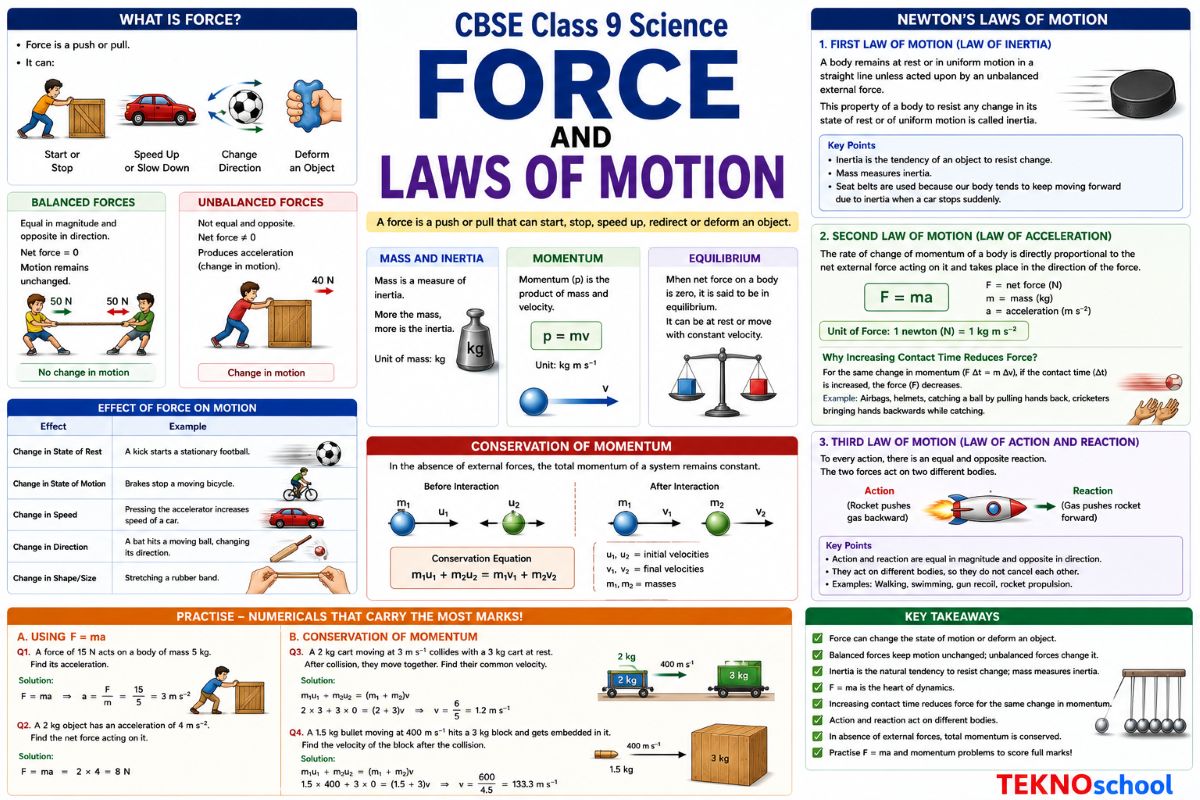
CBSE Class 9 · Science
Force and Laws of Motion
Force and Laws of Motion-A complete tutorial on force, inertia, momentum and Newton’s three laws, plus 11 worksheet types — MCQs, Assertion–Reason, Fill-ups, True/False, Match, VSA, SA, LA, Case-Based, HOTS and Numericals — each with answers.
What this chapter is about
In the last chapter you learned how to describe motion. Now you find out why objects move the way they do. Why does a ball rolling on the ground eventually stop? Why do you lurch forward when a bus brakes suddenly? Why does a gun kick back when fired? All these questions are answered by force and by the three laws of motion given by Sir Isaac Newton.
1 · Force and Its Effects
A force is a push or a pull acting on an object. We cannot see a force, but we can see what it does. Force is a vector quantity and its SI unit is the newton (N).
A force can
① Make a stationary object move · ② Stop a moving object · ③ Change the speed of a moving object · ④ Change the direction of motion · ⑤ Change the shape or size of an object.
2 · Balanced and Unbalanced Forces
| Feature | Balanced forces | Unbalanced forces |
|---|
| Resultant force | Zero | Non-zero |
| Effect on motion | No change in state of rest or motion | Produces acceleration; changes speed or direction |
| Effect on shape | May change the shape of the object | May also change shape |
| Example | Tug of war with neither side winning | One team pulling harder and the rope moving |
A ball rolling on the ground slows down and stops not because motion needs force to continue, but because an unbalanced force of friction acts against it. If friction were removed completely, the ball would keep rolling forever.
3 · Newton’s First Law of Motion
An object remains at rest, or in uniform motion in a straight line,
unless acted upon by an unbalanced external force.
This is also called the law of inertia. It tells us that force is needed not to keep an object moving, but to change its state of motion.
Everyday examples
• A passenger falls backward when a bus starts suddenly — the feet move with the bus but the upper body stays at rest.
• A passenger lurches forward when the bus brakes suddenly — the body continues in motion.
• Dust flies off a carpet when it is beaten — the carpet moves but the dust stays at rest.
• Leaves fall when a branch is shaken vigorously.
• We are advised to wear seat belts in cars for this very reason.
4 · Inertia and Mass
Inertia is the natural tendency of an object to resist any change in its state of rest or of uniform motion. The mass of an object is a measure of its inertia — a heavier object has greater inertia and is harder to move or stop.
| Type of inertia | Meaning | Example |
|---|
| Inertia of rest | Resists being set into motion | Dust flying off a beaten carpet |
| Inertia of motion | Resists being brought to rest | A passenger jerks forward when a bus stops |
| Inertia of direction | Resists a change in direction | Passengers lean outward when a bus takes a sharp turn |
5 · Momentum
The momentum of a body is the product of its mass and velocity. It measures the “quantity of motion” a body carries — a heavy truck at low speed and a light bullet at high speed can both be hard to stop.
p = m × v
SI unit: kg m/s · Vector quantity, in the direction of velocity
6 · Newton’s Second Law of Motion
The rate of change of momentum of a body is directly proportional to the applied
unbalanced force, and takes place in the direction of the force.
Deriving F = ma
Let a body of mass m have initial velocity u and final velocity v after time t.
Initial momentum = mu · Final momentum = mv
Change in momentum = mv − mu = m(v − u)
Rate of change of momentum = m(v − u)/t
By the second law, F ∝ m(v − u)/t. Since (v − u)/t = a, we get F ∝ ma, so F = kma.
The unit of force is chosen so that k = 1, giving F = ma.
The newton defined
1 newton is the force that produces an acceleration of 1 m/s² in a body of mass 1 kg. So 1 N = 1 kg m/s².
Why the second law explains so much
A cricketer pulls his hands back while catching a ball to increase the time of contact — this reduces the rate of change of momentum and hence the force on his hands. For the same reason, high-jump athletes land on cushions and car dashboards are padded.
7 · Newton’s Third Law of Motion
To every action there is an equal and opposite reaction.
The crucial point is that action and reaction act on two different bodies — never on the same body. That is why they do not cancel each other out.
| Situation | Action | Reaction |
|---|
| Walking | Foot pushes the ground backward | Ground pushes the foot forward |
| Firing a gun | Gun pushes the bullet forward | Bullet pushes the gun backward (recoil) |
| Rowing a boat | Oar pushes the water backward | Water pushes the boat forward |
| Rocket launch | Hot gases pushed downward | Rocket pushed upward |
8 · Conservation of Momentum
When two bodies collide and no external unbalanced force acts on them, the total momentum before the collision equals the total momentum after the collision.
m₁u₁ + m₂u₂ = m₁v₁ + m₂v₂
Recoil of a gun — a worked example
A gun of mass 4 kg fires a bullet of mass 20 g (0.02 kg) at 200 m/s. Before firing, total momentum = 0.
After firing: 0 = (0.02 × 200) + (4 × v)
4v = −4 → v = −1 m/s. The gun recoils at 1 m/s in the opposite direction.
PRACTICE ZONE
Worksheets with Answers
11 types · 10 questions each · answers given inline
Worksheet A · Multiple Choice Questions (10)
1. The SI unit of force is:
(a) joule (b) newton (c) kg m/s (d) m/s²
✓ Answer: (b) newton
2. Newton’s first law is also called the law of:
(a) Momentum (b) Gravitation (c) Inertia (d) Action–reaction
✓ Answer: (c) Inertia
3. The measure of inertia of a body is its:
(a) Velocity (b) Mass (c) Weight (d) Acceleration
✓ Answer: (b) Mass
4. The SI unit of momentum is:
(a) N (b) kg m/s (c) kg m/s² (d) J
✓ Answer: (b) kg m/s
5. 1 newton equals:
(a) 1 kg m/s (b) 1 kg m/s² (c) 1 g cm/s² (d) 1 kg m²/s
✓ Answer: (b) 1 kg m/s²
6. Action and reaction forces:
(a) Act on the same body (b) Act on two different bodies (c) Are unequal (d) Act in the same direction
✓ Answer: (b) Act on two different bodies
7. A body of mass 5 kg accelerates at 2 m/s². The force acting on it is:
(a) 2.5 N (b) 7 N (c) 10 N (d) 20 N
✓ Answer: (c) 10 N
8. When balanced forces act on a body, its:
(a) Speed increases (b) State of motion does not change (c) Direction changes (d) Momentum becomes zero
✓ Answer: (b) State of motion does not change
9. A cricketer pulls his hands back while catching a ball to:
(a) Increase the force (b) Increase the time of contact and reduce force (c) Increase momentum (d) Reduce the ball’s mass
✓ Answer: (b) Increase the time of contact and reduce force
10. A rocket moves forward because:
(a) Air pushes it (b) Gases pushed backward push the rocket forward (c) Of gravity (d) Of friction
✓ Answer: (b) Gases pushed backward push the rocket forward
Worksheet B · Assertion–Reason (10)
Choose: (a) Both A and R true, R correctly explains A · (b) Both true, R not the correct explanation · (c) A true, R false · (d) A false, R true.
1. A: A passenger falls backward when a bus starts suddenly. R: The upper body tends to remain at rest due to inertia of rest.
✓ Answer: (a)
2. A: Mass is a measure of inertia. R: A heavier body is harder to set into motion or stop.
✓ Answer: (a)
3. A: Action and reaction cancel each other out. R: They are equal in magnitude and opposite in direction.
✓ Answer: (d) — they do not cancel because they act on two different bodies.
4. A: A rolling ball eventually stops. R: An unbalanced force of friction acts on it.
✓ Answer: (a)
5. A: A gun recoils when a bullet is fired. R: Momentum is conserved in the absence of external forces.
✓ Answer: (a)
6. A: Balanced forces always produce acceleration. R: The resultant of balanced forces is zero.
✓ Answer: (d) — balanced forces produce no acceleration; the reason is true.
7. A: A cricketer moves his hands backward while catching a ball. R: Increasing the time reduces the rate of change of momentum and hence the force.
✓ Answer: (a)
8. A: Momentum is a vector quantity. R: It has the same direction as the velocity of the body.
✓ Answer: (a)
9. A: A force is needed to keep a body moving with uniform velocity in the absence of friction. R: Newton’s first law states that a body continues in uniform motion unless acted upon by a force.
✓ Answer: (d) — no force is needed; the reason correctly states the first law.
10. A: We can walk on the ground because of the third law. R: The ground pushes our foot forward when we push it backward.
✓ Answer: (a)
Worksheet C · Fill in the Blanks (10)
1. A push or a pull on an object is called a __________. → force
2. The SI unit of force is the __________. → newton
3. Newton’s first law is also known as the law of __________. → inertia
4. The measure of the inertia of a body is its __________. → mass
5. Momentum is the product of mass and __________. → velocity
6. The SI unit of momentum is __________. → kg m/s
7. According to the second law, F = __________. → ma
8. Action and reaction act on __________ bodies. → two different
9. 1 N = 1 kg × __________. → 1 m/s²
10. In the absence of an external force, the total __________ of a system is conserved. → momentum
Worksheet D · True or False (10)
1. Force is a vector quantity. → True
2. Balanced forces change the state of motion of a body. → False
3. A body with greater mass has greater inertia. → True
4. Momentum is a scalar quantity. → False (it is a vector)
5. Action and reaction act on the same body. → False (on two different bodies)
6. A force is needed to change the state of motion of a body. → True
7. 1 N = 1 kg m/s. → False (1 N = 1 kg m/s²)
8. Seat belts help reduce injury by increasing the stopping time. → True
9. A rocket works on the principle of the second law of motion. → False (it works on the third law and conservation of momentum)
10. Momentum is conserved in a collision when no external force acts. → True
Worksheet E · Match the Following (10)
| No. | Column A | Column B | Answer |
|---|
| 1 | Force | (a) kg m/s | 1→f |
| 2 | Momentum | (b) Law of inertia | 2→a |
| 3 | First law | (c) F = ma | 3→b |
| 4 | Second law | (d) Action and reaction | 4→c |
| 5 | Third law | (e) Measure of inertia | 5→d |
| 6 | Mass | (f) newton | 6→e |
| 7 | Recoil of a gun | (g) Zero resultant force | 7→i |
| 8 | Balanced forces | (h) Dust off a beaten carpet | 8→g |
| 9 | Inertia of rest | (i) Conservation of momentum | 9→h |
| 10 | Unbalanced force | (j) Produces acceleration | 10→j |
Worksheet F · Very Short Answer (10)
1. Define force.
✓ A push or a pull acting on an object.
2. Give the SI unit of force.
✓ Newton (N).
3. Define inertia.
✓ The tendency of a body to resist any change in its state of rest or uniform motion.
4. What is the measure of inertia?
✓ The mass of the body.
5. Write the formula for momentum.
✓ p = mv.
6. State Newton’s second law of motion.
✓ The rate of change of momentum is proportional to the applied unbalanced force and acts in its direction.
7. Define 1 newton.
✓ The force that gives a 1 kg mass an acceleration of 1 m/s².
8. Give one example of the third law of motion.
✓ Recoil of a gun when a bullet is fired (or walking, rowing, rocket propulsion).
9. Name the force that stops a rolling ball.
✓ Friction.
10. Find the force on a 2 kg body accelerating at 5 m/s².
✓ F = ma = 2 × 5 = 10 N.
Worksheet G · Short Answer (10)
1. List any four effects of a force.
✓ It can start motion, stop motion, change speed, change direction, or change the shape and size of a body.
2. Differentiate between balanced and unbalanced forces.
✓ Balanced forces have zero resultant and cause no change in motion; unbalanced forces have a non-zero resultant and produce acceleration.
3. Why does a passenger fall forward when a moving bus stops suddenly?
✓ Because of inertia of motion — the lower body stops with the bus while the upper body continues moving forward.
4. Define momentum and give its SI unit.
✓ Momentum is the product of mass and velocity (p = mv); its SI unit is kg m/s.
5. Why is a cricket ball caught with the hands moving backward?
✓ It increases the time of contact, reducing the rate of change of momentum and hence the force felt by the hands.
6. Why do action and reaction not cancel each other?
✓ Because they act on two different bodies, not on the same body.
7. State the law of conservation of momentum.
✓ In the absence of an external unbalanced force, the total momentum of a system before and after a collision remains the same.
8. Explain the three types of inertia with one example each.
✓ Inertia of rest (dust off a beaten carpet), inertia of motion (jerk forward when a bus stops), inertia of direction (leaning outward on a turn).
9. Why is it easier to stop a light vehicle than a heavy one moving at the same speed?
✓ The heavier vehicle has greater momentum and greater inertia, so a larger force is needed to stop it.
10. Why does a boat move backward when a person jumps forward from it?
✓ By conservation of momentum, the forward momentum of the person is balanced by an equal backward momentum of the boat.
Worksheet H · Long Answer (10)
1. State Newton’s first law and explain it with three everyday examples.
✓ A body stays at rest or in uniform straight-line motion unless an unbalanced external force acts on it. Examples: a passenger falls backward when a bus starts, lurches forward when it brakes, and dust flies off a beaten carpet.
2. Derive F = ma from Newton’s second law of motion.
✓ Change in momentum = mv − mu = m(v − u). Rate of change = m(v − u)/t = ma. By the second law F ∝ ma, so F = kma, and choosing the unit of force so that k = 1 gives F = ma.
3. Define 1 newton and show that 1 N = 1 kg m/s².
✓ 1 N is the force producing an acceleration of 1 m/s² in a mass of 1 kg. From F = ma, F = 1 kg × 1 m/s² = 1 kg m/s².
4. State Newton’s third law and explain it with four examples.
✓ To every action there is an equal and opposite reaction acting on a different body. Examples: walking, firing a gun (recoil), rowing a boat, and rocket propulsion.
5. State the law of conservation of momentum and apply it to the recoil of a gun.
✓ Total momentum stays constant with no external force. Before firing, momentum = 0; after firing, mbulletvbullet + mgunvgun = 0, so the gun recoils in the opposite direction with a much smaller speed because of its larger mass.
6. Explain inertia and its types, and state how mass is related to it.
✓ Inertia resists change in the state of rest or motion. Types: inertia of rest, of motion and of direction. Greater mass means greater inertia, so mass is a measure of inertia.
7. Explain, using the second law, why athletes land on sand or cushions.
✓ Soft landing increases the time over which momentum falls to zero, reducing the rate of change of momentum and hence the force experienced, so injury is avoided.
8. A force of 10 N acts on a 2 kg body at rest for 5 s. Find its acceleration, final velocity and momentum.
✓ a = F/m = 10/2 = 5 m/s²; v = u + at = 0 + 25 = 25 m/s; p = mv = 2 × 25 = 50 kg m/s.
9. Two objects of masses 100 g and 200 g move towards each other at 2 m/s and 1 m/s and stick together. Find their common velocity.
✓ Momentum before = (0.1 × 2) + (0.2 × −1) = 0.2 − 0.2 = 0. So the combined body is at rest; common velocity = 0 m/s.
10. Explain why a karate expert can break a slab of ice with a single blow.
✓ The hand is brought down very fast and stopped in an extremely short time, so the rate of change of momentum — and therefore the force exerted on the slab — is very large.
Worksheet I · Case / Passage-Based (10)
Passage 1: A bus suddenly starts moving and a standing passenger falls backward. Later, the driver applies the brakes and the same passenger lurches forward. The conductor advises everyone to hold the handrail.
1. Which law explains both observations? → Newton’s first law (law of inertia).
2. Name the inertia responsible for falling backward. → Inertia of rest.
3. Name the inertia responsible for lurching forward. → Inertia of motion.
4. Why does holding the handrail help? → It applies an external force on the body so it moves along with the bus.
Passage 2: A gun of mass 5 kg fires a bullet of mass 25 g with a muzzle velocity of 200 m/s.
5. What is the total momentum before firing? → Zero (both are at rest).
6. Find the momentum of the bullet after firing. → 0.025 × 200 = 5 kg m/s.
7. Find the recoil velocity of the gun. → 5v = −5 → v = −1 m/s (1 m/s backward).
Passage 3: A constant force acts on an object of mass 5 kg initially at rest, and after 4 seconds the object is moving at 8 m/s.
8. Find the acceleration of the object. → a = (8 − 0)/4 = 2 m/s².
9. Find the magnitude of the applied force. → F = ma = 5 × 2 = 10 N.
10. Find the change in momentum in these 4 seconds. → Δp = m(v − u) = 5 × 8 = 40 kg m/s.
Worksheet J · HOTS (10)
1. If action and reaction are equal and opposite, how does a horse manage to pull a cart?
✓ The action and reaction act on different bodies. The cart moves because the forward force from the ground on the horse exceeds the backward friction on the cart.
2. Why is it difficult to walk on a smooth, slippery floor?
✓ Friction is very low, so the ground cannot provide the forward reaction needed when we push it backward.
3. A truck and a car move with the same velocity. Which is harder to stop and why?
✓ The truck — its greater mass gives it greater momentum, so a larger force is needed to stop it in the same time.
4. Why are the roads of a highway banked at curves?
✓ To provide the inward force needed to change the vehicle’s direction, overcoming its inertia of direction.
5. Why does a balloon fly around the room when its mouth is released?
✓ Air rushes out backward (action) and pushes the balloon forward (reaction) — Newton’s third law.
6. A light and a heavy body have the same momentum. Which has greater velocity?
✓ The lighter body, since p = mv and a smaller mass needs a larger velocity for the same momentum.
7. Why are the tyres of vehicles fitted with treads?
✓ Treads increase friction, giving the tyres a better grip so the ground can supply the needed reaction force.
8. An object experiences a net zero force. Can it still be moving? Explain.
✓ Yes — by the first law it can move with uniform velocity in a straight line; zero net force means zero acceleration, not zero motion.
9. Why does a hollow plastic ball travel a shorter distance than a solid iron ball when both are hit with the same force?
✓ The lighter ball gains greater acceleration but has far less momentum, so air resistance and friction stop it much sooner.
10. Two identical bullets are fired, one from a light gun and one from a heavy gun, with the same force. Which gun recoils faster and why?
✓ The lighter gun — for the same magnitude of momentum, a smaller mass means a larger recoil velocity.
Worksheet K · Numerical Problems (10)
Use F = ma, p = mv, a = (v − u)/t and m₁u₁ + m₂u₂ = m₁v₁ + m₂v₂.
1. Find the force on a 3 kg body accelerating at 4 m/s². → F = 3 × 4 = 12 N
2. A force of 20 N acts on a 4 kg body. Find its acceleration. → a = 20/4 = 5 m/s²
3. Find the momentum of a 50 kg body moving at 4 m/s. → p = 50 × 4 = 200 kg m/s
4. A 1000 kg car accelerates from 0 to 20 m/s in 10 s. Find the force applied. → a = 2 m/s²; F = 1000 × 2 = 2000 N
5. A body of mass 2 kg changes velocity from 5 m/s to 15 m/s in 5 s. Find the force. → a = 10/5 = 2 m/s²; F = 2 × 2 = 4 N
6. A 500 g ball moving at 10 m/s is stopped in 0.1 s. Find the force. → a = (0 − 10)/0.1 = −100 m/s²; F = 0.5 × 100 = 50 N (opposing)
7. A gun of mass 10 kg fires a 20 g bullet at 400 m/s. Find the recoil velocity. → 10v = −(0.02 × 400) = −8 → v = −0.8 m/s
8. Find the change in momentum of a 5 kg body whose velocity rises from 2 m/s to 8 m/s. → Δp = 5(8 − 2) = 30 kg m/s
9. A 6 kg object at rest is acted on by 18 N for 3 s. Find its final velocity. → a = 18/6 = 3 m/s²; v = 0 + 3 × 3 = 9 m/s
10. A 2 kg trolley at 4 m/s hits a stationary 2 kg trolley and they move together. Find the common velocity. → (2 × 4) + 0 = (2 + 2)v → 8 = 4v → v = 2 m/s
Quick Recap
A force is a push or pull that can start, stop, speed up, redirect or deform an object. Balanced forces leave motion unchanged; unbalanced forces produce acceleration. Newton’s first law (inertia) says a body keeps doing what it is doing unless an unbalanced force acts, and mass measures inertia. Momentum is p = mv. The second law gives F = ma, defining 1 N = 1 kg m/s², and explains why increasing the contact time reduces force. The third law pairs every action with an equal and opposite reaction on a different body, and in the absence of external forces total momentum is conserved. Practise F = ma and the conservation-of-momentum numericals — they carry the most marks.