DIAC TRIAC and GTO
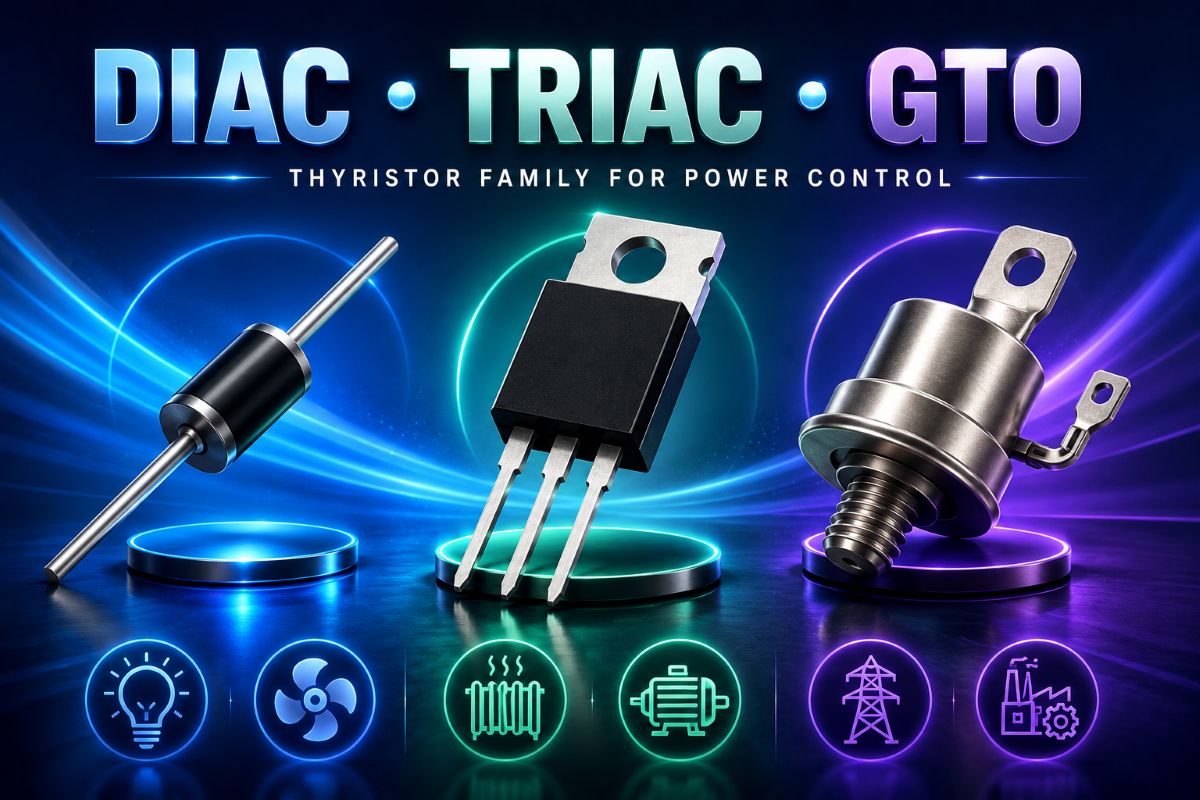
DIAC TRIAC and GTO provide reliable triggering, bidirectional AC control, and high‑power turn‑off capability in modern power electronics applications.
DIAC
A two-terminal bidirectional device used mainly to trigger TRIACs.
Working Principle
A DIAC remains OFF until the applied voltage reaches its breakover value. After breakover, it suddenly conducts in either direction and continues until the current falls below the holding current. This makes it useful as a trigger device for phase control circuits.
Main Features
>Two terminals only.
>Bidirectional conduction.
>No gate terminal.
>Used mainly for triggering TRIACs.
V-I Characteristic
The V-I curve is symmetrical in the first and third quadrants. Current remains very small until the breakover voltage is reached, then rises sharply. After conduction starts, the voltage across the DIAC drops suddenly.
In one line, a DIAC is a bidirectional trigger diode that turns ON only after the breakover voltage is reached.
TRIAC
A bidirectional power switch is used widely in AC control circuits.
Working Principle
A TRIAC can conduct current in both directions. It is triggered by a gate pulse and is commonly treated as two SCRs connected in inverse parallel with a common gate. Once turned on, it continues conducting until the current falls below the holding current.
Main Features
>Three terminals: MT1, MT2, and the gate.
>Bidirectional operation.
>Suitable for AC power control.
>Used in light dimmers and fan speed controllers.
V-I Characteristic
The TRIAC characteristic is symmetrical in the positive and negative halves of the AC cycle. It has a four-quadrant operation, and the gate current reduces the breakover point. This makes TRIACs ideal for phase angle control in AC circuits.
GTO
Gate Turn-Off thyristor for controlled switching in power electronics.
Working Principle
A GTO is similar to an SCR, but it can be turned OFF by applying a negative gate current. It is turned ON by a positive gate pulse and turned OFF by extracting carriers from the device through the gate terminal. This makes it a fully controllable thyristor.
Main Features
>Three terminals: anode, cathode, and gate.
>Can be turned ON and OFF by gate control.
>Useful in high-power switching applications.
>Faster control than SCR in many applications.
V-I Characteristic
The GTO V-I curve is similar to SCR, but its key advantage is the turn-off by gate signal. It shows forward blocking, forward conduction, and reverse blocking regions. Because of the gate turn-off ability, it is preferred in controlled power converters and inverters.