Edge Computing and Petrochemical Refineries
Fueling the Future: How Edge Computing Devices are Revolutionizing Petrochemical Refineries
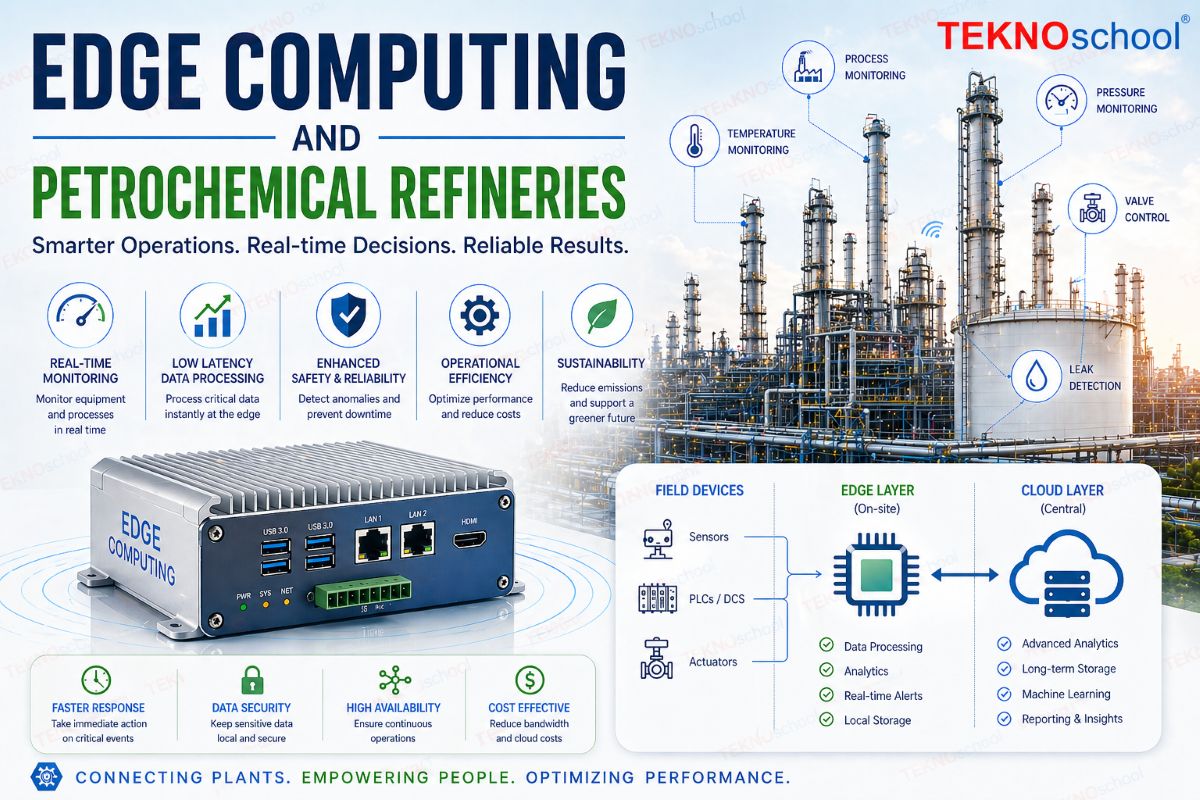
Edge Computing and Petrochemical Refineries– Petrochemical refineries are among the most complex, hazardous, and data-intensive industrial environments on the planet. Spanning hundreds of acres, a single modern refinery comprises a labyrinth of pipes, distillation columns, catalytic crackers, and storage tanks. To keep this massive infrastructure running safely and efficiently, operators rely on hundreds of thousands of sensors monitoring temperature, pressure, flow rates, and chemical compositions.
For years, the standard approach to handling this massive influx of industrial data was to route it to centralized Control Rooms via Distributed Control Systems (DCS) and, more recently, to the cloud for advanced analytics. However, the sheer volume of data generated by modern Industrial Internet of Things (IIoT) sensors has exposed the limitations of cloud-only architectures. Sending terabytes of raw data to a remote data center introduces latency, consumes massive bandwidth, and raises serious cybersecurity concerns.
This is where edge computing steps in. By bringing computation and data storage closer to the source of data generation—the “edge” of the network—refineries are unlocking unprecedented levels of operational efficiency, safety, and profitability.
What Are Edge Computing Devices in a Refinery Context?
In the consumer world, an edge device might be a smart speaker or a smartwatch. In a petrochemical refinery, edge computing devices look very different. They must survive in some of the harshest environments imaginable, subject to extreme temperatures, corrosive gases, heavy vibration, and strict safety regulations.
Key edge computing devices used in refineries include:
Industrial IoT (IIoT) Gateways: These act as the bridge between legacy equipment and modern networks. They collect data from PLCs (Programmable Logic Controllers) and sensors, translate industrial protocols (like Modbus or Profibus) into modern IT protocols (like MQTT or OPC UA), and perform initial data filtering.
Ruggedized Edge Servers: Built to withstand extreme conditions, these heavy-duty computers sit on the plant floor. They possess high processing power, often equipped with specialized AI accelerators (GPUs or TPUs) to run complex machine learning models locally.
Smart Sensors and Transmitters: The newest generation of sensors doesn’t just collect data; it processes it. A smart vibration sensor on a pump, for instance, might have enough built-in computational power to run an anomaly detection algorithm right on the device itself.
ATEX/Class 1 Div 1 Certified Devices: Any edge device deployed in a hazardous zone where explosive gases may be present must be intrinsically safe or housed in explosion-proof enclosures.
Example Applications: Edge Computing in Action
The true value of edge computing in petrochemicals becomes clear when we look at how these devices are applied to solve real-world refinery challenges.
1. Real-Time Predictive Maintenance for Rotating Equipment
Refineries rely heavily on rotating equipment—centrifugal pumps, massive compressors, and turbines. A catastrophic failure of a main compressor can shut down an entire processing unit, costing millions of dollars a day in lost production.
Traditionally, vibration data from these machines was sent to the cloud to be analyzed for signs of wear. However, sampling high-frequency vibration data generates enormous amounts of data. An edge computing device placed near the compressor can ingest high-frequency vibration and acoustic data (often thousands of data points per second), run a machine learning inference model locally, and determine the exact health of the machine. Instead of sending gigabytes of raw audio and vibration data to the cloud, the edge device simply sends a kilobyte-sized alert: “Bearing degradation detected on Pump A; estimated time to failure: 14 days.”
2. Intelligent Flare Monitoring and Emissions Control
Flaring is a critical safety mechanism used to burn off excess hydrocarbon gases. However, environmental regulations require strict monitoring of flare efficiency to minimize the release of unburned volatile organic compounds (VOCs) and smoke.
Operators now use high-definition optical and thermal cameras pointed at the flare stack. Transmitting these continuous, high-definition video feeds to the cloud for AI analysis would overwhelm plant networks. Instead, edge servers process the video feeds in real-time. Computer vision algorithms at the edge analyze the flame’s size, shape, and combustion efficiency. The edge device then instantly sends control signals to adjust the steam or air assist valves on the flare, ensuring optimal, smokeless combustion and maintaining strict environmental compliance.
3. Automated Video Analytics for Worker Safety
Safety is the highest priority in any petrochemical facility. Edge computing is transforming standard CCTV cameras into proactive safety tools.
Using edge-deployed computer vision models, video feeds are analyzed locally without ever leaving the plant network (which protects worker privacy). These edge systems can automatically detect if a worker has entered a restricted zone without proper Personal Protective Equipment (PPE), such as a hard hat or safety glasses. They can also detect “man-down” scenarios, immediately triggering alarms to the central control room if a worker collapses, ensuring a rapid emergency response.
4. Advanced Pipeline Leak Detection
Pipelines carrying volatile chemicals are subject to intense monitoring. Edge devices integrated with Distributed Acoustic Sensing (DAS) systems use fiber optic cables along the pipeline to listen for the distinct acoustic signature of a high-pressure leak. Because sound waves travel fast and require immediate action, an edge server analyzes the acoustic data locally. It can pinpoint the exact location of a leak within milliseconds and automatically trigger emergency shut-off valves, preventing a minor leak from becoming an environmental disaster.
The Strategic Advantages of Edge Computing
The shift toward edge architecture provides several distinct advantages that are specifically tailored to the needs of the oil and gas sector:
Ultra-Low Latency for Critical Control
In a chemical reaction, conditions can change in a fraction of a second. Relying on data to travel to a cloud server hundreds of miles away, be processed, and return a command simply takes too long. Edge computing provides single-digit millisecond latency, allowing for immediate, automated responses to critical safety and control events.
Bandwidth Optimization and Cost Reduction
Moving massive datasets over industrial networks, especially in remote offshore rigs or vast inland refineries utilizing cellular or satellite connections, is incredibly expensive. Edge devices act as data aggregators and filters. By processing data locally and only sending actionable insights, anomalies, or summarized reports to the cloud, refineries drastically reduce their bandwidth costs.
Enhanced Data Security and Privacy
Petrochemical operations are prime targets for cyberattacks. Sending sensitive operational data to the public cloud increases the attack surface. Edge computing allows refineries to keep their most sensitive data entirely on-premise, behind the facility’s firewalls. Even if the broader internet connection is compromised, the local edge devices can continue operating securely.
High Reliability and Offline Autonomy
Refineries cannot afford downtime due to internet outages. Because edge devices process data locally, they are not dependent on a continuous connection to the cloud. If the network goes down, the edge server continues to run predictive models, monitor safety cameras, and adjust operational parameters autonomously. Once the connection is restored, the device simply syncs the historical data back to the central system.
Looking Ahead: The Synergy of Cloud and Edge
It is important to note that edge computing does not replace the cloud; rather, it complements it. The future of refinery petrochemicals is a hybrid architecture.
The edge is designed for speed, immediate action, and local control. The cloud remains essential for heavy lifting: training the complex machine learning models, storing long-term historical data, and providing a macroscopic view of multiple refinery sites across the globe. The cloud acts as the brain that learns and develops the strategies, while edge devices act as the reflexes, executing those strategies instantly on the plant floor.
As refineries face increasing pressure to lower carbon emissions, improve energy efficiency, and maintain profitability in a volatile global market, digital transformation is no longer optional. Edge computing devices are proving to be the critical missing link in this transformation, turning the promise of the Industrial IoT into a tangible, powerful reality.