Engine Intake System Exhaust system
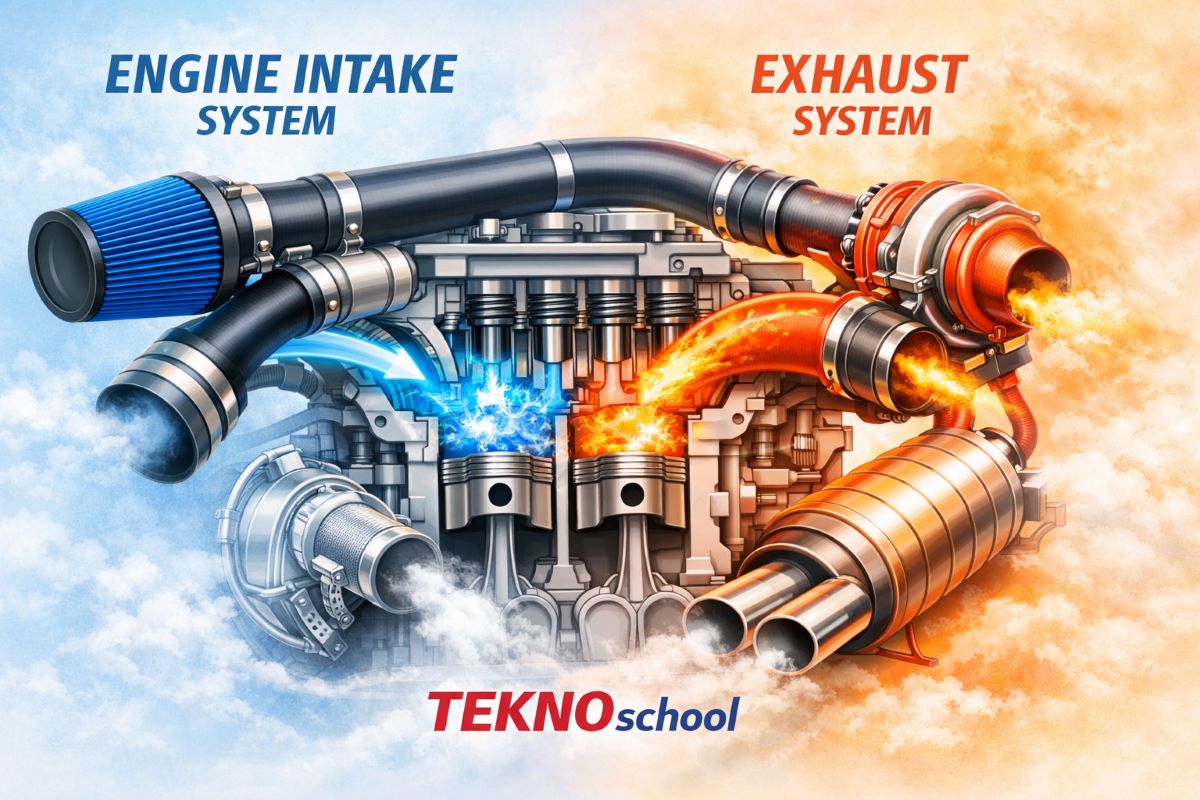
Engine Intake System Exhaust System. Every industrial engine, whether driving a generator or powering a critical facility, depends on two fundamental airflow systems working in perfect harmony. The engine intake system that feeds it clean combustion air, and the exhaust system that safely expels hot spent gases. Understanding how these systems are designed, what components they include, and how they behave under demanding conditions is essential for anyone responsible for mechanical equipment maintenance.
🌬️ Why Intake and Exhaust Systems Matter
An engine is essentially an air-breathing machine. Without a steady supply of clean, filtered combustion air, the engine cannot burn fuel efficiently. Without a properly designed exhaust pathway, dangerous hot gases would back up, overheat components, and create serious safety hazards.
In standard industrial facilities, intake and exhaust systems are relatively straightforward — filtered air comes in, exhaust gases go out through a silenced stack. However, in mission-critical facilities that must remain operational during extreme events including physical attacks or high-altitude nuclear blasts, these systems become significantly more complex. They must continue functioning even when outside air may be contaminated with chemical, biological, or radiological agents, and when pressure waves from blasts could otherwise destroy internal equipment.
🏗️ Intake System Design Features
A blast-protected air intake system is designed to protect the engine and the occupied spaces within a facility simultaneously. In such a setup, intake air fans draw outside air into a blast-resistant structure through an array of blast valve assemblies built directly into the facility walls. These blast valves are the first line of defense — they slam shut when sensors detect a blast event.
Inside this intake structure, the air passes through multiple filtration stages before reaching the engine:
- 🔴 Prefilter — Handles high-concentration dust and debris surges during attack conditions; can be bypassed during normal operations to preserve its service life
- 🟢 CBR (Chemical-Biological-Radiological) Filter Bank — Removes harmful agents and radioactive particles from the air; requires periodic replacement of reactive filter media even when not actively in service, because the media degrades simply from air exposure
- 🔵 Deep Cell Filter Bank — Provides secondary particulate removal for day-to-day contaminants
- 🟣 Roll Filter Assembly — Continuously captures particulate matter under normal operating conditions
A standby intake fan is always installed alongside the operating fan so maintenance can be performed without shutting down the air supply to the facility or engines.
💨 Exhaust System Design Features
The blast-protected exhaust system faces an additional challenge — not only must it vent extremely hot gases safely to the outside, but it must prevent the reverse: outside contamination from entering the facility through the exhaust duct of an engine that is not running. Two common blast-protected exhaust arrangements are used:
🔶 Option 1 — Mixing Chamber with Water Cooling Spray
Engine exhaust gases are discharged into a mixing chamber before exiting through blast valve assemblies. A water spray cooling system cools the exhaust to prevent damage to the blast valve assembly. When the facility enters blast mode and normal cooling systems are unavailable, the water spray activates automatically. Two isolation valves in series with an air purge between them prevent contaminated backflow through out-of-service engine exhaust ducts.
🟩 Option 2 — High-Temperature Blast Valve with Poppet Valve Relief
Each engine exhaust duct contains a dedicated high-temperature blast valve. When blast sensors trip the valve, a poppet relief valve diverts exhaust flow to a normally unoccupied gallery or tunnel within the facility. This arrangement keeps occupied areas safe from both blast pressure and toxic gases.
🔩 Major Components of Intake and Exhaust Systems
🔷 Combustion Air Particulate Filters
Clean combustion air is non-negotiable for engine performance. Two broad filter types are used:
Wet-type filters — Three common designs:
- 🔴 Viscous Impingement Filters: Wire strands coated with oil trap dust particles as air passes through
- 🟢 Oil Bath Filters: Air sweeps across an oil reservoir surface; oil coats and traps particles that collect in the reservoir
- 🔵 Traveling Screen Filters: A moving wire screen continuously dips through an oil bath; collected particles wash off as the screen cycles back through the bath
Dry-type filters — Made from materials such as fiberglass, polyester, cotton, or paper formed into woven, felted, pad, or mesh media. Most dry-type elements are disposable replaceable cartridges, though some prefilter sections designed for large-particle capture may use permanent elements.
🔸 Intake and Exhaust Silencers
Engine noise — especially exhaust noise — carries significant energy. Silencer units reduce this noise by either decreasing gas velocity and absorbing sound, or by canceling sound waves against each other. Silencers are installed in-line with the duct system and are typically several times larger in diameter than the connected duct.
- 🟣 Perforated Flow-Through Tube Type: Noise escapes into side chambers filled with sound-absorbing material
- 🟠 Baffled Type: Directional changes in gas flow cause sound waves to meet and cancel each other
Most combustion air intake systems do not require a dedicated silencer — the filter media itself acts as a baffle and noise-absorbing mass. Exhaust systems, carrying far more noise energy, almost always need a dedicated silencer unit. Internal volume of silencers is typically six to eight times the engine displacement to achieve adequate noise attenuation.
🟩 Ductwork and Expansion Joints
Intake and exhaust ducts are most commonly fabricated from carbon steel or stainless steel, selected based on a combination of initial cost and long-term maintenance requirements. A critical component within these duct systems is the bellows-type expansion joint — a flexible connector that accommodates thermal expansion, vibration, and movement between the rotating engine and the connected ductwork. It handles axial, lateral, and angular motion, or combinations of all three.
Expansion joint failures are among the most common maintenance problems in these systems. Common failure modes include:
- 🔴 Stress Corrosion: Chlorides, caustic agents, or high-temperature sulfurous gases acting on nickel alloys
- 🟠 Fatigue: Unanticipated vibration or unexpected temperature cycles beyond design limits
- 🔵 Carbide Precipitation: Unstabilized materials used at elevated operating temperatures
- 🟣 Squirm and Burst: Over-pressurization of the joint beyond rated capacity
When an expansion joint fails, field repairs may keep a system temporarily running, but they change the mechanical response characteristics of the entire duct system — potentially causing engine manifold cracking, duct hanger deformation, or even structural member failures. Any replacement joint must be designed to reflect current operating conditions; if stiffness characteristics differ significantly from the original, the entire duct system may require reanalysis and modification.
🔸 Isolation Valves and Dampers
Butterfly or slide-gate type valves provide isolation in blast-protected exhaust systems. Butterfly valves must use an offset shaft design so the disk makes continuous contact with the sealing surface. Trim components are typically stainless steel or similar materials with strong heat and corrosion resistance to handle the high-temperature exhaust environment reliably.
✅ Key Takeaway for Maintenance Teams
Engine intake and exhaust systems are not passive pathways — they are active, engineered systems with multiple protective layers. Maintaining clean filtration, monitoring expansion joint condition, verifying blast valve functionality, and ensuring silencer integrity are all critical preventive maintenance tasks. Any degradation in these systems directly impacts engine reliability, facility safety, and operational continuity.