Fuel Oil System in Gas Turbines
Fuel Oil System in Gas Turbines
Components, Working, and Control Systems
🔷 1. Purpose of Fuel Oil System
- Deliver fuel at the required pressure and temperature
- Ensure accurate fuel metering
- Provide fine atomization
- Maintain stable combustion
- Enable safe operation and shutdown
🔷 2. Types of Fuel Used
- 🛢️ Light Diesel Oil (LDO)
- 🔥 Heavy Fuel Oil (HFO)
- ⚙️ Dual-Fuel Systems
🔷 3. Major Components
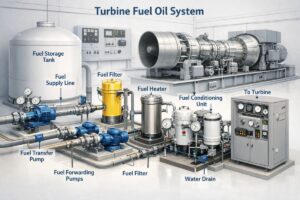
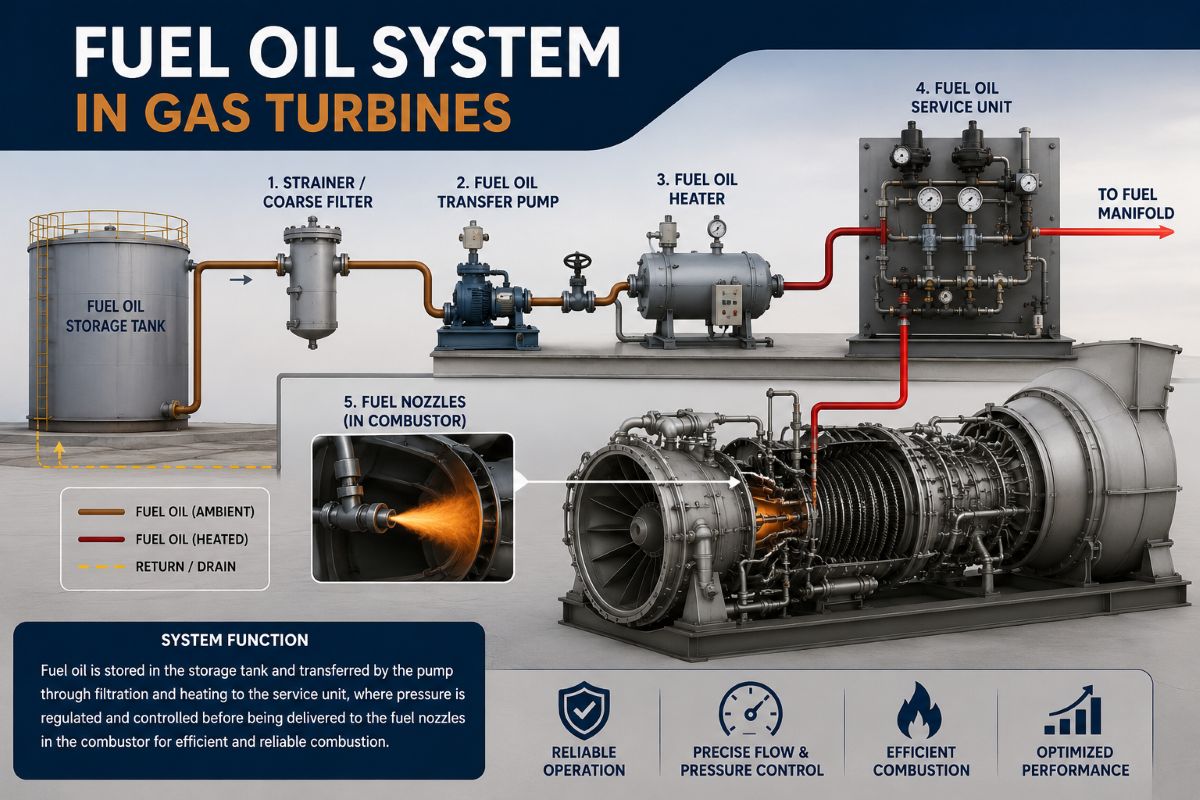
- Fuel Storage Tank
- Transfer Pump
- Day Tank
- Main Fuel Pump
- Filters (Primary & Secondary)
- Fuel Heater
- Fuel Control Valve (FCV)
- Flow Divider
- Fuel Nozzles / Injectors
- Return Line
🔷 4. Working Principle
- Fuel is supplied from the storage tank
- Pressurized by the main fuel pump
- Filtered to remove impurities
- Heated (for heavy fuel)
- Flow controlled via FCV
- Distributed to combustors
- Atomized through nozzles
- Combustion occurs continuously
- Excess fuel recirculated
🔷 5. Fuel Control Systems
⚙️ 5.1 Hydraulic Fuel Control System
Components: Flyweight governor, servo piston, pilot valve, fuel control valve
Working:
- Flyweights rotate with the turbine shaft
- Speed increase → flyweights move outward
- Pilot valve shifts → hydraulic oil flows
- Servo piston moves → adjusts fuel valve
- Maintains balance between speed and fuel flow
Key Point: Mechanical closed-loop system using oil pressure
🌬️ 5.2 Pneumatic Fuel Control System
Components: Air supply, regulator, diaphragm actuator, control valve
Working:
- Air pressure signals represent turbine conditions
- Pressure acts on the diaphragm
- Diaphragm movement adjusts the fuel valve
- Higher pressure → more fuel
- Lower pressure → less fuel
Key Point: Simple but less accurate due to air compressibility
💻 5.3 Electronic Fuel Control System
Components: ECU, sensors, actuators, fuel metering valve
Working:
- Sensors measure speed, temperature, and pressure
- ECU processes signals using control algorithms
- Calculates required fuel flow
- Actuators adjust the fuel valve precisely
- Continuous feedback ensures accuracy
Key Point: High precision, fast response, modern standard
🔷 6. Atomization Techniques
- 💧 Pressure Atomization
- 🌫️ Air-Assisted Atomization
🔷 7. Safety Features
- Pressure relief valves
- Emergency shut-off valves
- Flame detectors
- Leak detection systems
- Purge system
🔷 8. Operational Challenges
- Fuel contamination
- Viscosity issues
- Carbon deposits
- Pressure fluctuations
🔷 9. Maintenance
- Filter replacement
- Nozzle cleaning
- Pump inspection
- Control calibration
🔷 10. Advantages
- Stable combustion
- High efficiency
- Low emissions
- Reliable operation
🔷 11. Conclusion
The fuel oil system is a critical subsystem in gas turbines, ensuring efficient combustion and safe operation. Modern electronic control systems provide high precision, improved efficiency, and better emission control, making them essential in today’s industrial applications.