
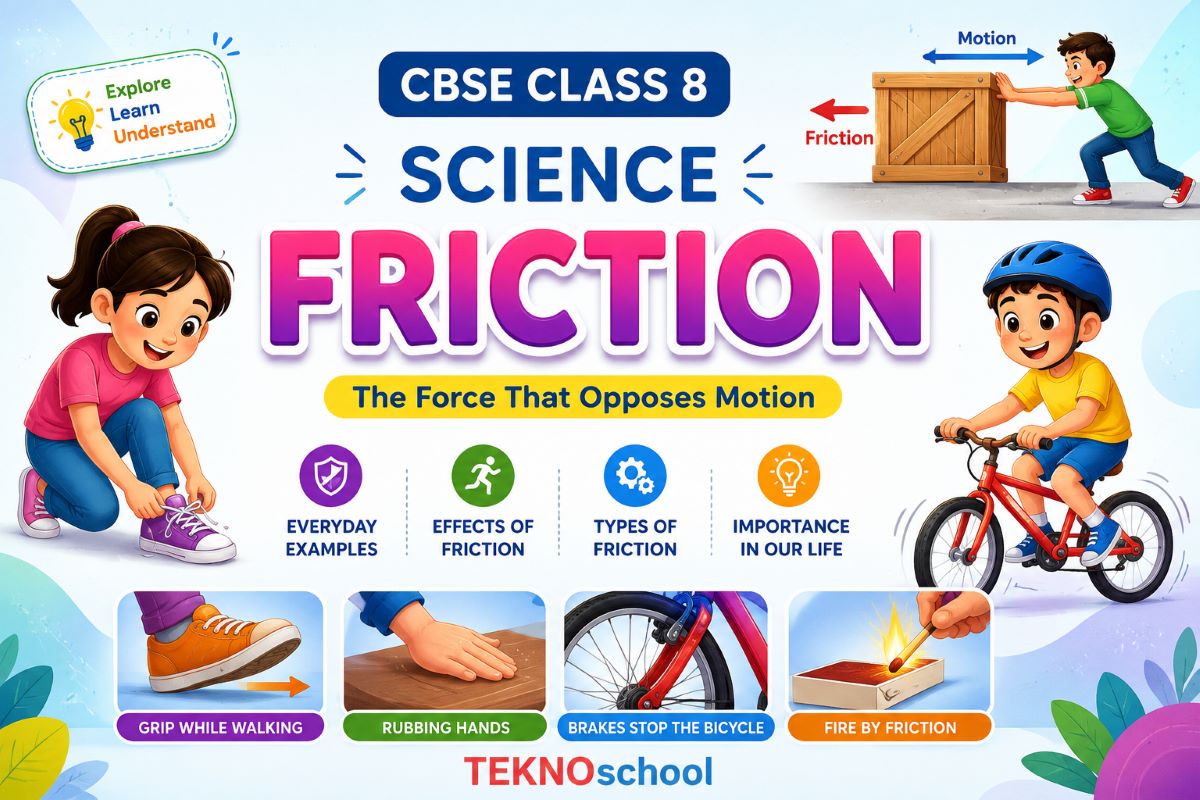
Friction
What is Friction?
Friction is a force that opposes the relative motion between two surfaces in contact. It acts in the direction opposite to the direction of motion or attempted motion.
When you push a book across a table, you feel resistance — that resistance is friction. It arises because no surface is perfectly smooth; at a microscopic level, every surface has tiny hills and valleys called irregularities. When two surfaces touch, their irregularities interlock and resist relative motion.
Friction is the force that opposes the relative sliding motion of one body over another body with which it is in contact. The direction of frictional force is always opposite to the direction of motion.
Types of Friction
Static Friction > Sliding Friction > Rolling Friction
This is why it is harder to start sliding an object than to keep it sliding, and why wheels (rolling) make transport so much easier than dragging.
Factors Affecting Friction
The rougher the surfaces in contact, the greater the friction. A rough road creates more friction than a smooth ice rink.
| Surface Type | Friction Level |
| Sandpaper | VERY HIGH |
| Concrete | HIGH |
| Polished Wood | MEDIUM |
| Wet Ice | LOW |
| Oiled Surface | VERY LOW |
The heavier the object pressing the surfaces together, the greater the friction. More weight = more interlocking of irregularities.
Low Friction
High Friction
Friction does NOT depend on the area of contact between surfaces (for solid surfaces). A large flat box and a small box of the same weight experience the same friction on the same surface.
Advantages & Disadvantages of Friction
Reducing and Increasing Friction
Methods of Reducing Friction
Methods of Increasing Friction
Fluid Friction & Drag
When objects move through a fluid (liquid or gas), they experience a resistive force called fluid friction or drag. The drag depends on the shape of the object, the speed of motion, and the nature of the fluid.
Quick Revision — Key Points Summary
| Concept | Key Point |
|---|---|
| Definition of Friction | Force opposing relative motion between surfaces in contact |
| Cause of Friction | Interlocking of microscopic irregularities on surfaces |
| Order of Friction | Static > Sliding (Kinetic) > Rolling |
| Factors Affecting | Nature of surfaces (roughness) and weight (normal force) |
| Methods to Reduce | Lubricants, ball bearings, streamlining, polished surfaces |
| Methods to Increase | Rough treads on tyres, spikes on shoes, sand on icy roads |
| Fluid Friction | Drag force from liquids/gases is reduced by streamlined shapes |
| Area of Contact | Does NOT affect friction between solid surfaces |
Exercise Zone
6 Question Types | 10 Questions Each | Answers Included
One-Sentence Answer Questions
Answer each question in one complete sentence.
Two-Sentence Answer Questions
Answer each question in exactly two complete sentences.
Yes / No Questions
Write YES or NO, then give one reason for your answer.
| # | Question | Answer | Reason |
|---|---|---|---|
| 1 | Does friction always act opposite to the direction of motion? | YES | Friction is always a resistive force that opposes the relative motion between surfaces. |
| 2 | Does friction depend on the area of contact between two solid bodies? | NO | Friction between solid surfaces depends only on the nature of the surfaces and the normal force, not the area of contact. |
| 3 | Is rolling friction greater than sliding friction? | NO | Rolling friction is much less than sliding friction, which is why wheels make transport far easier than dragging. |
| 4 | Can friction exist between a body and a fluid (liquid/gas)? | YES | Fluids exert a resistive drag force on moving objects, which is a form of fluid friction. |
| 5 | Is friction always harmful and should be completely eliminated? | NO | Friction is necessary for walking, writing, braking, and gripping — without it, daily life would be impossible. |
| 6 | Does a heavier object experience more friction on the same surface? | YES | Greater weight increases the normal force pressing surfaces together, increasing friction. |
| 7 | Does polishing a surface reduce friction? | YES | Polishing reduces the size of surface irregularities, so there is less interlocking and thus less friction. |
| 8 | Is static friction always equal to the applied force? | YES | As long as the body remains stationary, static friction adjusts itself to exactly equal the applied force, up to its maximum value. |
| 9 | Do streamlined shapes reduce fluid friction? | YES | Streamlined shapes allow fluid to flow smoothly around a body with minimal turbulence, greatly reducing drag. |
| 10 | Can we write on paper without friction? | NO | Friction between the pen/pencil tip and paper deposits ink or graphite; without it, the pen would just slide, and writing would be impossible. |
True / False Statements
Write TRUE or FALSE. If False, also write the corrected statement.
| # | Statement | Answer | Correction (if False) |
|---|---|---|---|
| 1 | Friction acts in the same direction as the motion of an object. | FALSE | Friction acts in the direction opposite to the motion of the object. |
| 2 | Rolling friction is less than sliding friction. | TRUE | — |
| 3 | Friction does not produce any heat. | FALSE | Friction converts kinetic energy into heat, which is why objects become warm when rubbed together. |
| 4 | Streamlined shapes help reduce fluid friction on moving vehicles. | TRUE | — |
| 5 | A larger area of contact between two solid bodies increases the friction between them. | FALSE | The area of contact does not affect friction between solid bodies; it depends on the nature of the surfaces and the normal force. |
| 6 | Lubricants help reduce friction between moving machine parts. | TRUE | — |
| 7 | Perfectly smooth surfaces have zero friction. | FALSE | In practice, no surface is perfectly smooth; all surfaces have microscopic irregularities, so perfectly frictionless solid surfaces do not exist in reality. |
| 8 | Fish have streamlined bodies to minimise water resistance. | TRUE | — |
| 9 | Static friction is always less than sliding friction. | FALSE | Static friction (at its maximum) is greater than sliding friction; it is harder to start moving an object than to keep it moving. |
| 10 | Friction is not useful and should always be reduced. | FALSE | Friction is very useful in many situations, such as walking, writing, and braking; only unwanted friction in machines should be reduced. |
Fill in the Blanks
Fill in each blank with the correct word or phrase.
1. Friction is a force that opposes the ____________ motion between two surfaces in contact.
2. The microscopic hills and valleys on surfaces are called ____________.
3. Among static, sliding and rolling friction, ____________ friction is the smallest.
4. The friction experienced by a body moving through a fluid is called ____________.
5. Oil and grease used to reduce friction are collectively called ____________.
6. Aeroplanes are given a ____________ shape to reduce air resistance.
7. The friction that acts on a stationary body when a force is applied is called ____________ friction.
8. ____________ bearings convert sliding friction to rolling friction in machines.
9. Friction between brake pads and wheels is useful for ____________ a vehicle.
10. Static friction is ____________ (greater / smaller) than sliding friction.
6. streamlined 7. static 8. ball 9. stopping / braking 10. greater
Four-Sentence Answer Questions
Answer each question in exactly four complete sentences.
Chapter: Friction — Complete Tutorial
Tutorial | Infographics | Diagrams | 1-Sentence | 2-Sentence | Yes/No | True/False | Fill-in-Blanks | 4-Sentence Answers