Force and Pressure
⚡
Force and Pressure
Class 8 Science – Tutorial, Revision & Worksheets
📌 1. What is Force?
🤜
Definition
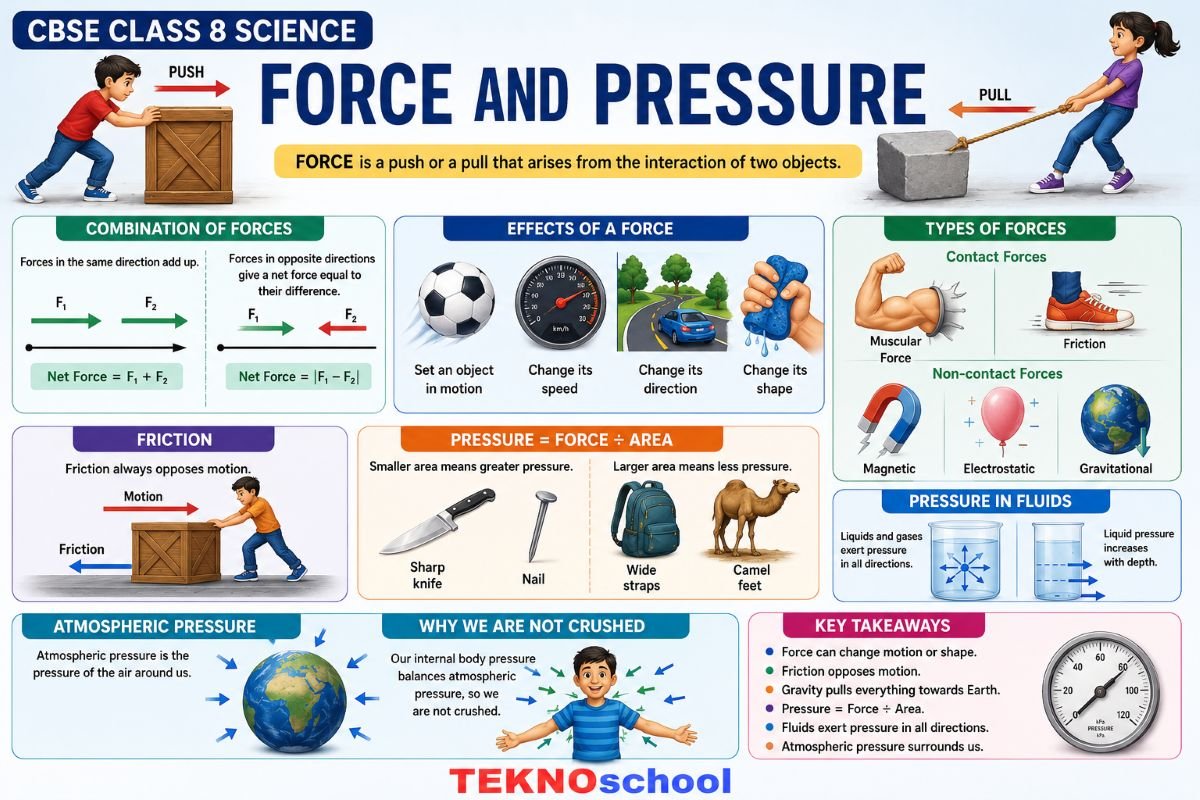
A push or pull on an object is called a force. Forces can change the state of motion, speed, or shape of an object.
📐
Direction Matters
Force has both magnitude and direction. The net effect depends on the direction in which forces act on the object.
⚖️
Unit of Force
The SI unit of force is the Newton (N), named after Sir Isaac Newton, who studied motion and forces.
🔄
Effects of Force
Force can make a stationary object move, stop a moving object, change its speed, change its direction, or change its shape.
💥 2. Effects of Force — At a Glance
1. Move a stationary object
A football at rest starts moving when kicked. A push applied to a stationary box on a floor sets it in motion.
2. Stop a moving object
A goalkeeper catches and stops the moving football. Brakes apply force to stop a moving bicycle.
3. Change the speed of a moving object
Pressing the accelerator pedal in a car increases its speed. A push in the same direction increases speed; in the opposite direction decreases it.
4. Change the direction of motion
A cricket batsman hits the ball and changes its direction. A force applied at an angle to motion changes the path of the object.
5. Change the shape of an object
Pressing a lump of clay changes its shape. Squeezing a rubber ball or stretching a spring shows that force can deform objects.
🔬 3. Types of Forces
🤝 Contact Force
Requires physical contact between objects. Examples: muscular force, friction.
🌌 Non-Contact Force
Acts without physical contact. Examples: gravity, magnetic force, electrostatic force.
💪 Muscular Force
Force exerted by muscles. Humans and animals use muscular force — lifting, pulling, kicking.
🧲 Magnetic Force
Force exerted by a magnet on magnetic materials. Acts without contact. Like poles repel; unlike poles attract.
⚡ Electrostatic Force
Force exerted by a charged object. A charged comb attracts small bits of paper without touching them.
🌍 Gravitational Force
The force of attraction between objects due to their mass. Earth pulls all objects towards its centre.
🔁 4. Friction
What is Friction?
Friction is a force that opposes the relative motion between two surfaces in contact. It always acts in the direction opposite to motion.
Friction is a Contact Force
Friction acts only when two surfaces are in contact. Rough surfaces create more friction than smooth surfaces.
Examples of Friction
Writing on paper, walking on the floor, brakes stopping a vehicle — all involve friction between surfaces.
🧱 5. What is Pressure?
📐 Definition
Pressure is the force acting per unit area. It tells us how concentrated a force is over a surface.
🔢 Formula
Pressure = Force ÷ Area
SI unit: Pascal (Pa) = N/m²
1 Pa = 1 N/m²
SI unit: Pascal (Pa) = N/m²
1 Pa = 1 N/m²
📏 Area and Pressure
Larger area → less pressure. Smaller area → more pressure. The same force spread over a larger area feels less intense.
🔪 Sharp Edges
Knives, needles, and nails are sharp, so they act over a very small area, creating very high pressure to cut or pierce.
💧 6. Pressure Exerted by Fluids
💧 Liquids Exert Pressure
Liquids exert pressure on the walls and bottom of the container in which they are stored.
⬇️ Pressure Increases with Depth
Pressure in a liquid increases with depth. Water from a hole at the bottom flows out faster than from a hole higher up.
🌬️ Gases Exert Pressure
Gases also exert pressure in all directions. Atmospheric air exerts atmospheric pressure on all surfaces.
🌡️ Atmospheric Pressure
The atmosphere exerts a large pressure on us at all times. We do not feel it because our body exerts equal pressure outward.
🏠 7. Force and Pressure in Daily Life
🏗️
Wide Foundations
Buildings have wide foundations to spread weight over a large area, reducing pressure on the ground.
🎒
Bag Straps
Wide bag straps spread the bag’s weight over a larger area of the shoulder, making it more comfortable to carry.
🐪
Camel’s Feet
Camels have large, flat feet to spread their weight over the sand, reducing pressure and preventing sinking.
🪡
Needles and Nails
Pointed tips have a very small area, so they exert very high pressure with a small force — easy to push into surfaces.
🩸
Dams
Dams are built thicker at the bottom because water pressure increases with depth — a greater force acts at the base.
📚
Revision Notes
Key definitions, formulas and important exam points
📖 Key Definitions
FORCE
A push or pull exerted on an object that may change its state of motion or shape.
PRESSURE
Force acting per unit area. Pressure = Force ÷ Area. SI unit: Pascal (Pa).
FRICTION
A contact force that opposes the relative motion between two surfaces in contact.
CONTACT FORCE
A force that acts only when there is physical contact between objects. E.g. muscular force, friction.
NON-CONTACT FORCE
A force that acts without physical contact. E.g. gravity, magnetic force, electrostatic force.
GRAVITATIONAL FORCE
The force of attraction between any two objects due to their masses. Earth’s gravity pulls all objects downward.
ELECTROSTATIC FORCE
Force exerted by a charged object on another charged or uncharged object without contact.
ATMOSPHERIC PRESSURE
Pressure exerted by the weight of the air (atmosphere) above us on all surfaces on Earth.
⭐ Important Points to Remember
1. Force = Push or Pull. SI unit = Newton (N). Force has both magnitude and direction.
2. Pressure = Force ÷ Area. SI unit = Pascal (Pa). Pressure increases as area decreases.
3. Friction is a contact force. Rough surfaces produce more friction than smooth surfaces.
4. Gravity, magnetic force, and electrostatic force are non-contact forces — they act at a distance.
5. Pressure in liquids increases with depth. Dams are thicker at the base for this reason.
6. Wide area → less pressure (bag straps, camel feet, building foundations).
7. Small area → more pressure (knife, needle, nail, pin — sharp pointed objects).
8. Atmosphere exerts pressure on us. We do not feel it because our body exerts equal outward pressure.
📝
Worksheets with Answers
Part A: 1-sentence | Part B: 2-sentence | Part C: 4-sentence
Part A — Very Short Answer (1 sentence each · 1 mark each)
Q1 · 1 Mark
What is force?
✅ ANSWER
A force is a push or pull exerted on an object that can change its state of motion, speed, direction, or shape.
Q2 · 1 Mark
What is the SI unit of force?
✅ ANSWER
The SI unit of force is the Newton (N), named after the scientist Sir Isaac Newton.
Q3 · 1 Mark
Define pressure.
✅ ANSWER
Pressure is the force acting per unit area on a surface, expressed as Pressure = Force ÷ Area, and its SI unit is the pascal (Pa).
Q4 · 1 Mark
What is friction?
✅ ANSWER
Friction is a contact force that opposes the relative motion between two surfaces that are in contact with each other.
Q5 · 1 Mark
Name two non-contact forces.
✅ ANSWER
Gravitational force and magnetic force are two examples of non-contact forces that act between objects without any physical contact.
Q6 · 1 Mark
Why does a sharp knife cut better than a blunt one?
✅ ANSWER
A sharp knife has a very small contact area, so it exerts much greater pressure on the object for the same applied force, making it cut easily.
Q7 · 1 Mark
How does a charged comb attract small pieces of paper?
✅ ANSWER
A charged comb exerts an electrostatic force on the small pieces of paper, attracting them without any physical contact between them.
Q8 · 1 Mark
What happens to pressure in a liquid as depth increases?
✅ ANSWER
Pressure in a liquid increases with depth because the weight of the liquid above adds to the pressure at greater depths.
Q9 · 1 Mark
Give one example of muscular force.
✅ ANSWER
Kicking a football is an example of muscular force, where the muscles of the leg exert a push on the ball to set it in motion.
Q10 · 1 Mark
Why do we not feel the large atmospheric pressure acting on our bodies?
✅ ANSWER
We do not feel atmospheric pressure because our body exerts an equal and opposite outward pressure that balances the atmospheric pressure acting inward on us.
Part B — Short Answer (2 sentences each · 2 marks each)
Q1 · 2 Marks
Distinguish between contact force and non-contact force with one example each.
✅ ANSWER
A contact force requires physical contact between objects to act — for example, friction between a sliding book and a table surface. A non-contact force acts between objects without any physical contact — for example, the gravitational force with which the Earth pulls all objects towards its centre.
Q2 · 2 Marks
How does the area of contact affect pressure? Give one practical example.
✅ ANSWER
Pressure and area of contact are inversely related — as the area increases, pressure decreases, and as the area decreases, pressure increases for the same applied force. For example, a wide shoulder strap on a school bag distributes the weight over a larger area, reducing the pressure on the shoulder and making it more comfortable to carry.
Q3 · 2 Marks
State two effects that a force can produce on an object.
✅ ANSWER
A force can change the state of motion of an object — it can make a stationary object move or stop a moving object, as seen when a goalkeeper stops a football. A force can also change the shape of an object — for example, pressing a lump of clay or stretching a rubber band changes the object’s form without necessarily changing its position.
Q4 · 2 Marks
Why are dams built thicker at the base than at the top?
✅ ANSWER
Dams are built thicker at the base because water pressure increases with depth — the greater the depth of water, the greater the force it exerts on the dam walls. The thick base is necessary to withstand this greater pressure at the bottom and prevent the dam from breaking or collapsing.
Q5 · 2 Marks
What is electrostatic force? Give one example from everyday life.
✅ ANSWER
Electrostatic force is the non-contact force exerted by a charged object on another charged or uncharged object, acting at a distance without physical contact between the two objects. A common everyday example is a plastic comb that, after being rubbed through dry hair, attracts and picks up small bits of paper lying nearby without actually touching them.
Q6 · 2 Marks
Why do camels have large, broad feet? Relate your answer to pressure.
✅ ANSWER
Camels have large, broad, padded feet that spread their body weight over a much greater area of sand when they walk or stand in the desert. This large contact area results in a very low pressure on the sand surface, which prevents the camel’s feet from sinking into the loose desert sand and allows it to walk easily.
Q7 · 2 Marks
How does friction act as both a useful and a harmful force? Give one example of each.
✅ ANSWER
Friction is useful in many situations — for example, the friction between our feet and the ground allows us to walk without slipping, and the friction between brake pads and wheels brings a bicycle or car to a safe stop. However, friction can also be harmful — it causes wear and tear on machine parts and vehicle tyres, and produces unwanted heat in engines, reducing their efficiency and requiring regular lubrication.
Q8 · 2 Marks
What is gravitational force? How does it affect objects on Earth?
✅ ANSWER
Gravitational force is the non-contact force of attraction that exists between any two objects having mass, and it acts along the line joining the centres of the two objects. On Earth, it is this gravitational force that pulls all objects downward towards the Earth’s centre — this is what gives every object its weight, causes thrown objects to fall back, and keeps the Moon in orbit around the Earth.
Q9 · 2 Marks
A force of 200 N acts on an area of 4 m². Calculate the pressure.
✅ ANSWER
Using the formula Pressure = Force ÷ Area, we get Pressure = 200 N ÷ 4 m² = 50 N/m². Therefore, the pressure exerted is 50 pascals (Pa), which means 50 Newtons of force act on every square metre of the surface.
Q10 · 2 Marks
Why do liquids exert pressure on the walls of their container?
✅ ANSWER
Liquids exert pressure on the walls of their container because the liquid molecules are in constant motion and continuously collide with the walls, exerting an outward force on them in all directions. This is why a hole made in the side of a water-filled container causes water to gush outward — the liquid pressure pushes the water through the opening.
Part C — Long Answer (4 sentences each · 4 marks each)
Q1 · 4 Marks
Describe five effects that a force can produce on an object, with one example for each.
✅ ANSWER
A force can make a stationary object move — for example, kicking a football at rest sets it rolling; conversely, a force can also stop a moving object, as seen when a goalkeeper catches and stops the ball or when brakes stop a bicycle. A force can change the speed of a moving object — pressing the accelerator in a car increases its speed, while applying the brakes decreases it. A force can change the direction of a moving object — a cricket batsman hitting the ball changes its path from the bowler’s direction back toward the field. Finally, a force can change the shape of an object — pressing a lump of clay, stretching a rubber band, or squeezing a plastic bottle all demonstrate that force can deform objects.
Q2 · 4 Marks
Explain the concept of pressure with the formula and discuss the relationship between pressure and area using daily life examples.
✅ ANSWER
Pressure is defined as the force acting per unit area on a surface, expressed by the formula Pressure = Force ÷ Area, with the SI unit being Pascal (Pa), where 1 Pa = 1 N/m². Pressure and area have an inverse relationship — for the same applied force, if the area of contact decreases, the pressure increases, and if the area increases, the pressure decreases. This is why sharp objects like knives, needles, and nails have pointed or thin edges — the tiny area of contact concentrates the force, creating very high pressure that allows them to cut or pierce with little effort. Conversely, wide foundations of buildings, broad feet of camels, and wide bag straps all use the principle of increasing area to reduce pressure and prevent sinking, discomfort, or structural failure.
Q3 · 4 Marks
Classify and describe the different types of forces. Give two examples of each type.
✅ ANSWER
Forces are broadly classified into two types: contact forces and non-contact forces, based on whether physical contact between objects is needed for the force to act. Contact forces require direct physical contact — muscular force (a person lifting a box, a bullock pulling a cart) and friction (brakes stopping a bicycle, writing on paper) are two common examples of contact forces. Non-contact forces act between objects that are not touching each other — gravitational force (Earth pulling all objects downward, the Moon being held in orbit) and magnetic force (a magnet attracting iron filings, a compass needle pointing north) are classic examples. Electrostatic force is another important non-contact force — a rubbed comb picking up paper bits and a charged balloon sticking to a wall are everyday demonstrations of it.
Q4 · 4 Marks
Explain how liquids and gases exert pressure. How does water pressure vary with depth?
✅ ANSWER
Liquids exert pressure on all surfaces they are in contact with — the bottom and walls of any container holding a liquid experience an outward force from the liquid, which is why water gushes out when a hole is made in the side of a full bucket. Pressure in a liquid increases with depth because the weight of the liquid above adds to the pressure at lower levels — a hole near the bottom of a container releases a stronger jet of water than a hole near the top. This principle explains why dams are built with thicker, stronger bases to withstand the higher water pressure at the bottom. Gases also exert pressure — the atmosphere, which is a mixture of gases, exerts a very large atmospheric pressure on all surfaces on Earth, which is why a sealed syringe resists being pulled open when no fluid is inside, and why our ears pop at high altitudes where atmospheric pressure is lower.
Q5 · 4 Marks
What is friction? Explain its usefulness and harmful effects in daily life with examples.
✅ ANSWER
Friction is a contact force that opposes the relative motion between two surfaces in contact, always acting in the direction opposite to the direction of motion; rough surfaces produce more friction than smooth ones. Friction is extremely useful in everyday life — it allows us to walk on the ground without slipping, lets vehicles brake safely, enables us to grip objects, helps matchsticks ignite, and allows pen or chalk to write on surfaces. However, friction also has harmful effects — it causes wear and tear of tyres, brake pads, shoe soles, and machine parts, reducing their lifespan and requiring frequent replacement or maintenance. To reduce unwanted friction in machines, lubricants such as oil and grease are applied between moving parts, and ball bearings are used to replace sliding friction with rolling friction, which is significantly smaller.
Q6 · 4 Marks
Explain magnetic force and electrostatic force as non-contact forces with examples.
✅ ANSWER
Magnetic force is a non-contact force exerted by a magnet on magnetic materials such as iron, nickel, and cobalt — a magnet can attract iron filings or pick up iron nails without touching them, and the needle of a compass aligns itself with the Earth’s magnetic field without any contact. Like magnetic poles repel each other while unlike poles attract, which can be demonstrated by bringing two bar magnets together and observing the push or pull depending on pole orientation. Electrostatic force is another non-contact force exerted by a charged body on other charged or uncharged objects — a plastic ruler or comb rubbed on hair becomes charged and can attract small bits of paper or dust from a distance. Both magnetic and electrostatic forces are examples of forces that can act across space, unlike friction or muscular force, which require direct contact between surfaces.
Q7 · 4 Marks
Explain gravitational force. How does it affect objects both on Earth and in space?
✅ ANSWER
Gravitational force is a universal non-contact attractive force that acts between any two objects that have mass — the greater the mass of the objects and the closer they are to each other, the stronger the gravitational pull between them. On Earth, it is this gravitational force that gives every object its weight, causes objects to fall downward when dropped, keeps water in rivers and oceans, and causes rain to fall from clouds to the ground. In space, gravitational force plays an even grander role — it keeps the Moon in orbit around the Earth, keeps the Earth and other planets in orbit around the Sun, and holds galaxies together across vast cosmic distances. Sir Isaac Newton is credited with first understanding and describing the law of universal gravitation after observing an apple fall from a tree and reasoning that the same force that pulls the apple must extend to the Moon.
Q8 · 4 Marks
How do engineers and architects use the concept of pressure in the design of buildings, tools, and equipment? Give four examples.
✅ ANSWER
Engineers and architects apply the principle of pressure (Force ÷ Area) extensively in design — buildings are given wide, spread-out foundations so that the weight of the structure is distributed over a large area, greatly reducing the pressure on the soil and preventing subsidence. Dams are designed with a wider, thicker base than the top because water pressure increases with depth, and the base must withstand the maximum water force at the reservoir’s deepest point. Cutting tools like knives, chisels, and axes are deliberately designed with thin, sharp edges to minimise the contact area, thereby maximising the pressure on the material being cut with the same muscular effort. Snow boots and snowshoes are designed with very large flat surfaces to spread a person’s weight over a greater area of snow, reducing pressure and preventing the wearer from sinking into the soft surface.
Q9 · 4 Marks
Two forces act on an object in the same direction and in opposite directions. How does the net force differ in each case? Explain with examples.
✅ ANSWER
When two forces act on an object in the same direction, the net force is the sum of the two individual forces and acts in the same direction, making it much easier to move the object — for example, two people pushing a heavy box together from the same side can move it easily when one person alone could not. When two forces of equal magnitude act on an object in opposite directions, the net force is zero, and the object remains stationary or continues in its current state of motion — for example, a game of tug of war where both teams pull with equal force results in no movement. If two forces act in opposite directions but are unequal, the net force equals the difference between them and acts in the direction of the larger force — for example, if one team in tug of war pulls with 300 N and the other with 200 N, the net force is 100 N in the direction of the stronger team, and the rope moves toward them. The concept of net force is fundamental to understanding how multiple forces combine to determine the final motion of any object.
Q10 · 4 Marks
Explain atmospheric pressure. Why do our ears hurt at high altitudes and when diving deep into water?
✅ ANSWER
Atmospheric pressure is the pressure exerted by the weight of the column of air above us in the Earth’s atmosphere — it acts on all surfaces in all directions at every point on Earth and is extremely large in magnitude, approximately 101,325 Pa (about 1 atm) at sea level. We do not normally feel this enormous pressure because our bodies exert an equal and opposite internal pressure outward, balancing the atmospheric pressure and keeping us in equilibrium. At high altitudes, such as on mountain peaks or in aeroplanes, the atmospheric pressure is lower because there is less air above us — this difference in pressure between the inside of our ears and the outside can cause discomfort, pain, or a “popping” sensation until our ears adjust through yawning or swallowing. Conversely, when diving deep underwater, the water pressure (which also increases with depth) adds to the atmospheric pressure, and the increasing total pressure on our eardrums causes pain or discomfort, which is why deep-sea divers use pressurised equipment to protect themselves.
Class 8 Science – Force and Pressure
Tutorial · Revision Notes · Worksheets with Answers (1, 2 & 4 sentence)