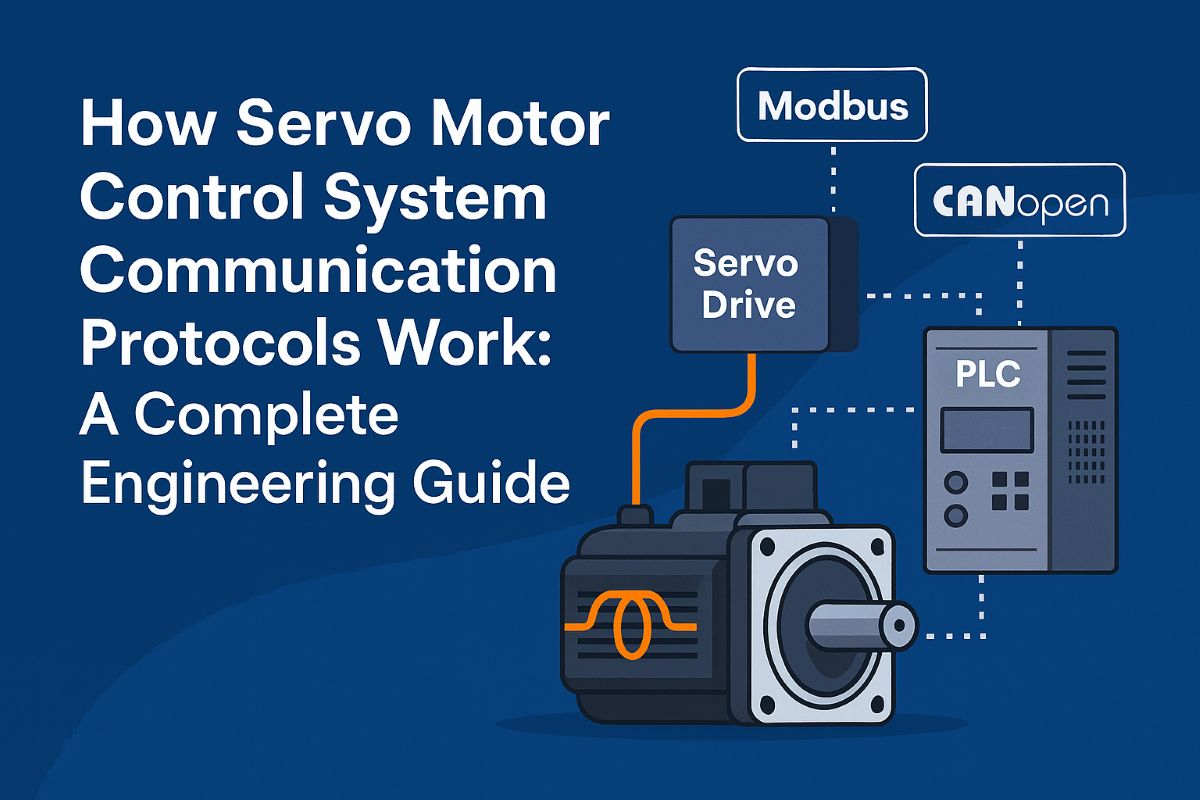
How Servo Motor Control System Communication Protocols Work: A Complete Engineering Guide
How Servo Motor Control System Communication Protocols Work: A Complete Engineering Guide
Introduction: The Invisible Engineering Behind Every Servo Motor
How Servo Motor Control System Communication Protocols Work: Every time a robotic arm moves with millimeter precision, a CNC spindle hits an exact depth, or a packaging machine runs at 1,000 cycles per minute without missing a beat — a communication protocol is working silently behind the scenes, making it all possible.
Servo motors do not operate in isolation. They are part of a tightly coordinated system involving PLCs, motion controllers, servo drives, encoders, and feedback devices — all constantly exchanging critical data at rates of dozens to thousands of times per second. The communication protocol is the engineering framework that enables fast, reliable, and precisely timed data exchange.
Understanding how these protocols work is not just academic knowledge — it is essential engineering competency for anyone designing, commissioning, or troubleshooting modern motion control systems.
🔁 The Basic Communication Loop
At its core, every servo motor communication protocol operates on a closed-loop control cycle. Here is how it works, step by step:
🔹 Step 1 — Command Generation: The PLC or motion controller calculates the desired position, velocity, or torque for each axis based on the machine program.
🔹 Step 2 — Data Transmission: The command data is packaged into a network frame and transmitted to the servo drive over the industrial Ethernet network.
🔹 Step 3 — Drive Execution: The servo drive receives the command and applies the appropriate current to the servo motor to achieve the desired motion.
🔹 Step 4 — Feedback Collection: The encoder on the servo motor measures the actual position and velocity, and sends this data back to the controller.
🔹 Step 5 — Error Correction: The controller compares the actual position against the commanded position, calculates any error, and issues a corrected command in the next cycle.
This entire loop — command out, feedback in, correction applied — repeats hundreds to thousands of times per second, depending on the protocol and application.
⏱️ Why Cycle Time and Determinism Are Everything
The speed and reliability of this loop define the quality of servo control. Two parameters matter above all others:
⚡ Cycle Time — How quickly one complete communication loop completes. Shorter cycle times allow the controller to catch and correct positional errors faster, resulting in smoother, more precise motion. EtherCAT achieves cycle times as low as 31 microseconds — that is 0.000031 seconds per loop.
🎯 Determinism — The guarantee that every communication cycle completes within a fixed, predictable time window — with zero variation. A non-deterministic network might deliver data in 250 µs one cycle and 900 µs the next. For servo control, this timing variation — called jitter — causes positional errors, vibration, and instability. Industrial protocols like PROFINET IRT achieve jitter below 1 microsecond.
🔄 How Multi-Axis Synchronization Works
Modern machines rarely control just one axis. A five-axis CNC machine, a delta robot, or a flying knife packaging unit requires multiple servo drives moving in perfect coordination — their positions precisely correlated at every moment.
This is achieved through network-wide clock synchronization:
🟢 The controller broadcasts a master clock signal to all servo drives on the network simultaneously.
🟢 Each drive locks its internal clock to the master reference using hardware-level synchronization — a process called Distributed Clock in EtherCAT or Isochronous Real-Time in PROFINET.
🟢 All drives execute their motion commands at exactly the same instant — synchronized to within microseconds of each other, regardless of how many axes are on the network.
This is why a 10-axis servo system can perform electronic gearing, cam profiling, or coordinated interpolation without any one axis leading or lagging the others.
📡 What Data Actually Travels on the Network?
Many engineers assume only position commands are transmitted. In reality, a full servo data frame contains:
📌 Process Data (cyclic) — Transmitted every single cycle:
- Target position, velocity, or torque command
- Actual position feedback from encoder
- Actual velocity and current feedback
- Drive status word (running, fault, warning)
- Controller control word (enable, halt, quick stop)
📋 Parameter Data (acyclic) — Transmitted on demand:
- Drive configuration parameters (PID gains, current limits, ramp rates)
- Fault history and diagnostic logs
- Firmware updates and identification data
- Homing method and limit switch configuration
The separation of cyclic process data (time-critical, every cycle) and acyclic parameter data (non-time-critical, on demand) is a fundamental design principle shared across EtherCAT, PROFINET, EtherNet/IP, POWERLINK, and CC-Link IE TSN.
🔌 The Role of Drive Profiles — CiA 402 and PROFIdrive
Raw communication speed means nothing without a standardized language for commanding servo drives. This is where drive profiles come in.
🔹 CiA 402 (DS402) — Used by EtherCAT, POWERLINK, and CC-Link IE TSN. Defines standard control modes including: Profile Position Mode, Profile Velocity Mode, Torque Control Mode, Cyclic Synchronous Position Mode (CSP), and Homing Mode.
🔹 PROFIdrive — Used by PROFINET. Defines equivalent control modes plus integrated safety functions, making it the preferred choice for safety-certified servo applications.
These profiles mean an engineer can replace a servo drive from one manufacturer with a drive from a different manufacturer — and the motion program continues to work with minimal reconfiguration.
🏁 Conclusion: Protocol Engineering Is Motion Engineering
Understanding how servo motor communication protocols work reveals a profound truth: the quality of motion is inseparable from the quality of communication.
Every microsecond of cycle time, every nanosecond of synchronization accuracy, every byte of feedback data — all of it directly shapes how precisely, smoothly, and reliably your servo system performs.
Whether you are engineering a new machine, selecting a drive platform, or diagnosing an existing system, protocol knowledge is not optional — it is foundational.
Master the communication layer, and you master servo motion control.
💬 “In precision motion control, the protocol is not the background infrastructure — it is the core engineering. The machine moves exactly as well as its communication system allows.”
🏷️ Tags: Servo Motor Communication Protocol, EtherCAT, PROFINET, EtherNet/IP, Industrial Ethernet, Motion Control, CiA 402, PROFIdrive, Servo Drive Engineering, Real-Time Communication, PLC, Industrial Automation