EtherCAT Cabinetless Automation: Power, Wiring, Safety & Real-Time Control for Distributed Machines
⚡ EtherCAT in Cabinetless Automation: Architecture, Power, Wiring & Safety
As machine builders shift toward cabinetless electrical systems, one technology consistently enables the transition: EtherCAT cabinetless automation. Known for its ultra-fast, deterministic communication and flexible topology, EtherCAT is the backbone of distributed automation. From powering machine-mounted drives to enabling real-time safety, EtherCAT transforms how control, I/O, and diagnostics are handled in modern machines.
This blog explores EtherCAT in Cabinetless Automation: Architecture, Power, Wiring & Safety that make cabinetless systems practical, scalable, and safe.
🔌 1. How EtherCAT Enables Cabinetless Automation
Cabinetless systems rely on distributed modules—I/O, drives, safety, and power—mounted directly on the machine. To function as a unified system, these modules must communicate with:
- ⚡ Ultra-low latency
- ⏱️ Deterministic timing
- 🔁 Real-time synchronization
- 🌐 Flexible topologies
EtherCAT delivers all of this.
🧠 Key EtherCAT Features:
- Distributed clocks — synchronize motion axes with nanosecond precision
- On-the-fly processing — each node reads/writes data as the frame passes
- Flexible topology — line, tree, ring, daisy-chain
- Hot connect — modules can be added/removed without rebooting
- Scalability — supports hundreds of nodes without performance loss
📦 In cabinetless machines, EtherCAT connects:
- IP67 drives
- Distributed I/O
- Safety modules
- HMI and controllers
All over a single twisted-pair cable.
🔋 2. EtherCAT P vs Standard EtherCAT: Which One Fits Cabinetless Designs?
EtherCAT comes in two flavors:
| Feature | Standard EtherCAT | EtherCAT P |
|---|---|---|
| Communication | Data only | Data + Power |
| Cable type | Shielded twisted pair | Hybrid cable (power + data) |
| Connectors | RJ45, M12 | M8, M12 hybrid |
| Power delivery | Separate cable | Integrated |
| Ideal for | Control cabinets | Cabinetless, machine-mounted modules |
🟦 Standard EtherCAT
- Uses separate cables for power and data
- Common in traditional control cabinets
- Requires external power distribution
🟧 EtherCAT P (Power + Protocol)
- Combines 24V power + EtherCAT data in one cable
- Reduces wiring by 50–70%
- Perfect for IP67 modules and machine-mounted drives
- Supports daisy-chain topology with hybrid connectors
🔌 Why EtherCAT P is ideal for cabinetless systems:
- Fewer cables
- Faster installation
- Cleaner routing
- Lower cost
- Simplified BOM
For OEMs building modular machines, EtherCAT P is a game-changer.
🧩 3. Distributed I/O Over EtherCAT: Reducing Wiring by 60–80%
In cabinet-based systems, I/O wiring is a nightmare:
- Long cable runs
- Terminal blocks
- Glands and conduits
- Panel space
- Manual testing
Cabinetless systems eliminate this by using distributed I/O modules mounted directly on the machine.
📡 EtherCAT I/O Modules:
- IP67-rated
- Digital and analog I/O
- IO-Link masters
- Diagnostic LEDs
- Daisy-chainable
🔧 Wiring Reduction Example:
- Traditional: 20 sensors → 20 cables → cabinet
- EtherCAT: 1 hybrid cable → daisy-chained I/O → sensors nearby
🟢 Result:
- 60–80% less wiring
- Faster build time
- Easier troubleshooting
- Cleaner machine design
EtherCAT’s deterministic behavior ensures that distributed I/O performs just as reliably as centralized I/O.
🛡️ 4. Safety Over EtherCAT (FSoE): Making Cabinetless Systems Safe and Compliant
Safety is non-negotiable. In traditional systems, safety requires:
- Hardwired relays
- Safety PLCs
- Dedicated wiring
- Complex troubleshooting
Cabinetless systems use Safety over EtherCAT (FSoE) to achieve functional safety over the same network.
🧠 What is FSoE?
- A certified safety protocol layered on EtherCAT
- Enables safe communication between the controller and the field devices
- Complies with IEC 61508, ISO 13849, and SIL3
🟨 Safety Functions Over EtherCAT:
- 🛑 Safe Torque Off (STO)
- 🐢 Safe Limited Speed (SLS)
- 🔄 Safe Stop (SS1/SS2)
- 🔁 Safe Direction (SDI)
- 🧱 Safe Zones and Muting
🔐 Benefits of FSoE in Cabinetless Systems:
- No separate safety wiring
- Distributed safety modules
- Real-time safety diagnostics
- Modular safety zones
- Faster commissioning
- Easier compliance
With FSoE, OEMs can build machines that are safe, scalable, and cabinet-free.
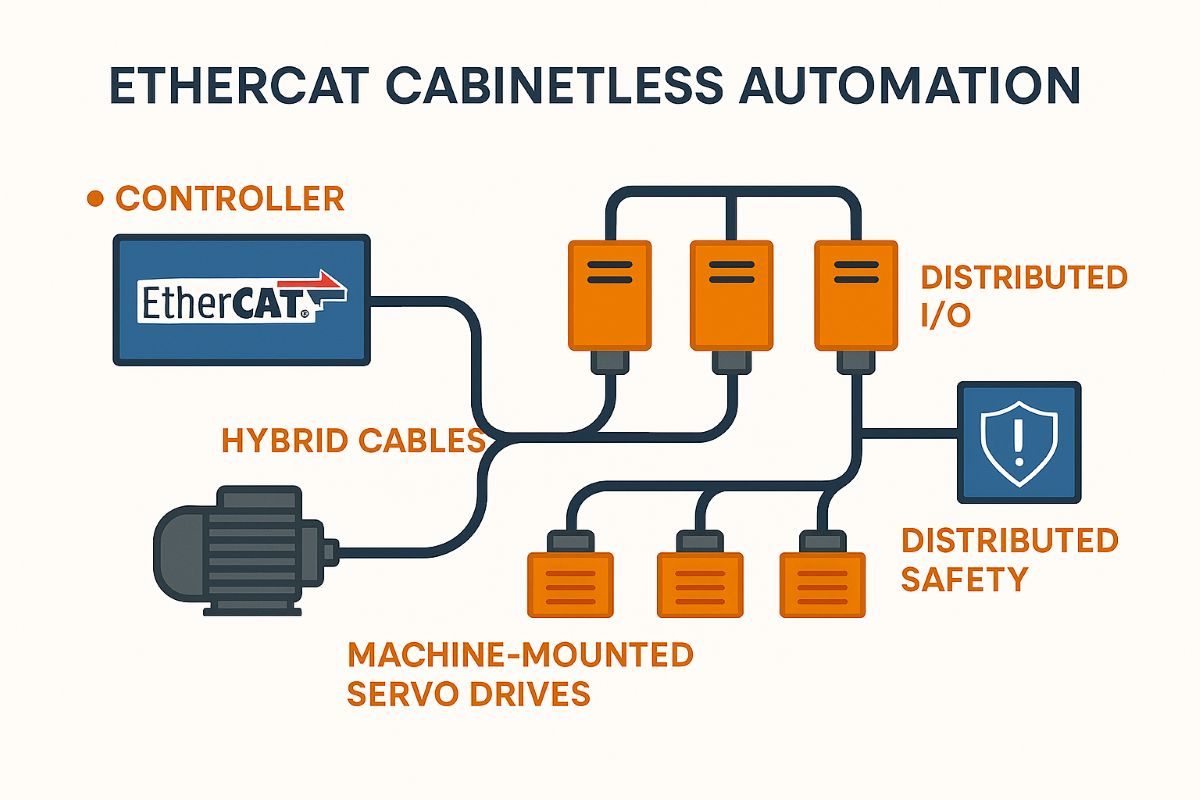
🏗️ Real-World Cabinetless EtherCAT Architecture
Here’s how a typical cabinetless EtherCAT system looks:
- 🎯 Controller (PLC or IPC) with EtherCAT master
- 🔌 EtherCAT P hybrid cable
- 🧩 Distributed I/O modules
- ⚙️ Machine-mounted servo drives
- 🛡️ Safety modules with FSoE
- 📊 HMI or SCADA interface
All connected over a single EtherCAT network.
🚀 Why EtherCAT Is the Backbone of Cabinetless Automation
EtherCAT enables:
- 📉 Reduced wiring
- ⏱️ Real-time motion control
- 🧱 Modular machine design
- 🔐 Functional safety
- 🔌 Power + data over one cable
- 🧠 Scalable diagnostics
- 🌐 Flexible topologies
Whether you’re building packaging machines, AGVs, robotic arms, or modular conveyors, EtherCAT makes cabinetless automation technically feasible and economically attractive.
🔮 Future Trends
EtherCAT is evolving to support:
- 🌐 TSN (Time-Sensitive Networking)
- 🧠 Integration with digital twins
- 📦 Modular Type Package (MTP)
- 🧪 Predictive maintenance
- 🧠 AI-based diagnostics
As these technologies mature, cabinetless systems will become the default architecture for smart, connected machines.