Cabinetless Electrical System: The Future of Machine Automation with Distributed Power, I/O & Drives
⚙️ What Is a Cabinetless Electrical System? The Future of Machine Automation
For decades, industrial machines were built around a centralized electrical control cabinet—a large enclosure packed with PLCs, drives, power supplies, relays, safety modules, and kilometers of wiring. While this approach worked reliably, it also introduced complexity, space constraints, heat issues, and long installation times.
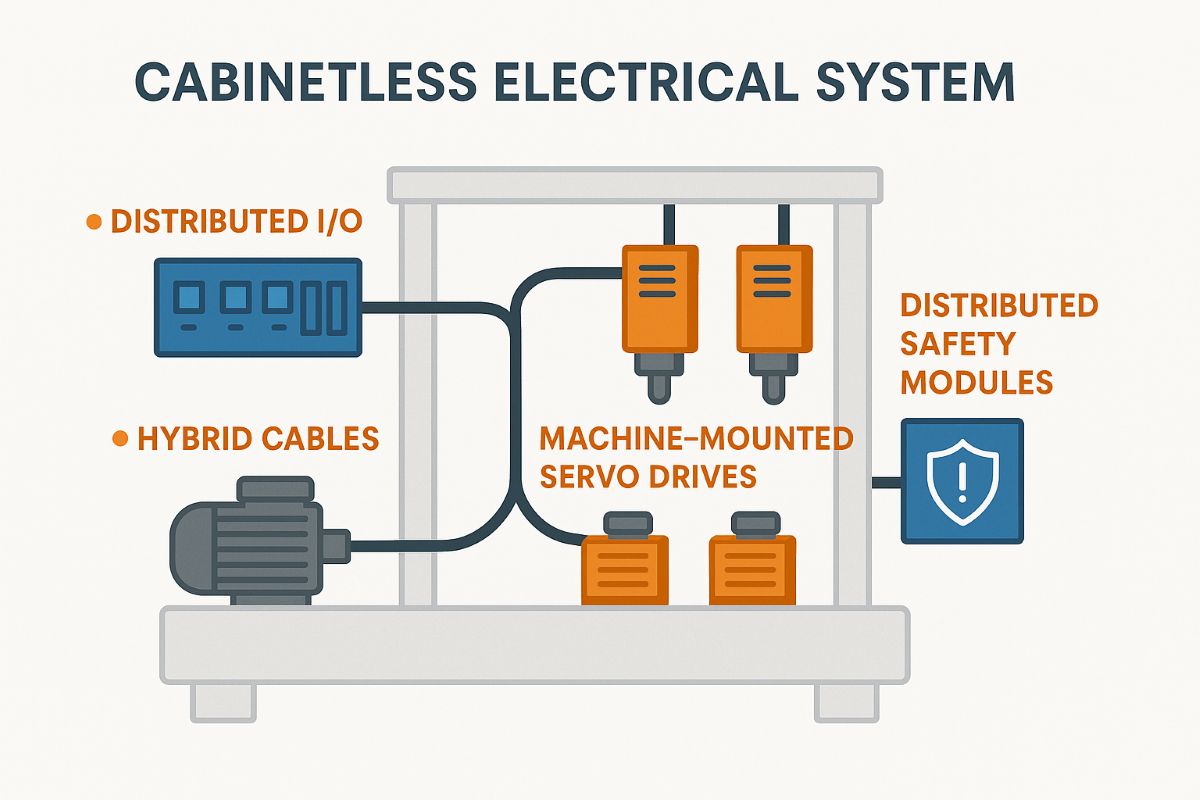
A cabinetless electrical system represents a fundamental shift in machine design. Instead of concentrating all electrical components in one cabinet, the system distributes them directly onto the machine using rugged, machine‑mounted modules.
🔹 Key idea:
Control, power, I/O, and safety move closer to the field devices—motors, sensors, actuators—eliminating the need for a large central cabinet.
🌐 What replaces the cabinet?
- 🧩 IP67 distributed I/O modules mounted near sensors
- ⚡ Machine‑mounted servo drives close to motors
- 🔌 Hybrid cables carrying power + communication
- 🛡️ Distributed safety modules
- 🚀 High‑speed industrial networks like EtherCAT
This architecture transforms machines into modular, scalable, and service‑friendly systems, perfectly aligned with Industry 4.0 and smart manufacturing.
🏭 Why OEMs Are Moving Toward Cabinetless Machines
Technical & Economic Drivers Behind the Shift
OEMs don’t adopt new architectures without strong reasons. Cabinetless systems deliver measurable benefits across engineering, production, and lifecycle costs.
🔧 1. Massive Wiring Reduction
Traditional machines require:
- Long cable runs from cabinet to field
- Cable trays, glands, conduits
- Extensive panel wiring and testing
Cabinetless systems reduce wiring by 60–80% because:
- I/O sits next to sensors
- Drives sit next to motors
- Daisy‑chain topologies replace star wiring
🟢 Result: Lower copper usage, faster builds, fewer wiring errors.
⏱️ 2. Faster Commissioning & Installation
With pre‑assembled, pre‑tested modules:
- Plug‑and‑play connections replace manual wiring
- Less on‑site debugging
- Faster startup and handover
⚡ Machines go from factory floor to production weeks faster.
🧱 3. Smaller Footprint & Compact Machines
Large cabinets:
- Consume valuable floor space
- Add weight and height
- Limit machine placement
Cabinetless designs:
- Shrink cabinets to small junction boxes—or eliminate them
- Enable mobile, skid‑based, or modular machines
- Improve machine aesthetics and ergonomics
📦 Ideal for packaging, intralogistics, and modular production lines.
🔄 4. True Modularity & Scalability
Modern production demands flexibility:
- Quick changeovers
- Plug‑and‑produce modules
- Easy expansion
Cabinetless machines behave like LEGO blocks:
- Each module has its own power, I/O, and drive
- New sections can be added without redesigning a cabinet
🌡️ 5. Better Thermal Management
Central cabinets trap heat from:
- Drives
- Power supplies
- Contactors
Distributed electronics:
- Spread heat across the machine
- Reduce cooling requirements
- Improve component life
🔥 Less heat concentration = higher reliability.
🧩 Inside a Cabinetless Architecture
How Power, I/O, Drives, and Safety Replace the Traditional Cabinet
A cabinetless system is not “electronics scattered everywhere.” It is a carefully engineered distributed architecture.
⚡ 1. Power Distribution
Instead of a central power bus:
- 🔌 IP67 power distribution blocks
- 🔗 Hybrid cables (24V + communication)
- 🔄 Daisy‑chain power routing
🟢 Benefits:
- Less copper
- Cleaner routing
- Faster installation
📡 2. Distributed I/O
Machine‑mounted I/O modules handle:
- 🔘 Digital inputs (sensors)
- 🔔 Digital outputs (valves, solenoids)
- 📈 Analog signals
- 🔗 IO‑Link masters for smart devices
Connected via EtherCAT, they deliver:
- Microsecond‑level synchronization
- Deterministic performance
- Real‑time diagnostics
⚙️ 3. Machine‑Mounted Drives
Modern IP67 servo drives:
- Mount directly on the machine frame
- Sit close to motors
- Eliminate long motor cables
- Reduce cabinet heat
🚀 Advantages:
- Faster response
- Cleaner wiring
- Easier maintenance
Perfect for packaging machines, robotics, conveyors, and AGVs.
🛡️ 4. Distributed Safety Architecture
Safety no longer requires bulky relay panels.
With Safety over EtherCAT (FSoE):
- 🛑 Safe Torque Off (STO)
- 🐢 Safe Limited Speed (SLS)
- 🔄 Safe Stop (SS1/SS2)
Safety logic runs over the same network—no hardwired safety chains across the machine.
🌐 5. Communication Backbone
EtherCAT is the backbone of cabinetless systems because it offers:
- ⚡ Ultra‑fast cycle times
- ⏱️ Deterministic behavior
- 🌳 Flexible topologies (line, tree, ring)
- 🔌 EtherCAT P (power + data in one cable)
This makes distributed automation high‑performance and future‑ready.
🚀 Where Cabinetless Systems Are Winning
Industries leading adoption include:
- 📦 Packaging machines
- 🚗 Automotive assembly lines
- 🍽️ Food & pharma (washdown environments)
- 📦 Intralogistics & conveyors
- 🤖 Robotics and cobots
OEMs report:
- ⏳ 20–40% faster build time
- 📉 30–50% smaller cabinets
- 🔌 60–80% wiring reduction
🔮 The Road Ahead
Cabinetless electrical systems are not a trend—they are a natural evolution toward:
- Modular production
- Digital twins
- Predictive maintenance
- Smart, connected machines
As IP67 components, EtherCAT P, and distributed safety mature, the traditional control cabinet will continue to shrink—and in many machines, disappear entirely.