
Motion in a Straight Line
Motion in a Straight Line
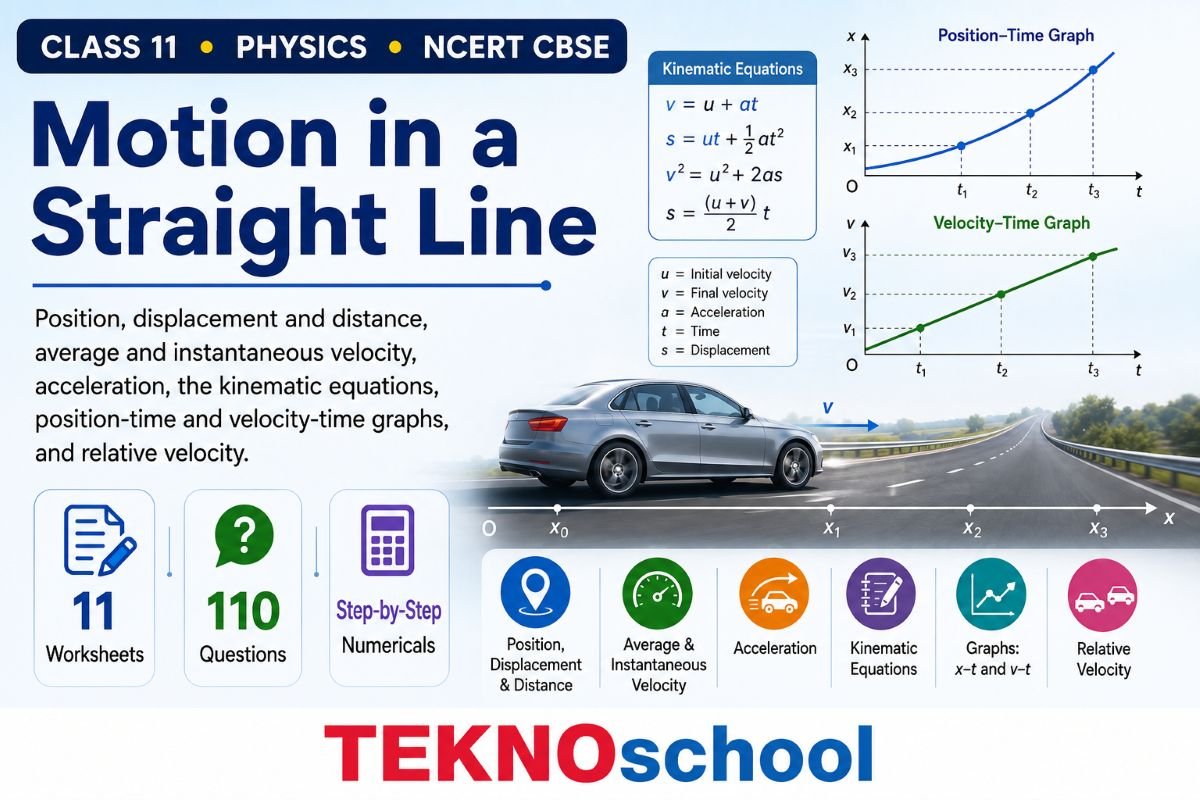
Motion in a Straight Line- Position, displacement and distance, average and instantaneous velocity, acceleration, the kinematic equations, position-time and velocity-time graphs, and relative velocity.
110 Questions
Step-by-Step Numericals
A car’s odometer and its position on a map tell two different stories. The odometer only ever climbs, tallying up every metre travelled, forward or backward, straight or winding. The map position is a single point, and comparing it to where the car started tells you nothing about the path taken to get there. Physics needs both kinds of description, and needs to keep them carefully apart.
This chapter restricts itself to motion along a single straight line — the simplest case — precisely so that the core ideas of kinematics can be built without the complication of direction changing in two dimensions. Everything here returns in the next chapter, extended to a plane, so the definitions are worth getting exactly right the first time.
What You Will Learn
- Position, path length and displacement
- Average velocity, average speed, and the difference between them
- Instantaneous velocity and instantaneous speed
- Average and instantaneous acceleration
- The kinematic equations of uniformly accelerated motion
- Interpreting position-time and velocity-time graphs
- Relative velocity in one dimension
1. Position, Path Length and Displacement
To describe motion we first fix an origin and a positive direction along the line, together forming a frame of reference. The position of an object is its location with respect to this origin.
| Term | Meaning |
|---|---|
| Path length | The total length of the actual path travelled between two points; always positive, a scalar |
| Displacement | The change in position, Δx = x2 − x1; can be positive, negative or zero, a vector |
Path length is never less than the magnitude of displacement. The two are equal only for motion in a fixed direction without reversal. If an object goes 10 m forward and then 4 m back, its path length is 14 m, but its displacement is only 6 m. If it returns exactly to its starting point, the displacement is zero even though the path length is not.
2. Average Velocity and Average Speed
Average velocity = Δx / Δt — displacement over time interval
Average speed = total path length / Δt
Average speed is never less than the magnitude of average velocity. The two are equal only when the motion is entirely in one direction without reversal. If a body returns to its starting point after any journey, the average velocity for that trip is zero, while the average speed is a positive number equal to the total path length divided by the total time.
3. Instantaneous Velocity and Speed
Instantaneous velocity is the velocity at a particular instant of time, defined as the limit of the average velocity as the time interval Δt approaches zero.
v = limΔt→0 Δx/Δt = dx/dt
Geometrically, it is the slope of the tangent to the position-time graph at that instant. Instantaneous speed is simply the magnitude of the instantaneous velocity.
4. Acceleration
Average acceleration = Δv / Δt
Instantaneous acceleration a = limΔt→0 Δv/Δt = dv/dt
Sign convention matters here. Acceleration is positive if velocity increases in the positive direction, and negative if velocity decreases in the positive direction, called retardation or deceleration when it opposes the motion. A body can have zero velocity and still have non-zero acceleration — a ball thrown straight up is momentarily at rest at its highest point, but gravity continues to act on it throughout.
5. Kinematic Equations for Uniform Acceleration
For motion with constant acceleration, three equations connect velocity, displacement, acceleration and time.
v = u + at
s = ut + ½at2
v2 = u2 + 2as
u = initial velocity, v = final velocity, a = constant acceleration, s = displacement, t = time
A Fourth Useful Relation
The distance covered in the nth second of motion is given by:
sn = u + a(2n − 1)/2
This is especially useful for problems asking for the distance covered specifically during, say, the fifth second, rather than the total distance up to that time.
6. Graphs of Motion
| Graph | Slope Gives | Area Under Gives |
|---|---|---|
| Position – time | Velocity | — (not meaningful) |
| Velocity – time | Acceleration | Displacement |
Reading a position-time graph: a straight line means uniform velocity; a horizontal line means the object is at rest; a curve bending upward (increasing slope) means increasing speed; a curve bending downward (decreasing slope) means decreasing speed. The slope can never be vertical for a physically realisable motion, since that would mean infinite velocity.
Reading a velocity-time graph: a straight horizontal line means zero acceleration, uniform velocity; a straight line with positive slope means uniform positive acceleration; the area between the graph and the time axis, counted positive above the axis and negative below, gives the net displacement over that interval.
7. Relative Velocity
The relative velocity of an object A with respect to another object B is the rate at which the position of A changes with respect to B.
vAB = vA − vB
Similarly, vBA = vB − vA = −vAB.
Sign matters throughout: in one dimension, choose a positive direction once and stick to it for every velocity in the problem. If two objects move in the same direction, their relative velocity is the difference of their speeds; if they move in opposite directions, it is the sum of their speeds, because the velocities themselves carry opposite signs and subtracting a negative adds it.
Worksheet Bank
Eleven worksheets • Ten questions in each • Answer given right below every question
Worksheet 1 — Multiple Choice Questions
1. Displacement is a
(a) scalar quantity (b) vector quantity (c) always positive quantity (d) dimensionless quantity
Answer: (b)
2. A body moving in a straight line covers 5 m forward and then 3 m back. Its displacement is
(a) 8 m (b) 2 m (c) 5 m (d) 3 m
Answer: (b) — net displacement is 5 − 3 = 2 m; the path length would be 8 m.
3. The slope of a position-time graph gives
(a) acceleration (b) velocity (c) displacement (d) speed only
Answer: (b)
4. The area under a velocity-time graph gives
(a) acceleration (b) velocity (c) displacement (d) jerk
Answer: (c)
5. A ball thrown vertically up has, at its highest point,
(a) zero velocity and zero acceleration (b) zero velocity and non-zero acceleration (c) non-zero velocity and zero acceleration (d) non-zero velocity and non-zero acceleration
Answer: (b) — gravity continues to act even though velocity is momentarily zero.
6. If a body returns to its starting point after a journey, its average velocity for the trip is
(a) equal to the average speed (b) zero (c) negative (d) undefined
Answer: (b)
7. Which of the following can never be negative?
(a) displacement (b) velocity (c) acceleration (d) path length
Answer: (d)
8. Two bodies move towards each other with speeds 5 m/s and 3 m/s. Their relative velocity has magnitude
(a) 2 m/s (b) 8 m/s (c) 15 m/s (d) 4 m/s
Answer: (b) — opposite directions mean the speeds add.
9. A straight, horizontal line on a velocity-time graph represents
(a) rest (b) uniform velocity (c) uniform acceleration (d) uniform retardation
Answer: (b) — a constant non-zero value, meaning zero acceleration.
10. The instantaneous velocity is defined as
(a) Δx/Δt for a finite Δt (b) the limit of Δx/Δt as Δt → 0 (c) total path length / total time (d) always equal to average velocity
Answer: (b)
Worksheet 2 — Fill in the Blanks
1. Path length is a ____________ quantity, while displacement is a ____________ quantity.
Answer: scalar; vector
2. Average velocity = displacement / ____________.
Answer: time interval
3. Instantaneous velocity is the ____________ of the position-time graph at a point.
Answer: slope of the tangent
4. Deceleration is also called ____________.
Answer: retardation
5. The kinematic equation connecting v, u, a and t is v = ____________.
Answer: u + at
6. The equation v2 = u2 + 2as does not involve the variable ____________.
Answer: time, t
7. The relative velocity of A with respect to B is given by vAB = ____________.
Answer: vA − vB
8. On a velocity-time graph, the slope represents ____________.
Answer: acceleration
9. Average speed is total path length divided by ____________.
Answer: total time taken
10. The distance covered in the nth second is given by sn = u + a(____________)/2.
Answer: 2n − 1
Worksheet 3 — True or False
1. Path length can be less than the magnitude of displacement.
Answer: False — path length is always greater than or equal to the magnitude of displacement.
2. A body can have zero velocity and non-zero acceleration at the same instant.
Answer: True — as at the highest point of vertical projectile motion.
3. Average speed can never be less than the magnitude of average velocity.
Answer: True
4. The kinematic equations v = u + at, s = ut + ½at2 and v2 = u2 + 2as hold only for constant acceleration.
Answer: True
5. The area under a position-time graph gives displacement.
Answer: False — the area under a position-time graph has no standard physical meaning; it is the slope that gives velocity.
6. Retardation is simply a negative value of acceleration in the chosen direction.
Answer: True
7. If two bodies move in the same direction, their relative velocity is the sum of their individual speeds.
Answer: False — when moving in the same direction the relative velocity is the difference of their speeds; it is the sum only when they move in opposite directions.
8. A curved position-time graph indicates non-uniform velocity.
Answer: True — since the slope, and hence velocity, changes from point to point.
9. Displacement can be zero even if the distance travelled is not zero.
Answer: True
10. Instantaneous speed can be less than the magnitude of instantaneous velocity.
Answer: False — instantaneous speed is always exactly equal to the magnitude of instantaneous velocity.
Worksheet 4 — Match the Columns
| No. | Column A | No. | Column B | Answer |
|---|---|---|---|---|
| 1 | v = u + at | i | Slope of position-time graph | 1 → v |
| 2 | v2 = u2 + 2as | ii | Displacement in nth second | 2 → vi |
| 3 | Velocity | iii | Slope of velocity-time graph | 3 → i |
| 4 | Acceleration | iv | Area under velocity-time graph | 4 → iii |
| 5 | Displacement | v | No time term, kinematic equation | 5 → iv |
| 6 | sn = u + a(2n−1)/2 | vi | Time-dependent, first equation of motion | 6 → ii |
| 7 | Path length | vii | Zero velocity, non-zero acceleration | 7 → ix |
| 8 | Same direction motion | viii | Relative velocity is sum of speeds | 8 → x |
| 9 | Opposite direction motion | ix | Scalar quantity | 9 → viii |
| 10 | Highest point of vertical throw | x | Relative velocity is difference of speeds | 10 → vii |
Cover the last column while attempting, then check.
Worksheet 5 — Assertion and Reason
Choose the correct option in each case:
(a) Both A and R are true, and R is the correct explanation of A
(b) Both A and R are true, but R is not the correct explanation of A
(c) A is true but R is false
(d) A is false but R is true
1. A: The average speed of an object can be greater than the magnitude of its average velocity. R: Average speed is based on total path length, which can exceed the magnitude of net displacement.
Answer: (a)
2. A: A body with zero acceleration cannot have a changing velocity. R: Acceleration is defined as the rate of change of velocity.
Answer: (a)
3. A: The three kinematic equations of motion can be applied to any motion in a straight line. R: They are valid for motion with uniform acceleration.
Answer: (d) — the reason is true, but the assertion is false; the equations fail for non-uniform acceleration.
4. A: The area under a velocity-time graph below the time axis represents negative displacement. R: A negative area indicates the object was moving in the negative direction during that interval.
Answer: (a)
5. A: A ball dropped from a height has increasing speed but constant velocity. R: Velocity and speed are always numerically equal in magnitude.
Answer: Both statements are false — a falling ball has increasing speed and increasing velocity, not constant velocity, since it is accelerating under gravity.
6. A: Two cars moving in the same direction at the same speed have zero relative velocity. R: Relative velocity is the difference between the two individual velocities.
Answer: (a)
7. A: A position-time graph can be a vertical straight line for a physically realisable motion. R: A vertical line would mean the object covers a finite distance in zero time, requiring infinite velocity.
Answer: (d) — the reason is true and is exactly why the assertion is false; such a graph is not physically possible.
8. A: Retardation is always shown as a negative number in calculations. R: Retardation means acceleration acting opposite to the direction of velocity.
Answer: (b) — both true, but whether it appears negative depends on the chosen positive direction; the reason describes the concept, not the sign convention used in calculation.
9. A: Distance covered in the 5th second is the same as the distance covered in 5 seconds. R: The nth second formula gives the distance covered during that particular one-second interval, not the total distance up to that time.
Answer: (d) — the reason is true, and it directly contradicts the false assertion; the two quantities are generally different.
10. A: In relative velocity problems, choosing a consistent positive direction is essential. R: Velocities in opposite directions carry opposite signs, and mixing sign conventions gives an incorrect relative velocity.
Answer: (a)
Worksheet 6 — Very Short Answer Questions (1 Mark)
1. Define displacement.
Answer: The change in position of an object, Δx = x2 − x1.
2. Write the SI unit of acceleration.
Answer: Metre per second squared, m/s2.
3. What does the slope of a velocity-time graph represent?
Answer: Acceleration.
4. Can displacement be zero when distance travelled is not zero? Give an example.
Answer: Yes, as when a body moves around a circular track and returns to its starting point.
5. Write the third kinematic equation of motion.
Answer: v2 = u2 + 2as
6. Define instantaneous speed.
Answer: The magnitude of the instantaneous velocity at a given instant.
7. What quantity does the area under a velocity-time graph give?
Answer: Displacement.
8. Write the formula for relative velocity of A with respect to B.
Answer: vAB = vA − vB
9. Is it possible for a body to have varying speed but constant velocity?
Answer: No, since a constant velocity fixes both the magnitude and direction, and the magnitude of velocity is exactly the speed.
10. Write the nth second distance formula.
Answer: sn = u + a(2n − 1)/2
Worksheet 7 — Short Answer Questions (2–3 Marks)
1. Distinguish between path length and displacement, with an example.
Answer: Path length is the total length of the actual path travelled and is always positive, while displacement is the straight-line change in position from start to finish and can be positive, negative or zero. If a person walks 8 m east and then 3 m west, the path length is 11 m, but the displacement is only 5 m east.
2. Explain why average speed can never be less than the magnitude of average velocity.
Answer: Average speed uses the total path length in the numerator, while average velocity uses the magnitude of the net displacement, and path length is always greater than or equal to the magnitude of displacement for the same interval. Since both are divided by the same time interval, average speed must be greater than or equal to the magnitude of average velocity, with equality only when the motion never reverses direction.
3. A ball is thrown vertically upward. Describe its velocity and acceleration throughout the motion.
Answer: On the way up, the velocity is positive but continuously decreasing due to gravity acting downward. At the highest point, the velocity becomes momentarily zero, though the acceleration due to gravity continues to act, unchanged in magnitude and direction. On the way down, the velocity becomes increasingly negative as the object speeds up, while the acceleration remains constant throughout, equal to g directed downward.
4. How can you determine acceleration from a velocity-time graph? Describe the three basic shapes and what each means.
Answer: The slope of a velocity-time graph gives the acceleration at that instant. A horizontal line has zero slope and represents zero acceleration, meaning uniform velocity. A straight line with positive slope represents uniform positive acceleration, with velocity increasing steadily. A straight line with negative slope represents uniform retardation, with velocity decreasing steadily, possibly becoming negative if the motion reverses.
5. Explain relative velocity with an example each for motion in the same direction and in opposite directions.
Answer: Relative velocity of A with respect to B is vAB = vA − vB. If two trains travel in the same direction at 60 km/h and 40 km/h, the relative velocity of the faster train with respect to the slower one is 60 − 40 = 20 km/h. If instead they approach each other, one at +60 km/h and the other at −40 km/h, the relative velocity is 60 − (−40) = 100 km/h, the sum of their speeds.
6. Why is instantaneous velocity defined as a limit rather than simply as Δx/Δt for some small Δt?
Answer: For any finite Δt, the ratio Δx/Δt only gives the average velocity over that interval, which can mask variations happening within it. Only by taking the limit as Δt approaches zero do we isolate the velocity at that exact instant, free from any averaging over a stretch of time. This limiting process is precisely what defines a derivative in calculus, dx/dt.
7. Derive the second kinematic equation, s = ut + ½at2, from a velocity-time graph.
Answer: On a velocity-time graph for uniform acceleration, the line rises from u at t = 0 to v = u + at at time t. The displacement equals the area under this line, which is a trapezium: the rectangular part contributes ut, and the triangular part above it, with base t and height (v − u) = at, contributes ½t(at) = ½at2. Adding these gives s = ut + ½at2.
8. A car accelerates uniformly from rest. Is the distance covered in the second second equal to twice the distance covered in the first second? Explain.
Answer: No. Using sn = u + a(2n − 1)/2 with u = 0, the first second gives s1 = a/2, and the second second gives s2 = 3a/2, which is three times s1, not twice. Successive one-second intervals for a body starting from rest cover distances in the ratio 1 : 3 : 5 : 7, the odd numbers, not a simple doubling.
9. Explain why the frame of reference must be specified before describing the position or velocity of an object.
Answer: Position is meaningful only relative to some chosen origin, and velocity depends on which observer is doing the measuring. A person walking down the aisle of a moving train has one velocity relative to the train and quite a different velocity relative to the ground, so any statement of position or velocity is incomplete, and potentially misleading, unless the frame of reference is made explicit.
10. Two cars A and B move along the same straight road, A at 20 m/s and B at 15 m/s, both in the same direction. Find their relative velocity and explain what it represents physically.
Answer: vAB = vA − vB = 20 − 15 = 5 m/s. This means that to an observer sitting inside car B, car A appears to be pulling steadily ahead at 5 m/s, even though to someone standing on the roadside both cars appear to be moving quite fast in the same direction.
Worksheet 8 — Long Answer Questions (5 Marks)
1. Define path length and displacement. Explain, with examples, the conditions under which they are equal and under which they differ.
Answer: Path length is the total length of the actual path traced by an object between two points, and it is always a positive scalar quantity, since it simply accumulates whatever distance is covered regardless of direction. Displacement is the vector difference between the final and initial positions, Δx = x2 − x1, and can be positive, negative, or zero depending on the net change in position. When an object moves in a single fixed direction without ever reversing, every bit of the path length contributes directly to the displacement, so the two become numerically equal. As soon as the object reverses direction even partially, the path length continues to accumulate while the displacement reflects only the net effect, so the path length always ends up greater than or equal to the magnitude of the displacement, and can be very much larger if the object doubles back on itself repeatedly, as when it returns exactly to its starting point and the displacement falls to zero.
2. Distinguish between average velocity, instantaneous velocity, average speed and instantaneous speed, with definitions and formulae.
Answer: Average velocity is the total displacement divided by the total time taken, Δx/Δt, and being based on displacement it is a vector that can be zero even after considerable motion. Average speed is the total path length divided by the total time taken, and being based on path length it is always a non-negative scalar, generally at least as large as the magnitude of the average velocity. Instantaneous velocity is the limit of the average velocity as the time interval shrinks to zero, v = dx/dt, giving the velocity at one particular instant and corresponding geometrically to the slope of the tangent to the position-time graph at that point. Instantaneous speed is simply the magnitude of the instantaneous velocity at that same instant, and unlike the average quantities, instantaneous speed and the magnitude of instantaneous velocity are always exactly equal, since at a single instant there is no room for a path to differ from the straight-line displacement.
3. Derive the three equations of motion for uniformly accelerated motion using the velocity-time graph method.
Answer: Consider an object with initial velocity u at t = 0, moving with constant acceleration a, so its velocity at time t is v. On a velocity-time graph this is a straight line of slope a, and since slope equals (v − u)/t, we get a = (v − u)/t, rearranged to v = u + at, the first equation. The displacement equals the area under this line up to time t, which is a trapezium with parallel sides u and v and width t, giving area = ½(u + v)t; substituting v = u + at gives s = ½(u + u + at)t = ut + ½at2, the second equation. To eliminate time, take the same trapezium area formula s = ½(u + v)t, and from the first equation t = (v − u)/a; substituting gives s = ½(u + v)(v−u)/a = (v2 − u2)/2a, rearranged to v2 = u2 + 2as, the third equation.
4. Explain how to interpret position-time and velocity-time graphs, describing what different shapes of each graph represent physically.
Answer: On a position-time graph, a horizontal line means the object is at rest, since its position is not changing; a straight sloped line means uniform velocity, with the slope giving that constant velocity; and a curve means non-uniform velocity, where a curve bending upward with increasing slope shows the velocity growing over time, and one flattening out shows the velocity decreasing. On a velocity-time graph, a horizontal line means zero acceleration and constant velocity; a straight line with constant positive slope means uniform acceleration; and the area between the graph and the time axis, taken as positive above the axis and negative below, gives the net displacement over that interval, with the total unsigned area giving the total path length instead.
5. Explain the concept of relative velocity in one dimension, deriving the formula and discussing the special cases of motion in the same and in opposite directions.
Answer: If object A has position xA(t) and object B has position xB(t), the position of A relative to B is xAB = xA − xB. Differentiating with respect to time gives the relative velocity, vAB = vA − vB, the rate at which A’s position appears to change as seen from B. When both objects move in the same direction, their velocities carry the same sign, so the relative velocity is the arithmetic difference of their speeds and is smaller in magnitude than either individual speed, meaning each object appears to move only slowly relative to the other. When the two objects move in opposite directions, one velocity is positive and the other negative, so subtracting them effectively adds their magnitudes, giving a relative velocity equal to the sum of their speeds; this is why two vehicles approaching each other appear, from either driver’s perspective, to be closing the gap far more quickly than either is actually travelling.
Worksheet 9 — Numericals with Step-by-Step Solutions
1. A runner covers 400 m along a circular track and ends up back at the starting point. Find the distance travelled and the displacement.
Answer:
Distance travelled = 400 m (the full path length)
Since the runner returns to the exact starting point, displacement = 0 m
2. A car travels 60 km in 1.5 hours. Find its average speed.
Answer:
Average speed = total path length / total time = 60/1.5
= 40 km/h
3. A body starts from rest and accelerates uniformly at 2 m/s2. Find its velocity after 5 s.
Answer:
u = 0, a = 2 m/s2, t = 5 s
v = u + at = 0 + 2(5)
v = 10 m/s
4. A car moving at 20 m/s is brought to rest by uniform braking in 4 s. Find the retardation and the distance travelled before stopping.
Answer:
u = 20 m/s, v = 0, t = 4 s
v = u + at → 0 = 20 + a(4) → a = −5 m/s2, so retardation = 5 m/s2
s = ut + ½at2 = 20(4) + ½(−5)(16) = 80 − 40
s = 40 m
5. A stone is thrown vertically upward with a speed of 30 m/s. Taking g = 10 m/s2, find the maximum height reached.
Answer:
u = 30 m/s, v = 0 at the highest point, a = −10 m/s2
v2 = u2 + 2as → 0 = (30)2 + 2(−10)s
0 = 900 − 20s → s = 900/20
s = 45 m
6. For the stone in question 5, find the total time taken to reach the highest point.
Answer:
v = u + at → 0 = 30 + (−10)t
t = 30/10
t = 3 s
7. A body moving with an initial velocity of 5 m/s accelerates at 3 m/s2. Find the distance covered in the 4th second.
Answer:
u = 5 m/s, a = 3 m/s2, n = 4
sn = u + a(2n−1)/2 = 5 + 3(2×4−1)/2 = 5 + 3(7)/2 = 5 + 10.5
s4 = 15.5 m
8. Two trains, A and B, move on parallel tracks in the same direction with speeds 72 km/h and 54 km/h. Find their relative velocity in m/s.
Answer:
Convert to m/s: 72 km/h = 20 m/s, 54 km/h = 15 m/s
Same direction: vAB = vA − vB = 20 − 15
vAB = 5 m/s
9. Two cars approach each other on a straight road with speeds 15 m/s and 10 m/s. Find their relative velocity, and the time they take to meet if they are initially 500 m apart.
Answer:
Taking one direction as positive: vA = +15 m/s, vB = −10 m/s
Relative velocity = vA − vB = 15 − (−10) = 25 m/s
Time to meet = separation / relative velocity = 500/25
t = 20 s
10. A particle moves with velocity given by v = 4t − 3 (in m/s, t in seconds). Find its acceleration and its displacement between t = 0 and t = 2 s.
Answer:
a = dv/dt = d(4t−3)/dt = 4 m/s2 (constant)
Displacement s = ∫v dt from 0 to 2 = ∫(4t−3)dt = [2t2 − 3t] from 0 to 2
= (2(4) − 3(2)) − 0 = 8 − 6
s = 2 m
Worksheet 10 — Case Based Questions
Case I: A cyclist starts from her home and rides 6 km east to a market, then turns around and rides 2 km west to a friend’s house, all in a total time of 40 minutes. She then rests for 10 minutes before riding straight back home, a distance of 4 km, taking 15 minutes.
1. Find the total path length for the entire trip, from leaving home to returning home.
Answer: 6 km + 2 km + 4 km = 12 km.
2. Find her net displacement for the entire trip.
Answer: Since she ends up back at home, the displacement for the whole trip is zero.
3. Find her displacement from home at the moment she reaches her friend’s house.
Answer: 6 km east minus 2 km west = 4 km east of home.
4. Calculate her average speed for the first 40 minutes, in km/h.
Answer: Path length in that time = 6 + 2 = 8 km, time = 40 min = 2/3 h. Average speed = 8/(2/3) = 12 km/h.
5. Calculate her average velocity for the first 40 minutes, in km/h, and explain why it differs from the average speed.
Answer: Displacement in that time = 4 km east, time = 2/3 h. Average velocity = 4/(2/3) = 6 km/h east. It is lower than the average speed of 12 km/h because she reversed direction partway, so the path length exceeds the net displacement while the time is the same for both calculations.
Case II: A physics teacher records the velocity of a toy car released on a straight track at one-second intervals: at t = 0, v = 2 m/s; at t = 1 s, v = 5 m/s; at t = 2 s, v = 8 m/s; at t = 3 s, v = 11 m/s. The class is asked to analyse this data before the teacher reveals it comes from a motor providing constant acceleration.
6. Find the acceleration of the car between each pair of consecutive readings and confirm it is constant.
Answer: Between each second, velocity increases by 3 m/s, so acceleration = Δv/Δt = 3/1 = 3 m/s2 in every interval, confirming constant acceleration.
7. Using u = 2 m/s and a = 3 m/s2, verify the velocity at t = 3 s using the first kinematic equation.
Answer: v = u + at = 2 + 3(3) = 2 + 9 = 11 m/s, matching the recorded value exactly.
8. Find the total displacement of the car from t = 0 to t = 3 s.
Answer: s = ut + ½at2 = 2(3) + ½(3)(9) = 6 + 13.5 = 19.5 m.
9. Find the distance covered specifically during the 3rd second, that is between t = 2 s and t = 3 s.
Answer: s3 = u + a(2n−1)/2 = 2 + 3(5)/2 = 2 + 7.5 = 9.5 m.
10. On a velocity-time graph of this data, what shape would the graph take, and what does its slope represent?
Answer: A straight line rising from (0, 2) with a constant positive gradient, since acceleration is constant. Its slope represents the acceleration of the car, here 3 m/s2, and the area under the line up to any time gives the displacement up to that time.
Worksheet 11 — Higher Order Thinking Skills
1. Can a body have zero average velocity over an interval but a non-zero instantaneous velocity at every point within that interval? Explain with an example.
Answer: Yes. Consider a ball thrown straight up and caught again at the same height: its average velocity over the whole flight is zero, since the net displacement is zero, yet at every instant during the flight except the single turning point, its instantaneous velocity is non-zero, being positive on the way up and negative on the way down. Average velocity depends only on the endpoints of the interval, so it can vanish even while the object is in vigorous motion throughout.
2. A student claims that if acceleration is zero at an instant, velocity must also be zero at that instant. Evaluate this claim.
Answer: The claim is false. Acceleration measures the rate of change of velocity, not velocity itself, so zero acceleration only means velocity is momentarily not changing, which is entirely consistent with that velocity being any constant, non-zero value. A car cruising on a highway at a constant 100 km/h has zero acceleration and a very large velocity at the same time; the two quantities are independent at any given instant.
3. Explain, without using calculus, why the area under a velocity-time graph gives displacement.
Answer: Imagine slicing the time axis into many extremely narrow strips. Over each strip the velocity is nearly constant, so the small displacement during that strip is approximately velocity multiplied by that tiny time interval, which is exactly the area of that thin rectangular strip under the graph. Adding up the areas of all the strips adds up all the small displacements, giving the total displacement over the whole interval, and this reasoning holds regardless of whether the velocity is constant or varies in a complicated way.
4. Two objects are dropped from the same height at different times. Does the relative velocity between them change as they fall? Justify your answer.
Answer: No, the relative velocity stays constant throughout the fall. Both objects experience exactly the same acceleration g, so at any instant their velocities differ only by whatever gap existed when the second one was dropped; since both velocities increase at the identical rate, the difference between them, vAB = vA − vB, never changes. This is a general feature: two bodies undergoing the same constant acceleration always maintain a fixed relative velocity, even though each is individually speeding up.
5. A position-time graph shows a smooth curve that becomes momentarily horizontal at one point, then continues rising. What is happening to the object’s velocity at that instant, and can you say anything about its acceleration there?
Answer: A momentarily horizontal tangent means the slope, and hence the velocity, is instantaneously zero at that point, even though the object is not permanently at rest since the curve continues rising afterward. This is analogous to the turning point of a ball thrown upward, and it indicates the object briefly reversed or paused its motion in the positive direction. Since the velocity is changing from decreasing to increasing around that point, the acceleration there is non-zero, and in fact it must be positive just after the pause for the velocity to grow again.
6. Explain why the kinematic equations v = u + at and s = ut + ½at2 cannot be applied to a car accelerating from a red light where the driver presses the accelerator progressively harder over time.
Answer: These equations are derived strictly for the case of constant acceleration, and their derivation assumes the velocity-time graph is a straight line throughout the motion. If the driver presses the accelerator progressively harder, the acceleration itself is increasing with time rather than staying fixed, making the velocity-time graph a curve rather than a straight line, so the trapezium-area argument used to derive these equations no longer applies, and using them would give an incorrect result.
7. A ball is dropped from a tower and, at the same instant, a second ball is thrown downward from the same height with some initial speed. Which ball hits the ground first, and how does their relative velocity behave during the fall?
Answer: The thrown ball hits the ground first, since it starts with a head start in downward velocity while both experience the same downward acceleration g throughout the fall. Their relative velocity is constant during the fall and equal to the thrown ball’s initial speed, since both velocities increase at the same rate under gravity and their difference never changes; only their positions, not their relative speed, evolve differently as time passes.
8. Sketch, in words, the position-time graph of a ball bouncing elastically up and down repeatedly on the floor, and describe what happens to the corresponding velocity-time graph at each bounce.
Answer: The position-time graph would show a series of smooth, downward-curving arcs, each starting at zero height, rising to a peak, and falling back to zero, repeating for every bounce, with each successive arc slightly lower if energy is lost. On the velocity-time graph, each arc corresponds to a straight line with constant negative slope, since gravity gives constant downward acceleration throughout each flight, but at the exact instant of each bounce, the velocity reverses abruptly from a large negative value to a large positive one, creating a near-vertical jump in the graph and, in the idealised elastic case, an instant of very large, undefined acceleration at that single moment.
9. Explain why the distance-time graph for a car undergoing constant retardation to a stop is a curve that becomes progressively flatter, rather than a straight line.
Answer: The slope of a position-time graph at any point equals the velocity at that instant, and under constant retardation the velocity is steadily decreasing from its initial value down to zero. A graph whose slope keeps decreasing must curve, becoming progressively flatter as the car slows, until the slope reaches exactly zero at the moment the car stops, after which the graph becomes horizontal since the car’s position no longer changes.
10. A river flows at 3 m/s and a swimmer can swim at 5 m/s in still water. Using the idea of relative velocity, explain how the swimmer should aim to cross the river most quickly, versus how she should aim to land directly opposite her starting point.
Answer: To cross in the shortest possible time, the swimmer should aim straight across, perpendicular to the bank, since any component of her effort directed upstream or downstream only reduces the effective speed carrying her across, even though the current will then carry her downstream from directly opposite her start. To land exactly opposite her starting point instead, she must angle herself partly upstream so that the upstream component of her velocity exactly cancels the river’s downstream flow of 3 m/s, leaving only the remaining component to carry her across; this takes longer than the straight-across strategy, since part of her 5 m/s effort is now spent purely cancelling the current rather than making progress across the river.
Quick Revision
Everything worth carrying into the exam hall, in one place.
All the Formulae
Average velocity = Δx/Δt Average speed = path length/Δt
v = dx/dt a = dv/dt
v = u + at
s = ut + ½at2
v2 = u2 + 2as
sn = u + a(2n−1)/2
vAB = vA − vB
Reading Graphs at a Glance
| Graph Shape | On Position-Time | On Velocity-Time |
|---|---|---|
| Horizontal line | Object at rest | Zero acceleration, uniform velocity |
| Straight sloped line | Uniform velocity | Uniform acceleration |
| Curve, steepening | Increasing velocity | Increasing acceleration |
| Curve, flattening | Decreasing velocity | Decreasing acceleration |
The Three Great Contrasts
Path length ≥ |Displacement| — equal only without reversal
Average speed ≥ |Average velocity| — equal only without reversal
Instantaneous speed = |Instantaneous velocity| — always exactly equal, no exception
Same direction → relative velocity is the difference of speeds
Opposite directions → relative velocity is the sum of speeds
Ten Points Students Lose Marks On
- The kinematic equations hold only for constant acceleration — say so explicitly when using them.
- Distance covered in the nth second is not the same as total distance in n seconds — use the sn formula for the former.
- Zero velocity does not mean zero acceleration — the top of a vertical throw is the classic example.
- Fix one positive direction at the start of a relative velocity problem and never switch it mid-solution.
- The area under a velocity-time graph gives displacement; the slope of a position-time graph gives velocity. Do not swap these.
- Below the time axis on a v-t graph, area counts as negative displacement, not zero.
- Displacement can be negative or zero; path length and speed can never be negative.
- Same-direction motion subtracts speeds for relative velocity; opposite-direction motion adds them.
- Always convert km/h to m/s (divide by 3.6) before mixing with SI-based formulae.
- State the formula first, substitute with correct signs, then compute — sign errors are the single biggest cause of lost marks in this chapter.