
Units and Measurements
Units and Measurements
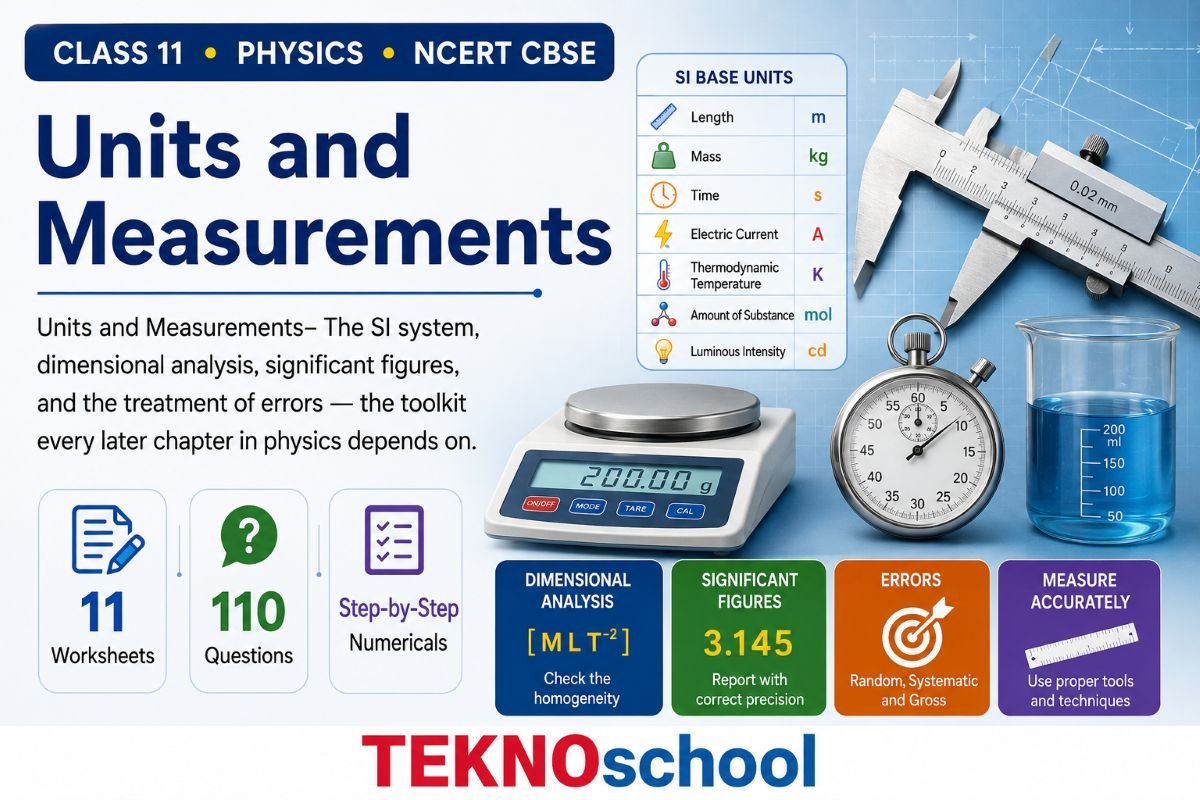
Units and Measurements- The SI system, dimensional analysis, significant figures, and the treatment of errors — the toolkit every later chapter in physics depends on.
110 Questions
Step-by-Step Numericals
Say a bridge is “long.” That tells a builder almost nothing. Say it is “1.2 kilometres, measured to the nearest ten metres,” and suddenly there is something to work with — a number, a unit, and an honest statement of how much that number can be trusted.
This chapter is about making physics that precise. Every quantity from here on will be a number attached to a unit, built from a small set of base units, checked for consistency by its dimensions, and reported with only as many digits as the measurement actually earns. None of it is difficult on its own; the challenge is applying all of it together, carefully, every single time.
What You Will Learn
- Fundamental and derived units, and the seven SI base units
- Dimensions and dimensional formulae of physical quantities
- The principle of homogeneity and dimensional analysis
- Uses and limitations of dimensional analysis
- Significant figures and the rules for rounding
- Types of error and their mathematical treatment
- Combination of errors in sums, products and powers
1. Units and the SI System
Measurement is the comparison of a physical quantity with a fixed, standard quantity of the same kind called a unit. A measurement is meaningless without stating both the numerical value and the unit.
Fundamental, or base, units are units that are independent of one another and cannot be derived from any other unit.
Derived units are units obtained by combining the base units according to the definition of the quantity, such as the unit of speed, metre per second.
The internationally accepted system of units is the SI system, Système International d’Unités, which has seven base units.
| Quantity | SI Unit | Symbol |
|---|---|---|
| Length | metre | m |
| Mass | kilogram | kg |
| Time | second | s |
| Electric current | ampere | A |
| Temperature | kelvin | K |
| Amount of substance | mole | mol |
| Luminous intensity | candela | cd |
Two supplementary units are also used: the radian, rad, for plane angle, and the steradian, sr, for solid angle. Every other unit in physics, such as those for force, energy or pressure, is derived from these base units by combination.
2. Dimensions and Dimensional Formulae
The dimensions of a physical quantity are the powers to which the base quantities must be raised to represent it. The dimensions of mass, length and time are written as [M], [L] and [T].
The dimensional formula is the expression showing how, and to what powers, the base quantities enter into a given quantity.
| Quantity | Formula | Dimensional Formula |
|---|---|---|
| Area | length × length | [M0L2T0] |
| Volume | length3 | [M0L3T0] |
| Speed / Velocity | length / time | [M0LT−1] |
| Acceleration | velocity / time | [M0LT−2] |
| Force | mass × acceleration | [MLT−2] |
| Work / Energy | force × distance | [ML2T−2] |
| Power | work / time | [ML2T−3] |
| Pressure | force / area | [ML−1T−2] |
| Density | mass / volume | [ML−3T0] |
| Momentum | mass × velocity | [MLT−1] |
Principle of Homogeneity of Dimensions
Only quantities with the same dimensions can be added to or subtracted from one another, and the dimensions on the two sides of a valid physical equation must be identical. This single principle underlies every use of dimensional analysis.
Uses of Dimensional Analysis
1. To check the dimensional consistency of a given equation.
2. To derive a relationship between physical quantities.
3. To convert units from one system to another.
Limitations of Dimensional Analysis
It cannot determine dimensionless constants such as 1/2 or π. It cannot be used for equations involving trigonometric, exponential or logarithmic functions. It cannot decide whether a quantity is a scalar or a vector, and it fails if a physical quantity depends on more than three unknown factors, since only three equations can be formed from M, L and T.
3. Significant Figures
The significant figures in a measured quantity are all the digits that are known reliably, plus the first digit that is uncertain. They indicate how precisely a quantity is known.
Rules for Counting Significant Figures
• All non-zero digits are significant.
• Zeros between two non-zero digits are significant. (2005 has 4 significant figures)
• Leading zeros, to the left of the first non-zero digit, are never significant. (0.0025 has 2 significant figures)
• Trailing zeros in a number with a decimal point are significant. (2.500 has 4 significant figures)
• Trailing zeros in a number without a decimal point are ambiguous unless expressed in scientific notation.
• In scientific notation, a × 10n, all digits in “a” are significant.
Rules for Arithmetic Operations
Addition or subtraction: the result should have as many decimal places as the term with the fewest decimal places.
Multiplication or division: the result should have as many significant figures as the term with the fewest significant figures.
4. Errors in Measurement
No measurement is ever perfectly exact. The difference between the true value and the measured value of a quantity is called an error.
| Type of Error | Description |
|---|---|
| Systematic errors | Errors that occur in one direction only, either positive or negative, arising from instrumental defects, imperfect technique, or personal bias. They can be minimised by improving technique and instruments. |
| Random errors | Errors that occur irregularly, sometimes positive and sometimes negative, due to unpredictable fluctuations in conditions. They are reduced by taking a large number of readings and averaging. |
| Gross errors | Large errors arising from carelessness of the observer, such as misreading an instrument or recording the wrong value. |
Absolute, Relative and Percentage Error
Absolute error, Δai = |amean − ai|, the magnitude of the difference between the mean value and each individual measurement
Mean absolute error, Δamean = the average of all the individual absolute errors
Relative error = Δamean / amean
Percentage error = (Δamean / amean) × 100%
Combination of Errors
Sum or difference, Z = A ± B: the absolute errors add — ΔZ = ΔA + ΔB
Product, Z = AB: the relative errors add — ΔZ/Z = ΔA/A + ΔB/B
Quotient, Z = A/B: the relative errors add — ΔZ/Z = ΔA/A + ΔB/B
Power, Z = An: the relative error is multiplied by the power — ΔZ/Z = n(ΔA/A)
Accuracy versus precision: accuracy is how close a measured value is to the true value, while precision is the resolution or limit to which a quantity is measured. A stopwatch reading 4.80 s is more precise than one reading 4.8 s, but neither is necessarily more accurate — that depends on how close it is to the actual time.
Worksheet Bank
Eleven worksheets • Ten questions in each • Answer given right below every question
Worksheet 1 — Multiple Choice Questions
1. The number of base units in the SI system is
(a) 5 (b) 6 (c) 7 (d) 9
Answer: (c)
2. The dimensional formula of force is
(a) [MLT−1] (b) [MLT−2] (c) [ML2T−2] (d) [ML−1T−2]
Answer: (b)
3. The number of significant figures in 0.00420 is
(a) 2 (b) 3 (c) 5 (d) 6
Answer: (b) — leading zeros are not significant, but the trailing zero after the decimal point is.
4. Which of the following cannot be determined using dimensional analysis?
(a) unit conversion (b) dimensionless constants (c) checking an equation (d) deriving a formula
Answer: (b)
5. Errors that occur irregularly and can be reduced by taking the mean of many readings are called
(a) systematic errors (b) gross errors (c) random errors (d) instrumental errors
Answer: (c)
6. The dimensional formula of pressure is
(a) [ML−1T−2] (b) [MLT−2] (c) [ML2T−2] (d) [ML−3T0]
Answer: (a)
7. If Z = A/B, the relative error in Z is
(a) ΔA/A − ΔB/B (b) ΔA/A + ΔB/B (c) ΔA + ΔB (d) (ΔA/A)(ΔB/B)
Answer: (b) — relative errors always add, whether multiplying or dividing.
8. Precision refers to
(a) closeness to the true value (b) the resolution of the measuring instrument (c) the number of trials (d) the type of error
Answer: (b) — closeness to the true value is accuracy.
9. The SI unit of luminous intensity is the
(a) mole (b) kelvin (c) candela (d) ampere
Answer: (c)
10. When adding 12.36 and 4.1, the result should be reported as
(a) 16.46 (b) 16.5 (c) 16.4 (d) 16
Answer: (b) — the answer must match the fewest decimal places, one, so 16.46 rounds to 16.5.
Worksheet 2 — Fill in the Blanks
1. The SI unit of mass is the ____________.
Answer: kilogram
2. The dimensional formula of energy is ____________.
Answer: [ML2T−2]
3. Only quantities with the same ____________ can be added or subtracted.
Answer: dimensions
4. Leading zeros in a measured number are ____________ significant.
Answer: never
5. Errors arising from carelessness of the observer are called ____________ errors.
Answer: gross
6. The absolute error is defined as Δai = ____________.
Answer: |amean − ai|
7. For Z = An, the relative error in Z is ____________ times the relative error in A.
Answer: n
8. The supplementary SI unit for plane angle is the ____________.
Answer: radian
9. In multiplication or division, the result should have as many significant figures as the term with the ____________ significant figures.
Answer: fewest
10. The dimensional formula of density is ____________.
Answer: [ML−3T0]
Worksheet 3 — True or False
1. Dimensional analysis can determine the numerical value of a dimensionless constant.
Answer: False — this is one of its major limitations.
2. Trailing zeros after a decimal point are significant.
Answer: True
3. Random errors can be completely eliminated with a sufficiently careful observer.
Answer: False — they arise from unpredictable fluctuations and can only be reduced by averaging, not eliminated.
4. A high-precision instrument always gives an accurate reading.
Answer: False — precision and accuracy are independent; a precise instrument can still be wrongly calibrated.
5. When two quantities are added, their absolute errors are added.
Answer: True — even for subtraction, the absolute errors add.
6. The dimensions of angle are [M0L0T0], that is, it is dimensionless.
Answer: True — angle is the ratio of two lengths, arc to radius, so its dimensions cancel.
7. Dimensional analysis can be used to check an equation involving sinθ.
Answer: False — it cannot handle trigonometric, exponential or logarithmic functions.
8. Systematic errors always occur in the same direction.
Answer: True
9. The number 100 always has three significant figures.
Answer: False — without a decimal point the trailing zeros are ambiguous; it could have one, two or three, depending on how it was measured.
10. Force and weight have the same dimensional formula.
Answer: True — weight is simply the force of gravity, [MLT−2].
Worksheet 4 — Match the Columns
| No. | Column A | No. | Column B | Answer |
|---|---|---|---|---|
| 1 | Force | i | [ML−1T−2] | 1 → iii |
| 2 | Energy | ii | [MLT−1] | 2 → v |
| 3 | Pressure | iii | [MLT−2] | 3 → i |
| 4 | Power | iv | [M0LT−2] | 4 → vi |
| 5 | Momentum | v | [ML2T−2] | 5 → ii |
| 6 | Acceleration | vi | [ML2T−3] | 6 → iv |
| 7 | Length | vii | ampere | 7 → ix |
| 8 | Electric current | viii | kelvin | 8 → vii |
| 9 | Metre | ix | unit of length | 9 → x |
| 10 | Temperature | x | SI unit of length itself | 10 → viii |
Cover the last column while attempting, then check.
Worksheet 5 — Assertion and Reason
Choose the correct option in each case:
(a) Both A and R are true, and R is the correct explanation of A
(b) Both A and R are true, but R is not the correct explanation of A
(c) A is true but R is false
(d) A is false but R is true
1. A: Angle is a dimensionless quantity. R: Angle is defined as the ratio of arc length to radius, both having the dimension of length.
Answer: (a)
2. A: Dimensional analysis cannot verify the equation s = ut + (1/2)at2 completely. R: Dimensional analysis cannot determine the numerical value of a dimensionless constant like 1/2.
Answer: (a)
3. A: A digital stopwatch reading to 0.01 s is always more accurate than one reading to 0.1 s. R: Precision and accuracy mean the same thing in measurement.
Answer: Both statements are false — a more precise instrument need not give a more accurate reading, and precision and accuracy are distinct concepts.
4. A: Random errors are reduced by taking the mean of a large number of observations. R: Random errors are equally likely to be positive or negative, so they tend to cancel out on averaging.
Answer: (a)
5. A: The relative error in Z = A2 is twice the relative error in A. R: For a power relation, the relative error is multiplied by the value of the power.
Answer: (a)
6. A: Two physical quantities with the same dimensions must represent the same physical quantity. R: Dimensional formulae only show the powers of M, L and T, not the exact physical meaning.
Answer: (d) — the reason is true, but the assertion is false; work and torque share the dimensional formula [ML2T−2] yet are entirely different quantities.
7. A: The number 3.0500 has five significant figures. R: All zeros appearing after a decimal point are significant regardless of position.
Answer: (a)
8. A: Systematic errors can be reduced by improving experimental technique. R: Systematic errors occur consistently in one direction due to identifiable causes such as instrumental defects.
Answer: (a)
9. A: When two quantities are divided, their absolute errors are subtracted. R: Error propagation always follows the same arithmetic as the original operation.
Answer: Both statements are false — even in division, the relative errors add, never subtract, since either quantity’s error can push the result in either direction.
10. A: Dimensional analysis fails for a quantity depending on more than three unknown factors. R: Only three independent equations can be formed from the exponents of M, L and T.
Answer: (a)
Worksheet 6 — Very Short Answer Questions (1 Mark)
1. Define a fundamental unit.
Answer: A unit that is independent of other units and cannot be derived from them.
2. Write the dimensional formula of velocity.
Answer: [M0LT−1]
3. State the principle of homogeneity of dimensions.
Answer: The dimensions on both sides of a valid physical equation must be identical.
4. How many significant figures are there in 6.020?
Answer: Four.
5. Define absolute error.
Answer: The magnitude of the difference between the mean value and an individual measured value.
6. Name one limitation of dimensional analysis.
Answer: It cannot determine dimensionless constants; equally acceptable is that it fails for trigonometric or exponential relations.
7. What is the SI unit of amount of substance?
Answer: The mole.
8. Distinguish accuracy from precision in one line.
Answer: Accuracy is closeness to the true value; precision is the resolution of the measurement.
9. Write the percentage error formula.
Answer: Percentage error = (Δamean / amean) × 100%
10. What are gross errors usually caused by?
Answer: Carelessness of the observer, such as misreading the instrument.
Worksheet 7 — Short Answer Questions (2–3 Marks)
1. Distinguish between fundamental and derived units, with one example of each.
Answer: Fundamental units are independent of one another and cannot be derived, such as the metre for length. Derived units are obtained by combining fundamental units according to the definition of the quantity, such as the metre per second for speed, which combines the units of length and time.
2. State the three main uses of dimensional analysis.
Answer: Dimensional analysis is used to check whether a given physical equation is dimensionally consistent, to derive a relationship between physical quantities when the form of dependence is known, and to convert a physical quantity from one system of units to another.
3. State the rules for significant figures in addition and in multiplication, with an example of each.
Answer: In addition or subtraction, the result should carry as many decimal places as the term with the fewest decimal places, so 12.36 + 4.1 is reported as 16.5. In multiplication or division, the result should carry as many significant figures as the term with the fewest significant figures, so 4.2 × 3.65 with two and three significant figures respectively is reported to two, as 15.
4. Distinguish between systematic and random errors.
Answer: Systematic errors occur consistently in one direction, arising from instrumental defects, imperfect technique or personal bias, and can be reduced by correcting the technique or instrument. Random errors occur irregularly, sometimes positive and sometimes negative, due to unpredictable fluctuations, and are minimised by taking a large number of readings and averaging them.
5. Explain how errors combine in a product, Z = AB.
Answer: When two measured quantities are multiplied, the relative or fractional errors of each add together to give the relative error of the result, so ΔZ/Z = ΔA/A + ΔB/B. This holds regardless of which quantity is larger, since either measurement’s uncertainty can shift the product in either direction.
6. Why can dimensional analysis not be used to check an equation containing sinθ or ex?
Answer: Trigonometric, exponential and logarithmic functions are defined only for dimensionless arguments, and their expansion as a series mixes different powers of that argument. Since a dimensional check requires every term to carry consistent dimensions, and these functions do not correspond to a fixed dimensional power, dimensional analysis simply cannot be applied to them.
7. What is meant by the principle of homogeneity of dimensions, and why is it useful?
Answer: The principle states that only quantities with the same dimensions can be added, subtracted or equated, and both sides of a correct physical equation must have identical dimensions. It is useful because it provides a quick check on any derived formula: if the dimensions on the two sides do not match, the formula must be wrong, even before any numerical calculation is attempted.
8. Define percentage error and explain what a small percentage error indicates about a measurement.
Answer: Percentage error is the relative error expressed as a percentage, given by (Δamean/amean) × 100%. A small percentage error indicates that the individual readings were close together and close to the mean, suggesting the measurement was carried out carefully and consistently, though it does not by itself guarantee that the mean value is close to the true value.
9. Give two examples of quantities that share the same dimensional formula but represent different physical concepts.
Answer: Work and torque both have the dimensional formula [ML2T−2], yet work is a scalar quantity while torque is a vector quantity. Similarly, the impulse of a force and momentum both have the dimensional formula [MLT−1], though they arise in different physical contexts.
10. A student measures the length of a rod five times and obtains slightly different values each time. Explain the likely cause and the correct way to report the result.
Answer: The small variation between readings is most likely due to random errors, from slight differences in positioning the scale or reading the marking each time. The correct approach is to calculate the mean of all five readings as the best estimate of the true length, and to report the mean absolute error alongside it to indicate the uncertainty in the measurement.
Worksheet 8 — Long Answer Questions (5 Marks)
1. What are the seven SI base units? Explain the difference between fundamental and derived units with examples.
Answer: The seven SI base units are the metre for length, kilogram for mass, second for time, ampere for electric current, kelvin for temperature, mole for amount of substance, and candela for luminous intensity, along with the supplementary units radian for plane angle and steradian for solid angle. Fundamental units are independent of one another and form the building blocks of the system, whereas derived units are formed by combining these base units according to the definition of a quantity: speed, defined as distance over time, has the derived unit metre per second, and force, defined through mass times acceleration, has the derived unit kilogram metre per second squared, later named the newton.
2. State the uses and limitations of dimensional analysis, illustrating each with an example.
Answer: Dimensional analysis is used to check the consistency of an equation, since both sides must have identical dimensions; to derive a relationship between quantities, such as finding that the time period of a pendulum must depend on the square root of its length divided by g; and to convert units from one system to another by comparing the dimensional formula in each system. Its limitations are equally important: it cannot fix dimensionless numerical constants, such as the factor 2π in the pendulum formula, which must come from experiment or derivation rather than dimensions alone; it cannot handle equations with trigonometric, exponential or logarithmic terms, since these require a dimensionless argument; it cannot distinguish between a scalar and a vector quantity of the same dimensions, such as work and torque; and it breaks down if a quantity depends on more than three independent unknowns, since only three equations can be written from the powers of M, L and T.
3. Explain significant figures, stating the rules for counting them and for their use in arithmetic operations.
Answer: Significant figures are all the digits in a measured value that are known with certainty, plus one estimated digit, and they communicate how precisely the quantity was measured. All non-zero digits are significant; zeros between two non-zero digits are significant; leading zeros before the first non-zero digit are never significant; and trailing zeros are significant only if the number contains a decimal point, otherwise they are ambiguous unless scientific notation is used. In addition or subtraction the result is rounded to the least number of decimal places among the terms, while in multiplication or division it is rounded to the least number of significant figures among the terms, ensuring the final answer never claims more precision than the least precise measurement that went into it.
4. Distinguish between the different types of error in measurement and explain how each can be minimised.
Answer: Systematic errors occur consistently in one direction due to identifiable causes such as a poorly zeroed instrument, faulty calibration or a consistent bias in the observer’s technique; they are reduced by correcting or replacing the instrument and by refining the experimental method. Random errors arise from unpredictable fluctuations in conditions during the experiment and appear irregularly in either direction; since they cannot be traced to a single cause, they are minimised statistically by taking a large number of readings and computing the mean, which tends to average the fluctuations out. Gross errors result from outright carelessness, such as misreading a scale or recording a wrong digit; the only remedy is greater attention and, where possible, repeating and cross-checking readings, since these are mistakes rather than genuine limitations of measurement.
5. Derive how errors combine for a quantity Z = ApBq/Cr, and explain the physical reasoning behind the rule.
Answer: For a quantity built from products, quotients and powers of measured quantities, the general rule is that the relative error in Z equals the sum of the relative errors of A, B and C, each multiplied by the magnitude of its power: ΔZ/Z = p(ΔA/A) + q(ΔB/B) + r(ΔC/C). This follows because taking the logarithm of Z converts the powers into multiplying factors and the products and quotients into sums and differences, so that differentiating gives exactly this combination, and because an error in either the numerator or the denominator can shift the final result in the same direction, the terms are always added rather than subtracted regardless of whether the quantity appears above or below the line. The physical reasoning is that uncertainty never cancels by coincidence; every measured input contributes its own share of uncertainty to the final answer, and a quantity raised to a higher power contributes proportionally more, since a small relative error in a squared or cubed term is magnified by that power.
Worksheet 9 — Numericals with Step-by-Step Solutions
1. Check the dimensional consistency of v = u + at, where v and u are velocities, a is acceleration and t is time.
Answer:
[v] = [u] = [M0LT−1]
[at] = [M0LT−2][T] = [M0LT−1]
Both sides give [M0LT−1], so the equation is dimensionally consistent.
2. The time period T of a pendulum depends on its length l and acceleration due to gravity g. Use dimensional analysis to find the relation T ∝ lxgy.
Answer:
[T] = [M0L0T1], [l] = [M0LT0], [g] = [M0LT−2]
T = k lxgy → [T] = [L]x[LT−2]y = [Lx+yT−2y]
Comparing powers of L: x + y = 0. Comparing powers of T: −2y = 1, so y = −1/2
Then x = 1/2
T ∝ √(l/g), matching the known formula T = 2π√(l/g).
3. Find the dimensional formula of the universal gravitational constant G, given F = Gm1m2/r2.
Answer:
G = Fr2/(m1m2)
[G] = [MLT−2][L2] / [M][M] = [ML3T−2] / [M2]
[G] = [M−1L3T−2]
4. Round off 24.648 to (a) four significant figures and (b) three significant figures.
Answer:
(a) Four significant figures: 24.65 (the dropped digit 8 rounds the preceding 4 up to 5)
(b) Three significant figures: 24.6
5. Add 4.2 m, 0.362 m and 12.1 m, expressing the answer to the correct number of decimal places.
Answer:
Raw sum = 4.2 + 0.362 + 12.1 = 16.662
The term with the fewest decimal places (4.2 and 12.1) has only one decimal place.
Answer: 16.7 m
6. Multiply 3.24 (3 significant figures) by 2.0 (2 significant figures) and express the answer correctly.
Answer:
Raw product = 3.24 × 2.0 = 6.48
The term with fewer significant figures (2.0) has 2 significant figures.
Answer: 6.5
7. The length of a rod is measured five times as 25.2 cm, 25.4 cm, 25.1 cm, 25.3 cm and 25.0 cm. Find the mean length and the mean absolute error.
Answer:
Mean = (25.2+25.4+25.1+25.3+25.0)/5 = 126.0/5 = 25.2 cm
Absolute errors: 0.0, 0.2, 0.1, 0.1, 0.2
Mean absolute error = (0.0+0.2+0.1+0.1+0.2)/5 = 0.6/5 = 0.12 cm
Result: (25.2 ± 0.12) cm
8. For the measurement in question 7, find the percentage error.
Answer:
Percentage error = (Δamean/amean) × 100 = (0.12/25.2) × 100
≈ 0.48%
9. The sides of a rectangle are measured as l = (5.0 ± 0.1) cm and b = (4.0 ± 0.2) cm. Find the area with its absolute error.
Answer:
Area A = l × b = 5.0 × 4.0 = 20 cm2
ΔA/A = Δl/l + Δb/b = 0.1/5.0 + 0.2/4.0 = 0.02 + 0.05 = 0.07
ΔA = 0.07 × 20 = 1.4 cm2
Result: A = (20 ± 1.4) cm2
10. The density of a sphere is found using ρ = m/((4/3)πr3). If the error in mass is 2% and the error in radius is 1%, find the maximum percentage error in density.
Answer:
ρ = m × r−3 (constants like 4/3 and π contribute no error)
Δρ/ρ = Δm/m + 3(Δr/r) = 2% + 3(1%) = 2% + 3%
Maximum percentage error in density = 5%
Worksheet 10 — Case Based Questions
Case I: A student times the swing of a simple pendulum using a stopwatch that reads to 0.01 s. Timing 20 oscillations five times, she gets 40.2 s, 40.4 s, 40.1 s, 40.5 s and 40.3 s. Her friend, using an ordinary wristwatch that reads only to the nearest second, gets a single reading of 40 s for the same 20 oscillations and insists his answer is “close enough” since it takes far less effort.
1. Calculate the mean time for 20 oscillations from the student’s five readings.
Answer: Mean = (40.2+40.4+40.1+40.5+40.3)/5 = 201.5/5 = 40.3 s.
2. Calculate the mean absolute error in her measurement.
Answer: Absolute errors: 0.1, 0.1, 0.2, 0.2, 0.0. Mean absolute error = 0.6/5 = 0.12 s.
3. Explain why the two students’ single readings differ from each student’s own repeated measurements, referring to the type of error involved.
Answer: The slight variation among the student’s own five readings is due to random errors, from small differences in reaction time each time she starts and stops the watch. Taking multiple readings and averaging reduces the effect of this random error, which is exactly why her mean is more trustworthy than any single reading.
4. Is the friend’s wristwatch reading more precise, less precise, or equally precise compared to the stopwatch? Justify your answer.
Answer: Less precise. Precision depends on the resolution of the instrument, and the wristwatch can only resolve to the nearest whole second while the stopwatch resolves to a hundredth of a second, so the stopwatch’s readings carry far more significant information about the true time.
5. Explain to the friend, using the concepts of this chapter, why a single reading is scientifically less reliable than five averaged readings, even with the same instrument.
Answer: A single reading carries the full effect of whatever random error happened to occur at that instant, with no way to know whether it lies above or below the true value. Repeating the measurement and averaging causes the random fluctuations, which are equally likely to be positive or negative, to largely cancel out, giving a mean that lies closer to the true value than any one reading is likely to.
Case II: A physics teacher writes an equation on the board: E = mc2, then beside it writes a second, unfamiliar equation proposed by a student: F = kmv/t2, where F is force, m is mass, v is velocity, t is time and k is a constant the student wants to determine. The teacher asks the class to check the second equation using the tools from this chapter before accepting it.
6. Write the dimensional formula of the left-hand side, F.
Answer: [F] = [MLT−2]
7. Write the dimensional formula of the right-hand side, mv/t2, treating k as dimensionless for now.
Answer: [mv/t2] = [M][LT−1]/[T2] = [MLT−3]
8. Is the student’s equation dimensionally consistent? Explain your conclusion.
Answer: No. The left side has dimensions [MLT−2] while the right side has [MLT−3], and these do not match even if k is taken as a pure number. By the principle of homogeneity, the equation as written cannot be correct.
9. Suppose instead k itself is allowed to carry dimensions. What must the dimensional formula of k be for the equation to balance?
Answer: [k] must supply the missing [T] to turn [MLT−3] into [MLT−2], so [k] = [M0L0T1], meaning k would have to carry the dimension of time.
10. Explain why checking E = mc2 the same way does not, by itself, prove the equation is correct.
Answer: Dimensional analysis can only confirm that the equation is dimensionally consistent, that is both sides reduce to [ML2T−2]. It cannot confirm the numerical constant of proportionality, here exactly 1, nor can it show that the underlying physical relationship between energy, mass and the speed of light is actually true; that confirmation came from experiment and from the theory of relativity, not from dimensions alone.
Worksheet 11 — Higher Order Thinking Skills
1. Two quantities have the same dimensional formula. Does this guarantee they are physically the same kind of quantity? Justify with an example.
Answer: No. Dimensions describe only how a quantity is built from mass, length and time, not its full physical character. Work and torque both carry the dimensional formula [ML2T−2], yet work is a scalar representing energy transferred, while torque is a vector representing a turning effect. Dimensional agreement is a necessary condition for two quantities to be added or equated, but it is not sufficient to establish that they mean the same thing physically.
2. Explain why a formula derived purely from dimensional analysis can never be trusted completely, even if it passes every dimensional check.
Answer: Dimensional analysis can identify the correct combination of powers of the relevant variables, but it is blind to any purely numerical, dimensionless factor multiplying that combination, such as 2π or 1/2, since these have no dimensions to constrain them. It also assumes in advance which variables are relevant; if the true relationship depends on a fourth quantity the analyst did not think to include, the method will confidently produce a formula that is simply wrong. The method is a powerful check and a useful shortcut, but it can never substitute for an actual derivation or experimental verification.
3. A student reports the average of three readings, 4.2 cm, 4.5 cm and 4.3 cm, as 4.333333 cm. Explain what is wrong with this and correct it.
Answer: Each original reading has only two significant figures, so no arithmetic operation performed on them can manufacture extra genuine precision; reporting six decimal places falsely claims a level of certainty the measuring instrument never provided. The correct mean, 13.0/3 = 4.333…, should be rounded to match the precision of the original data, giving 4.3 cm, consistent with the two significant figures in each input.
4. Explain why the rule “relative errors add for both multiplication and division” makes physical sense, even though multiplication makes a quantity bigger and division makes it smaller.
Answer: Error propagation concerns how uncertain the final result is, not how large it is. Whether a quantity is multiplied or divided, an uncertainty in either input can push the final answer away from its true value in either direction, and there is no reason for the uncertainty from the numerator to partially cancel the uncertainty from the denominator, since the two are independent and unrelated measurements. The size of the result changes with multiplication or division, but the fractional uncertainty always accumulates, which is why the rule for relative error is identical in both cases.
5. A newly proposed formula for the speed of sound in a gas is v = k Pxρy, where P is pressure and ρ is density. Using dimensional analysis, find x and y, and comment on what dimensional analysis alone cannot tell you about this formula.
Answer: [v] = [LT−1], [P] = [ML−1T−2], [ρ] = [ML−3]. Writing [LT−1] = [ML−1T−2]x[ML−3]y and comparing powers of M gives x + y = 0; comparing powers of T gives −2x = −1, so x = 1/2 and y = −1/2, giving v ∝ √(P/ρ). What dimensional analysis cannot supply is the numerical constant k, nor can it tell us whether the real physical law requires an additional factor, such as the ratio of specific heats γ that actually appears in the true formula v = √(γP/ρ); since γ is dimensionless, dimensional analysis has no way of detecting its presence at all.
6. Explain why increasing the number of repeated readings reduces random error but does nothing at all to reduce systematic error.
Answer: Random error fluctuates unpredictably in sign from one reading to the next, so averaging many readings allows the positive and negative deviations to cancel, bringing the mean closer to the true value. Systematic error, by contrast, shifts every single reading in the same direction by roughly the same amount, for instance because a scale is miscalibrated by a fixed offset; averaging a hundred readings that are all wrong in the same way simply reproduces that same wrongness in the average. No amount of repetition can reveal or correct a systematic error, since repetition only cancels effects that vary from trial to trial.
7. A quantity Q is calculated as Q = A + B − C. Explain why the absolute error in Q is the sum of the absolute errors of A, B and C, even though C is being subtracted.
Answer: Error propagation must account for the worst-case combination of uncertainties, since we do not know in advance whether each individual error will push its quantity above or below its true value. If A and B are overestimated and C is underestimated at the same time, all three mistakes conspire to push the final answer in the same direction, so the absolute errors must be added regardless of whether the corresponding quantity was added or subtracted in the formula. Subtracting a quantity in the formula does not subtract its uncertainty.
8. Why is scientific notation, such as 4.20 × 10³, preferred over writing 4200 when reporting a measured value?
Answer: Writing 4200 leaves the number of significant figures ambiguous, since the trailing zeros could be placeholders or could be genuinely measured digits, and there is no way for a reader to tell which. Writing 4.20 × 10³ removes all ambiguity: every digit shown in the coefficient, including both the two and the zero, is explicitly stated to be significant, so the reader knows immediately that the measurement is trusted to three significant figures.
9. Explain, using dimensional reasoning, why it would be physically meaningless to write an equation such as “distance = mass + time.”
Answer: Distance has dimension [L], mass has dimension [M], and time has dimension [T]; these are three entirely independent base quantities with no common footing. The principle of homogeneity requires that only quantities of the same dimension can be added, and adding a length to a mass is as meaningless as trying to add three kilograms to five seconds and calling the result a number of anything in particular — the operation simply has no physical interpretation.
10. A very precise instrument gives a reading of 9.812 m/s2 for g at a location, while the locally accepted true value is 9.780 m/s2. A less precise instrument gives 9.75 m/s2 at the same location. Compare the two instruments in terms of precision and accuracy.
Answer: The first instrument is more precise, since it resolves to three decimal places against the second instrument’s two, giving finer detail in every reading. However, the first instrument is less accurate here, since its reading of 9.812 differs from the true value of 9.780 by 0.032, whereas the second instrument’s 9.75 differs by only 0.030, putting it slightly closer to the true value despite its coarser resolution. This illustrates precisely why precision and accuracy must be judged separately: a finer instrument is not automatically a more correct one.
Quick Revision
Everything worth carrying into the exam hall, in one place.
Dimensional Formulae to Know Cold
| Quantity | Formula | Quantity |
|---|---|---|
| Velocity | [LT−1] | Momentum |
| Acceleration | [LT−2] | [MLT−1] |
| Force | [MLT−2] | Density |
| Work / Energy | [ML2T−2] | [ML−3] |
| Power | [ML2T−3] | Angle |
| Pressure | [ML−1T−2] | [M0L0T0], dimensionless |
Significant Figure Rules in Four Lines
All non-zero digits — always significant
Zeros between digits — always significant
Leading zeros — never significant
Trailing zeros — significant only with a decimal point
Error Combination Cheat-Sheet
| Operation | Rule |
|---|---|
| Z = A ± B | ΔZ = ΔA + ΔB — absolute errors add |
| Z = AB or Z = A/B | ΔZ/Z = ΔA/A + ΔB/B — relative errors add |
| Z = An | ΔZ/Z = n(ΔA/A) — relative error scales with the power |
Facts Worth Memorising
7 — SI base units, plus 2 supplementary (radian, steradian)
3 uses of dimensional analysis — check, derive, convert
4 limitations — constants, trig/exp/log, scalar vs vector, >3 unknowns
Accuracy = closeness to true value • Precision = instrument resolution
3 error types — systematic (one direction), random (irregular), gross (carelessness)
Ten Points Students Lose Marks On
- Relative errors always add, even in division — never subtract them.
- Addition/subtraction rounds to fewest decimal places; multiplication/division rounds to fewest significant figures. Do not swap these.
- Leading zeros are never significant; trailing zeros need a decimal point to count.
- Dimensional analysis cannot find numerical constants like 1/2 or 2π — always mention this limitation when asked.
- Same dimensional formula does not mean same physical quantity (work vs torque).
- Precision is about the instrument; accuracy is about the true value. They are independent.
- Systematic error is reduced by better technique; random error is reduced by averaging. Do not mix the remedies up.
- For Z = An, multiply the relative error by n, not by n2 or add n.
- Always state units and significant figures together in a final numerical answer.
- Show the dimensional formula step by step; substituting and matching powers earns method marks even if the final answer is misremembered.