Physical World
Physical World
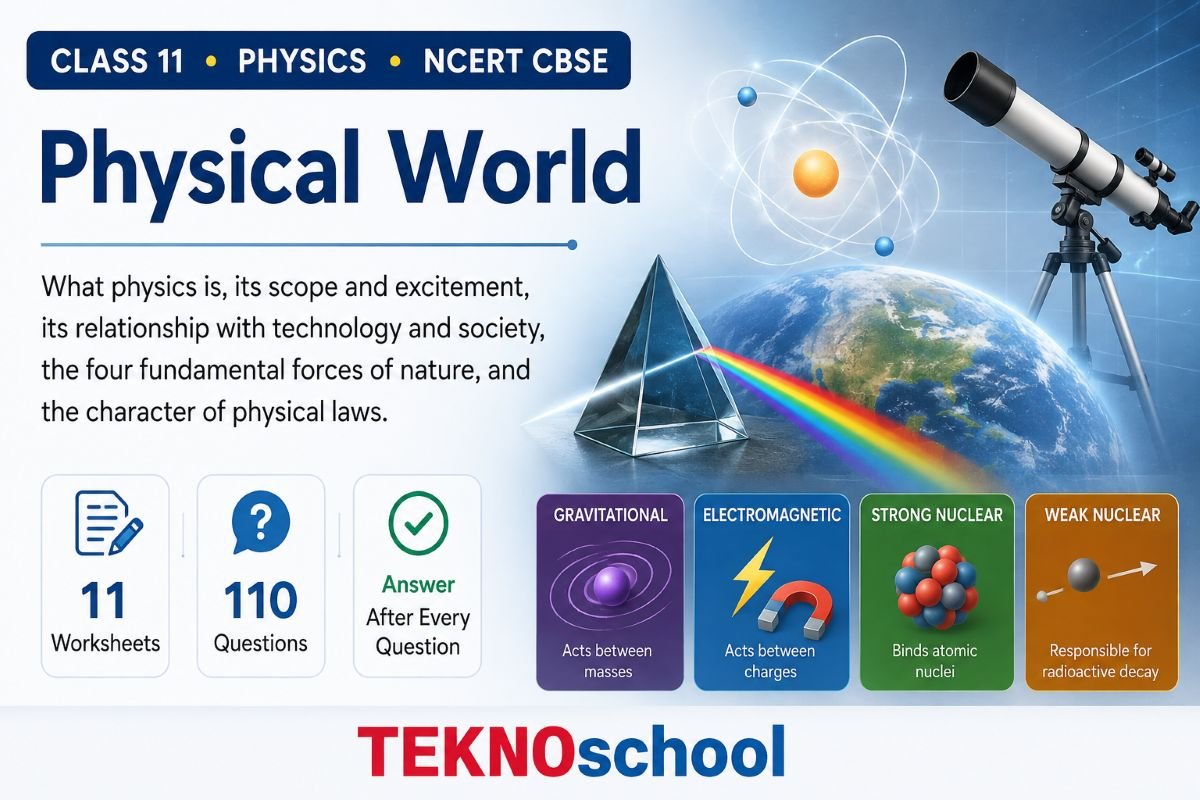
Physical World- What physics is, its scope and excitement, its relationship with technology and society, the four fundamental forces of nature, and the character of physical laws.
110 Questions
Answer After Every Question
A falling apple, the light from a star that left it centuries ago, the hum of a transformer, the spark of a synapse — physics claims all of it as its territory. That claim can sound grand, almost too large to be useful. This opening chapter exists to make it precise: to say exactly what physics studies, how it relates to the technology built on it, and what kind of laws it has produced.
There is very little to calculate here and a great deal to understand. Examiners draw heavily on definitions, classifications and named examples from this chapter, so precision in wording matters as much as the ideas themselves.
What You Will Learn
- What physics is and the scope of the subject
- Physics at the macroscopic and microscopic scale
- The excitement of physics through its major domains
- Physics in relation to technology and society
- The four fundamental forces of nature
- The nature of physical laws and conservation principles
1. What Is Physics?
Physics is the branch of science concerned with the study of the basic laws of nature and their manifestation in different physical phenomena. The word comes from the Greek physis, meaning nature.
In practice, physics is the study of the fundamental laws of nature and their manifestations in terms of the basic concepts of matter, energy, space and time.
Two Broad Approaches
Unification is the attempt to explain diverse physical phenomena in terms of a few concepts and laws. Newton unified the force causing an apple to fall with the force that keeps the moon in orbit, showing both to be gravitation.
Reductionism is the attempt to derive the properties of a bigger, more complex system from the properties and interactions of its constituent, simpler parts. Explaining the behaviour of a gas in terms of the motion of its molecules is an example of this approach.
2. Scope of Physics
The scope of physics is described by considering its domain at two very different scales.
| Domain | Scale | Examples of Study |
|---|---|---|
| Macroscopic | Laboratory, terrestrial and astronomical scales | Mechanics, heat, sound, light, electricity, magnetism |
| Microscopic | Atomic, molecular and nuclear scale | Atomic and molecular physics, nuclear physics |
Classical physics deals principally with macroscopic phenomena and includes subjects such as mechanics, electrodynamics, optics and thermodynamics, largely developed before the twentieth century. Quantum theory is the theoretical framework needed to explain microscopic phenomena at the atomic and subatomic scale.
| Branch of Classical Physics | Deals With |
|---|---|
| Mechanics | Motion of bodies under the action of forces |
| Electrodynamics | Electric and magnetic phenomena associated with charged and magnetic bodies |
| Optics | Phenomena involving light |
| Thermodynamics | Systems in macroscopic equilibrium, dealing with heat, work, temperature and their interconversion |
3. Physics, Technology and Society
The relation is a two-way one. Physics often leads to technology, and technology can lead to new physics. Discovery of the laws of electromagnetic induction led to the generator, and the discovery of the transistor transformed electronics. Conversely, the technology of vacuum pumps that allowed a very good vacuum helped Faraday’s experiments and, much later, the study of cathode rays leading to the discovery of the electron.
| Technology | Scientific Principle(s) Involved |
|---|---|
| Steam engine | Laws of thermodynamics |
| Nuclear reactor | Controlled nuclear fission |
| Radio and television | Generation, propagation and detection of electromagnetic waves |
| Computers | Digital logic built on transistor and semiconductor physics |
| Lasers | Light amplification by stimulated emission of radiation |
| Production of ultra-high magnetic fields | Superconductivity |
| Rocket propulsion for space travel | Newton’s laws of motion |
| Electric generator | Faraday’s laws of electromagnetic induction |
4. Fundamental Forces in Nature
All the different forces observed in nature — muscular force, friction, tension, the push of a spring, and more — can ultimately be traced back to just four fundamental forces.
1. Gravitational Force
The force of mutual attraction between any two objects due to their masses, described by Newton’s universal law of gravitation. It is by far the weakest of the four fundamental forces but is always attractive and has infinite range, and because it acts on all matter it dominates on the scale of planets, stars and galaxies.
2. Electromagnetic Force
The force between charged particles. It can be attractive or repulsive, has infinite range, and is enormously stronger than gravity. It governs the structure of atoms and molecules and is the origin of nearly all the everyday forces we experience — friction, tension, the normal reaction, and the elastic force of a spring are all electromagnetic in origin at the atomic level.
3. Strong Nuclear Force
The force that binds protons and neutrons together inside the nucleus. It is the strongest of the four fundamental forces but acts only over an extremely short range, of the order of the size of the nucleus. It is charge-independent and is responsible for the very high stability of the nucleus, overcoming the strong electrical repulsion between the positively charged protons packed closely together.
4. Weak Nuclear Force
A short-range force that appears only in certain nuclear processes, such as beta decay of a radioactive nucleus. It is stronger than gravity but much weaker than both the electromagnetic and the strong nuclear force.
| Force | Relative Strength | Range | Operates On |
|---|---|---|---|
| Gravitational | Weakest | Infinite | All masses |
| Weak nuclear | Stronger than gravity | Very short | Certain nuclear particles |
| Electromagnetic | Much stronger still | Infinite | Charged particles |
| Strong nuclear | Strongest | Very short, nuclear size | Protons and neutrons |
Why gravity dominates on the cosmic scale despite being the weakest force: the strong and weak nuclear forces act only over nuclear-sized distances, and electromagnetic forces between large bodies tend to cancel out since ordinary matter is electrically neutral overall. Gravity has no such cancellation, since mass is always positive and always attractive, so on the scale of planets and stars its cumulative effect wins out even though it is intrinsically the feeblest of the four.
5. Nature of Physical Laws
Physicists have found that certain quantities, called conserved quantities, remain unchanged in an isolated system even as the system undergoes change. A conservation law states that a particular physical quantity does not change with time.
| Conservation Law | Statement |
|---|---|
| Conservation of energy | The total energy of an isolated system remains constant; energy can only change form |
| Conservation of momentum | The total momentum of an isolated system remains constant if no external force acts on it |
| Conservation of charge | The total electric charge of an isolated system remains constant |
| Conservation of angular momentum | The total angular momentum of an isolated system remains constant in the absence of an external torque |
Conservation laws and symmetry: conservation laws are now understood to arise from deep symmetries of nature. Conservation of energy is connected with the fact that the laws of physics do not change with time; conservation of momentum follows from the fact that physical laws are the same everywhere in space, that is space is homogeneous. This connection between symmetry and conservation is one of the most powerful ideas in all of physics.
Worksheet Bank
Eleven worksheets • Ten questions in each • Answer given right below every question
Worksheet 1 — Multiple Choice Questions
1. The attempt to explain diverse phenomena using a few concepts and laws is called
(a) reductionism (b) unification (c) quantisation (d) relativity
Answer: (b)
2. Which of the following is the strongest fundamental force?
(a) gravitational (b) weak nuclear (c) electromagnetic (d) strong nuclear
Answer: (d)
3. The weakest of the four fundamental forces is the
(a) strong nuclear force (b) electromagnetic force (c) gravitational force (d) weak nuclear force
Answer: (c)
4. Beta decay of a radioactive nucleus is governed by the
(a) gravitational force (b) strong nuclear force (c) weak nuclear force (d) electromagnetic force
Answer: (c)
5. Thermodynamics deals with
(a) motion of bodies (b) charged particles (c) heat, work and temperature (d) light phenomena
Answer: (c)
6. The scientific principle behind the electric generator is
(a) nuclear fission (b) Faraday’s laws of electromagnetic induction (c) Newton’s laws of motion (d) superconductivity
Answer: (b)
7. Conservation of momentum is connected with the fact that
(a) time is homogeneous (b) space is homogeneous (c) space is isotropic (d) charge is quantised
Answer: (b) — the laws of physics being the same at every point in space.
8. Explaining the properties of a gas from the motion of its molecules is an example of
(a) unification (b) reductionism (c) symmetry (d) conservation
Answer: (b)
9. The force that binds protons and neutrons together in a nucleus is the
(a) gravitational force (b) electromagnetic force (c) weak nuclear force (d) strong nuclear force
Answer: (d)
10. Which branch of classical physics deals with electric and magnetic phenomena?
(a) mechanics (b) optics (c) electrodynamics (d) thermodynamics
Answer: (c)
Worksheet 2 — Fill in the Blanks
1. The word physics comes from the Greek word ____________, meaning nature.
Answer: physis
2. Physics studying phenomena at the atomic and nuclear scale is called ____________ physics.
Answer: microscopic
3. There are ____________ fundamental forces in nature.
Answer: four
4. The strong nuclear force is charge-____________ in nature.
Answer: independent
5. The scientific principle behind a nuclear reactor is controlled nuclear ____________.
Answer: fission
6. Laser stands for light amplification by ____________ emission of radiation.
Answer: stimulated
7. A quantity that does not change with time in an isolated system is said to be ____________.
Answer: conserved
8. Conservation of energy is connected with the fact that physical laws do not change with ____________.
Answer: time
9. Production of ultra-high magnetic fields is possible using the phenomenon of ____________.
Answer: superconductivity
10. Rocket propulsion is based on ____________ laws of motion.
Answer: Newton’s
Worksheet 3 — True or False
1. The gravitational force is the strongest of the four fundamental forces.
Answer: False — it is the weakest.
2. The strong nuclear force has an infinite range.
Answer: False — it acts only over an extremely short, nuclear-sized range.
3. Friction and tension are ultimately electromagnetic in origin.
Answer: True
4. Technology can sometimes lead to new discoveries in physics.
Answer: True — the vacuum pump aiding the discovery of the electron is one example.
5. Quantum theory is the framework mainly used for macroscopic phenomena.
Answer: False — it is needed to explain microscopic, atomic-scale phenomena.
6. Conservation laws are connected to underlying symmetries of nature.
Answer: True
7. The weak nuclear force is stronger than the electromagnetic force.
Answer: False — it is weaker than both the electromagnetic and the strong nuclear force.
8. Newton unified the force causing an apple to fall with the force keeping the moon in orbit.
Answer: True — showing both to be manifestations of gravitation.
9. Electromagnetic force can be both attractive and repulsive.
Answer: True — unlike gravity, which is always attractive.
10. Radio and television work on the principle of nuclear fission.
Answer: False — they work through the generation, propagation and detection of electromagnetic waves.
Worksheet 4 — Match the Columns
| No. | Column A — Technology | No. | Column B — Principle | Answer |
|---|---|---|---|---|
| 1 | Steam engine | i | Superconductivity | 1 → vi |
| 2 | Nuclear reactor | ii | Newton’s laws of motion | 2 → vii |
| 3 | Radio and television | iii | Faraday’s laws of induction | 3 → v |
| 4 | Laser | iv | Laws of thermodynamics | 4 → viii |
| 5 | Electric generator | v | Generation and detection of electromagnetic waves | 5 → iii |
| 6 | Ultra-high magnetic fields | vi | Laws of thermodynamics | 6 → i |
| 7 | Rocket propulsion | vii | Controlled nuclear fission | 7 → ii |
| 8 | Computers | viii | Stimulated emission of radiation | 8 → ix |
| 9 | Semiconductor devices | ix | Transistor and semiconductor physics | 9 → iv |
| 10 | Steam turbine power plant | x | Same as (1), thermodynamics | 10 → x |
Cover the last column while attempting, then check.
Worksheet 5 — Assertion and Reason
Choose the correct option in each case:
(a) Both A and R are true, and R is the correct explanation of A
(b) Both A and R are true, but R is not the correct explanation of A
(c) A is true but R is false
(d) A is false but R is true
1. A: Gravity dominates on the scale of planets and galaxies. R: Gravity is the strongest of the four fundamental forces.
Answer: (c) — gravity does dominate at large scale, but it is actually the weakest of the four forces; it dominates because it never cancels and acts on all mass.
2. A: The strong nuclear force can hold protons together in a nucleus despite their mutual repulsion. R: The strong nuclear force is far stronger than the electromagnetic force at nuclear distances.
Answer: (a)
3. A: Friction between two solid surfaces is ultimately electromagnetic in origin. R: All the everyday contact forces arise from interactions between the electrons of neighbouring atoms.
Answer: (a)
4. A: Momentum is conserved in an isolated system. R: The laws of physics are the same at every point in space.
Answer: (a)
5. A: Technology always follows from physics and never leads to it. R: The discovery of the electron came directly from studying cathode rays produced using an improved vacuum pump.
Answer: (d) — the reason is true, and it actually disproves the assertion: here a technological advance in vacuum pumps helped drive new physics.
6. A: Explaining gas behaviour from molecular motion is an example of unification. R: Unification means deriving the properties of a whole from the behaviour of its parts.
Answer: Both statements are false — that example is reductionism, not unification, and the reason describes reductionism, not unification.
7. A: The weak nuclear force is involved in beta decay. R: The weak nuclear force is stronger than the strong nuclear force.
Answer: (c) — the assertion is true, but the reason is false; the weak force is weaker than the strong nuclear force.
8. A: Conservation laws are considered fundamental principles of physics. R: They are linked to the underlying symmetries of space and time.
Answer: (a)
9. A: Newton’s law of gravitation is an example of unification in physics. R: It showed that the same force explains both falling objects on Earth and the orbit of the moon.
Answer: (a)
10. A: Classical physics is sufficient to explain the behaviour of electrons inside an atom. R: Classical physics deals mainly with macroscopic phenomena.
Answer: (d) — the reason is true, but the assertion is false; atomic-scale behaviour needs quantum theory, not classical physics.
Worksheet 6 — Very Short Answer Questions (1 Mark)
1. Define physics.
Answer: The study of the basic laws of nature and their manifestation in different physical phenomena, in terms of matter, energy, space and time.
2. Name the two broad approaches used in the study of physics.
Answer: Unification and reductionism.
3. Name the four fundamental forces of nature.
Answer: Gravitational, weak nuclear, electromagnetic and strong nuclear.
4. Which fundamental force is the weakest?
Answer: The gravitational force.
5. Which fundamental force is the strongest?
Answer: The strong nuclear force.
6. State the law of conservation of energy in one line.
Answer: The total energy of an isolated system remains constant; it can only change form.
7. Name the scientific principle behind the electric generator.
Answer: Faraday’s laws of electromagnetic induction.
8. What does macroscopic scale refer to in physics?
Answer: The laboratory, terrestrial and astronomical scale, as opposed to the atomic and nuclear scale.
9. Which force is responsible for beta decay?
Answer: The weak nuclear force.
10. Name the field theory needed to describe microscopic phenomena.
Answer: Quantum theory.
Worksheet 7 — Short Answer Questions (2–3 Marks)
1. Distinguish between unification and reductionism, with one example of each.
Answer: Unification explains diverse phenomena using a few common concepts and laws, as when Newton showed that the falling of an apple and the orbit of the moon are both due to gravitation. Reductionism derives the properties of a complex system from the behaviour of its simpler constituent parts, as when the properties of a gas are explained in terms of the motion of its individual molecules.
2. Distinguish between macroscopic and microscopic domains of physics with examples.
Answer: The macroscopic domain covers laboratory, terrestrial and astronomical scales and includes subjects such as mechanics, heat and electricity. The microscopic domain covers the atomic, molecular and nuclear scale and includes atomic, molecular and nuclear physics, requiring quantum theory rather than classical concepts.
3. Give three examples of how technology has led to new discoveries in physics.
Answer: Improved vacuum pump technology enabled Faraday’s experiments and, later, the study of cathode rays that led to the discovery of the electron. The development of particle accelerators has allowed physicists to probe the structure of the nucleus and discover subatomic particles. Advances in low-temperature technology made possible the discovery and study of superconductivity.
4. Compare the range and relative strength of the strong nuclear force and the gravitational force.
Answer: The strong nuclear force is by far the strongest of the four fundamental forces but acts only over an extremely short range, roughly the size of a nucleus. The gravitational force is the weakest of all four but has an infinite range, so its effect, though tiny between small objects, extends without limit and dominates over astronomical distances.
5. Explain why gravity, despite being the weakest fundamental force, dominates at the scale of planets and stars.
Answer: Both nuclear forces act only over nuclear-sized distances and so contribute nothing at large scale. Electromagnetic forces between large bodies largely cancel out because ordinary matter is electrically neutral overall. Gravity has no such cancellation, since mass is always positive and the force is always attractive, so its cumulative effect keeps growing with the amount of mass present, allowing it to dominate despite being intrinsically the feeblest force.
6. State the four major conservation laws of physics.
Answer: Conservation of energy, stating that the total energy of an isolated system stays constant; conservation of momentum, stating that total momentum stays constant in the absence of an external force; conservation of charge, stating that total electric charge stays constant; and conservation of angular momentum, stating that total angular momentum stays constant in the absence of an external torque.
7. How are conservation laws related to symmetries in nature?
Answer: Conservation of energy is connected with the fact that the laws of physics do not change with time. Conservation of momentum follows from the fact that the laws of physics are the same at every point in space, that is space is homogeneous. Each conservation law thus reflects a deep symmetry that the laws of nature obey.
8. List the branches of classical physics with the phenomena each deals with.
Answer: Mechanics deals with the motion of bodies under the action of forces. Electrodynamics deals with electric and magnetic phenomena associated with charged and magnetic bodies. Optics deals with phenomena involving light. Thermodynamics deals with systems in macroscopic equilibrium and the relationships between heat, work and temperature.
9. Explain, with an example, how physics leads to technology.
Answer: Physics leads to technology when a fundamental discovery is turned into a practical device. Faraday’s discovery of the laws of electromagnetic induction, originally a piece of pure physics, was later applied to build the electric generator, which today supplies power to entire cities.
10. Why is the strong nuclear force said to be charge-independent?
Answer: Because it acts equally between two protons, between two neutrons and between a proton and a neutron, regardless of their electric charge. This is unlike the electromagnetic force, which depends entirely on the charges involved and would only push two protons apart.
Worksheet 8 — Long Answer Questions (5 Marks)
1. What is physics? Explain its scope with reference to the macroscopic and microscopic domains.
Answer: Physics is the study of the basic laws of nature and their manifestations in different physical phenomena, understood in terms of matter, energy, space and time. Its scope is described through two domains at very different scales. The macroscopic domain includes laboratory, terrestrial and astronomical scales and covers classical subjects such as mechanics, heat, sound, light, electricity and magnetism, largely developed before the twentieth century. The microscopic domain includes the atomic, molecular and nuclear scale, covering atomic and nuclear physics, and here the classical concepts fail and quantum theory is required to explain the observed phenomena. Together the two domains span everything from the structure of the atom to the motion of galaxies.
2. Describe the relationship between physics and technology, giving suitable examples of both directions of influence.
Answer: Physics and technology influence each other in both directions. Physics often leads to technology: the discovery of the laws of electromagnetic induction led directly to the electric generator, and the study of semiconductors led to the transistor and modern electronics. Technology can equally lead to new physics: improvements in vacuum pump technology gave Faraday better apparatus for his experiments, and later allowed the study of cathode rays that culminated in the discovery of the electron. Advances in particle accelerator technology have similarly opened up the study of subatomic particles that would otherwise be inaccessible. This continuous exchange has driven the rapid progress of physics over the last two centuries.
3. Describe the four fundamental forces of nature, comparing their relative strengths and ranges.
Answer: The gravitational force is the mutual attraction between masses; it is the weakest of the four forces but has infinite range and is always attractive, so it dominates on the scale of planets and galaxies. The weak nuclear force appears in certain nuclear processes such as beta decay; it is stronger than gravity but weaker than the other two, and acts only over a very short range. The electromagnetic force acts between charged particles, can be attractive or repulsive, has infinite range, and is responsible for the structure of atoms as well as for nearly all everyday contact forces such as friction and tension. The strong nuclear force binds protons and neutrons together inside the nucleus; it is the strongest of the four but acts only over a range roughly the size of the nucleus itself, and is charge-independent.
4. Explain why gravity, though the weakest fundamental force, is the dominant force at the scale of the universe.
Answer: The strong and weak nuclear forces act only over distances comparable to the size of a nucleus and become utterly negligible at any larger scale, so they play no role in the dynamics of planets or stars. The electromagnetic force, although far stronger than gravity in principle, acts between charges of both signs, and since ordinary bulk matter contains roughly equal positive and negative charge, the electromagnetic forces between large bodies very nearly cancel out. Gravity suffers no such cancellation: mass is always positive, the force is always attractive, and the effect of every particle in a body adds up rather than cancelling. Over astronomical distances, where the nuclear forces have vanished and the electromagnetic force has cancelled away, gravity alone survives to govern the motion of planets, stars and galaxies.
5. What is meant by a conservation law? State the major conservation laws of physics and explain their connection with symmetry.
Answer: A conservation law states that a particular physical quantity remains constant with time in an isolated system, however much the system changes internally. The major conservation laws are those of energy, momentum, electric charge and angular momentum, each holding for a system on which no relevant external influence acts. These laws are not arbitrary rules but consequences of deep symmetries in nature: conservation of energy follows from the fact that the laws of physics do not change with time, and conservation of momentum follows from the fact that the laws of physics are the same at every point in space, that is space is homogeneous. This link between symmetry and conservation is one of the most far-reaching ideas in modern physics, showing that the constancy of certain quantities is really a reflection of an underlying uniformity in the laws of nature themselves.
Worksheet 9 — Classify and Connect
1. Rank the four fundamental forces from strongest to weakest.
Answer: Strong nuclear, electromagnetic, weak nuclear, gravitational.
2. Classify as unification or reductionism: explaining the falling apple and the moon’s orbit by one law; explaining the pressure of a gas from molecular collisions.
Answer: Unification — explaining the apple and the moon by one law of gravitation. Reductionism — explaining gas pressure from the motion of individual molecules.
3. Classify as macroscopic or microscopic: study of planetary orbits, study of nuclear structure, study of sound waves, study of electron energy levels.
Answer: Macroscopic — planetary orbits and sound waves. Microscopic — nuclear structure and electron energy levels.
4. Match each force to its correct range: infinite, infinite, very short (nuclear-sized), very short.
Answer: Gravitational — infinite. Electromagnetic — infinite. Strong nuclear — very short, nuclear-sized. Weak nuclear — very short.
5. For each device, name the branch of classical physics primarily involved: a telescope, a steam turbine, an electric motor.
Answer: Telescope — optics. Steam turbine — thermodynamics. Electric motor — electrodynamics.
6. Classify these as conserved quantities or not: kinetic energy of a single colliding ball, total momentum of two colliding balls, total energy of an isolated system, speed of an accelerating car.
Answer: Conserved — total momentum of the two-ball system and total energy of the isolated system. Not conserved — the kinetic energy of a single ball, which can change during collision, and the speed of an accelerating car, which by definition is changing.
7. Connect each conservation law to the symmetry it arises from: energy, momentum.
Answer: Conservation of energy — the laws of physics do not change with time. Conservation of momentum — the laws of physics are the same at every point in space.
8. Classify these forces as arising ultimately from the electromagnetic force or not: tension in a string, gravitational pull of the Earth, normal reaction from a table, nuclear binding force.
Answer: Electromagnetic in origin — tension and normal reaction, both arising from interatomic forces. Not electromagnetic — gravitational pull, a separate fundamental force, and nuclear binding, which is due to the strong nuclear force.
9. Two protons in a nucleus experience both the strong nuclear force and the electromagnetic force. State the direction of each and the net outcome.
Answer: The electromagnetic force between the two positively charged protons is repulsive, tending to push them apart. The strong nuclear force between them is attractive and, at the short nuclear distance involved, far exceeds the electromagnetic repulsion, so the net effect binds the protons together within the nucleus.
10. Classify the following as macroscopic or microscopic physics, and hence classical or quantum: motion of the planets, structure of the hydrogen atom, flow of heat in a metal rod, radioactive decay of a nucleus.
Answer: Motion of the planets — macroscopic, classical mechanics. Structure of the hydrogen atom — microscopic, quantum theory. Flow of heat in a metal rod — macroscopic, classical thermodynamics. Radioactive decay of a nucleus — microscopic, quantum and nuclear physics.
Worksheet 10 — Case Based Questions
Case I: A student reads that a single spacecraft launch depends on Newton’s laws to calculate the thrust needed, on thermodynamics to design the engine that burns the fuel, on electrodynamics to run its onboard radio communication, and on the theory of relativity to correct the timing signals from its GPS receiver so that the satellite’s clock does not drift out of step with clocks on the ground.
1. Which branch of physics governs the thrust calculation for the launch?
Answer: Mechanics, based on Newton’s laws of motion.
2. Which branch of classical physics is used to design the engine?
Answer: Thermodynamics, dealing with heat, work and their conversion.
3. Which branch of physics governs the onboard radio communication?
Answer: Electrodynamics, involving the generation and propagation of electromagnetic waves.
4. The passage shows several branches of physics working together on one project. What does this illustrate about the scope of physics?
Answer: That physics is not a set of isolated topics but an interconnected body of knowledge, and real technological projects typically draw simultaneously on mechanics, thermodynamics, electrodynamics and more, each contributing its own laws to a single working system.
5. Identify one instance in this passage of physics leading to technology.
Answer: Any of the examples qualifies, such as Newton’s laws of motion, worked out as pure physics centuries earlier, being applied directly to calculate the thrust needed for a modern spacecraft launch.
Case II: In a nuclear power station, uranium nuclei are split apart to release energy, which heats water into steam that turns a turbine. Engineers must ensure the reaction is controlled, since an uncontrolled version of the same nuclear process is used in a different kind of device altogether. Within each uranium nucleus itself, particles that repel each other electrically are nonetheless held together tightly enough that the nucleus does not fly apart on its own.
6. Name the nuclear process being described and the branch of physics it belongs to.
Answer: Nuclear fission, part of nuclear physics, a microscopic domain of physics.
7. After fission, the steam turns a turbine. Which branch of classical physics governs this stage?
Answer: Thermodynamics and mechanics together, since heat is converted to work and then to the turbine’s motion.
8. Name the force that holds the protons and neutrons together inside each nucleus despite their electrical repulsion.
Answer: The strong nuclear force, which overcomes the electromagnetic repulsion between the positively charged protons.
9. Identify the “different kind of device” that uses the same nuclear process without control.
Answer: A nuclear weapon, which releases the energy of fission all at once rather than in a controlled, sustained manner.
10. Which fundamental force provides the electrical repulsion mentioned between the particles in the nucleus?
Answer: The electromagnetic force, acting between the positively charged protons.
Worksheet 11 — Higher Order Thinking Skills
1. A student says the electromagnetic force must always be stronger than gravity in every situation. Is this correct? Explain with an example.
Answer: The statement is correct about the intrinsic strength between individual charged particles, but misleading about which force dominates in bulk matter. Between two electrons, the electromagnetic force vastly exceeds the gravitational force. Yet a planet made of roughly equal positive and negative charge experiences almost no net electromagnetic force from another planet, because the charges cancel, while the gravitational pulls of every particle add together undiminished. So at the scale of planets, gravity wins even though it is fundamentally the weaker force between any two individual particles.
2. Explain why no single technology can be said to depend on only one branch of physics, using the modern smartphone as an example.
Answer: A smartphone’s processor depends on semiconductor and quantum physics, its screen on optics, its battery on electrochemistry closely tied to electrodynamics, its wireless signal on the generation and propagation of electromagnetic waves, and its camera sensor on the photoelectric effect, itself a quantum phenomenon. A single everyday device therefore draws simultaneously on many separate branches of physics, illustrating that real technology is rarely the product of an isolated area of study.
3. If the strong nuclear force had an infinite range like gravity, what would you expect to happen to ordinary matter, and why?
Answer: Since the strong force is far more powerful than the electromagnetic and gravitational forces, an infinite range would let it act between every proton and neutron in the universe rather than only within a single nucleus. All nuclear matter would tend to collapse together into one enormous mass, since nothing would be left to keep separate nuclei, atoms and bodies apart. The short range of the strong force is therefore essential to the existence of distinct atoms, and hence of chemistry and ordinary matter as we know it.
4. A physicist claims to have found a process in which momentum is not conserved, even though no external force acted on the system. What should a careful scientist check before accepting this claim?
Answer: Conservation laws hold for truly isolated systems, so the first thing to check is whether every object involved has actually been included, since an overlooked object carrying away momentum would make the visible part of the system appear to violate conservation. It should also be checked whether any external force, however small, was actually present but unaccounted for, and whether the measurements themselves were accurate. Because conservation of momentum rests on the deep symmetry that space is homogeneous, a genuine violation would be an extraordinary result, and ordinary experimental oversight is a far more likely explanation than an actual failure of the law.
5. Explain why the discovery of the transistor is often cited as an example of both unification and the physics-technology-society link.
Answer: The transistor grew out of unifying understanding of how electrons behave in a semiconductor crystal, bringing together quantum theory and electromagnetism into one coherent explanation of conduction in solids. It is also a striking example of physics feeding into technology and then transforming society, since this single piece of solid-state physics replaced bulky vacuum tubes and made possible every modern computer, phone and electronic device, reshaping communication, industry and daily life on a global scale within a few decades.
6. Two students argue about which force is “most important.” One says gravity, since it holds the universe together; the other says the electromagnetic force, since it governs chemistry and everyday life. Evaluate both claims.
Answer: Both claims have merit because “importance” depends on scale. On the scale of galaxies, stars and planets, gravity is indeed the dominant force shaping structure and motion, since the nuclear forces are irrelevant at that distance and electromagnetic forces largely cancel. On the scale of atoms, molecules and everyday objects, the electromagnetic force is what actually governs chemical bonding, the structure of matter, and virtually every contact force we experience directly. Rather than one force being universally more important, each fundamental force dominates the regime suited to its range and the way it does or does not cancel in bulk matter.
7. A textbook states that physical laws are “unchanging.” Reconcile this with the fact that Newtonian mechanics was later found to need correction by relativity and quantum theory.
Answer: The statement that physical laws are unchanging refers to the laws of nature themselves not varying with time or location, which is the symmetry underlying conservation of energy and momentum. It does not mean that our human formulation of those laws is final. Newtonian mechanics remains an excellent approximation within the everyday range of speeds and sizes for which it was developed; relativity and quantum theory revealed that it breaks down at very high speeds and very small scales, refining our description rather than showing that nature itself had changed.
8. Explain how the same underlying force can produce both attraction and repulsion, using the electromagnetic force as your example.
Answer: The electromagnetic force depends on the sign of the interacting charges rather than acting in only one way. Two like charges, both positive or both negative, repel one another, while two unlike charges attract. This is fundamentally different from gravity, where mass has only one sign and the force is always attractive. It is precisely this dual nature that allows electrons to be attracted to a nucleus while being repelled from one another, giving atoms their structure.
9. If the four fundamental forces could eventually be shown to be different aspects of a single underlying force, what would this achieve in the spirit of physics as described in this chapter?
Answer: It would be the ultimate act of unification, extending the same spirit that let Newton unify terrestrial and celestial gravity, or that later unified electricity, magnetism and light into electromagnetism. A single unified force would mean that gravity, the electromagnetic force, and the two nuclear forces are not four separate rules of nature but different appearances of one deeper law, which is exactly the kind of simplification and unity that physics as a discipline continually seeks.
10. Explain why conservation of angular momentum, rather than linear momentum, is the relevant law for understanding why a spinning ice skater speeds up when pulling in her arms.
Answer: The skater is rotating about a fixed axis, not moving from place to place, so it is her angular momentum, not her linear momentum, that is conserved in the absence of an external torque. When she pulls her arms inward she reduces the distribution of her mass about the axis of rotation, and for angular momentum to remain unchanged her rotational speed must increase to compensate. This is a direct consequence of the conservation law and has nothing to do with linear momentum, which describes straight-line motion rather than rotation.
Quick Revision
Everything worth carrying into the exam hall, in one place.
The Four Fundamental Forces
| Force | Strength Rank | Range | Example |
|---|---|---|---|
| Gravitational | 4th — weakest | Infinite | Planetary orbits |
| Weak nuclear | 3rd | Very short | Beta decay |
| Electromagnetic | 2nd | Infinite | Friction, atomic structure |
| Strong nuclear | 1st — strongest | Nuclear size only | Binding of the nucleus |
Technology and the Physics Behind It
Steam engine → Laws of thermodynamics
Nuclear reactor → Controlled nuclear fission
Radio & TV → Electromagnetic wave generation and detection
Computers → Transistor and semiconductor physics
Laser → Stimulated emission of radiation
Ultra-high magnetic fields → Superconductivity
Rocket propulsion → Newton’s laws of motion
Electric generator → Faraday’s laws of induction
Conservation Laws and Their Symmetries
| Conserved Quantity | Underlying Symmetry |
|---|---|
| Energy | Laws of physics do not change with time |
| Momentum | Space is homogeneous, same everywhere |
| Charge | Total charge of an isolated system is fixed |
| Angular momentum | Conserved when no external torque acts |
Key Terms in One Line Each
Unification — one law explaining many phenomena
Reductionism — explaining a whole through its parts
Macroscopic — laboratory to astronomical scale
Microscopic — atomic, molecular and nuclear scale
Classical physics — mechanics, electrodynamics, optics, thermodynamics
Quantum theory — framework for microscopic phenomena
Ten Points Students Lose Marks On
- Gravity is the weakest force, not the strongest — the single most common slip in this chapter.
- Strong nuclear force is strongest but has the shortest range, not infinite.
- Do not confuse unification (many phenomena, one law) with reductionism (whole from parts).
- Everyday contact forces (friction, tension, normal reaction) trace back to the electromagnetic force.
- Explain why gravity dominates at large scale — cancellation of charge and no cancellation of mass — not just that it does.
- Energy flow and conservation are different ideas; conservation means constant total, not zero change of form.
- Match each technology to its correct principle precisely — “electricity” is too vague; name the actual law.
- Beta decay is weak nuclear force, not strong nuclear force.
- State the symmetry behind each conservation law when asked to explain, not just the law itself.
- Classical physics is not “wrong” at the atomic scale, it is simply inadequate; quantum theory is needed instead.