CBSE Class 9 · Science
Tissue
Tissue-A complete tutorial on plant and animal tissues and their functions, plus 11 worksheet types — MCQs, Assertion–Reason, Fill-ups, True/False, Match, VSA, SA, LA, Case-Based, HOTS and Identification-based — each with answers.
What this chapter is about
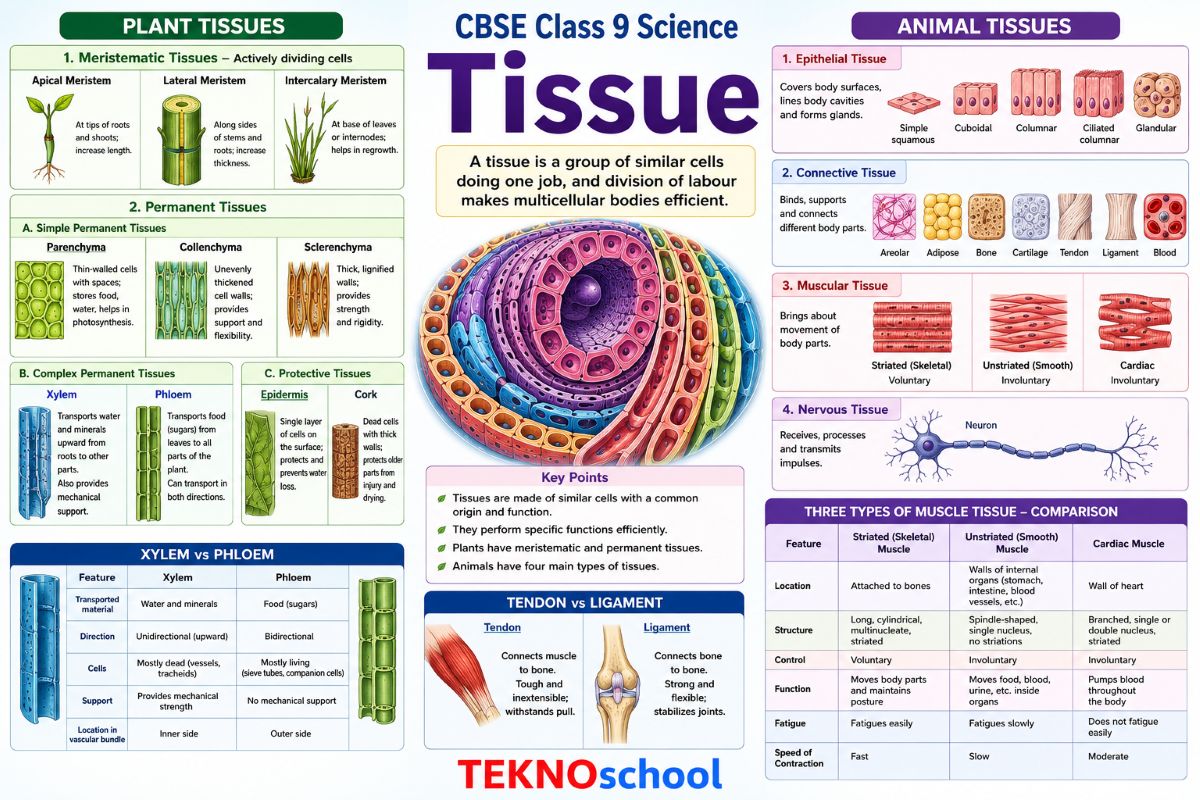
In a multicellular body, cells do not all do the same job. Groups of similar cells team up to perform one particular function — and such a group is called a tissue. In this chapter you learn why this division of labour matters, how plant tissues differ from animal tissues, and how each type — from the growing tip of a root to the blood flowing in your veins — is built to suit its work.
1 · What is a Tissue?
A tissue is a group of cells that are similar in structure and origin and work together to perform a specific function. Unicellular organisms carry out every activity with a single cell, but multicellular organisms show division of labour — different tissues handle different jobs, which makes the body far more efficient.
Plant tissues vs animal tissues
Plants are stationary, so they need more supportive (dead) tissue and their growth is limited to certain regions. Animals move about in search of food and shelter, so they need more living tissue and consume more energy. In plants, growth occurs only at specific regions; in animals, growth is more uniform throughout the body.
2 · Plant Tissues — Meristematic Tissue
Meristematic tissue consists of actively dividing cells found in the growing regions of a plant. Its cells are living, thin-walled, tightly packed with no intercellular spaces, have dense cytoplasm, a prominent nucleus and no vacuoles (or very small ones).
| Type | Location | Function |
|---|
| Apical meristem | Tips of roots and shoots | Increases the length of the plant |
| Lateral meristem (cambium) | Along the sides of stems and roots | Increases the girth (thickness) |
| Intercalary meristem | At the base of leaves or above nodes | Increases the length of internodes (regrowth in grasses) |
3 · Permanent Tissue — Simple Permanent Tissue
When meristematic cells stop dividing and take up a fixed shape, size and function, they become permanent tissue. This process is called differentiation. Simple permanent tissue is made of only one type of cell.
| Tissue | Structure | Function & location |
|---|
| Parenchyma | Living, thin-walled, loosely packed with large intercellular spaces | Stores food and water; fills spaces. Chlorenchyma (with chlorophyll) makes food; aerenchyma (with air cavities) helps aquatic plants float |
| Collenchyma | Living, irregularly thickened at corners, little intercellular space | Gives flexibility and mechanical support; found in leaf stalks and below the epidermis of stems |
| Sclerenchyma | Dead, long and narrow, walls thickened with lignin, no intercellular space | Gives hardness and strength; found in stems, veins of leaves, seed coats and husks of coconut |
Protective tissues
The epidermis is the outermost single layer of cells that protects all parts of the plant. In dry habitats it secretes a waxy cutin layer to check water loss. Small pores called stomata, guarded by guard cells, allow gaseous exchange and transpiration. In older stems, the outer layer becomes cork (phellem) — dead cells with suberin in their walls, making them impervious to gases and water.
4 · Complex Permanent Tissue
Complex permanent tissues are made of more than one type of cell working together. The two conducting tissues, xylem and phloem, together form the vascular bundle.
| Feature | Xylem | Phloem |
|---|
| Conducts | Water and minerals | Prepared food |
| Direction | Upward only (roots → leaves) | Both directions |
| Components | Tracheids, vessels, xylem parenchyma, xylem fibres | Sieve tubes, companion cells, phloem parenchyma, phloem fibres |
| Nature of cells | Mostly dead (except xylem parenchyma) | Mostly living (except phloem fibres) |
5 · Animal Tissues — Epithelial Tissue
Epithelial tissue is the covering or protective tissue of the animal body. Its cells are tightly packed with almost no intercellular space, and rest on a basement membrane. It covers organs, lines cavities, and forms a barrier that regulates what passes across.
| Type | Structure | Location & function |
|---|
| Squamous | Flat, thin, tile-like cells | Lining of mouth, blood vessels, lung alveoli — allows diffusion |
| Stratified squamous | Many layers of flat cells | Skin — prevents wear and tear |
| Cuboidal | Cube-shaped cells | Kidney tubules, salivary glands — absorption and secretion |
| Columnar | Tall, pillar-like cells | Lining of intestine — absorption and secretion |
| Ciliated columnar | Columnar cells bearing cilia | Respiratory tract — cilia push mucus and dust forward |
| Glandular | Folded epithelium forming glands | Secretes substances such as sweat, saliva and enzymes |
6 · Connective Tissue
Connective tissue binds, supports and connects different tissues and organs. Its cells are loosely spaced and embedded in an intercellular matrix, which may be jelly-like, dense or even hard.
| Tissue | Nature of matrix | Location & function |
|---|
| Areolar | Loose and jelly-like | Between skin and muscles, around blood vessels — fills space, supports organs, repairs tissue |
| Adipose | Cells filled with fat globules | Below the skin and between organs — stores fat and insulates the body |
| Bone | Hard, rigid; calcium and phosphorus compounds | Skeleton — supports the body, anchors muscles, protects organs |
| Cartilage | Solid but flexible; proteins and sugars | Nose, ear, trachea, larynx and joints — smooths bone surfaces, gives flexible support |
| Tendon | Fibrous, great strength, limited flexibility | Joins muscle to bone |
| Ligament | Elastic, strong, very little matrix | Joins bone to bone at joints |
| Blood | Fluid matrix called plasma | Contains RBCs, WBCs and platelets — transports gases, food, wastes and hormones |
7 · Muscular Tissue
Muscular tissue is made of long cells called muscle fibres that can contract and relax, producing movement. It contains special contractile proteins.
| Feature | Striated (skeletal) | Unstriated (smooth) | Cardiac |
|---|
| Control | Voluntary | Involuntary | Involuntary |
| Shape of cells | Long, cylindrical, unbranched | Spindle-shaped | Cylindrical and branched |
| Nuclei | Many (multinucleate) | Single | Single |
| Striations | Present (light and dark bands) | Absent | Present |
| Location | Attached to bones (limbs) | Alimentary canal, blood vessels, iris | Heart only |
Cardiac muscle is unique — it works rhythmically and tirelessly throughout life without ever getting fatigued.
8 · Nervous Tissue
Nervous tissue is highly specialised to receive stimuli and transmit impulses very rapidly from one place to another. It is found in the brain, spinal cord and nerves.
Its unit is the nerve cell (neuron), which has a cell body containing the nucleus and cytoplasm, short branched dendrites, and a single long fibre called the axon. A neuron may be up to a metre long. Nerve impulses allow us to move our body in response to a stimulus.
Classification at a Glance
PLANT: Meristematic + Permanent
ANIMAL: Epithelial · Connective · Muscular · Nervous
Permanent → Simple (parenchyma, collenchyma, sclerenchyma) + Complex (xylem, phloem)
PRACTICE ZONE
Worksheets with Answers
11 types · 10 questions each · answers given inline
Worksheet A · Multiple Choice Questions (10)
1. The tissue responsible for increase in the length of a plant is:
(a) Lateral meristem (b) Apical meristem (c) Sclerenchyma (d) Parenchyma
✓ Answer: (b) Apical meristem
2. Which tissue makes up the husk of a coconut?
(a) Parenchyma (b) Collenchyma (c) Sclerenchyma (d) Epidermis
✓ Answer: (c) Sclerenchyma
3. Xylem conducts:
(a) Food (b) Hormones (c) Water and minerals (d) Oxygen only
✓ Answer: (c) Water and minerals
4. The tissue that joins bone to bone is:
(a) Tendon (b) Ligament (c) Cartilage (d) Areolar tissue
✓ Answer: (b) Ligament
5. The fluid matrix of blood is called:
(a) Lymph (b) Plasma (c) Serum (d) Cytoplasm
✓ Answer: (b) Plasma
6. Which muscle is branched and involuntary?
(a) Striated (b) Smooth (c) Cardiac (d) Skeletal
✓ Answer: (c) Cardiac
7. The functional unit of nervous tissue is the:
(a) Nephron (b) Neuron (c) Axon (d) Dendrite
✓ Answer: (b) Neuron
8. Cork cells are impervious to water because their walls contain:
(a) Cutin (b) Lignin (c) Suberin (d) Cellulose
✓ Answer: (c) Suberin
9. Adipose tissue mainly acts as:
(a) A conductor (b) A fat store and insulator (c) A support for bones (d) A secretory tissue
✓ Answer: (b) A fat store and insulator
10. Ciliated epithelium is found in the:
(a) Intestine (b) Skin (c) Respiratory tract (d) Kidney tubules
✓ Answer: (c) Respiratory tract
Worksheet B · Assertion–Reason (10)
Choose: (a) Both A and R true, R correctly explains A · (b) Both true, R not the correct explanation · (c) A true, R false · (d) A false, R true.
1. A: Meristematic cells divide actively. R: They have dense cytoplasm, thin walls and prominent nuclei.
✓ Answer: (a)
2. A: Sclerenchyma provides strength to the plant. R: Its cell walls are thickened with lignin.
✓ Answer: (a)
3. A: Xylem cells are mostly living. R: Living cells are needed to conduct water upward.
✓ Answer: (d) — xylem is mostly dead; water still moves through the hollow tubes.
4. A: Aquatic plants float on water. R: Their parenchyma has large air cavities (aerenchyma).
✓ Answer: (a)
5. A: Cardiac muscle never tires. R: It contracts and relaxes rhythmically throughout life.
✓ Answer: (a)
6. A: Blood is a connective tissue. R: Its cells are suspended in a fluid matrix called plasma.
✓ Answer: (a)
7. A: Tendons join bone to bone. R: Tendons are strong with limited flexibility.
✓ Answer: (d) — tendons join muscle to bone; ligaments join bone to bone.
8. A: Epithelial cells are tightly packed. R: Epithelium forms a barrier that regulates what passes through.
✓ Answer: (a)
9. A: Plants have more dead supportive tissue than animals. R: Plants are stationary and need strong mechanical support.
✓ Answer: (a)
10. A: Grass regrows quickly after mowing. R: Grass has intercalary meristem at the base of its leaves.
✓ Answer: (a)
Worksheet C · Fill in the Blanks (10)
1. A group of similar cells performing a specific function is a __________. → tissue
2. Growth in girth of a stem is due to the __________ meristem. → lateral (cambium)
3. Parenchyma containing chlorophyll is called __________. → chlorenchyma
4. The walls of sclerenchyma are thickened with __________. → lignin
5. Small pores in the epidermis of leaves are called __________. → stomata
6. Xylem and phloem together form the __________ bundle. → vascular
7. The tissue that connects muscle to bone is the __________. → tendon
8. Fat-storing connective tissue is called __________ tissue. → adipose
9. The long fibre of a neuron is the __________. → axon
10. Muscles of the alimentary canal are __________ muscles. → unstriated (smooth/involuntary)
Worksheet D · True or False (10)
1. Meristematic tissue cells have large vacuoles. → False (vacuoles are absent or very small)
2. Collenchyma provides flexibility to the plant. → True
3. Phloem transports water only. → False (it transports food)
4. Cartilage is present in the nose and ear. → True
5. Striated muscles are involuntary. → False (they are voluntary)
6. Blood is a type of connective tissue. → True
7. Epithelial tissue has large intercellular spaces. → False (cells are tightly packed)
8. Cork cells are dead. → True
9. Nervous tissue transmits impulses rapidly. → True
10. Ligaments contain very little matrix. → True
Worksheet E · Match the Following (10)
| No. | Column A | Column B | Answer |
|---|
| 1 | Apical meristem | (a) Joins bone to bone | 1→f |
| 2 | Sclerenchyma | (b) Transports food | 2→g |
| 3 | Phloem | (c) Present only in the heart | 3→b |
| 4 | Ligament | (d) Stores fat, insulates body | 4→a |
| 5 | Adipose tissue | (e) Transmits impulses | 5→d |
| 6 | Cardiac muscle | (f) Growth in length | 6→c |
| 7 | Neuron | (g) Lignified dead cells | 7→e |
| 8 | Cork | (h) Gaseous exchange in leaves | 8→i |
| 9 | Stomata | (i) Suberin in walls | 9→h |
| 10 | Cartilage | (j) Flexible support in nose and ear | 10→j |
Worksheet F · Very Short Answer (10)
1. Define a tissue.
✓ A group of cells similar in structure and origin that work together for a specific function.
2. Name the tissue that increases the girth of a stem.
✓ Lateral meristem (cambium).
3. Which plant tissue is dead?
✓ Sclerenchyma (also cork and most xylem).
4. What is differentiation?
✓ The process by which meristematic cells take up a permanent shape, size and function.
5. Name the tissue that conducts food in plants.
✓ Phloem.
6. Which epithelium lines the intestine?
✓ Columnar epithelium.
7. Name the connective tissue with a fluid matrix.
✓ Blood.
8. Which muscle is found only in the heart?
✓ Cardiac muscle.
9. Name the structural unit of nervous tissue.
✓ The neuron (nerve cell).
10. Which substance makes cork impervious to water?
✓ Suberin.
Worksheet G · Short Answer (10)
1. Why do plants have more dead tissue than animals?
✓ Plants are stationary and need strong mechanical support, which dead thick-walled tissues provide with less energy expenditure.
2. List three characteristics of meristematic tissue.
✓ Cells are living and actively dividing; thin-walled with dense cytoplasm and prominent nuclei; no intercellular spaces and no large vacuoles.
3. Differentiate between parenchyma and sclerenchyma.
✓ Parenchyma is living, thin-walled with intercellular spaces and stores food; sclerenchyma is dead, lignified and provides strength.
4. State two functions of the epidermis in plants.
✓ It protects all parts of the plant and, through stomata, allows gaseous exchange and transpiration; its cutin layer checks water loss.
5. Give two differences between xylem and phloem.
✓ Xylem carries water and minerals upward and is mostly dead; phloem carries food in both directions and is mostly living.
6. Differentiate between a tendon and a ligament.
✓ A tendon joins muscle to bone and is strong with limited flexibility; a ligament joins bone to bone and is highly elastic.
7. Why is blood called a connective tissue?
✓ Its cells are suspended in a fluid matrix (plasma) and it connects different parts of the body by transporting materials.
8. Differentiate between striated and unstriated muscles.
✓ Striated muscles are voluntary, cylindrical, multinucleate and banded; unstriated muscles are involuntary, spindle-shaped, uninucleate and unbanded.
9. Describe the structure of a neuron.
✓ It has a cell body with nucleus and cytoplasm, short branched dendrites, and one long axon that carries impulses.
10. What is the function of areolar tissue?
✓ It fills spaces inside organs, supports internal organs and helps in repair of tissues.
Worksheet H · Long Answer (10)
1. Classify plant tissues with examples of each type.
✓ Plant tissues → Meristematic (apical, lateral, intercalary) and Permanent → Simple (parenchyma, collenchyma, sclerenchyma) and Complex (xylem, phloem); protective tissues are epidermis and cork.
2. Describe the three types of meristematic tissue with their locations and functions.
✓ Apical (tips of root and shoot) increases length; lateral/cambium (sides) increases girth; intercalary (base of leaves, above nodes) lengthens internodes.
3. Compare parenchyma, collenchyma and sclerenchyma on structure and function.
✓ Parenchyma: living, thin-walled, spaces present, stores food. Collenchyma: living, thickened at corners, gives flexibility. Sclerenchyma: dead, lignified, gives hardness and strength.
4. Explain the structure and functions of xylem and phloem.
✓ Xylem (tracheids, vessels, parenchyma, fibres) carries water and minerals upward and is mostly dead. Phloem (sieve tubes, companion cells, parenchyma, fibres) carries food both ways and is mostly living.
5. Describe the types of epithelial tissue with their locations.
✓ Squamous (mouth, alveoli), stratified squamous (skin), cuboidal (kidney tubules), columnar (intestine), ciliated columnar (respiratory tract), glandular (secretory glands).
6. Describe any five types of connective tissue with their functions.
✓ Areolar fills spaces and repairs; adipose stores fat and insulates; bone supports and protects; cartilage gives flexible support; blood transports materials.
7. Compare the three types of muscular tissue.
✓ Striated: voluntary, cylindrical, multinucleate, banded, in limbs. Unstriated: involuntary, spindle-shaped, uninucleate, unbanded, in gut and vessels. Cardiac: involuntary, branched, uninucleate, banded, in heart only.
8. Explain the protective tissues in plants and their importance.
✓ Epidermis protects, checks water loss with cutin and permits exchange through stomata; cork replaces it in older stems, with suberin making it waterproof and gas-proof while protecting against injury and infection.
9. Give the differences between plant and animal tissues.
✓ Plant tissues have more dead supportive cells, limited growth regions and low energy needs; animal tissues are mostly living, grow uniformly and need more energy for movement.
10. Explain nervous tissue and how it enables us to respond to a stimulus.
✓ It is made of neurons with dendrites, a cell body and an axon. A stimulus creates an impulse in the dendrites, which travels along the axon to the brain or spinal cord and back to muscles, causing a response.
Worksheet I · Case / Passage-Based (10)
Passage 1: A gardener trims the lawn every week, yet the grass grows back quickly. He also notices that a young stem bends easily in the wind without breaking, while an older stem is much stiffer.
1. Which tissue lets the grass regrow quickly? → Intercalary meristem.
2. Which tissue gives the young stem flexibility? → Collenchyma.
3. Which tissue makes the older stem stiff? → Sclerenchyma (lignified).
4. Which meristem increased the thickness of the older stem? → Lateral meristem (cambium).
Passage 2: A boy falls while playing and injures his knee. The doctor says the tissue joining his bones at the joint is stretched, but no bone is broken. He also advises rest so that the tissue attaching muscle to bone is not strained further.
5. Name the tissue joining bone to bone. → Ligament.
6. Name the tissue attaching muscle to bone. → Tendon.
7. Which smooth tissue covers the bone ends at the joint? → Cartilage.
Passage 3: Under a microscope, a student sees a tissue with long, cylindrical, unbranched cells having many nuclei and clear light and dark bands. In another slide, the cells are branched with a single nucleus and also show bands.
8. Identify the first tissue. → Striated (skeletal) muscle.
9. Identify the second tissue and its location. → Cardiac muscle, found only in the heart.
10. Which of the two is under our conscious control? → The striated muscle (voluntary).
Worksheet J · HOTS (10)
1. Why can a tree survive even though most of its trunk is made of dead tissue?
✓ Dead xylem and sclerenchyma still conduct water and give mechanical support, while the thin living layers carry out the metabolic work.
2. Why do desert plants have a thick waxy layer on their leaves?
✓ The cutin layer on the epidermis reduces water loss by transpiration in a dry habitat.
3. Why does a cut on the skin heal but a deep injury leave a scar?
✓ The stratified squamous epithelium and areolar tissue regenerate; deeper damage is repaired by fibrous connective tissue, forming a scar.
4. Why is cardiac muscle involuntary rather than voluntary?
✓ The heart must beat continuously without conscious effort; voluntary control would risk stopping the pumping of blood.
5. A person is feeling cold. How does adipose tissue help?
✓ The fat stored beneath the skin acts as an insulator, reducing heat loss from the body.
6. Why does a lotus leaf float on water?
✓ Its parenchyma contains large air cavities (aerenchyma) that give buoyancy.
7. Why is the epithelium of the alveoli extremely thin?
✓ Thin squamous cells allow rapid diffusion of oxygen and carbon dioxide across them.
8. If the cambium of a plant is destroyed, what will happen?
✓ The plant will stop increasing in girth, though it may still grow in length through apical meristem.
9. Why are the cells of the respiratory tract ciliated?
✓ The cilia sweep mucus with trapped dust and germs out of the airway, keeping it clean.
10. Which is more advantageous — a body of similar cells or one with tissues? Justify.
✓ A body with tissues is better: division of labour lets each tissue specialise, making the organism more efficient and able to grow larger and more complex.
Worksheet K · Identification-Based (10)
Read each description and name the tissue or structure.
1. Dividing cells at the tip of a root. → Apical meristem
2. Living cells thickened at the corners, giving flexibility. → Collenchyma
3. Dead, lignified cells forming the husk of a coconut. → Sclerenchyma
4. Two bean-shaped cells surrounding a pore in a leaf. → Guard cells (of a stoma)
5. Tissue carrying water from roots to leaves. → Xylem
6. Flat tile-like cells lining the alveoli. → Squamous epithelium
7. Connective tissue with a hard matrix of calcium and phosphorus. → Bone
8. Spindle-shaped muscle cells with a single nucleus and no bands. → Unstriated (smooth) muscle
9. Short branched projections of a nerve cell. → Dendrites
10. Dead protective outer layer of an old tree trunk. → Cork (phellem)
Quick Recap
A tissue is a group of similar cells doing one job, and division of labour makes multicellular bodies efficient. Plant tissues are meristematic (apical, lateral, intercalary) or permanent — simple (parenchyma, collenchyma, sclerenchyma), complex (xylem, phloem) and protective (epidermis, cork). Animal tissues are epithelial (covering and secretion), connective (areolar, adipose, bone, cartilage, tendon, ligament, blood), muscular (striated, unstriated, cardiac) and nervous (neurons). Learn the xylem–phloem, tendon–ligament and three-muscle comparison tables — they carry the most marks.