CBSE Class 9 · Science
The Fundamental Unit of Life
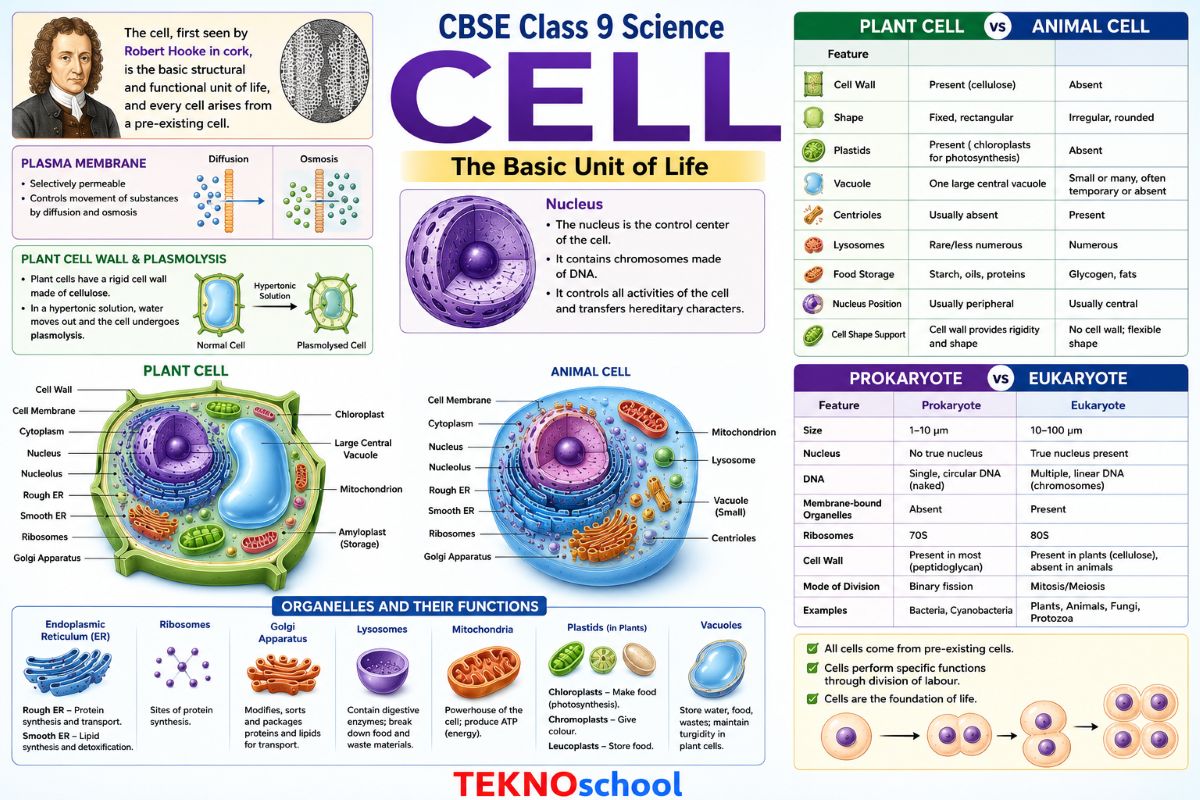
The Fundamental Unit of Life-A complete tutorial on the cell, its organelles and functions, plus 11 worksheet types — MCQs, Assertion–Reason, Fill-ups, True/False, Match, VSA, SA, LA, Case-Based, HOTS and Identification-based — each with answers.
What this chapter is about
Every living thing — a blade of grass, an elephant, the mould on bread, and you — is built from cells. In this chapter you discover how the cell was first seen through a simple microscope, why it is called the fundamental unit of life, what lies inside it, and how each tiny organelle does a specific job. You will also learn how substances move in and out of cells by diffusion and osmosis, and how plant and animal cells differ.
1 · Discovery of the Cell
In 1665, Robert Hooke examined a thin slice of cork under a self-made microscope and saw tiny compartments that looked like the small rooms of a monastery. He named them cells — from the Latin cellula, meaning “a little room”. These were actually the dead cell walls of cork.
| Scientist | Contribution |
|---|
| Robert Hooke (1665) | Observed cork cells; coined the term “cell” |
| Leeuwenhoek (1674) | First saw free-living cells in pond water |
| Robert Brown (1831) | Discovered the nucleus |
| Purkinje (1839) | Coined the term “protoplasm” for the living substance of a cell |
| Schleiden & Schwann | Proposed the cell theory |
| Virchow (1855) | Stated that all cells arise from pre-existing cells |
The Cell Theory
① All living organisms are composed of cells. ② The cell is the basic structural and functional unit of life. ③ All cells arise from pre-existing cells.
2 · Unicellular and Multicellular Organisms
Unicellular organisms are made of a single cell that performs every life function on its own — e.g. Amoeba, Paramoecium, Chlamydomonas and bacteria. Multicellular organisms are made of many cells, where groups of cells take up specialised jobs. This sharing of work is called division of labour.
Shape and size vary widely
The smallest cell is Mycoplasma (about 0.1 µm), the largest is the ostrich egg, and the longest is the nerve cell. Shapes differ too — red blood cells are disc-like, nerve cells are long and branched, and Amoeba keeps changing shape. Shape and size depend on the function the cell performs.
3 · The Plasma Membrane
The plasma membrane (cell membrane) is the outermost covering of an animal cell. It is made of lipids and proteins, is flexible, and is selectively permeable — it allows only certain substances to pass in and out.
Diffusion
The movement of a substance from a region of higher concentration to lower concentration. Gases like CO₂ and O₂ move across the plasma membrane by diffusion.
Osmosis
The movement of water molecules through a selectively permeable membrane from a region of higher water concentration to a region of lower water concentration.
| Solution outside the cell | Water movement | Effect on the cell |
|---|
| Hypotonic (dilute) | Water enters the cell | Cell swells up |
| Isotonic (same) | Equal in and out | No change in size |
| Hypertonic (concentrated) | Water leaves the cell | Cell shrinks (plasmolysis in plant cells) |
Endocytosis
Because the plasma membrane is flexible, some cells can engulf food and other material from outside by folding around it. Amoeba takes in its food this way.
4 · The Cell Wall
Plant cells have an extra rigid covering outside the plasma membrane called the cell wall, made mainly of cellulose. It gives structural strength and rigidity, protects the cell, and allows plant cells to withstand changes in the surrounding medium.
Plasmolysis
When a living plant cell is placed in a hypertonic solution, water leaves the cell and the protoplasm shrinks away from the cell wall. This is called plasmolysis. It happens only in living cells, so it is used to test whether a cell is alive.
5 · The Nucleus
The nucleus is the control centre of the cell. It is bound by a double-layered nuclear membrane with pores that allow materials to move between the nucleus and the cytoplasm. Inside lie the nucleolus and the chromatin material.
Chromatin condenses into thread-like chromosomes when the cell is about to divide. Chromosomes carry DNA, which holds the information for building and organising the cell. A functional segment of DNA is called a gene. The nucleus therefore controls all cell activities and passes on hereditary characters.
Prokaryotic and Eukaryotic Cells
| Feature | Prokaryotic cell | Eukaryotic cell |
|---|
| Size | Generally small (1–10 µm) | Generally large (5–100 µm) |
| Nuclear region | Poorly defined, no membrane — called nucleoid | Well defined, with a nuclear membrane |
| Chromosome | Single | More than one |
| Membrane-bound organelles | Absent | Present |
| Example | Bacteria, blue-green algae | Plant and animal cells |
6 · Cytoplasm and Cell Organelles
The cytoplasm is the fluid content inside the plasma membrane. It contains many specialised structures called cell organelles, each doing a particular job. Together, the cytoplasm and the nucleus form the protoplasm — the living part of the cell.
| Organelle | Key features | Function |
|---|
| Endoplasmic reticulum (ER) | Network of tubes and sheets; RER has ribosomes, SER does not | RER makes proteins; SER makes lipids and detoxifies poisons; acts as a transport channel |
| Golgi apparatus | Stacks of membrane-bound sacs (cisternae) | Stores, modifies and packages materials; forms lysosomes |
| Lysosome | Sacs of powerful digestive enzymes | Digests waste and worn-out organelles; called the suicide bag of the cell |
| Mitochondria | Double membrane; folded inner membrane (cristae); has its own DNA and ribosomes | Releases energy as ATP; called the powerhouse of the cell |
| Plastids (plant cells only) | Chromoplasts (coloured), Leucoplasts (colourless); has its own DNA and ribosomes | Green chloroplasts carry out photosynthesis (kitchen of the cell); leucoplasts store starch, oil and protein |
| Vacuole | Large and central in plant cells; small in animal cells | Stores water, sap and wastes; gives turgidity and rigidity to plant cells |
Why lysosomes are “suicide bags”
When a cell is damaged or worn out, the lysosome membrane bursts and its enzymes digest the cell’s own material — destroying the cell itself.
7 · Plant Cell vs Animal Cell
| Feature | Plant cell | Animal cell |
|---|
| Cell wall | Present (cellulose) | Absent |
| Plastids | Present | Absent |
| Vacuole | Large and central | Small or absent |
| Shape | Fixed, usually rectangular | Irregular, can change |
| Centriole | Usually absent | Present |
8 · Cell Division
New cells are formed from existing cells by cell division. There are two main types:
Mitosis — a cell divides to form two identical daughter cells with the same number of chromosomes as the parent. It helps in growth and repair of tissues.
Meiosis — occurs in reproductive cells and forms four daughter cells, each with half the number of chromosomes. It produces gametes and maintains the chromosome number across generations.
PRACTICE ZONE
Worksheets with Answers
11 types · 10 questions each · answers given inline
Worksheet A · Multiple Choice Questions (10)
1. The term “cell” was coined by:
(a) Robert Brown (b) Robert Hooke (c) Leeuwenhoek (d) Virchow
✓ Answer: (b) Robert Hooke
2. The nucleus was discovered by:
(a) Purkinje (b) Schwann (c) Robert Brown (d) Hooke
✓ Answer: (c) Robert Brown
3. Which organelle is called the powerhouse of the cell?
(a) Ribosome (b) Lysosome (c) Mitochondria (d) Golgi apparatus
✓ Answer: (c) Mitochondria
4. The cell wall of a plant cell is mainly made of:
(a) Protein (b) Cellulose (c) Lipid (d) Chitin
✓ Answer: (b) Cellulose
5. Lysosomes are known as:
(a) Kitchen of the cell (b) Suicide bags (c) Powerhouse (d) Brain of the cell
✓ Answer: (b) Suicide bags
6. The movement of water through a selectively permeable membrane is called:
(a) Diffusion (b) Osmosis (c) Plasmolysis (d) Endocytosis
✓ Answer: (b) Osmosis
7. Which of these is a prokaryotic organism?
(a) Amoeba (b) Bacteria (c) Onion cell (d) Human cheek cell
✓ Answer: (b) Bacteria
8. The undefined nuclear region of a prokaryotic cell is called:
(a) Nucleolus (b) Nucleoid (c) Chromatin (d) Cytoplasm
✓ Answer: (b) Nucleoid
9. Which organelle is absent in animal cells?
(a) Mitochondria (b) Golgi apparatus (c) Plastids (d) Ribosome
✓ Answer: (c) Plastids
10. The smallest known cell is:
(a) Nerve cell (b) Ostrich egg (c) Mycoplasma (d) Red blood cell
✓ Answer: (c) Mycoplasma
Worksheet B · Assertion–Reason (10)
Choose: (a) Both A and R true, R correctly explains A · (b) Both true, R not the correct explanation · (c) A true, R false · (d) A false, R true.
1. A: The plasma membrane is called selectively permeable. R: It allows only certain substances to pass through it.
✓ Answer: (a)
2. A: Mitochondria are called the powerhouse of the cell. R: They release energy in the form of ATP.
✓ Answer: (a)
3. A: Plant cells do not need a cell wall. R: The plasma membrane alone gives them rigidity.
✓ Answer: (d) — plant cells do need a cell wall; it provides the rigidity.
4. A: Lysosomes are called suicide bags. R: Their enzymes can digest the cell’s own material when it is damaged.
✓ Answer: (a)
5. A: A bacterial cell is prokaryotic. R: Its nuclear region lacks a nuclear membrane.
✓ Answer: (a)
6. A: A plant cell placed in a hypertonic solution swells up. R: Water enters the cell by osmosis.
✓ Answer: (d) — in a hypertonic solution water leaves the cell and it shrinks.
7. A: Mitochondria and plastids can make some of their own proteins. R: They have their own DNA and ribosomes.
✓ Answer: (a)
8. A: The nucleus controls all activities of the cell. R: It contains chromosomes carrying DNA.
✓ Answer: (a)
9. A: Plasmolysis occurs only in living cells. R: Only a living protoplasm can shrink away from the cell wall.
✓ Answer: (a)
10. A: Meiosis produces two identical daughter cells. R: Meiosis occurs during growth and repair of tissues.
✓ Answer: (d) — meiosis forms four cells with half the chromosomes; mitosis is for growth and repair.
Worksheet C · Fill in the Blanks (10)
1. Robert Hooke observed cells in a thin slice of __________. → cork
2. The living substance of a cell is called __________. → protoplasm
3. The plasma membrane is __________ permeable. → selectively
4. The cell wall of plants is made of __________. → cellulose
5. The __________ is called the control centre of the cell. → nucleus
6. Green plastids containing chlorophyll are called __________. → chloroplasts
7. A functional segment of DNA is called a __________. → gene
8. The shrinking of protoplasm away from the cell wall is __________. → plasmolysis
9. Cells with a poorly defined nuclear region are called __________ cells. → prokaryotic
10. Cell division that produces gametes is called __________. → meiosis
Worksheet D · True or False (10)
1. All living organisms are made of cells. → True
2. Animal cells have a cell wall. → False
3. Amoeba is a unicellular organism. → True
4. The Golgi apparatus makes proteins. → False (it stores, modifies and packages them)
5. Mitochondria have their own DNA. → True
6. Bacteria are eukaryotic organisms. → False (they are prokaryotic)
7. Plant cells have a large central vacuole. → True
8. A cell placed in a hypotonic solution shrinks. → False (it swells up)
9. Chloroplasts are the site of photosynthesis. → True
10. Mitosis produces four daughter cells. → False (it produces two)
Worksheet E · Match the Following (10)
| No. | Column A | Column B | Answer |
|---|
| 1 | Mitochondria | (a) Coined the term “cell” | 1→f |
| 2 | Lysosome | (b) Photosynthesis | 2→g |
| 3 | Chloroplast | (c) Discovered the nucleus | 3→b |
| 4 | Robert Hooke | (d) Packaging and dispatch | 4→a |
| 5 | Robert Brown | (e) Cellulose | 5→c |
| 6 | Golgi apparatus | (f) Powerhouse of the cell | 6→d |
| 7 | Cell wall | (g) Suicide bag | 7→e |
| 8 | Nucleoid | (h) Four daughter cells | 8→i |
| 9 | Meiosis | (i) Prokaryotic cell | 9→h |
| 10 | Vacuole | (j) Storage sac | 10→j |
Worksheet F · Very Short Answer (10)
1. Who discovered the cell?
✓ Robert Hooke, in 1665.
2. Name the basic structural unit of life.
✓ The cell.
3. What is protoplasm?
✓ The living substance of a cell — cytoplasm together with the nucleus.
4. Define osmosis.
✓ Movement of water through a selectively permeable membrane from higher to lower water concentration.
5. Name the organelle that makes proteins.
✓ Ribosomes (on the rough endoplasmic reticulum).
6. Which plastid stores starch?
✓ Leucoplast.
7. What is a gene?
✓ A functional segment of DNA.
8. Name the longest cell in the human body.
✓ The nerve cell.
9. How does Amoeba take in food?
✓ By endocytosis (engulfing it with its flexible plasma membrane).
10. Name the two types of cell division.
✓ Mitosis and meiosis.
Worksheet G · Short Answer (10)
1. State the three points of the cell theory.
✓ All organisms are made of cells; the cell is the basic structural and functional unit of life; all cells arise from pre-existing cells.
2. Differentiate between diffusion and osmosis.
✓ Diffusion is movement of any substance from higher to lower concentration; osmosis is movement of only water through a selectively permeable membrane.
3. Why is the plasma membrane called selectively permeable?
✓ Because it permits only certain substances to enter or leave the cell, controlling what passes through.
4. What is plasmolysis? Why does it occur?
✓ Shrinking of the protoplasm away from the cell wall when a living plant cell loses water in a hypertonic solution.
5. Give two functions of the nucleus.
✓ It controls all cell activities and carries hereditary information through DNA in chromosomes.
6. Why are mitochondria called the powerhouse of the cell?
✓ They release the energy needed for cellular activities and store it as ATP.
7. Differentiate between RER and SER.
✓ RER has ribosomes on its surface and makes proteins; SER has none and makes lipids and detoxifies poisons.
8. State two functions of the Golgi apparatus.
✓ It stores, modifies and packages materials for dispatch, and it forms lysosomes.
9. Give two differences between a prokaryotic and a eukaryotic cell.
✓ Prokaryotic cells lack a nuclear membrane and membrane-bound organelles; eukaryotic cells have both.
10. Why is the cell called the fundamental unit of life?
✓ Because every living organism is made of cells, and each cell can carry out all the basic activities of life.
Worksheet H · Long Answer (10)
1. Compare a plant cell and an animal cell on any five points.
✓ Plant cell: cell wall present, plastids present, large central vacuole, fixed rectangular shape, centriole usually absent. Animal cell: no cell wall, no plastids, small or no vacuole, irregular shape, centriole present.
2. Describe the structure and functions of the nucleus.
✓ Bound by a double nuclear membrane with pores; contains the nucleolus and chromatin. Chromatin condenses into chromosomes carrying DNA. It controls all cell activities and transmits hereditary characters.
3. Explain the effect of hypotonic, isotonic and hypertonic solutions on a cell.
✓ Hypotonic: water enters and the cell swells. Isotonic: equal movement, no change. Hypertonic: water leaves and the cell shrinks (plasmolysis in plant cells).
4. Write the structure and functions of mitochondria.
✓ Double membrane with a folded inner membrane (cristae) increasing surface area; has its own DNA and ribosomes. It releases energy as ATP, so it is called the powerhouse of the cell.
5. Describe the endoplasmic reticulum, its types and functions.
✓ A network of membranous tubes and sheets. RER (with ribosomes) makes proteins; SER makes lipids and detoxifies poisons. Both serve as channels for transport and give internal support.
6. What are plastids? Describe their types and functions.
✓ Plant organelles with their own DNA and ribosomes. Chromoplasts are coloured (green chloroplasts carry out photosynthesis); leucoplasts are colourless and store starch, oils and proteins.
7. Explain the contributions of Hooke, Leeuwenhoek, Brown, Purkinje and Virchow.
✓ Hooke saw and named cells; Leeuwenhoek first observed free-living cells; Brown discovered the nucleus; Purkinje named protoplasm; Virchow stated that cells arise from pre-existing cells.
8. Differentiate between mitosis and meiosis.
✓ Mitosis: two identical daughter cells with the same chromosome number; used for growth and repair. Meiosis: four daughter cells with half the chromosome number; forms gametes.
9. Why do organelles need to be membrane-bound? Explain with two examples.
✓ Membranes keep each organelle’s chemical environment separate so reactions do not interfere. Lysosome membranes contain destructive enzymes; mitochondrial membranes hold the machinery for energy release.
10. What would happen to the life of a cell if there were no Golgi apparatus?
✓ Materials made in the ER could not be modified, packaged or dispatched, lysosomes would not form, and secretion and storage in the cell would fail.
Worksheet I · Case / Passage-Based (10)
Passage 1: A student mounted a peel of Rhoeo leaf in water and observed it. She then added a strong sugar solution and watched again. The coloured protoplasm had pulled away from the cell wall.
1. Name the process observed. → Plasmolysis.
2. Why did water leave the cells? → The sugar solution was hypertonic, so water moved out by osmosis.
3. What does this prove about the cells? → That they are living (plasmolysis occurs only in living cells).
4. What would happen if the peel were put back in pure water? → Water would re-enter and the cells would become turgid again (deplasmolysis).
Passage 2: An organelle in the cell contains powerful digestive enzymes within a membrane. When the cell becomes old or damaged, this membrane bursts and the cell is destroyed.
5. Name the organelle described. → Lysosome.
6. Why is it given a nickname, and what is it? → “Suicide bag”, because it can digest the cell’s own material.
7. Which organelle forms it? → The Golgi apparatus.
Passage 3: Under a microscope, a bacterial cell shows no nuclear membrane and no membrane-bound organelles, while an onion cell shows a clear nucleus, a rigid outer covering and a large central vacuole.
8. Classify the two cells. → Bacterial cell = prokaryotic; onion cell = eukaryotic.
9. Name the nuclear region of the bacterial cell. → Nucleoid.
10. Name the rigid outer covering of the onion cell and its material. → Cell wall, made of cellulose.
Worksheet J · HOTS (10)
1. Dried raisins swell up when placed in water. Explain why.
✓ Water enters the raisin by osmosis because the solution inside is more concentrated than the surrounding water.
2. Why can a plant cell survive in a very dilute medium while an animal cell may burst?
✓ The rigid cell wall resists further expansion; an animal cell has only a flexible plasma membrane, so it can burst.
3. Why is salt sprinkled on raw vegetables to draw out water?
✓ Salt makes the surroundings hypertonic, so water leaves the cells by osmosis.
4. Mitochondria and plastids are said to be semi-autonomous. Why?
✓ They have their own DNA and ribosomes, so they can make some of their own proteins.
5. What would happen to a cell if its plasma membrane ruptured?
✓ The cell would lose control over what enters and leaves, its contents would leak out, and it would die.
6. Muscle cells and liver cells contain very many mitochondria. Why?
✓ These cells are highly active and need large amounts of energy (ATP).
7. Why does a nerve cell have such an unusually long shape?
✓ Its shape suits its function of carrying messages over long distances in the body.
8. A cell placed in a solution neither swells nor shrinks. What can you conclude?
✓ The solution is isotonic — water enters and leaves at equal rates.
9. Why do unicellular organisms not need division of labour among organs?
✓ A single cell performs all life functions itself, so specialised organs are unnecessary.
10. If the nucleus were removed from a cell, what would happen and why?
✓ The cell could not control its activities or divide, since the nucleus holds the DNA that directs everything; the cell would eventually die.
Worksheet K · Identification-Based (10)
Read each description and name the cell part, process or scientist.
1. The outermost living covering of an animal cell, made of lipids and proteins. → Plasma membrane
2. A rigid cellulose covering found only in plant cells. → Cell wall
3. A dense body inside the nucleus. → Nucleolus
4. Thread-like structures that carry hereditary information. → Chromosomes
5. Stacks of flattened sacs that package and dispatch cell products. → Golgi apparatus
6. A double-membraned organelle with finger-like inner folds called cristae. → Mitochondria
7. A green plastid where food is prepared. → Chloroplast
8. A large fluid-filled sac occupying most of a plant cell. → Central vacuole
9. The process by which Amoeba engulfs its food. → Endocytosis
10. The scientist who stated that all cells arise from pre-existing cells. → Rudolf Virchow
Quick Recap
The cell, first seen by Robert Hooke in cork, is the basic structural and functional unit of life, and every cell arises from a pre-existing cell. The plasma membrane is selectively permeable and controls movement by diffusion and osmosis; plant cells add a rigid cellulose wall and can undergo plasmolysis. The nucleus, with its chromosomes and DNA, controls all activities, while organelles divide the work — ER and ribosomes for synthesis, Golgi for packaging, lysosomes for digestion, mitochondria for energy, plastids for food-making and storage, and vacuoles for storage and turgidity. Learn the plant-versus-animal and prokaryote-versus-eukaryote tables and the organelle functions — they carry the most marks.