Stars and the Solar System
Stars and the Solar System
Stars and the Solar System-Everything above your head after sunset — the Moon, the twinkling stars, the steady planets, the sudden streak of a meteor — follows rules you can learn in one chapter. Let us decode the night sky.
1. Celestial Objects
The Sun, the Moon, the planets, the stars and all other objects in the sky are called celestial objects. They are of two broad kinds.
Foundational idea
Luminous bodies make their own light — the Sun and all other stars.
Non-luminous bodies do not make light; they only reflect sunlight — the Moon, planets, asteroids and comets.
This single distinction explains a great deal. The Moon looks bright, but it is only a mirror for sunlight. Venus outshines every star in the sky, yet it produces no light at all.
2. The Moon
The Moon is Earth’s only natural satellite. It is our nearest celestial neighbour, about 3,84,400 km away.
Phases of the Moon
Half of the Moon always faces the Sun and is lit. But from Earth we see only a part of that lit half, and how much we see changes daily. These changing shapes are the phases of the Moon.
| Phase | What you see | Day of lunar month |
|---|---|---|
| New Moon (Amavasya) | Moon not visible at all | Day 0 |
| Waxing crescent | Thin bright sliver, growing | Days 1–6 |
| First quarter | Half disc bright | Day 7 |
| Waxing gibbous | More than half, growing | Days 8–14 |
| Full Moon (Purnima) | Complete bright disc | Day 15 |
| Waning gibbous | More than half, shrinking | Days 16–21 |
| Last quarter | Half disc bright (other side) | Day 22 |
| Waning crescent | Thin sliver, shrinking away | Days 23–29 |
Remember the cycle length
One full cycle of phases — from one Full Moon to the next — takes about 29.5 days. This is called a lunar month, and it is the basis of the Indian calendar.
Why we always see the same face
The Moon takes the same time to rotate once on its axis as it takes to revolve once around the Earth (about 27.3 days). Because these two periods match exactly, the same side of the Moon always faces us. The other side — the “far side” — was never seen by human eyes until spacecraft photographed it.
The Moon’s surface
Harsh conditions — and why
The Moon has no atmosphere and no liquid water. Its gravity is too weak to hold on to gases.
Consequences: no wind, no sound, no weather, no life. The sky there is always black, even in daytime. Temperatures swing violently — scorching in sunlight, freezing in shadow. Footprints left in 1969 are still there, because there is no wind to erase them.
Through a telescope the Moon shows craters (bowl-shaped pits made by impacts), mountains, and dark flat plains. Neil Armstrong became the first human to set foot on the Moon on 21 July 1969, aboard the Apollo 11 mission, along with Edwin “Buzz” Aldrin.
3. The Stars
Stars are enormous balls of hot gas that make their own light and heat by nuclear fusion in their cores. They look like tiny points only because they are unimaginably far away.
The Sun and the light year
The Sun is the nearest star to us, about 150 million km away. Sunlight takes about 8 minutes to reach Earth. Every other star is so distant that kilometres become clumsy, so astronomers use a bigger unit.
Light year — a unit of distance, not time
A light year is the distance travelled by light in one year.
Light travels at 3,00,000 km per second, so:
1 light year = about 9.46 million million km (roughly 9,46,00,00,00,000 km).
The classic exam trap
A light year measures distance, never time. Writing “a light year is one year of light” costs full marks. It is a unit of length, like a kilometre — just a very large one.
The next nearest star after the Sun is Alpha Centauri (its closest member is Proxima Centauri), about 4.3 light years away. Its light left it more than four years ago. When you look at distant stars, you are literally looking into the past.
Why stars twinkle but planets do not
A star is so far away that it acts as a single point source of light. Its thin beam is bent unevenly as it passes through the constantly shifting layers of our atmosphere, so its brightness flickers — it twinkles.
A planet is far closer, so it appears as a small disc — a bundle of many points. When one point dims, another brightens, and the flickers average out. Planets therefore shine with a steady light. This is the easiest way to tell a planet from a star with the naked eye.
Why stars are invisible in daytime
Stars do not go anywhere at sunrise. They are shining all day, but the Sun’s light scattered by our atmosphere makes the sky so bright that the faint starlight is drowned out. On the Moon, with no atmosphere to scatter light, stars are visible even while the Sun blazes.
The apparent movement of stars
Observation you can make tonight
Stars appear to rise in the east and set in the west. They are not really moving across the sky — the Earth is rotating from west to east, and that gives the stars an apparent motion in the opposite direction, exactly as the Sun has.
The Pole Star
One star seems to stay fixed all night: the Pole Star (Dhruva Tara). It lies almost exactly above the North Pole, in line with Earth’s axis of rotation. Since Earth spins about that axis, the Pole Star does not appear to move at all. Every other star seems to circle around it.
How to find the Pole Star
Locate Ursa Major. Take the two stars at the outer end of its “bowl” — the pointer stars. Imagine a straight line joining them and extend it northward by about five times the gap between them. The moderately bright star you land on is the Pole Star. This is how sailors and travellers found north for centuries.
A limitation worth knowing
The Pole Star is visible only from the Northern Hemisphere. From Australia or South Africa it never rises above the horizon.
4. Constellations
A constellation is a group of stars that appears to form a recognisable pattern in the sky. The stars in a constellation are not physically close to one another — they may be hundreds of light years apart. The pattern exists only from our viewing angle on Earth. There are 88 recognised constellations.
| Constellation | Other names | Shape & stars | Best seen |
|---|---|---|---|
| Ursa Major | Great Bear, Big Dipper, Saptarshi, Sapta Rishi | Ladle or question mark; 7 bright stars (4 form the bowl, 3 the handle) | Summer, early part of the night |
| Orion | The Hunter, Mriga | Hunter with belt and sword; 7–8 bright stars, 3 in a straight line form the belt | Winter, late evening |
| Cassiopeia | Sharmishtha | Distorted letter W or M; 5 bright stars | Winter, early part of the night |
| Leo Major | The Lion, Simha | Crouching lion; bright star Regulus at the base of the “sickle” | Spring |
Sirius — the brightest star in the night sky
Draw an imaginary line through the three stars of Orion’s belt and extend it eastward. It leads you straight to Sirius, the brightest star visible from Earth. Orion is a signpost as well as a picture.
Constellations appear to shift westward through the night and change with the seasons — both effects come from Earth’s own motions, not from the stars moving.
5. The Solar System
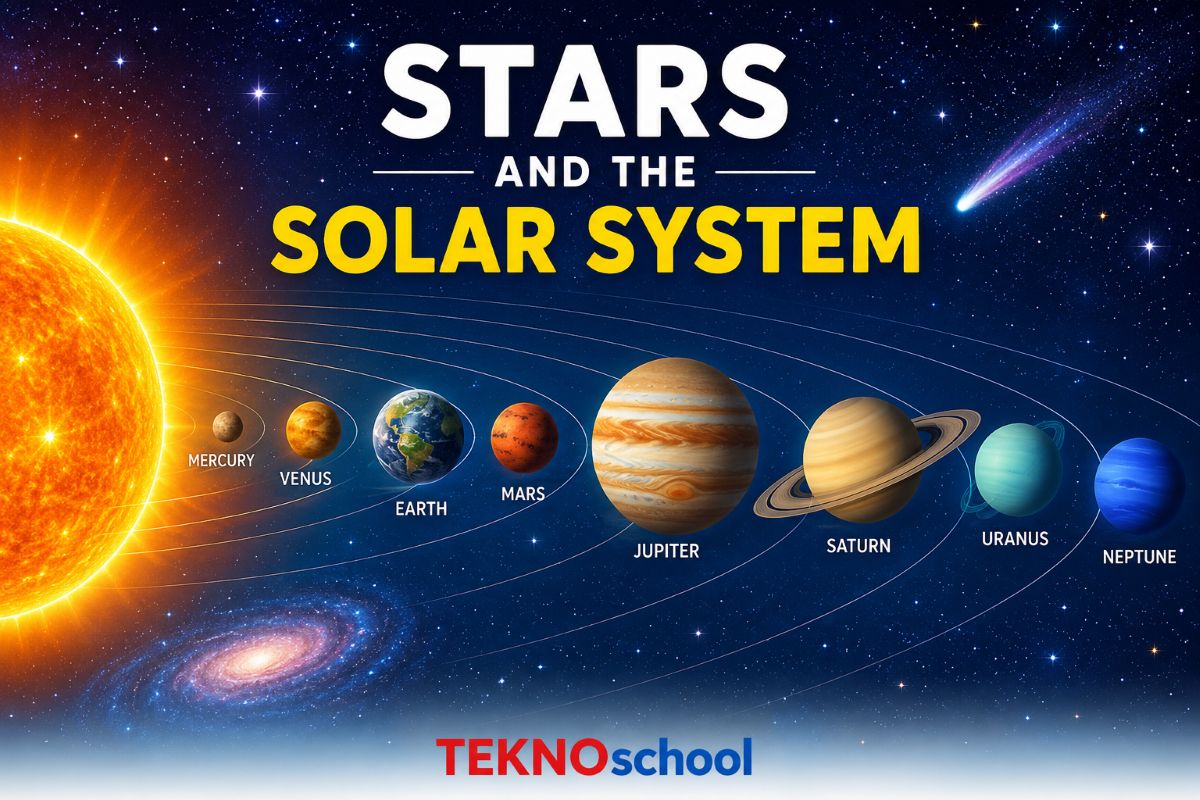
The Sun and all the objects held by its gravity form the solar system: eight planets, their satellites, asteroids, comets and meteoroids. The Sun contains about 99.8% of all the matter in the solar system — it is the anchor everything else orbits.
What makes something a planet
A planet is a large, roughly spherical, non-luminous body that revolves around a star in an elliptical orbit and has cleared its orbital neighbourhood. Planets shine only by reflecting sunlight. The time taken for one full revolution is its period of revolution; the time for one spin on its axis is its period of rotation.
Order of the planets
Nearest to farthest from the Sun
Memory trick: My Very Efficient Mother Just Served Us Noodles.
Blue = inner (terrestrial) planets, small and rocky. Purple = outer planets, large and gaseous.
Where did Pluto go?
Pluto was counted as the ninth planet until 2006, when the International Astronomical Union reclassified it as a dwarf planet — it has not cleared its orbital neighbourhood of other objects. Older books still list nine planets. The correct answer today is eight.
The eight planets at a glance
| Planet | Satellites | Key facts to remember |
|---|---|---|
| Mercury | None | Nearest to the Sun and the smallest planet. Almost no atmosphere. Visible just before sunrise or just after sunset, close to the horizon. Shortest period of revolution (88 days). |
| Venus | None | Brightest planet in the sky; called the morning star or evening star though it is not a star. Earth’s nearest planetary neighbour and nearly its twin in size. Hottest planet — a thick carbon dioxide blanket traps heat. Rotates east to west, opposite to most planets. |
| Earth | 1 (the Moon) | The only planet known to support life. Appears blue-green from space because of water and vegetation. Its tilted axis plus revolution causes the seasons. Rotation causes day and night. |
| Mars | 2 (Phobos, Deimos) | The Red Planet, coloured by iron oxide in its soil. Thin atmosphere. Last of the inner planets. |
| Jupiter | Many (95+ known) | The largest planet — over 1,300 Earths would fit inside. Has faint rings and the Great Red Spot, a storm bigger than Earth. Rotates fastest of all planets. |
| Saturn | Many (146+ known) | Yellowish, famous for its bright, beautiful rings visible through a small telescope. Least dense planet — less dense than water, so it would float. |
| Uranus | Many (27+ known) | Seen only with a large telescope. Highly tilted axis — it rolls on its side. Like Venus, it rotates east to west. |
| Neptune | Many (14+ known) | Farthest planet from the Sun. Longest period of revolution (about 165 Earth years). Visible only through powerful telescopes. |
Must-know exceptions
Only Venus and Uranus rotate from east to west. Only Mercury and Venus have no satellites. Venus is the brightest planet but Jupiter is the largest — do not swap these.
6. Other Members of the Solar System
Asteroids
Between the orbits of Mars and Jupiter lies a broad gap filled with a large number of small rocky objects revolving around the Sun. These are asteroids, and the region is the asteroid belt. They are visible only through large telescopes and are thought to be leftover material that never formed into a planet.
Comets
A comet is a body of ice and dust revolving around the Sun in a highly elongated elliptical orbit. Its period of revolution is usually very long. Near the Sun, the ice vaporises and the comet develops a bright head and a long tail.
Which way does a comet’s tail point?
The tail always points away from the Sun — pushed outward by solar radiation and the solar wind. It does not trail behind the comet’s motion. So on the outward journey, the comet actually travels tail-first.
Halley’s Comet returns roughly every 76 years. It last appeared in 1986 and is next expected in 2061.
Meteors and meteorites
| Term | Meaning |
|---|---|
| Meteoroid | A small rocky object moving through space, before it reaches any atmosphere. |
| Meteor (shooting star) | The bright streak of light seen when a meteoroid enters Earth’s atmosphere. Friction with air heats it until it glows and burns up completely. It is not a star. |
| Meteorite | A larger meteoroid that does not burn up entirely and lands on Earth’s surface. Meteorites give scientists direct samples of solar system material. |
| Meteor shower | Many meteors seen in a short time, occurring when Earth passes through the dusty trail left behind by a comet. |
Artificial satellites
An artificial satellite is a man-made object launched into orbit around the Earth. Unlike the Moon, it is built by humans and orbits much closer to Earth.
What satellites do for us
Weather forecasting · Long-distance communication and television · Remote sensing of crops, forests and water · Navigation (GPS, NavIC) · Astronomical research · Distance education.
India’s satellites include Aryabhata (the first, launched 1975), INSAT, IRS, Kalpana-1 and EDUSAT.
7. Quick Revision
The twenty facts that carry the chapter
1. Stars are luminous; planets, moons, asteroids and comets are non-luminous.
2. The Moon is Earth’s only natural satellite, 3,84,400 km away.
3. Phases of the Moon repeat every 29.5 days — one lunar month.
4. Moon’s rotation period equals its revolution period, so one face is always hidden.
5. The Moon has no atmosphere, no water and no life.
6. Neil Armstrong walked on the Moon on 21 July 1969.
7. The Sun is the nearest star, 150 million km away.
8. 1 light year = distance light travels in one year = about 9.46 million million km.
9. Alpha Centauri, the next nearest star, is 4.3 light years away.
10. Stars twinkle (point sources); planets do not (small discs).
11. Stars appear to move east to west because Earth rotates west to east.
12. The Pole Star lies above the North Pole and appears stationary.
13. Ursa Major’s two pointer stars, extended five times, locate the Pole Star.
14. Orion has 7–8 bright stars; its belt points to Sirius, the brightest star.
15. Cassiopeia looks like a distorted W.
16. Eight planets: Mercury, Venus, Earth, Mars, Jupiter, Saturn, Uranus, Neptune.
17. Venus is the brightest planet; Jupiter is the largest; Mercury is the smallest and nearest.
18. Venus and Uranus rotate east to west; Mercury and Venus have no satellites.
19. Asteroids lie between Mars and Jupiter; a comet’s tail always points away from the Sun.
20. A meteor burns up in the atmosphere; a meteorite reaches the ground.
Worksheet
Eight question types, ten questions each, with answers given right below every question.
A. Fill in the Blanks
1. The distance light travels in one year is called one ____________.
Answer: light year
2. The nearest star to the Earth is the ____________.
Answer: Sun
3. The constellation Ursa Major is also known as ____________ in Hindi.
Answer: Saptarshi (Sapta Rishi)
4. The planet nearest to the Sun is ____________ and the planet farthest from the Sun is ____________.
Answer: Mercury; Neptune
5. A group of stars forming a recognisable pattern is called a ____________.
Answer: constellation
6. A meteoroid that survives its fiery passage and lands on the Earth is called a ____________.
Answer: meteorite
7. The Pole Star appears stationary because it lies almost directly above the Earth’s ____________.
Answer: North Pole (axis of rotation)
8. ____________ is the brightest planet and ____________ is the largest planet of the solar system.
Answer: Venus; Jupiter
9. Asteroids are found between the orbits of ____________ and ____________.
Answer: Mars; Jupiter
10. The phases of the Moon repeat after about ____________ days.
Answer: 29.5 (about one month)
B. True or False
1. The Moon produces its own light.
False. The Moon is non-luminous; it only reflects sunlight.
2. A light year is a unit of time.
False. It is a unit of distance.
3. Planets twinkle but stars do not.
False. It is the reverse — stars twinkle, planets shine steadily.
4. Venus rotates from east to west.
True. Venus and Uranus are the two exceptions.
5. The stars of a constellation are physically close to one another in space.
False. They may be hundreds of light years apart; the pattern is only an appearance from Earth.
6. The Pole Star can be seen from every part of the Earth.
False. It is visible only from the Northern Hemisphere.
7. Saturn is less dense than water.
True. Given a large enough ocean, Saturn would float.
8. A comet’s tail points towards the Sun.
False. The tail always points away from the Sun.
9. Stars are present in the sky during the day as well.
True. They are simply outshone by scattered sunlight.
10. Mercury and Venus have no natural satellites.
True.
C. Multiple Choice Questions
1. Which of the following is not a member of the solar system?
(a) Asteroid (b) Satellite (c) Constellation (d) Comet
Answer: (c) Constellation. Its stars lie far outside the solar system.
2. Which of the following is not a planet of the Sun?
(a) Sirius (b) Mercury (c) Saturn (d) Earth
Answer: (a) Sirius — it is a star, the brightest in the night sky.
3. The planet with the shortest period of revolution around the Sun is
(a) Neptune (b) Earth (c) Mercury (d) Jupiter
Answer: (c) Mercury — about 88 days, being nearest to the Sun.
4. Phases of the Moon occur because
(a) the Moon’s orbit is elliptical
(b) the Earth casts its shadow on the Moon
(c) we see only that part of the Moon which reflects sunlight towards us
(d) our distance from the Moon keeps changing
Answer: (c). Option (b) describes a lunar eclipse, not phases.
5. The Pole Star does not appear to move because it is
(a) the brightest star (b) nearest to the Earth
(c) located along the Earth’s axis of rotation (d) actually stationary in space
Answer: (c).
6. A shooting star is actually a
(a) star that is falling (b) meteor (c) comet (d) satellite
Answer: (b) Meteor. No star is involved.
7. Which constellation looks like a distorted letter W?
(a) Orion (b) Leo Major (c) Cassiopeia (d) Ursa Major
Answer: (c) Cassiopeia.
8. The satellites of Mars are
(a) Phobos and Deimos (b) Titan and Europa
(c) Io and Ganymede (d) Triton and Charon
Answer: (a) Phobos and Deimos.
9. Halley’s Comet appears after about
(a) 76 days (b) 76 months (c) 76 years (d) 760 years
Answer: (c) 76 years. Last seen 1986, next expected 2061.
10. The Moon has no atmosphere mainly because
(a) it is too cold (b) its gravity is too weak to hold gases
(c) it has no water (d) it rotates too slowly
Answer: (b).
D. Match the Following
| Column A | Column B |
|---|---|
| 1. Sirius | (a) Rings visible through a small telescope |
| 2. Saturn | (b) Red Planet |
| 3. Mars | (c) Reaches the Earth’s surface |
| 4. Meteorite | (d) Brightest star in the night sky |
| 5. Ursa Major | (e) Between Mars and Jupiter |
| 6. Asteroid belt | (f) Morning star / evening star |
| 7. Venus | (g) Contains the pointer stars |
| 8. Aryabhata | (h) 21 July 1969 |
| 9. Neil Armstrong | (i) Great Red Spot |
| 10. Jupiter | (j) India’s first artificial satellite |
Answers:
1 → (d) 2 → (a) 3 → (b) 4 → (c) 5 → (g)
6 → (e) 7 → (f) 8 → (j) 9 → (h) 10 → (i)
E. Assertion and Reason
Choose the correct option for each:
(a) Both A and R are true, and R is the correct explanation of A.
(b) Both A and R are true, but R is not the correct explanation of A.
(c) A is true but R is false.
(d) A is false but R is true.
1. A: Planets do not twinkle. R: Planets are much closer to us than stars and appear as small discs.
Answer: (a).
2. A: We always see the same side of the Moon. R: The Moon does not rotate on its axis.
Answer: (c). The Moon does rotate — its rotation period simply equals its revolution period.
3. A: The Pole Star appears fixed in the sky. R: It lies close to the line of the Earth’s axis of rotation.
Answer: (a).
4. A: The Moon has no atmosphere. R: The Moon is very far from the Earth.
Answer: (b). Both statements are true, but the real cause is the Moon’s weak gravity, not its distance.
5. A: Venus is called the morning star. R: Venus is a star that shines in the early morning.
Answer: (c). Venus is a planet, not a star; the name is only traditional.
6. A: A light year is used to measure astronomical distances. R: Distances between stars are far too large to express conveniently in kilometres.
Answer: (a).
7. A: Stars are not visible during the day. R: Stars stop emitting light during daytime.
Answer: (c). Stars shine constantly; scattered sunlight simply overwhelms them.
8. A: A comet’s tail grows longer as it approaches the Sun. R: Solar heat vaporises the comet’s ice, and solar radiation pushes the gas and dust outward.
Answer: (a).
9. A: Constellations appear to change position through the night. R: The stars in them are revolving around the Earth.
Answer: (c). The apparent movement is caused by the Earth’s rotation.
10. A: Artificial satellites orbit much closer to the Earth than the Moon does. R: They are launched and placed in orbit by human-built rockets.
Answer: (b). Both are true, but the reason does not explain the closeness of the orbit.
F. Very Short Answer Questions (1 mark)
1. Name the natural satellite of the Earth.
Answer: The Moon.
2. Define a light year.
Answer: The distance travelled by light in one year, about 9.46 million million km.
3. Which planet is known as the Red Planet, and why?
Answer: Mars, because of the iron oxide in its soil.
4. What is a satellite?
Answer: A body that revolves around a planet.
5. Name the two planets that have no satellites.
Answer: Mercury and Venus.
6. How many bright stars form Ursa Major?
Answer: Seven.
7. What are the pointer stars?
Answer: The two stars at the outer end of Ursa Major’s bowl, whose line points to the Pole Star.
8. Name the first Indian artificial satellite.
Answer: Aryabhata, launched in 1975.
9. Which is the hottest planet of the solar system?
Answer: Venus.
10. Why is Earth called the blue planet?
Answer: Because water covers about two-thirds of its surface, giving it a blue-green appearance from space.
G. Short Answer Questions (2–3 marks)
1. Why does the Moon change its shape from day to day?
Answer: Sunlight always lights up one half of the Moon. As the Moon revolves around the Earth, the portion of that lit half turned towards us keeps changing. We therefore see different shapes — the phases — over a cycle of about 29.5 days.
2. Distinguish between a meteor and a meteorite.
Answer: A meteor is the bright streak produced when a small meteoroid enters the atmosphere and burns up completely due to friction with air. A meteorite is a larger meteoroid that does not burn up entirely and reaches the Earth’s surface.
3. Why do stars twinkle while planets do not?
Answer: A star is so distant that it behaves as a point source; its narrow beam is refracted unevenly by the moving layers of our atmosphere, so its brightness flickers. A planet is nearby and appears as a small disc made of many points; the flickering of individual points cancels out, giving steady light.
4. Why can we not see stars during the day?
Answer: Stars shine all the time, but during the day the atmosphere scatters intense sunlight in every direction. The sky becomes so bright that the comparatively faint light of the stars is drowned out and cannot be distinguished.
5. What is a constellation? Give two examples.
Answer: A constellation is a group of stars that appears to form a recognisable pattern in the sky, although the stars may lie at very different distances from us. Examples: Ursa Major and Orion.
6. Why is Venus called the morning star or the evening star, and why is the name misleading?
Answer: Venus is the brightest object in the sky after the Sun and the Moon, and it appears in the eastern sky before sunrise or in the western sky after sunset. The name is misleading because Venus is a planet, not a star — it does not produce its own light.
7. State two differences between a star and a planet.
Answer: (i) A star is luminous and produces its own light by nuclear fusion; a planet is non-luminous and only reflects sunlight. (ii) Stars twinkle, planets do not. (Also: stars are enormously farther away, and planets revolve around stars.)
8. Why is the distance between stars expressed in light years and not in kilometres?
Answer: Stellar distances are so enormous that expressing them in kilometres produces unmanageably long numbers. Alpha Centauri, for instance, is about 40 million million km away — but only 4.3 light years, which is far easier to write, compare and remember.
9. Why is there no life on the Moon?
Answer: The Moon has no atmosphere and no liquid water, because its gravity is too weak to retain gases. Without air and water, and with extreme temperature swings between sunlight and shadow, life as we know it cannot exist there.
10. Give two differences between the Moon and an artificial satellite.
Answer: (i) The Moon is a natural satellite formed by nature; an artificial satellite is designed and launched by humans. (ii) The Moon orbits about 3,84,400 km away, while artificial satellites orbit only a few hundred to a few tens of thousands of kilometres from the Earth.
H. Long Answer Questions (5 marks)
1. Explain how the Pole Star can be located in the night sky, and why it appears stationary.
Answer: First locate Ursa Major, a group of seven bright stars shaped like a ladle. The two stars at the outer end of its bowl are called the pointer stars. Imagine a straight line joining them and extend it northward by about five times the distance between them. The moderately bright star you reach is the Pole Star.
It appears stationary because it lies almost exactly along the line of the Earth’s axis of rotation, nearly overhead at the North Pole. As the Earth spins about this axis, the direction of the Pole Star from us does not change, so it seems fixed while every other star appears to trace a circle around it. This is why it has served as a reliable direction marker for travellers and sailors for centuries. It is visible only from the Northern Hemisphere.
2. Describe the solar system and name its members.
Answer: The solar system consists of the Sun and all the celestial bodies held in orbit by its gravity. Its members are:
(i) The Sun — the only star of the system and the source of all its heat and light.
(ii) Eight planets — Mercury, Venus, Earth, Mars, Jupiter, Saturn, Uranus and Neptune, revolving in elliptical orbits.
(iii) Satellites — bodies revolving around planets, such as our Moon.
(iv) Asteroids — small rocky bodies between Mars and Jupiter.
(v) Comets — icy bodies in highly elongated orbits, developing long tails near the Sun.
(vi) Meteoroids — small rocky fragments moving through space.
All these bodies except the Sun are non-luminous and shine only by reflecting sunlight.
3. Explain the phases of the Moon with reference to a complete lunar cycle.
Answer: The Moon does not produce light; it reflects sunlight. The Sun always illuminates one half of the Moon, but as the Moon revolves around the Earth we view that lit half from continually changing angles, so different amounts of it are visible.
At New Moon, the lit side faces entirely away from us and the Moon is invisible. Over the next days a waxing crescent grows, reaching first quarter (half disc) on about day 7, then waxing gibbous, until on about day 15 the whole lit half faces us — Full Moon. The bright portion then shrinks through waning gibbous, last quarter and waning crescent, returning to New Moon. The entire cycle takes about 29.5 days, which forms one lunar month.
4. Write short notes on asteroids, comets and meteors.
Answer: Asteroids are a large number of small rocky bodies revolving around the Sun in the wide gap between the orbits of Mars and Jupiter, forming the asteroid belt. They are visible only through large telescopes and are believed to be material that never combined into a planet.
Comets are bodies of ice and dust revolving around the Sun in highly elongated elliptical orbits, usually with very long periods. On approaching the Sun the ice vaporises, producing a glowing head and a long tail that always points away from the Sun. Halley’s Comet returns about every 76 years.
Meteors are the bright streaks, popularly called shooting stars, produced when small meteoroids enter the Earth’s atmosphere at high speed and burn up due to friction with the air. If a meteoroid is large enough to survive and land on the surface, it is called a meteorite.
5. Describe the constellation Orion and explain how it helps in locating Sirius.
Answer: Orion, also called the Hunter, is one of the most striking constellations of the winter sky and is best seen late in the evening. It contains seven or eight bright stars. Three bright stars in a straight line form the hunter’s belt, while four other bright stars mark the corners of a rough quadrilateral around it, and a faint line of stars forms the sword hanging from the belt.
To locate Sirius, imagine a straight line passing through the three stars of Orion’s belt and extend it towards the east. It leads to a very bright star — Sirius, the brightest star in the night sky. Orion therefore acts as a natural signpost, which is why observers learn it early.
6. Why does the same side of the Moon always face the Earth?
Answer: The Moon rotates on its own axis and also revolves around the Earth. Both these motions take almost exactly the same time — about 27.3 days. Because the two periods are equal, the Moon turns through exactly the same angle about its axis as it moves through around the Earth. The result is that the same face is always presented to us.
This is not because the Moon fails to rotate — a common misconception. If the Moon did not rotate at all, we would in fact see every side of it during one revolution. The far side of the Moon was first photographed by spacecraft in 1959.
7. What are artificial satellites? Explain their uses.
Answer: Artificial satellites are man-made objects launched by rockets into orbit around the Earth. They revolve much closer to the Earth than the Moon does, and they serve many practical purposes:
(i) Weather forecasting — tracking clouds, cyclones and rainfall.
(ii) Communication — telephone, television and internet links across long distances.
(iii) Remote sensing — surveying crops, forests, minerals and water resources.
(iv) Navigation — guiding ships, aircraft and vehicles.
(v) Astronomical research — observing space without atmospheric distortion.
(vi) Education — reaching remote classrooms through satellites such as EDUSAT.
India’s satellites include Aryabhata, the INSAT and IRS series, and Kalpana-1.
8. Compare the inner planets with the outer planets.
Answer: The inner planets — Mercury, Venus, Earth and Mars — lie between the Sun and the asteroid belt. They are comparatively small, made mainly of rock and metal, have solid surfaces, higher densities, few or no satellites and no ring systems. They complete their orbits quickly.
The outer planets — Jupiter, Saturn, Uranus and Neptune — lie beyond the asteroid belt. They are far larger, made mainly of gases, have no solid surface to stand on, lower densities, a great many satellites and ring systems. Being far from the Sun, they are cold and take a very long time to complete one revolution — Neptune needs about 165 Earth years.
9. The Moon’s surface has no footprint-erasing wind and no sound. Explain why, and describe two other consequences.
Answer: All these effects follow from a single cause: the Moon’s gravity is too weak to hold on to gases, so it has no atmosphere.
Wind is moving air; with no air there is no wind, so the footprints left by the Apollo astronauts in 1969 remain undisturbed. Sound needs a material medium to travel through; in the vacuum of the Moon, sound cannot propagate at all, so astronauts must use radio.
Two further consequences: (i) The lunar sky is always black, even at midday, because there is no air to scatter sunlight — stars are visible in daytime. (ii) Temperatures swing violently, since there is no atmospheric blanket to trap and distribute heat: sunlit regions become scorching while shadowed regions are freezing.
10. Explain why the constellations we see change with the seasons.
Answer: The Earth revolves around the Sun once a year. As it moves along its orbit, our night side faces different directions in space at different times of the year. The stars lying in the direction of the Sun are lost in daylight and cannot be seen, while those in the opposite direction are visible all night.
Because the Earth’s position keeps changing, the set of constellations visible at a given hour of night gradually changes too. Ursa Major dominates the summer sky, while Orion and Cassiopeia become prominent in winter. The stars themselves have not moved — it is our vantage point that has shifted. A separate motion, the Earth’s daily rotation, additionally makes constellations drift from east to west through a single night.