CBSE Class 8 Science Light
@import url(‘https://fonts.cdnfonts.com/css/zalando-sans’);
Light
Light – Reflection, Dispersion, the Human Eye & Braille System
Light is the form of energy that makes things visible to our eyes. Without light, we would not be able to see anything around us. In this chapter, we explore how light behaves when it strikes different surfaces, how it splits into a band of beautiful colours, and how the human eye captures images of the world.
1. What Makes Things Visible?
We can see objects only when light from those objects reaches our eyes. Objects themselves can be of two kinds:
☀️ Luminous Objects
Objects that produce their own light — the Sun, stars, a burning candle, an electric bulb.
🌙 Non-Luminous (Illuminated) Objects
Objects that do not produce light but become visible by reflecting light that falls on them — the Moon, a book, a table.
⚠️ Key Point: If you are in a completely dark room, you cannot see objects inside the room because no light is being reflected from them. However, objects outside the room (where light is present) can be seen through a window.
2. Laws of Reflection
When a ray of light falls on a smooth, polished surface (like a mirror), it bounces back. This phenomenon is called reflection of light.
Key Terms in Reflection
Incident Ray — The ray of light that falls on the reflecting surface.
Reflected Ray — The ray of light that bounces back from the reflecting surface.
Normal — An imaginary line drawn perpendicular to the reflecting surface at the point of incidence.
Angle of Incidence (∠i) — The angle between the incident ray and the normal.
Angle of Reflection (∠r) — The angle between the reflected ray and the normal.
📐 The Two Laws of Reflection
Law 1: The angle of incidence is always equal to the angle of reflection. (∠i = ∠r)
Law 2: The incident ray, the reflected ray, and the normal at the point of incidence all lie in the same plane.
3. Regular and Diffused Reflection
All surfaces reflect light, but the nature of the reflected light depends on the smoothness of the surface.
✅ Important: Diffused reflection does NOT mean the failure of the laws of reflection. Each individual ray still obeys both laws — the surface irregularities simply cause the reflected rays to scatter in different directions.
4. Reflected Light Can Be Reflected Again
When two mirrors are placed facing each other, the light reflected from the first mirror strikes the second mirror and gets reflected again. This process can repeat, creating multiple images of a single object.
💡 Did You Know? When two plane mirrors are placed parallel and facing each other, an infinite number of images are formed due to continuous reflection of light between the mirrors. This is the principle used in barber shops!
Applications of Multiple Reflections
🔭 Periscope
A periscope uses two plane mirrors inclined at 45° to allow viewing of objects that are not in the direct line of sight. It is widely used in submarines and by soldiers in trenches.
🔮 Kaleidoscope
A kaleidoscope contains two or three mirrors set at 60° to each other inside a tube, with small coloured glass pieces at one end. As the tube is rotated, the mirrors produce beautiful, symmetrical patterns through multiple reflections. At 60°, five images of each object are produced.
5. Sunlight — White or Coloured? (Dispersion)
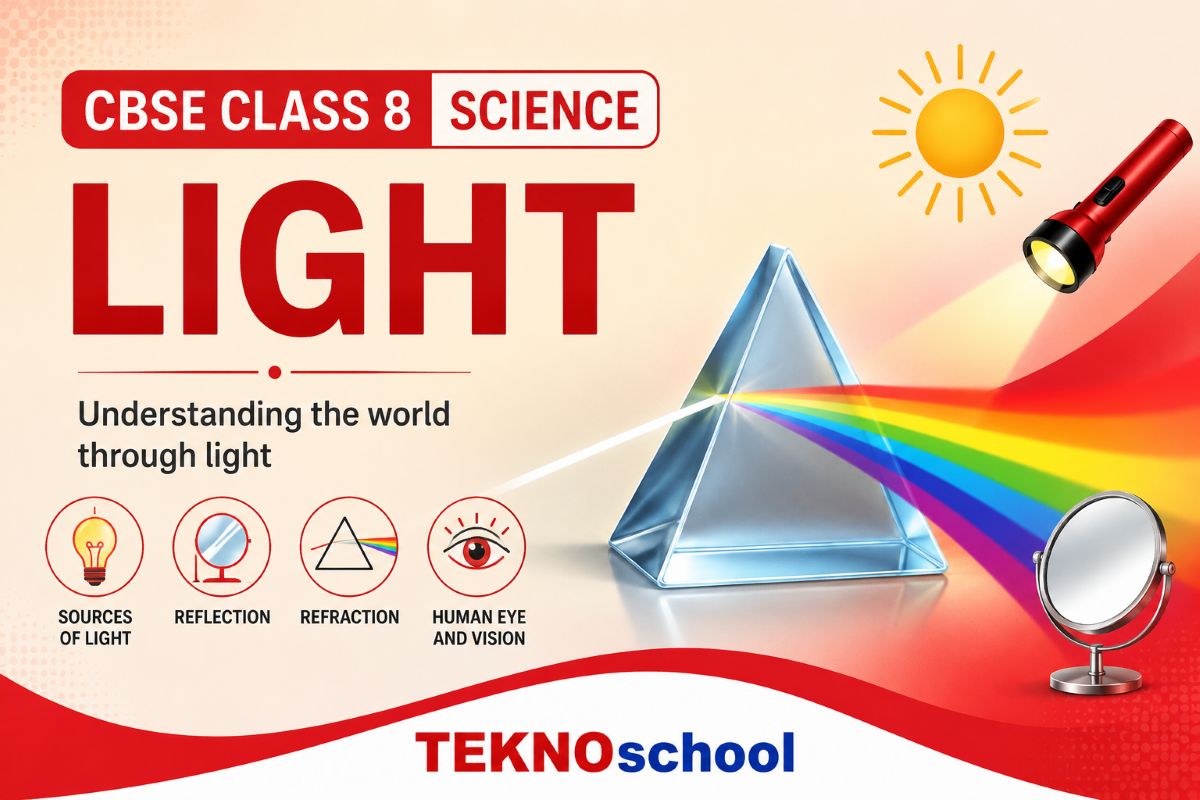
Sunlight appears white, but it is actually a mixture of seven colours. When white light passes through a glass prism, it splits into a band of seven colours called a spectrum. This phenomenon is called dispersion of light.
The Seven Colours of White Light — VIBGYOR
Red deviates the least · Violet deviates the most
💡 Rainbow: A rainbow is a natural example of dispersion. Tiny water droplets in the air act like tiny prisms — they refract, internally reflect, and disperse sunlight into its seven component colours. A rainbow always forms in the direction opposite to the Sun.
⚠️ Exam Tip: A single red light passing through a prism will NOT produce a spectrum — it will remain red. Only white light (a mixture of colours) can produce a spectrum through dispersion.
6. The Human Eye
The human eye is a remarkable sense organ that allows us to see the world. It works somewhat like a camera — light enters, passes through a lens, and forms an image on a light-sensitive layer.
Rods and Cones — The Photoreceptors
🌙 Rods
Sensitive to dim light. Help us see in low-light conditions (night vision). Cannot detect colours.
☀️ Cones
Sensitive to bright light. Help us perceive colours and see fine details in daylight. Responsible for colour vision.
💡 Why Can Owls See at Night? Nocturnal birds like owls have a large number of rods in their retina but very few cones. This allows them to see well in dim light. On the other hand, diurnal birds (like eagles) have more cones, giving them excellent colour vision in bright daylight.
✅ Persistence of Vision: The image formed on the retina persists for about 1/16th of a second even after the object is removed. This is why we perceive moving images in films as continuous motion — the frames change faster than 1/16th of a second.
7. Care of the Eyes
Our eyes are precious and need proper care. Here are important guidelines to protect your vision:
🔹 Do not look at the Sun or a powerful light directly — it can damage the retina permanently.
🔹 Never rub your eyes — if dust particles enter, wash your eyes with clean water.
🔹 Read at normal distance — do not bring the book too close or keep it too far from your eyes.
🔹 Ensure sufficient light while reading — too little or too much light strains the eyes.
🔹 Eat foods rich in Vitamin A — carrots, papaya, mangoes, green vegetables, fish, and eggs support eye health.
🔹 Visit an eye doctor regularly to check for defects.
🔹 Do not use a laser torch to look at anyone’s eyes — laser light can severely damage the retina.
⚠️ Cataract: In some elderly people, the eye lens becomes cloudy, leading to blurred or foggy vision. This condition is called cataract. It can be corrected through surgery, where the opaque lens is removed and an artificial lens is implanted.
🔴 Night Blindness: Deficiency of Vitamin A can cause a condition where a person cannot see properly in dim light. This is called night blindness. Including Vitamin-A-rich foods in your diet helps prevent this condition.
8. Visually Challenged Persons & the Braille System
People with limited or no vision (visually challenged persons) can read and write using a special system designed for them.
The Braille System
The Braille system was invented by Louis Braille in 1824. It is a tactile (touch-based) writing system that uses patterns of raised dots on paper.
Each Braille character is made up of a cell of six dots arranged in two columns of three dots each. Different combinations of raised and flat dots represent different letters, numbers, and punctuation marks.
The system currently in use was adopted in 1932. Unique Braille codes exist for many languages, including several Indian languages, as well as for mathematics and scientific notation.
💡 Non-Optical Aids: Besides Braille, visually challenged persons can use various non-optical aids, including tactile aids (Braille writer, slate and stylus), auditory aids (audio books, screen readers), and electronic aids (special computer software and devices) to learn, read, and communicate.
9. Properties of Image Formed by a Plane Mirror
When you look into a plane mirror, the image you see has certain specific characteristics:
🔹 The image is virtual — it cannot be obtained on a screen.
🔹 The image is erect (upright).
🔹 The image is of the same size as the object.
🔹 The distance of the image from the mirror equals the distance of the object from the mirror.
🔹 The image is laterally inverted — the left side of the object appears as the right side in the image, and vice versa. This is why the word AMBULANCE is written in reverse on the front of ambulances, so that it reads correctly in the rear-view mirror of vehicles ahead.
📝 Complete Worksheet
MCQ · Fill in the Blanks · True / False · Match the Columns · One-Sentence · Short Answer · Long Answer · HOTS · Assertion-Reason
1. The image formed by a plane mirror is —
(a) Virtual, behind the mirror and enlarged
(b) Virtual, behind the mirror and of the same size as the object
(c) Real, at the surface of the mirror and enlarged
(d) Real, behind the mirror and of the same size
Answer: (b) Virtual, behind the mirror and of the same size as the object.
2. The phenomenon of splitting of white light into seven colours is called —
(a) Reflection (b) Refraction (c) Dispersion (d) Deviation
Answer: (c) Dispersion.
3. The angle of incidence is equal to the angle of reflection. This is the statement of the —
(a) Law of dispersion (b) Law of refraction
(c) Law of reflection (d) Law of absorption
Answer: (c) Law of reflection.
4. Which of the following cannot be used to make a lens?
(a) Plastic (b) Water (c) Clay (d) Glass
Answer: (c) Clay — because it is opaque and does not allow light to pass through.
5. The image of the object is always formed on the —
(a) Iris (b) Retina (c) Pupil (d) Cornea
Answer: (b) Retina.
6. A kaleidoscope works on the principle of —
(a) Refraction (b) Total internal reflection
(c) Multiple reflection (d) Dispersion
Answer: (c) Multiple reflection.
7. In dim light, the size of the pupil —
(a) Decreases (b) Increases (c) Remains the same (d) Becomes zero
Answer: (b) Increases — so that more light can enter the eye.
8. The difference in the colour of the eye of different individuals is due to —
(a) Retina (b) Pupil (c) Iris (d) Sclera
Answer: (c) Iris.
1. The bouncing back of light from a smooth surface is called __________.
Answer: Reflection
2. The angle of incidence is always __________ to the angle of reflection.
Answer: Equal
3. An imaginary line drawn perpendicular to the reflecting surface at the point of incidence is called the __________.
Answer: Normal
4. The splitting of white light into seven colours is called __________.
Answer: Dispersion
5. The __________ is the light-sensitive layer at the back of the eye where images are formed.
Answer: Retina
6. __________ cells in the retina are sensitive to dim light, while __________ cells are sensitive to bright light and colour.
Answer: Rods; Cones
7. The image formed on the retina persists for about __________ of a second.
Answer: 1/16th
8. The Braille system was invented by __________.
Answer: Louis Braille
9. The __________ is the coloured part of the eye that controls the size of the pupil.
Answer: Iris
10. When two plane mirrors are placed parallel and facing each other, __________ images are formed.
Answer: Infinite (countless)
1. Regular reflection takes place from rough surfaces.
Answer: False — Regular reflection takes place from smooth, polished surfaces. Rough surfaces produce diffused (irregular) reflection.
2. Diffused reflection is caused by the failure of the laws of reflection.
Answer: False — The laws of reflection are obeyed at every point even in diffused reflection. It is caused by the irregularities of the surface.
3. The human eye has a convex lens.
Answer: True.
4. A rainbow is formed due to the reflection of light only.
Answer: False — A rainbow is formed due to refraction, internal reflection, and dispersion of sunlight by water droplets in the atmosphere.
5. A plane mirror produces a real and inverted image.
Answer: False — A plane mirror produces a virtual, erect, and laterally inverted image of the same size as the object.
6. Cataract is caused by deficiency of Vitamin A.
Answer: False — Cataract is the clouding of the eye lens that occurs in old age. Night blindness is caused by Vitamin A deficiency.
7. The incident ray, the reflected ray and the normal all lie in the same plane.
Answer: True — This is the second law of reflection.
8. The optic nerve transmits visual signals from the retina to the brain.
Answer: True.
| # | Column A | # | Column B |
|---|---|---|---|
| 1. | Cornea | (a) | Controls the size of the pupil |
| 2. | Iris | (b) | Splitting of white light into seven colours |
| 3. | Retina | (c) | Transparent front layer of the eye |
| 4. | Dispersion | (d) | Multiple reflection of light |
| 5. | Kaleidoscope | (e) | Light-sensitive screen where image is formed |
Answers: 1 → (c), 2 → (a), 3 → (e), 4 → (b), 5 → (d)
1. Name the part of the eye where no vision is possible.
Answer: Blind spot.
2. What type of lens is present in the human eye?
Answer: Convex lens.
3. Name the device that uses two plane mirrors to see objects not in the direct line of sight.
Answer: Periscope.
4. What type of image is formed by regular reflection?
Answer: A clear image is formed by regular reflection.
5. Which part of the eye gives it its distinctive colour?
Answer: Iris.
6. Name the nerve that carries visual signals from the retina to the brain.
Answer: Optic nerve.
7. What eye disease is caused by Vitamin A deficiency?
Answer: Night blindness.
8. How many mirrors are used in a periscope?
Answer: Two plane mirrors.
9. Give one natural example of dispersion of light.
Answer: Rainbow.
10. What is the angle of reflection when a light ray falls perpendicular (normally) to a mirror?
Answer: 0° (zero degrees) — because the angle of incidence is 0°, so the angle of reflection is also 0°.
Q1. Differentiate between regular and diffused reflection.
Answer: Regular reflection occurs when parallel light rays fall on a smooth, polished surface (like a mirror) and the reflected rays are also parallel, forming a clear image. Diffused reflection occurs when parallel light rays fall on a rough, uneven surface and the reflected rays scatter in different directions. No clear image is formed. However, in both cases, the laws of reflection are obeyed at each point of incidence.
Q2. What is the angle of reflection when a ray of light is incident on a plane mirror at an angle of 40°?
Answer: According to the law of reflection, the angle of incidence is always equal to the angle of reflection (∠i = ∠r). Therefore, if the angle of incidence is 40°, the angle of reflection will also be 40°.
Q3. Why is the word AMBULANCE written in reverse on the front of an ambulance?
Answer: The word AMBULANCE is written in reverse (mirror writing) so that drivers of vehicles ahead can read it correctly through their rear-view mirror. Since a plane mirror produces a laterally inverted image, the reversed writing appears as the correct, readable word “AMBULANCE” in the mirror.
Q4. State the two laws of reflection.
Answer: (i) The angle of incidence is always equal to the angle of reflection (∠i = ∠r). (ii) The incident ray, the reflected ray, and the normal at the point of incidence all lie in the same plane.
Q5. What is dispersion of light? Name the colours of the spectrum in order.
Answer: The splitting of white light into its seven component colours when it passes through a transparent medium like a glass prism is called dispersion of light. The seven colours in order are: Violet, Indigo, Blue, Green, Yellow, Orange, and Red (VIBGYOR).
Q6. What is the function of the iris in the human eye?
Answer: The iris is the coloured part of the eye that controls the size of the pupil. In bright light, the iris makes the pupil smaller (constrict) to reduce the amount of light entering the eye. In dim light, it makes the pupil larger (dilate) to allow more light to enter.
Q1. Explain the structure and working of the human eye with a neat description of its main parts.
Answer: The human eye is a sense organ that detects light and forms images. Its main parts are: (i) Cornea — the transparent outer covering at the front of the eye that refracts (bends) light entering the eye. (ii) Iris — the coloured, muscular diaphragm behind the cornea that controls the size of the pupil and hence the amount of light entering the eye. (iii) Pupil — the dark, circular opening in the centre of the iris. It appears black because most of the light entering it is absorbed by the retina. (iv) Eye Lens — a convex, crystalline lens that further focuses the light onto the retina. It can change its shape (curvature) to focus on objects at different distances — this ability is called the power of accommodation. (v) Retina — the light-sensitive layer at the back of the eye. It contains two types of photoreceptor cells: rods (sensitive to dim light, enable night vision) and cones (sensitive to bright light and colour). The image is formed on the retina. (vi) Optic Nerve — carries the electrical signals produced by the retina to the brain, which interprets them as visual images. (vii) Blind Spot — the point where the optic nerve leaves the eye. No rods or cones are present here, so no vision is possible at this spot.
Q2. What is the Braille system? Explain its construction and significance.
Answer: The Braille system is a tactile (touch-based) method of reading and writing designed for visually challenged persons. It was invented by Louis Braille in 1824, and the current version was adopted in 1932. Each Braille character consists of a cell made up of six dots, arranged in two columns of three dots each. By raising different combinations of these six dots, different letters, numbers, and punctuation marks are represented. The visually challenged person reads by running their fingertips over the raised dot patterns. Different Braille codes exist for various languages, including several Indian languages, as well as for mathematics and scientific notation. Besides Braille, visually challenged persons also use other aids: tactile aids (Braille writer, slate and stylus), auditory aids (audiobooks, screen readers), and electronic aids (special software, refreshable Braille displays). The Braille system has been of immense importance in empowering visually challenged individuals to access education, information, and communication independently.
Q3. Describe the construction and working of a kaleidoscope. How does it produce beautiful patterns?
Answer: A kaleidoscope is a toy/device that produces beautiful, symmetrical patterns by using the principle of multiple reflections. Construction: It consists of a hollow tube (usually made of cardboard or metal). Inside the tube, two or three rectangular plane mirrors are placed lengthwise, inclined at 60° to each other, forming a triangular shape. At one end of the tube, there is a translucent screen behind which small, coloured glass pieces (or beads) are placed. The other end has a small viewing hole (eyepiece). Working: When the tube is held towards light and the viewer looks through the eyepiece, the coloured glass pieces are reflected multiple times in the mirrors. Since the mirrors are set at 60°, five images of each piece are formed. These images, along with the original pieces, create beautiful, symmetrical patterns. When the tube is rotated, the glass pieces rearrange, and a new pattern is produced with each turn. Kaleidoscopes are used by designers and artists to generate ideas for patterns in wallpapers, fabrics, and jewellery.
Q1. Suppose you are standing in a room with white walls. You can see the walls even though they are not mirrors. Why?
Answer: White walls are not smooth or polished like mirrors, so they do not produce regular reflection. However, they still reflect light — they produce diffused (irregular) reflection. Light from a source (like a bulb or sunlight) falls on the wall and gets scattered in all directions, making the wall visible from any angle. This is why we can see the wall without it acting as a mirror.
Q2. Gurmit wanted to perform an eye observation activity using a laser torch. Her teacher advised her not to do so. Can you explain the basis of the teacher’s advice?
Answer: A laser torch produces a highly concentrated beam of intense light. If this light enters the eye, it can cause severe and permanent damage to the retina (the light-sensitive layer at the back of the eye). Unlike normal light, laser light does not spread out, so all its energy is focused on a tiny spot on the retina, potentially burning and destroying the photoreceptor cells (rods and cones). Hence, one should never look directly at a laser beam.
Q3. A person is standing 1 metre in front of a plane mirror. How far away will the person’s image appear from the person?
Answer: In a plane mirror, the image is formed at the same distance behind the mirror as the object is in front of it. So the image will be 1 metre behind the mirror. The total distance between the person and their image will be 1 m + 1 m = 2 metres.
Q4. Will a red-coloured light produce a spectrum when passed through a glass prism? Why or why not?
Answer: No, a red-coloured light will not produce a spectrum when passed through a prism. A spectrum is produced only when white light (which is a mixture of seven colours) passes through a prism — the prism separates it into its component colours (dispersion). Red light is a single colour (monochromatic light), so there are no other colours to be separated. It will simply pass through the prism as red light, slightly deviated from its path.
Directions: For each question, choose the correct option:
(a) Both Assertion and Reason are true, and Reason is the correct explanation of Assertion.
(b) Both Assertion and Reason are true, but Reason is NOT the correct explanation of Assertion.
(c) Assertion is true, but Reason is false.
(d) Assertion is false, but Reason is true.
Q1.
Assertion (A): We can see objects around us because light reflected from those objects reaches our eyes.
Reason (R): Light is a form of energy that enables the sense of sight.
Answer: (a) Both A and R are true, and R correctly explains A. We see objects because they reflect light into our eyes, and light itself is the energy that makes sight possible.
Q2.
Assertion (A): Diffused reflection does not obey the laws of reflection.
Reason (R): In diffused reflection, the reflected rays go in different directions.
Answer: (d) A is false, but R is true. Diffused reflection does obey the laws of reflection at each individual point — the rays scatter only because the surface is rough and uneven, not because the laws fail.
Q3.
Assertion (A): Owls can see clearly at night.
Reason (R): The retina of an owl has a large number of cone cells.
Answer: (c) A is true, but R is false. Owls can see clearly at night because their retina has a large number of rod cells (not cone cells). Rod cells are sensitive to dim light and enable night vision.
Q4.
Assertion (A): A rainbow is a natural phenomenon showing dispersion of light.
Reason (R): Tiny water droplets in the atmosphere act like small prisms, refracting and dispersing sunlight into seven colours.
Answer: (a) Both A and R are true, and R correctly explains A. Water droplets refract, internally reflect, and disperse white sunlight into the VIBGYOR spectrum, forming a rainbow in the sky opposite to the Sun.