
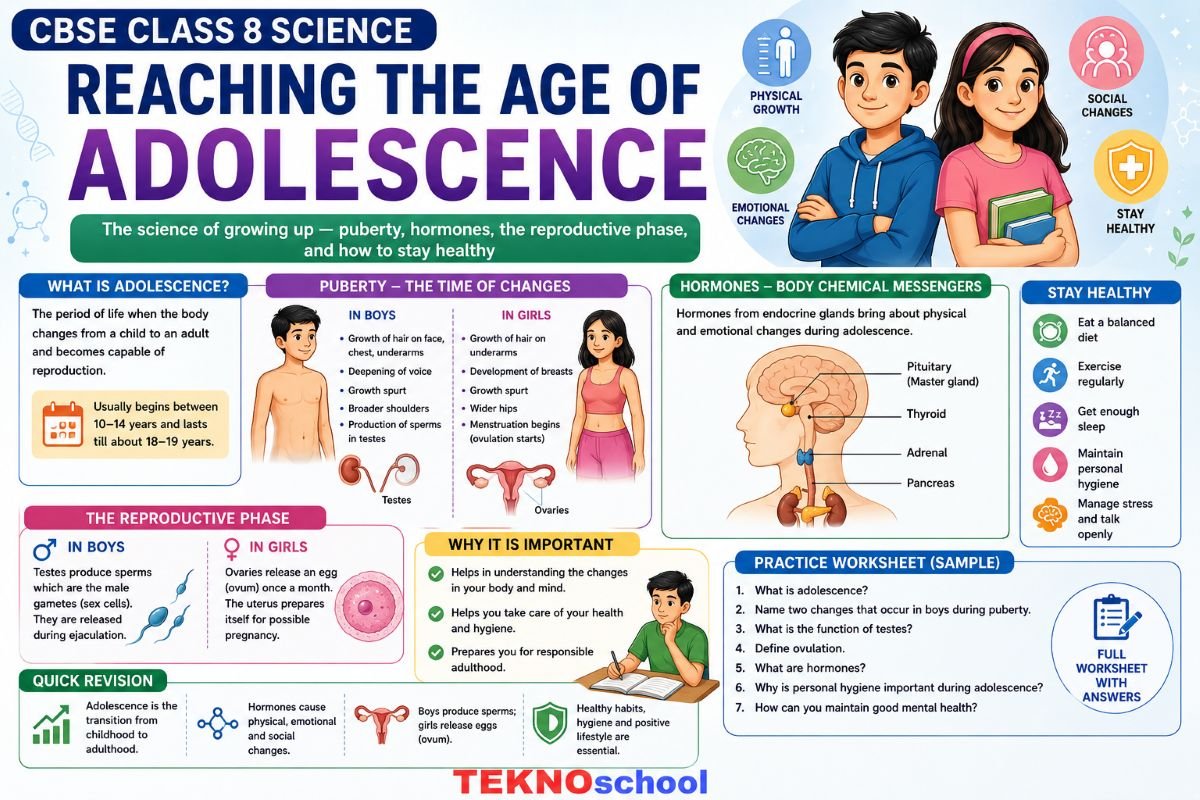
Reaching the Age of Adolescence
Reaching the Age of Adolescence
Reaching the Age of Adolescence — The science of growing up — puberty, hormones, the reproductive phase, and how to stay healthy — with a full practice worksheet and quick revision.
Between childhood and adulthood, our bodies pass through a remarkable stage of change. You grow taller, your voice may change, and your body begins preparing for adult life. This stage is called adolescence, and the changes are guided quietly by chemical messengers called hormones.
In this chapter we will understand what happens during puberty, why these changes take place, how the body becomes capable of reproduction, and how good food, cleanliness and healthy choices help us grow into fit, confident adults.
🎯 What You Will Learn
- The meaning of adolescence and puberty
- The physical and emotional changes at puberty
- The role of hormones and endocrine glands
- How the sex of a baby is determined
- How to take care of reproductive health
1. Adolescence and Puberty
The period of life when the body changes from that of a child to that of an adult is called adolescence. It usually begins around the age of 11 and lasts up to 18 or 19 years. Since this period covers the ‘teen’ years, adolescents are also called teenagers.
📚 Key Idea
Puberty is the stage of adolescence during which the body becomes capable of reproduction. The changes of puberty mark the beginning of adult life. Girls generally reach puberty a little earlier than boys.
Note: The exact age of puberty differs from person to person. There is nothing to worry about if it comes a little earlier or later — every body follows its own natural timetable.
2. Changes at Puberty
Several changes take place in the body during puberty. Study each one carefully.
📏 Increase in Height
The most obvious change is a sudden increase in height, as the long bones of the arms and legs lengthen. Girls usually grow faster at first, but by about 18 years both boys and girls reach their full height.
👤 Change in Body Shape
In boys, the shoulders broaden and the body becomes more muscular. In girls, the region below the waist becomes wider. These changes give boys and girls their adult body shapes.
🎤 Change in Voice
The voice box (larynx) grows larger. In boys it grows more, forming the Adam’s apple, and the voice becomes deep. In girls the larynx is smaller, so the voice stays higher-pitched.
💦 Active Sweat and Oil Glands
Sweat glands and oil (sebaceous) glands become more active. This often leads to pimples and acne on the face — a normal part of growing up that keeping the skin clean helps manage.
🌱 Development of Reproductive Organs
The reproductive organs mature. In males the testes begin to produce sperm; in females the ovaries begin to mature and release eggs (ova). The body is now able to reproduce.
🧠 Mental and Emotional Maturity
The brain develops further, so adolescents think more independently and become more aware of themselves and others. Feelings and moods may change quickly — this too is a normal part of maturing.
3. Secondary Sexual Characters
Features that help us tell males and females apart — other than the reproductive organs themselves — are called secondary sexual characters. They appear at puberty.
4. The Role of Hormones
What causes all these changes? The answer is hormones — chemical substances made by special glands called endocrine glands. Hormones are released directly into the blood and travel to the body parts (targets) where they act.
At puberty, the pituitary gland signals the reproductive organs to become active:
- The testes produce the male hormone testosterone, which brings about male characters.
- The ovaries produce the female hormone estrogen, which brings about female characters.
In short: Hormones make sure the right changes happen at the right age. Their release is controlled by the pituitary gland, often called the ‘master gland’.
5. The Reproductive Phase of Life
The part of life during which a person is capable of reproduction is called the reproductive phase. In girls it begins at puberty and continues until about 45–50 years of age.
During this phase, an ovary releases one mature egg roughly every 28 to 30 days. If the egg is not fertilised, the thick lining of the uterus breaks down and passes out of the body along with some blood. This flow is called menstruation, and it usually lasts 3 to 5 days.
📚 Two Terms to Know
Menarche: the very first menstruation, which marks the start of the reproductive phase.
Menopause: the stopping of menstruation around 45–50 years, marking the end of the reproductive phase.
6. How Is the Sex of a Baby Determined?
Every human cell contains thread-like structures called chromosomes. Two of these are sex chromosomes, named X and Y. Females have two X chromosomes (XX); males have one X and one Y (XY).
An important truth: The egg always carries an X chromosome, so it is the father’s sperm (X or Y) that decides whether the baby is a boy or a girl. The mother is never responsible for the sex of the child. Blaming her is both unfair and unscientific.
7. Other Hormones and Their Glands
Besides the sex hormones, several other endocrine glands release hormones that keep the body working properly.
8. Hormones in Insects and Frogs
Hormones also control the life cycles of some animals. The change from a young form to an adult — called metamorphosis — is driven by hormones.
- In insects such as moths and butterflies, metamorphosis (egg → larva → pupa → adult) is controlled by insect hormones.
- In frogs, the change from tadpole to adult frog is controlled by the hormone thyroxine, which needs iodine. Without enough iodine, a tadpole cannot become an adult frog.
9. Reproductive Health
Adolescence is a time of rapid growth, so the body needs extra care. Good habits during these years build a healthy adult life.
🍳 A Balanced Diet
Eat food rich in proteins, carbohydrates, fats, vitamins and minerals — roti or rice, dal, vegetables, fruits and milk. Iron-rich foods (like leafy greens and jaggery) are especially important. Avoid too much junk food.
🥒 Personal Hygiene
Because the sweat and oil glands are very active, bathe daily and keep the whole body clean. Girls should take special care of cleanliness during menstruation to stay comfortable and healthy.
🏃 Physical Activity
Regular walking, playing and exercise keep the body fit and the mind fresh, and help you sleep and study better.
🚫 Say ‘NO’ to Drugs
Never take alcohol, tobacco or any drug. They harm the body, are addictive, and destroy health and studies. If anyone pressures you, firmly say no and talk to your parents, a teacher or a doctor.
Key Terms to Remember
⚡ Quick Revision
- Adolescence (about 11–19 yrs) is the change from child to adult; puberty makes the body capable of reproduction.
- Changes at puberty: increased height, change in body shape and voice, active sweat/oil glands, maturing reproductive organs, and mental maturity.
- Secondary sexual characteristics (facial hair in boys, breast development in girls) tell males and females apart.
- Changes are driven by hormones: testosterone (testes) and estrogen (ovaries), controlled by the pituitary gland.
- Menarche starts the reproductive phase; menopause (45–50 yrs) ends it.
- Sex is decided by the father: sperm with X → girl (XX), sperm with Y → boy (XY). The mother is never responsible.
- Other hormones: thyroxine (goitre), insulin (diabetes), adrenaline (stress), growth hormone (dwarfism/gigantism).
- Stay healthy with a balanced diet, cleanliness, exercise, and by saying no to drugs.
📝 Practice Worksheet
Attempt every question first, then check the answer given below it.
Part A · Multiple Choice Questions
1. The stage of life at which the body becomes capable of reproduction is called:
(a) infancy (b) puberty (c) old age (d) menopause
2. The male hormone is:
(a) estrogen (b) insulin (c) testosterone (d) thyroxine
3. A baby will be a girl if the fertilising sperm carries the chromosome:
(a) X (b) Y (c) XY (d) YY
4. Deficiency of iodine can cause the disease:
(a) diabetes (b) goitre (c) dwarfism (d) acne
5. The change from tadpole to frog is controlled by:
(a) insulin (b) adrenaline (c) thyroxine (d) testosterone
Part B · Fill in the Blanks
1. Chemical messengers secreted by endocrine glands are called __________.
2. The female sex hormone is __________.
3. The first menstruation is known as __________.
4. Females have two __________ chromosomes.
5. The gland that controls other endocrine glands is the __________ gland.
Part C · True or False
1. Girls usually reach puberty a little earlier than boys.
2. The mother is responsible for the sex of the baby.
3. The Adam’s apple is more prominent in boys.
4. Insulin controls the level of sugar in the blood.
Part D · Match the Following
Part E · Very Short Answer
1. What are endocrine glands also known as?
2. At what age does menopause usually occur?
3. Name the hormone secreted by the adrenal glands.
Part F · Short Answer
1. What are secondary sexual characters? Give one example each for boys and girls.
2. Why is a balanced diet important during adolescence?
3. Why does the voice of boys become deep at puberty?
Part G · Long Answer
1. Explain how the sex of a baby is determined.
2. Describe any four changes that take place in the body at puberty.
Part H · Think Higher (HOTS)
1. A family blames the mother because they have only daughters. Using science, explain why this is wrong.
2. Why might a tadpole fail to develop into an adult frog if the water lacks iodine?
3. Why should adolescents keep their skin especially clean?