HV Capacitor Bank – Design and Specification Guide
HV Capacitor Bank – Design, Standards, and Engineering Essentials
Introduction
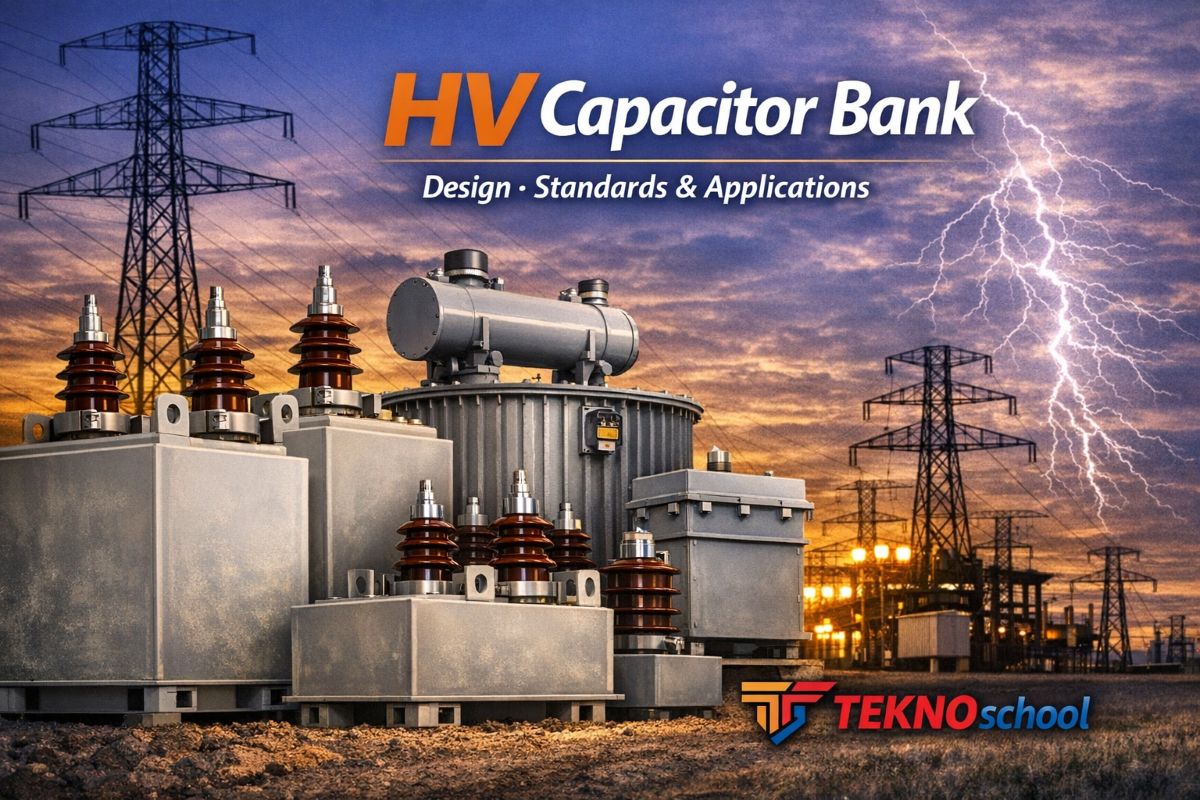
In modern industrial power systems, maintaining an optimal power factor is essential for efficiency and cost control. The HV Capacitor Bank plays a pivotal role in reactive power compensation, ensuring stable voltage profiles and minimising transmission losses.
1. Scope and Purpose
The specification covers the design, manufacture, assembly, testing, and delivery of high‑voltage shunt capacitors used for individual motor power‑factor correction and outdoor installation. Each capacitor bank includes all accessories required for safe and efficient operation — from reactors and resistors to structural supports and protective devices.
The goal is clear: deliver a system that performs consistently under tropical, humid, and corrosive conditions typical of Indian industrial sites, with a design ambient temperature of 50°C and altitude up to 1000 m above mean sea level.
2. Codes and Standards
Compliance with recognised standards ensures safety and interoperability. The specification mandates adherence to the latest Bureau of Indian Standards (BIS) publications, including:
| Standard | Description |
|---|---|
| IS 13925 | Shunt capacitors for AC systems above 1000 V |
| IS 2099 | Bushings for alternating voltages above 1 kV |
| IS 2544 | Porcelain post insulators |
| IS 5553 | Reactors |
| IS 9402 | HV fuses for capacitor protection |
| IS 12672 | Internal fuses and overpressure disconnectors |
| IS 8084 | Interconnecting bus bars up to 36 kV |
| IS 5 | Paint color codes for electrical equipment |
Where Indian standards are unavailable, equivalent IEC, BS, IEEE, or NEMA standards apply. In case of conflict, statutory regulations take precedence, followed by data sheets, job specifications, and finally, this specification.
3. General Requirements
The blog emphasises reliability and lifecycle support:
- Only proven, field‑tested equipment is acceptable — prototypes are excluded.
- Vendors must guarantee spare‑part availability for 15 years and provide one‑year notice before product phase‑out.
- Complete design responsibility lies with the supplier, ensuring compatibility among all components.
This approach reflects the long‑term maintenance philosophy essential for continuous industrial operation.
4. Construction Overview
An HV capacitor bank typically includes:
- Capacitor units of appropriate kVAR rating
- Series reactor for inrush current limitation
- Residual Voltage Transformer (RVT) for monitoring and protection
- External expulsion or HRC fuses and internal element fuses
- Insulators, bushings, and cable boxes
- Aluminium bus bars with PVC sleeves
- Discharge resistors to safely dissipate stored energy
- Galvanised steel support structure ensuring a minimum 2.75 m clearance from the ground
The structure’s galvanising thickness (≥ 610 g/m²) ensures corrosion resistance in outdoor environments.
5. Design Features
Capacitor Units
Each phase comprises multiple single‑phase units connected in a star formation. The dielectric is polypropylene or mixed dielectric, impregnated with non‑PCB, biodegradable fluid. Units must withstand electrodynamic and thermal stresses during transient conditions and conform to IS 13925 overload capacity.
Discharge Resistors
Resistors reduce terminal voltage to ≤ 50 V within 10 minutes after disconnection, ensuring operator safety.
Bus Bars
High‑conductivity aluminium bus bars are insulated with heat‑shrink PVC sleeves and rated for 130% of nominal current. Minimum clearances for 6.6 kV systems are:
- Phase‑to‑phase: 228.6 mm
- Phase‑to‑earth: 177.8 mm
Series Reactor
The reactor limits inrush current and supports harmonic filtering. It is oil‑immersed, air‑cored, and equipped with a conservator. Temperature rise limits follow IS 2026.
Cable Boxes
Designed for XLPE‑insulated copper or aluminium cables, cable boxes meet IP‑55 ingress protection and withstand system fault levels for one second. Nickel‑plated brass glands and tinned copper lugs ensure secure terminations.
Residual Voltage Transformer (RVT)
The RVT provides continuous voltage monitoring and unbalance protection. It features dual secondary windings — one star‑connected and one open‑delta — each rated at 110/√3 V.
Insulators and Bushings
Bushings comply with IS 2099 and are suitable for highly polluted environments, with vitrified porcelain construction for mechanical strength and moisture resistance.
6. Protection and Safety
Protection is coordinated through the circuit breaker controlling the capacitor bank, typically including:
- IDMTL over‑current and earth‑fault relays
- Neutral voltage displacement relay
- Under‑voltage and over‑voltage relays
- Timer preventing premature re‑closure before full discharge
Manufacturers may recommend additional protection schemes for enhanced reliability.
7. Painting and Marking
Durability extends to surface treatment. All enclosures and frameworks receive two coats of epoxy‑based acid/alkali‑resistant paint (shade 631 as per IS 5) after anti‑rust priming. Fasteners are cadmium‑plated or zinc‑passivated.
Each unit bears a stainless‑steel nameplate showing ratings, technical particulars, and connection diagrams. The same applies to reactors and RVTs for easy identification during maintenance.
8. Sizing Criteria
The capacitor bank and series reactor together must deliver the specified net capacitive kVAR at nominal voltage. Design must account for system voltage variation and voltage rise due to reactor impedance. Insulation levels are selected accordingly, and reactors are sized to carry continuous over‑current per IS 13925.
9. Inspection and Testing
Routine and acceptance tests are mandatory under IS 13925, witnessed by the purchaser’s representative. Key tests include:
- Visual examination
- Capacitance and output measurement
- Insulation resistance
- Voltage tests between the terminals and the container
- Discharge device efficacy
- Dielectric loss angle (tan δ) measurement
- Sealing test
Type‑test reports from recognized agencies must accompany all equipment. Series reactors and RVTs undergo routine testing at sub‑supplier works.
10. Packing and Dispatch
Equipment is packed in multiple sections for safe transport and outdoor storage. Each crate includes waterproof wrapping, skid bottoms, and clear markings such as Fragile, This Side Up, and Center of Gravity. Documentation — erection manuals, test reports, and final drawings — is enclosed in waterproof covers.
Conclusion
The HV Capacitor Bank specification by QUANTA Process Solutions Pvt. Ltd. exemplifies engineering precision and compliance with international standards. From dielectric selection to structural design and testing, every detail ensures long‑term reliability in demanding industrial environments.
For engineers and students exploring power‑factor correction systems, this document provides a benchmark for understanding how design discipline, material selection, and protection coordination converge to create safe, efficient, and sustainable high‑voltage installations.