Applications of PLCs in Substation Automation and SCADA
⚡ Applications of PLCs in Substation Automation and SCADA
Applications of PLCs in Substation Automation and SCADA– Substation automation has evolved from hardwired relay logic and isolated monitoring panels into a smart, networked, and highly responsive control environment. Today, utilities and industrial power systems require fast communication, better visibility, reduced downtime, and seamless integration between field equipment and control rooms. In this transition, the Programmable Logic Controller (PLC) has become an important platform for substation automation, especially in systems where flexibility, protocol conversion, logic control, alarm handling, and SCADA integration are essential.
PLCs are no longer limited to simple motor control or factory automation. In modern substations, they are increasingly used for RTU replacement, intelligent alarm management, communication with IEDs, data concentration, metering support, and protocol interfacing with existing SCADA systems. Their modular design, fast scan time, and ability to work with both analog and discrete I/O make them highly suitable for station-level automation applications.
🔹 Why PLCs Are Used in Substation Automation
A substation contains multiple intelligent devices such as protection relays, energy meters, breaker monitoring units, transformer monitoring systems, annunciators, and bay controllers. These devices generate a large amount of operational data. A PLC can collect, process, validate, and transmit this information to SCADA or a higher-level control system in an organized way. Unlike conventional hardwired RTUs, PLCs provide easy programming, online diagnostics, future expandability, and simpler maintenance.
PLCs are particularly useful in brownfield substations where utilities want to modernize control functions without completely replacing the existing infrastructure. They can sit between old field equipment and the control network, helping engineers retain legacy systems while adding Ethernet communication, trending, remote diagnostics, and protocol interoperability.
🔹 RTU Emulation and Replacement
One of the most valuable applications of a PLC in substations is RTU emulation and replacement. Traditional Remote Terminal Units were designed mainly for collecting status signals and analog values and transmitting them to a remote SCADA master. However, modern PLCs can perform the same role while offering much more intelligence. A PLC can acquire breaker status, isolator position, transformer tap information, alarm contacts, and analog measurements, then package that data for SCADA transmission.
When an aging RTU becomes difficult to maintain, a PLC-based system can replace it without requiring a complete redesign of the substation. The PLC can emulate the required communication behavior and continue serving the master station while also providing advanced local control logic. This is especially helpful in phased modernization projects where continuity of operation is critical.
🔹 Alarm Reduction and Intelligent Messaging
Substations often suffer from alarm flooding. During abnormal conditions, dozens of alarms may arrive at the control room within seconds, making it difficult for operators to identify the root cause. A PLC can reduce nuisance alarms by applying programmable logic, delay timers, sequence checking, and event suppression rules. Instead of transmitting every raw signal directly, it can group related alarms and generate meaningful messages.
For example, if a breaker trip occurs due to relay operation, the PLC can combine relay pickup, breaker open feedback, and feeder fault indication into one intelligent message such as: Feeder tripped due to overcurrent protection. This reduces operator confusion and improves response time. Intelligent messaging is one of the strongest reasons to use PLCs over basic data collection devices.
📊 Infographic: PLC Roles Inside a Modern Substation
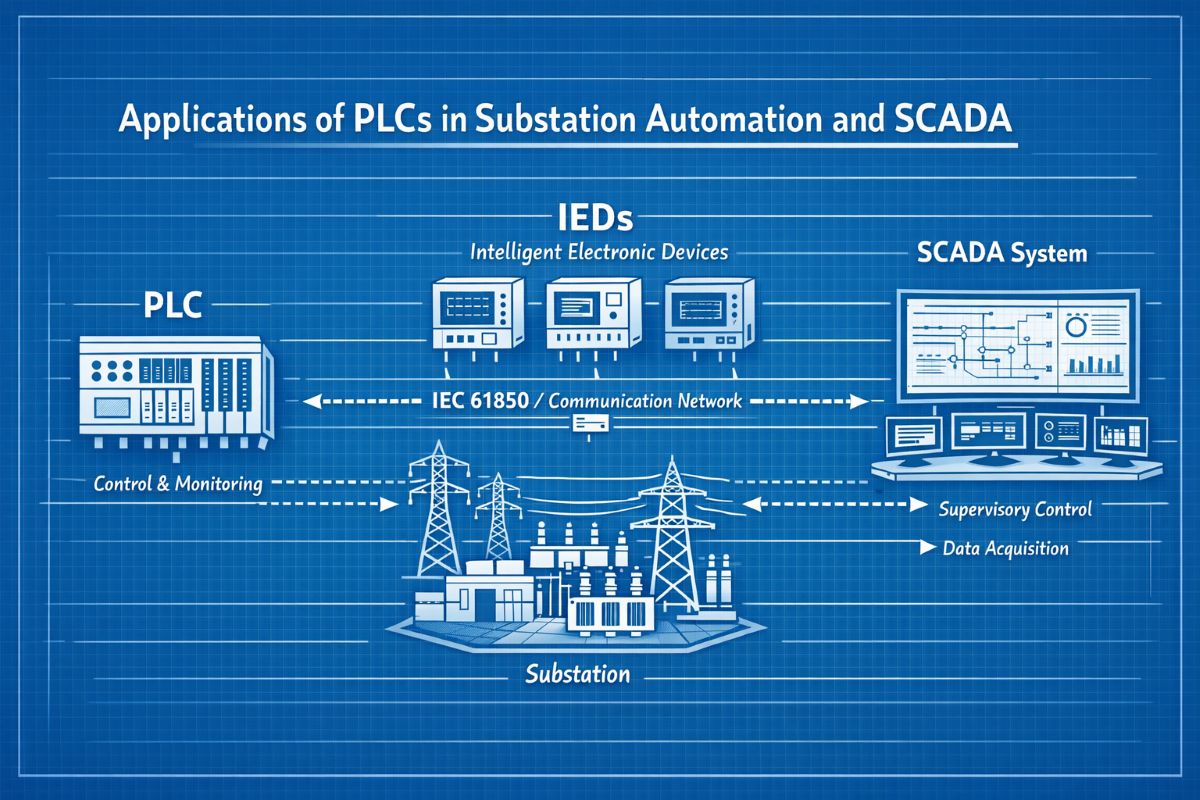
Field Signals ➜ Breaker status, transformer alarms, analog values, interlocks
PLC Processing ➜ Logic execution, alarm filtering, protocol conversion, data validation
Communication Layer ➜ Ethernet, TCP/IP, DNP 3.0, Modbus, DF1, Profinet, ControlNet
SCADA / Control Center ➜ Monitoring, trending, metering, event logging, remote operation
🔹 Use of Existing SCADA Protocols
A major challenge in substation upgrades is compatibility with existing SCADA protocols. Utilities often cannot change the master station just because a field device is replaced. PLCs solve this problem by supporting or interfacing with widely used industrial and utility communication protocols. This allows the automation engineer to retain the original SCADA architecture while replacing outdated field hardware.
With support for Ethernet and TCP/IP networks, PLCs can communicate efficiently over modern infrastructure while still handling older devices through serial or gateway-based communication. Depending on the platform and communication modules used, PLC systems can interact using DNP 3.0, Modbus, Modbus Plus, AB DF1, ControlNet, and Profinet. This multi-protocol capability is extremely valuable in substations where equipment from different generations and manufacturers must operate together.
🔹 Integration of IEDs and Data Concentration
Modern substations use many IEDs (Intelligent Electronic Devices), including protection relays, energy meters, disturbance recorders, transformer monitoring units, and bay controllers. If every IED communicates directly with SCADA, the system becomes harder to manage. A PLC can act as a data concentrator, collecting data from multiple IEDs and presenting a clean, unified data structure to the SCADA master.
This simplifies network design and reduces engineering effort at the supervisory level. Instead of managing many individual device mappings, the SCADA system can communicate with one PLC or gateway layer. The PLC can also normalize data, scale analog values, timestamp discrete events, and generate health diagnostics for connected IEDs.
🔹 Analog and Discrete I/O Handling
Substation automation requires both analog and discrete I/O. Analog signals may include bus voltage, current, power, transformer temperature, oil level, or transducer outputs. Discrete signals may include breaker open/close status, trip circuit healthy, relay alarm, spring charged status, isolator position, and panel trouble contacts. PLCs are ideal for managing this mix because they can scan both signal types in a structured and reliable way.
In addition, PLC logic can apply filtering, debounce noisy contacts, perform alarm deadband control, and convert raw signals into engineering values. This makes the data delivered to SCADA more meaningful and stable than direct unmanaged acquisition.
🔹 Metering, Monitoring, Logging, and Trending
A PLC-based substation system can do far more than real-time monitoring. It can also support metering and station information management by collecting kW, kWh, kvar, voltage, current, demand, frequency, and power factor data from meters and relays. This information can then be logged, trended, and used for operational analysis.
Parameter monitoring and historical trending help maintenance teams detect abnormal patterns before they become failures. For instance, rising transformer temperature, repeated breaker operation counts, declining battery voltage, or increasing load current can all be monitored through the PLC. Such data improves predictive maintenance and supports better asset management decisions.
🔹 Key PLC Applications in Substations
| Application | How PLC Helps |
|---|---|
| RTU replacement | Collects field data, executes logic, and communicates with SCADA master |
| Alarm reduction | Filters nuisance alarms and creates intelligent event messages |
| Protocol conversion | Bridges DNP 3.0, Modbus, DF1, ControlNet, Profinet, and TCP/IP systems |
| IED integration | Acts as a concentrator for relays, meters, and monitoring devices |
| Trending and logging | Stores process values, equipment health data, and event history |
🔹 Final Perspective
PLCs offer a practical and powerful solution for modern substation automation. They combine logic solving, communication flexibility, I/O handling, alarm intelligence, and data management in one platform. Whether the goal is to replace an old RTU, integrate multiple IEDs, support existing SCADA protocols, or improve monitoring and event handling, PLCs provide a scalable and maintainable approach.
As substations continue moving toward digitalization, the PLC will remain an important bridge between field-level electrical equipment and supervisory systems. Its real strength lies not only in control, but in turning disconnected station data into useful operational intelligence.