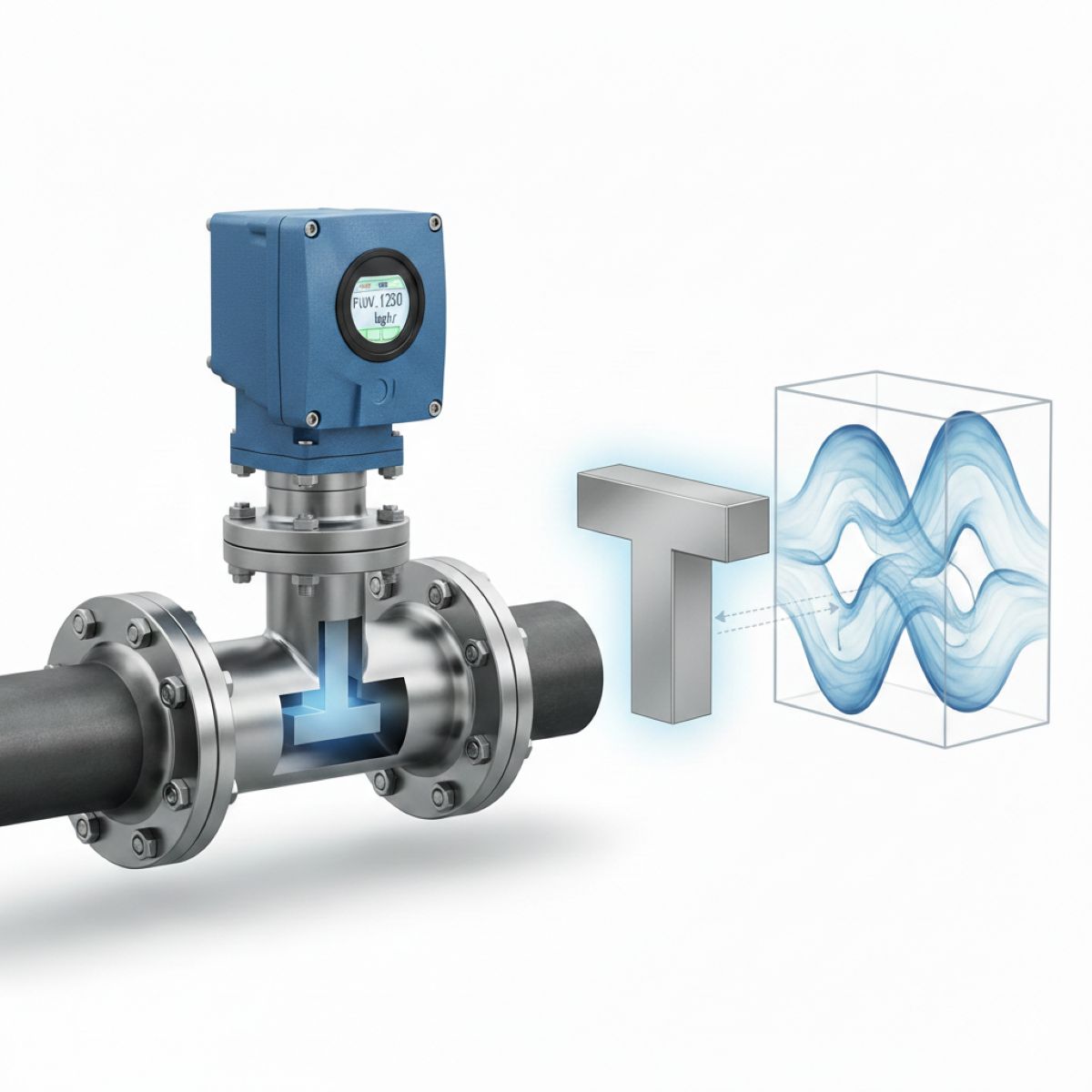
Vortex Flow Meters
🌪️ Vortex Flow Meters: Measuring the Swirl! 🌊
Introduction
Welcome to the world of flow measurement! 🌍 If you’ve ever wondered how industries measure the steam powering a turbine 🏭, the gas flowing through a pipeline ⛽, or the water cooling a massive reactor ❄️, you’ve come to the right place. Today, we are diving deep into one of the most versatile and reliable heroes of the instrumentation world: the Vortex Flow Meter.
Imagine standing by a river and sticking a paddle into the water. You notice little swirls or whirlpools forming behind the paddle and floating downstream, right? 🛶 That simple phenomenon is the secret sauce behind this technology!
In this blog we will break down everything you need to know about Vortex Flow Meters in simple, plain English. No complex jargon without explanation, just pure engineering goodness sprinkled with emojis! 🛠️✨
📑 Table of Contents
🧐 What is a Vortex Flow Meter? (The Basics)
🎡 How Does It Work? (The Von Kármán Effect)
🏗️ Construction & Anatomy
🧱 Material of Construction (MOC)
📋 Key Specifications & Data Sheet Decode
📐 Design & Sizing Guidelines
🛠️ Installation Guidelines (Do’s & Don’ts)
🚀 Latest Technology & Smart Features
🏭 Applications in Industry
⚠️ Hazardous & Corrosive Applications
🥊 Vortex vs. The Rest (Comparison)
🏆 Major Brands & Popular Models
🏁 Conclusion
🧐 1. What is a Vortex Flow Meter? (The Basics)
A Vortex Flow Meter is a device used to measure the flow rate of liquids 💧, gases ☁️, and steam ♨️. It is a “volumetric” flow meter, meaning it measures the volume of fluid passing through a pipe per unit of time (like liters per minute or cubic meters per hour).
Why are they so popular?
Versatility: They can measure almost anything—liquid, gas, or steam.
No Moving Parts: Unlike a turbine meter that has a spinning wheel, a vortex meter has no moving parts to wear out. 🚫⚙️
Reliability: They are robust and can last for years with little maintenance.
Cost-Effective: Compared to some high-tech meters, they offer a great balance of price and performance. 💰
Think of the Vortex Flow Meter as the “Swiss Army Knife” 🔪 of flow measurement. It might not be the specialist for every single extreme condition, but it is amazing at handling a wide variety of jobs.
🎡 2. How Does It Work? (The Von Kármán Effect)
Okay, let’s get into the science, but keep it simple. The working principle is based on a phenomenon called the Von Kármán Vortex Street. 🛣️
The Paddle in the Stream Analogy 🛶
Imagine a smooth stream of water. Now, place a flat rock or a stick (an obstacle) in the middle of the stream. What happens?
As the water flows past the obstacle, it can’t flow through it, so it has to go around. This creates a disturbance.
On the downstream side of the stick, the water starts to curl back on itself.
These curls turn into spinning whirlpools called vortices.
These vortices detach (or “shed”) from the stick in a repeating pattern: one from the left side, then one from the right, then left, then right. 🔄
Here is the cool part: The faster the water flows, the faster the vortices are created.
The Nerdy Math (Don’t Worry, It’s Easy!) 🧮
f=St ×V/d
Translation:
f = How many vortices per second (frequency), swirls
St = Strouhal Number (a magic constant ≈ 0.2)
V = How fast the fluid is zooming
d = Width of the obstacle
Bottom line: More swirls = faster flow. Less swirls = slower flow. SIMPLE! 🎯We count swirls in a vortex flow meter.
If we count how many vortices are formed in one second (the frequency), we can calculate exactly how fast the fluid is moving!
🏗️ 3. Construction & Anatomy
Let’s take an X-ray look inside a Vortex Flow Meter to see what it’s made of. 🩺
1. The Meter Body 🛡️
This is the main housing that connects to your pipeline. It looks like a piece of pipe with flanges (rims) on the ends to bolt it into place.
It holds the pressure of the fluid.
It protects the delicate sensors inside.
2. The Bluff Body (The Shedder Bar) 🧱
This is the “stick in the stream” we talked about. It is a bar placed right in the middle of the flow path.
Shape: It’s not just a round pole. It usually has a specific shape—triangle, trapezoid, or T-shape—carefully designed to create strong, clean vortices.
Function: To deliberately disturb the flow and create the swirls.
3. The Sensor 📡
You can’t see the vortices in a steel pipe with your naked eye, so we need a sensor.
Piezoelectric Crystals: These are the most common. When a vortex spins off the shedder bar, it creates a tiny pressure pulse (a mini squeeze). The crystal detects this squeeze and converts it into an electrical signal ⚡.
Capacitance Sensors: These detect changes in capacitance caused by vortex vibration.
4. The Transmitter 🧠
This is the “brain” of the operation. It sits on top of the meter body (usually in a blue or grey box).
It receives the tiny electrical pulses from the sensor.
It filters out noise (like pipe vibrations).
It counts the pulses and calculates the flow rate.
It displays the number on a screen (LCD) and sends the data to the control room (via 4-20mA, HART, or Modbus).
🧱 4. Material of Construction (MOC)
Choosing the right material is critical! If you pick the wrong one, your acid might eat the meter, or your steam might melt it! 😱
A. Wetted Parts (Parts touching the fluid) 🌊
Stainless Steel (SS304 / SS316L):
Best for: Water, Steam, Air, Mild Chemicals.
Why: It is the industry standard. Resistant to rust and durable. 90% of meters use this. 🥈
Hastelloy C:
Best for: Aggressive acids, chlorides, seawater.
Why: Super corrosion resistance. If SS316 fails, Hastelloy is the next step up. 💪
Titanium:
Best for: Highly corrosive environments, specific chemical processes.
Why: Lightweight and extremely resistant to corrosion.
Tantalum:
Best for: The nastiest stuff imaginable (like hot concentrated Hydrochloric acid).
Why: It’s almost chemically inert (doesn’t react with anything). But it is very expensive! 💸
Plastic / PTFE (Teflon) Lined:
Best for: Corrosive liquids where metal cannot be used.
Why: Chemical resistance at a lower cost than exotic metals. (Note: Plastic usually can’t withstand high temperatures or steam.)
B. Non-Wetted Parts (The Housing) 🏠
Aluminum: Commonly used for the transmitter box (painted). Lightweight and cheap.
Stainless Steel: Used for the transmitter box in offshore or marine environments to prevent rusting from salty air. 🚢
📋 5. Key Specifications & Data Sheet Decode
When you look at a datasheet, it can look like confusing code. Let’s decode the important specs! 🕵️♂️
1. Accuracy 🎯
Liquids: Typically ±0.75% of the rate. (Very good!)
Gas/Steam: Typically ±1.0% to ±1.5% of the rate. (Slightly less accurate than liquid because gases compress).
2. Turndown Ratio (Rangeability) 📉
This tells you the range between the lowest and highest flows the meter can measure.
Vortex Average: 20:1 or 30:1.
Translation: If the max flow is 100 liters/min, it can be measured accurately down to 5 liters/min. Below that, the flow is too slow to make vortices, and the meter reads zero.
3. Reynolds Number (Re) 🔢
This is a physics number that describes how “swirly” or “smooth” a fluid is.
Constraint: Vortex meters require turbulent flow (high Reynolds number) to operate.
Limit: Usually, Re > 20,000 is needed for linear accuracy. If the flow is too slow (laminar), no vortices form. 🐢 = ❌
4. Pressure & Temperature Limits 🌡️
Temp: Standard meters handle -40°C to +260°C. High-temp versions (for superheated steam) can go up to 450°C.
Pressure: Usually limited by the flange rating (ANSI 150#, 300#, 600#). The sensor itself is very tough.
5. Output Signals 📡
4-20mA: The standard analog signal.
Pulse: A simple on/off pulse for every unit of volume (great for totalizing).
HART/Modbus/Profibus: Digital communication for “smart” plants.
📐 6. Design & Sizing Guidelines
Warning: ⚠️ Never buy a meter based on “Line Size” (Pipe Size). Just because you have a 4-inch pipe doesn’t mean you need a 4-inch meter!
Sizing Rule #1: Velocity is King 👑
Vortex meters need a minimum velocity to shed vortices.
Liquids: Need at least 0.3 to 0.5 m/s.
Gases/Steam: Need at least 3 to 6 m/s.
If your process normally runs very slowly, you might need to reduce the pipe size at the meter (e.g., use a 2-inch meter in a 4-inch pipe) to speed up the fluid. This is called “necking down.” 📉
Sizing Rule #2: Pressure Drop ⏬
Every obstruction in a pipe slows down the flow slightly and drops the pressure.
Ensure the pressure drop across the meter isn’t too high, or your pumps will work too hard.
Cavitation Check: If measuring liquid, ensure the pressure drop doesn’t cause the liquid to boil (flash) into gas inside the meter. That destroys sensors! 💥
Design Checklist ✅
Check Min/Max Flow rates.
Check Process Temperature.
Check Process Pressure.
Confirm Fluid Density/Viscosity.
🛠️ 7. Installation Guidelines (Do’s & Don’ts)
Installation is where 50% of problems happen. A perfect meter installed poorly is just a piece of junk. 🗑️
A. Straight Run Requirements 📏
Vortex meters hate “disturbed” flow. Elbows, valves, and pumps create turbulence that confuses the vortex sensor. You need a straight pipe to smooth the flow.
Upstream (Before the meter): Usually 10D to 20D.
Example: If the meter is 50mm (2 inches), you need 500mm to 1000mm of straight pipe before it.
If there is a control valve upstream, you might need 50D! (Try to keep control valves downstream.
Downstream (After the meter): Usually 5D.
B. Orientation 🧭
Liquids: Install in a horizontal or vertical pipe (flow going UP). ⬆️
Never flow down for liquids (pipe might not be full).
Gas/Steam: Horizontal or Vertical (Up or Down is usually fine).
Horizontal Pipes:
Install the meter so the shedder bar is horizontal or vertical?
Pro Tip: For high-temp steam, install the transmitter to the side or bottom so heat rises away from the electronics. 🔥🚫
C. Alignment & Gaskets 💍
Center it! If the meter is off-center, it creates weird swirls.
Gaskets: Don’t let the gasket stick out into the flow! It disturbs the velocity profile.
D. Vibration 📳
Vortex meters measure vibration (pressure pulses). If the pipe itself is shaking like a washing machine, the meter will get confused.
Fix: Support the pipe firmly on both sides of the meter. Use rubber vibration dampeners if needed.
🚀 8. Latest Technology & Smart Features
Vortex meters aren’t stuck in the 1970s. They have gone digital! 🤖
1. Multivariable Transmitters (All-in-One) 🎼
Old way: 1 Vortex Meter + 1 Pressure Transmitter + 1 Temp Sensor + 1 Flow Computer = Mass Flow.
New way: The Multivariable Vortex Meter.
It has a built-in temperature sensor (inside the shedder bar) and a built-in pressure sensor.
Result: It outputs Mass Flow (kg/hr) directly! Amazing for steam. ♨️⚖️
2. Dual-Sensor / Dual-Bar Design ✌️
To fight vibration, some brands use two sensors.
Sensor A feels (Flow + Pipe Vibration).
Sensor B feels (Only Pipe Vibration).
Math: A – B = Pure Flow! 🧠
3. Spectral Signal Processing (SSP) 📶
Advanced digital filters analyze the frequency spectrum. They can tell the difference between the “rhythm” of a vortex and the “noise” of a pump, automatically ignoring the noise.
4. Non-Wetted Sensors 🛡️
Some designs allow you to replace the sensor without shutting down the line. The sensor is outside the fluid, sensing pulses through the wall. Great for critical 24/7 plants.
🏭 9. Applications in Industry
Where will you find these gadgets? Everywhere!
🔌 Power Plants
Steam Flow: Measuring high-pressure steam going to turbines.
Condensate: Measuring hot water returning from the process.
🧪 Chemical & Petrochemical
Raw Materials: Measuring liquid chemicals entering a reactor.
Nitrogen Gas: Monitoring blanket gas usage in tanks.
🍕 Food & Beverage
CIP Systems: Measuring hot water and cleaning agents.
Steam: For cooking, sterilization, and autoclaves. (Hygienic connections available).
🏗️ HVAC & Utilities
Compressed Air: Finding leaks in the factory air system. 💨
Natural Gas: Measuring fuel to boilers (burner efficiency).
⚠️ 10. Hazardous & Corrosive Applications
☠️ Hazardous Areas (Explosive Atmospheres)
In Oil & Gas plants, a spark can cause a disaster. 💥
Certification: Look for meters certified as Explosion Proof (Ex d) or Intrinsically Safe (Ex ia).
Standards: ATEX (Europe), IECEx (Global), FM/CSA (USA/Canada).
Design: The electronics are sealed in heavy-duty housings that prevent any internal spark.
🧪 Corrosive Media
Acids (Sulfuric, Hydrochloric) and Alkalis (Caustic Soda) eat steel for breakfast.
Solution 1: Hastelloy or Titanium bodies. Expensive but proven.
Solution 2: Wafer-style meters. They have a less metal body, making them cheaper in exotic materials.
Solution 3: Plastic Bodies (PVC/PVDF). Good for low-pressure/temp corrosive water treatment.
🥊 11. Vortex vs. The World (Comparison)
How does Vortex stack up against the rivals? 🤺
| Feature | 🌪️ Vortex | 🧲 Magnetic (Mag) | 🦇 Ultrasonic | 🎡 Turbine |
| Fluid Types | Liquid, Gas, Steam | Conductive Liquid Only | Liquid, Gas | Clean Liquid, Gas |
| Moving Parts | No | No | No | Yes (Rotor) |
| Dirty Fluid? | OK (Small particles) | Excellent (Slurries) | Good | Bad (Bearings fail) |
| Accuracy | Good (0.75%) | Best (0.2 – 0.5%) | Good (0.5 – 1%) | High (0.2%) |
| Pressure Drop | Medium | None | None | High |
| Cost | Medium | Medium/High | High | Low/Medium |
| Steam? | YES (The King) 👑 | No ❌ | Yes (Expensive) | No ❌ |
Summary:
Use Mag meters for dirty water/sludge.
Use Turbine for clean fuel/oil transfer.
Use Vortex for Steam, Gas, and Clean Low-Viscosity Liquids.
🏆 12. Major Brands & Popular Models
If you are buying one, these are the industry heavyweights. You can’t go wrong with these.
1. Emerson (Rosemount) 🇺🇸
Model: 8800 Series
Famous For: The “Gasket-Free” design. The sensor is isolated from the process. Very tough.
Cool Feature: “CriticalProcess” feature allows sensor replacement under pressure.
2. Yokogawa 🇯🇵
Model: digitalYEWFLO
Famous For: Reliability and long history.
Cool Feature: SSP (Spectral Signal Processing) technology that is amazing at filtering noise.
3. Endress+Hauser (E+H) 🇨🇭
Model: Prowirl 200
Famous For: Innovative features and ease of use.
Cool Feature: Detects “wet steam” (steam-quality monitoring), helping save turbines from damage!
4. Krohne 🇩🇪
Model: OPTISWIRL 4200
Famous For: Integrated Pressure & Temp compensation built-in standard.
Cool Feature: Great for “sandwich” (wafer) installation.
5. Siemens 🇩🇪
Model: SITRANS FX330
Famous For: Robust German engineering and integration with Siemens PLC systems.
🏁 13. Conclusion
The Vortex Flow Meter is truly the workhorse of modern industry. 🐎 It might not be the fanciest technology compared to Ultrasonic, or as accurate as a Coriolis meter, but for measuring Steam and Gas reliably and affordably, it is unbeatable.
Key Takeaways to Remember:
Vortex Shedding: Swirls created by an obstacle measure the flow. 🌀
Sizing is Key: Don’t just match pipe size; check the velocity! 📐
Steam Expert: It is the #1 choice for steam measurement. ♨️
Install Right: Give it straight pipe runs and support it against vibration. 🛠️
So, the next time you see a blue or yellow box sitting on top of a steam pipe in a factory, give a little nod. You now know exactly what that clever little device is doing—counting millions of tiny invisible swirls every day to keep the world running! 🌍✨