Ultrasonic Flow Meters
Ultimate Guide to Ultrasonic Flow Meters
In the world of industrial flow measurement, the Ultrasonic Flow Meters (UFM) stands out as a versatile, non-intrusive powerhouse. Whether you are measuring pristine water in a municipal plant, corrosive acids in a chemical refinery, or hydrogen gas in the new energy sector, UFMs offer a unique set of advantages.
This comprehensive guide covers everything you need to know about ultrasonic flow meters—from their working principles and construction to installation guidelines and top market brands.
1. Basics & Working Principle
Unlike mechanical meters that use moving parts (like turbines), ultrasonic meters use sound waves to determine the velocity of a fluid. There are two primary technologies used:
A. Transit Time (Time-of-Flight)
This is the most common method for clean liquids and gases.
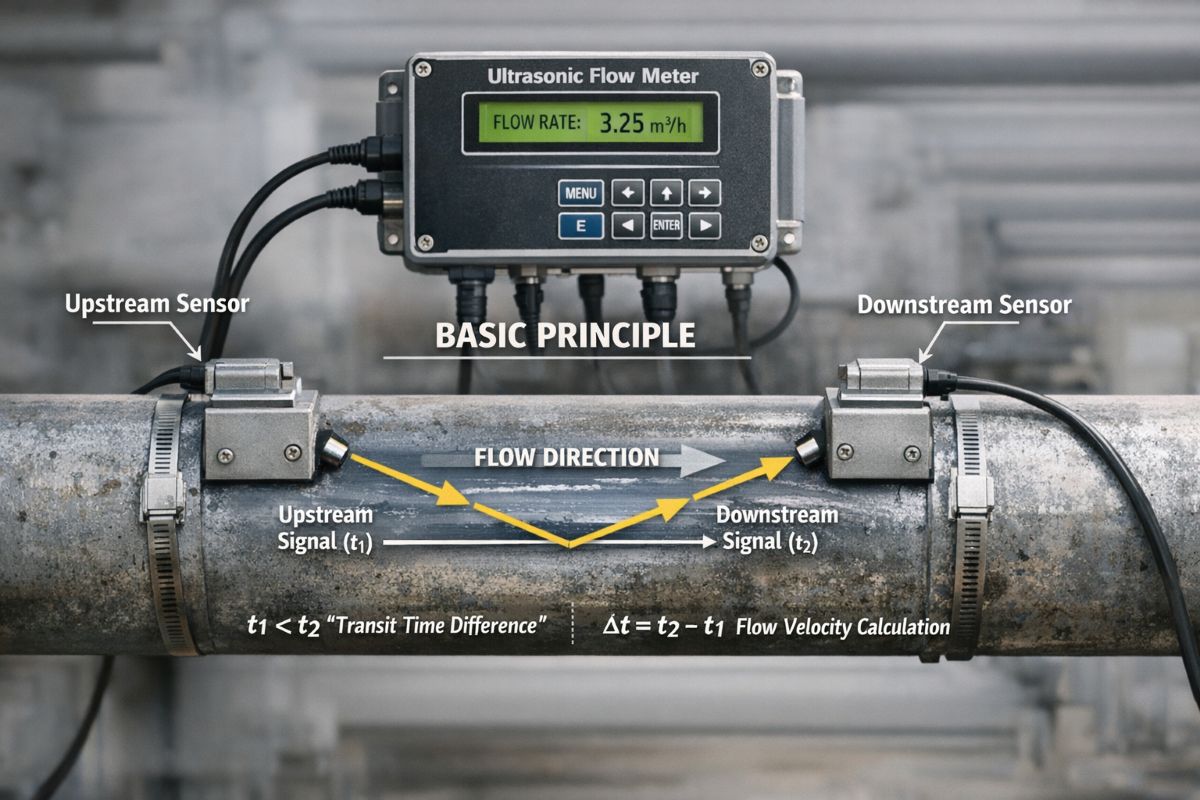
Two transducers are mounted on the pipe: one upstream and one downstream. They send ultrasonic pulses to each other. The meter compares the travel time of ultrasonic pulses moving “with the flow” versus “against the flow,” and the difference relates to flow velocity. Transit‑time is typically preferred for relatively clean liquids because heavy aeration/solids can disturb the acoustic path.
B. Doppler Effect
This method is used for dirty fluids, slurries, or aerated liquids.
The meter sends a frequency into the pipe. The sound reflects off particles or bubbles in the fluid and returns to the transducer.
The frequency of the reflected sound shifts due to the particle velocity (Doppler shift). The meter calculates flow based on this frequency change. In Pulsed‑Wave Doppler, a single transducer element acts as both transmitter and receiver. In Continuous‑Wave Doppler, two separate elements are used — one for transmitting and one for receiving.
2. Construction & Types
Major Components
Transducers: Piezoelectric crystals that convert electrical signals into ultrasonic sound waves.
Transmitter/Flow Computer: The electronic unit that processes signals, calculates flow, and outputs data (4-20mA, HART, Modbus).
Sensor Cable: Low-noise coaxial cables connecting transducers to the transmitter.
Spool Piece (Inline only): The pipe section containing the sensors.
Types of Ultrasonic Flow Meters
| Feature | Clamp-On (Non-Intrusive) | Inline (Wetted) |
| Installation | Strapped to the outside of the existing pipe. | Flanged into the pipeline (requires cutting pipe). |
| Accuracy | Good (±1% to ±3%). | High (±0.3% to ±0.5%). |
| Maintenance | Zero contact; no wear and tear. | Sensors touch fluid; may require cleaning. |
| Best For | Retrofits, corrosive/hazardous fluids, temporary checks. | Custody transfer, critical process control. |
3. Materials of Construction (MOC)
Selecting the right MOC is vital for longevity, especially in inline meters where sensors touch the fluid.
Transducers: typically Stainless Steel (316L) or Titanium for standard applications. PEEK or PVDF are used for aggressive chemicals.
Flow Body (Inline): Carbon Steel, SS304/316, Duplex Steel, or Hastelloy.
Couplant (Clamp-on): A gel or grease applied between the sensor and pipe to eliminate air gaps. High-temp pastes or solid foil pads are used for extreme heat.
4. Design & Installation Guidelines
Correct installation is the single most critical factor for UFM performance.
Design Specifications
Turndown Ratio: High rangeability, typically 100:1 or better.
Pipe Size: From small tubing (1/2″) to massive penstocks (100″+).
Fluid Velocity: typically 0.1 m/s to 20 m/s.
Installation Best Practices
Straight Run: To ensure a symmetrical flow profile, you generally need:
Upstream: 10 to 20 times the pipe diameter (10D-20D).
Downstream: 5 times the pipe diameter (5D).
Mounting Methods (Clamp-on):
V-Method: Transducers are on the same side. Sound bounces off the opposite wall. (Best for small/medium pipes).
Z-Method: Transducers are on opposite sides. Sound travels directly across. (Best for large pipes or high-attenuation fluids).
W-Method: Sound bounces 3 times. (Used for very small pipes to increase path length).
Position: Install at the 3 o’clock or 9 o’clock position on a horizontal pipe to avoid air (top) and sludge (bottom).
5. Applications in Industry
A. Hazardous Areas & Harsh Environments
Explosion-Proof: For oil & gas (Zone 1 or Zone 2), meters usually carry ATEX or IECEx certifications (Ex d or Ex ia).
Non-Contact Safety: Clamp-on meters are ideal here because they do not require cutting into a high-pressure hydrocarbon line, eliminating leak points.
Extreme Temperatures: Wave-injector nozzles can isolate transducers from pipes reaching up to 400°C or down to cryogenic temperatures (LNG).
B. Corrosive & Aggressive Media
Acids (Sulfuric, Hydrochloric): Inline meters would require expensive exotic alloys (Hastelloy, Tantalum). A clamp-on UFM is a perfect solution as it measures through the plastic/lined pipe without ever touching the acid.
Hydrogen: With the rise of green energy, specialized UFMs are now used for measuring hydrogen blends and pure H2 gas flow, handling the unique sound speed properties of hydrogen.
C. Water & Wastewater
Large Diameter Pipes: It is very expensive to buy a 40-inch magnetic flow meter. A clamp-on ultrasonic meter costs the same for a 4-inch pipe as it does for a 40-inch pipe, making it highly economical for large water networks.
6. Calibration and Maintenance
Calibration
Zero Calibration: Essential for clamp-on meters. This is done by shutting off flow (but keeping the pipe full) to set the “zero” reading.
Wet Calibration: For custody transfer (buying/selling), inline meters are sent to accredited flow labs to be calibrated against a master meter.
In-Situ Verification: Advanced meters usually have internal diagnostics (Signal Strength, Sound Speed ratio) that verify accuracy without removing the meter.
Maintenance
Couplant Check: For clamp-on meters, the coupling gel can dry out over years. Re-greasing sensors is a standard maintenance task (usually every 2-3 years).
No Drift: Since there are no moving parts, the calibration remains stable longer than turbine or PD meters.
7. Major Brands and Models
When specifying a UFM, these are the industry leaders known for reliability:
FLEXIM (Emerson): The global leader in clamp-on technology. Famous for the FLUXUS series, which works on everything from gas to liquid to steam.
Siemens: Known for the SITRANS F series (both inline and clamp-on). Very popular in water and energy sectors.
Endress+Hauser: Their Prosonic Flow series is a standard in chemical and process industries.
Emerson (Rosemount): The Daniel series is the gold standard for custody transfer gas ultrasonic meters.
Panametrics (Baker Hughes): Inventors of many ultrasonic technologies; strong in flare gas and steam measurement.
Krohne: The OPTISONIC series provides robust inline solutions for process applications.
Summary Table: Selection Quick Guide
| Application | Recommended Type | Key Consideration |
| Clean Water | Transit Time (Clamp-on/Inline) | Cost-effective |
| Sewage / Slurry | Doppler or Hybrid | Signal strength in dirty fluid |
| Strong Acid | Clamp-on (PFTE lined pipe) | Chemical compatibility |
| Natural Gas Sale | Multi-path Inline | Accuracy (Custody Transfer) |
| Temporary Audit | Portable Clamp-on | Battery life and data logging |
Ready to Select a Meter?
If you are planning an installation, start by determining if you need portability (for checking multiple pipes) or permanent monitoring. For hazardous acids or high-pressure gas, always prioritize non-intrusive (clamp-on) models to maximize safety.