Thermodynamics
Thermodynamics
Understanding Heat, Work, and the Laws that Govern Energy Transformation
Chapter Summary
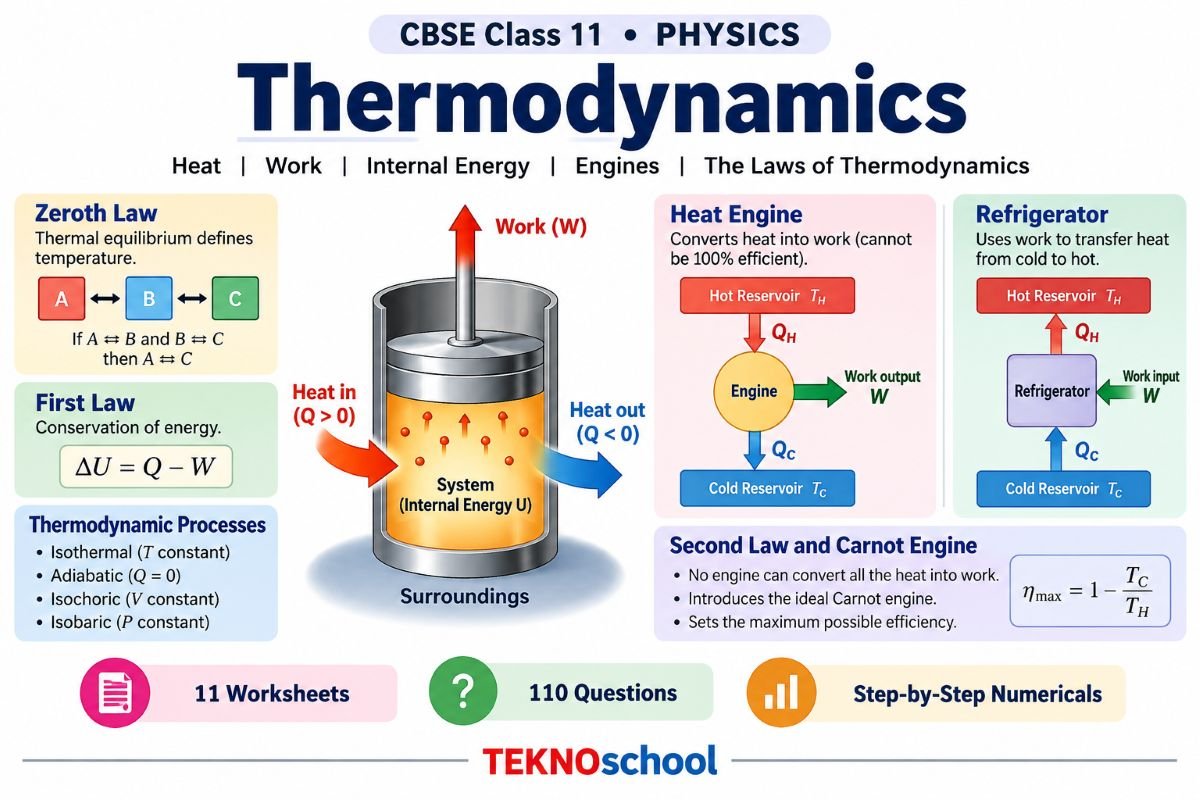
Thermodynamics is the branch of physics that studies how heat, work, and internal energy exchange between a system and its surroundings. It begins with the Zeroth Law, which defines temperature through thermal equilibrium, and builds toward the First Law, a statement of energy conservation linking heat, work, and internal energy change. The chapter explores different thermodynamic processes such as isothermal, adiabatic, isochoric, and isobaric changes, each with its own relationship between pressure, volume, and temperature. It then introduces heat engines and refrigerators as practical devices governed by these principles, showing why no machine can convert heat entirely into work. Finally, the Second Law of Thermodynamics and the idealised Carnot engine set the ultimate efficiency limits that real engines can only approach, never exceed.
1. Introduction to Thermodynamics
Thermodynamics deals with the macroscopic study of systems involving heat, temperature, and energy transfer. Unlike mechanics, which tracks the motion of individual particles, thermodynamics deals with bulk properties of matter such as pressure, volume, and temperature, which are meaningful only for a large collection of particles.
Definition: A thermodynamic system is any collection of matter or a region of space chosen for study, separated from its surroundings by a boundary. Everything outside the boundary that can exchange energy or matter with the system is called the surroundings.
1.1 Types of Thermodynamic Systems
| System Type | Matter Exchange | Energy Exchange | Example |
|---|---|---|---|
| Open System | Yes | Yes | A boiling open pot of water |
| Closed System | No | Yes | Gas in a sealed piston-cylinder |
| Isolated System | No | No | An ideal thermos flask |
2. Thermal Equilibrium and the Zeroth Law
Two systems are said to be in thermal equilibrium with each other if there is no net flow of heat between them when they are brought into thermal contact. Thermal equilibrium is the basis on which the concept of temperature is defined.
Zeroth Law of Thermodynamics: If two systems A and B are separately in thermal equilibrium with a third system C, then A and B are also in thermal equilibrium with each other.
This law justifies the use of a thermometer: the thermometer is system C, and once it reaches equilibrium with a body, it reads that body’s temperature. Any two bodies that give the same thermometer reading are in thermal equilibrium with each other.
3. Heat, Internal Energy and Work
The internal energy (U) of a system is the sum of the kinetic and potential energies of all its constituent molecules. It is a state variable, meaning its value depends only on the current state of the system, not on the path taken to reach that state.
Heat (Q) is energy transferred between a system and its surroundings solely because of a temperature difference. Work (W) is energy transferred by any other means, such as a piston compressing or expanding a gas. Unlike internal energy, both heat and work are path-dependent quantities — they describe a process, not a state.
Important Distinction: Internal energy is a state function (depends only on initial and final states). Heat and work are path functions (depend on how the process occurs) and therefore cannot be written as ΔQ or ΔW — only as Q and W for a given process.
4. The First Law of Thermodynamics
ΔQ = ΔU + ΔW
Heat supplied to a system equals the increase in internal energy plus the work done by the system
The First Law is simply a restatement of the law of conservation of energy applied to thermodynamic processes. Here, ΔQ is the heat supplied to the system, ΔU is the change in internal energy, and ΔW is the work done by the system on its surroundings. If work is done on the system instead, ΔW is taken as negative.
4.1 Specific Heat Capacity
The specific heat capacity of a substance is the amount of heat required to raise the temperature of a unit mass of the substance by one degree. For gases, two specific heats are defined depending on whether volume or pressure is held constant.
| Quantity | Symbol | Condition Held Constant |
|---|---|---|
| Molar specific heat at constant volume | CV | Volume |
| Molar specific heat at constant pressure | CP | Pressure |
For an ideal gas, these are related by CP − CV = R, where R is the universal gas constant. CP is always greater than CV because at constant pressure, some of the supplied heat is used to do work as the gas expands, in addition to raising its internal energy.
5. Thermodynamic State Variables and Equation of State
State variables such as pressure (P), volume (V), and temperature (T) describe the equilibrium state of a system. For a given amount of an ideal gas, these variables are connected by the equation of state, PV = nRT, where n is the number of moles and R is the universal gas constant.
6. Thermodynamic Processes
A thermodynamic process describes how a system moves from one equilibrium state to another. The table below compares the four fundamental processes covered in this chapter.
| Process | Held Constant | Key Relation | First Law Form |
|---|---|---|---|
| Isothermal | Temperature | PV = constant | ΔU = 0, so ΔQ = ΔW |
| Adiabatic | Heat exchange (ΔQ = 0) | PVγ = constant | ΔU = −ΔW |
| Isochoric (Isovolumetric) | Volume | P/T = constant | ΔW = 0, so ΔQ = ΔU |
| Isobaric | Pressure | V/T = constant | ΔQ = ΔU + PΔV |
Worked Example: One mole of an ideal gas undergoes an isothermal expansion at 300 K, and its volume doubles. Since ΔU = 0 for an isothermal process, the heat absorbed equals the work done by the gas, calculated as W = nRT ln(V₂/V₁).
6.1 Cyclic Process
A cyclic process is one in which the system returns to its original state after a series of changes. Since internal energy is a state variable, ΔU = 0 for a complete cycle, which means the total heat absorbed equals the total work done: ΔQ = ΔW. This principle underlies the operation of every heat engine.
7. Heat Engines
A heat engine is a device that converts heat energy into mechanical work through a cyclic process. It consists of three essential parts: a hot reservoir (source) that supplies heat, a working substance that undergoes the cycle, and a cold reservoir (sink) that absorbs the rejected heat.
η = W / Q1 = 1 − (Q2 / Q1)
Efficiency of a heat engine: work output divided by heat absorbed from the source
Here Q₁ is the heat absorbed from the hot reservoir and Q₂ is the heat rejected to the cold reservoir. No real engine can achieve 100% efficiency because some heat must always be rejected to the sink.
8. Refrigerators and Heat Pumps
A refrigerator or heat pump is essentially a heat engine run in reverse. Work is done on the system to extract heat from a cold reservoir and deliver it to a hot reservoir.
α = Q2 / W = Q2 / (Q1 − Q2)
Coefficient of performance of a refrigerator
| Device | Purpose | Direction of Net Heat Transfer |
|---|---|---|
| Heat Engine | Produce work from heat | Hot to cold reservoir |
| Refrigerator | Remove heat from cold space | Cold to hot reservoir (using work input) |
| Heat Pump | Warm a hot space | Cold to hot reservoir (using work input) |
9. The Second Law of Thermodynamics
The First Law only accounts for energy conservation but does not restrict the direction in which processes occur. The Second Law addresses this gap by placing fundamental limits on the conversion of heat into work.
Kelvin-Planck Statement: No process is possible whose sole result is the absorption of heat from a reservoir and its complete conversion into work.
Clausius Statement: No process is possible whose sole result is the transfer of heat from a colder object to a hotter object without any external work being done.
10. Reversible and Irreversible Processes
A reversible process is one that can be reversed such that both the system and surroundings return to their original states, with no net change anywhere else. Such a process must occur infinitely slowly through a series of equilibrium states, with no friction or dissipative effects. All real processes are, to some degree, irreversible, since they involve friction, turbulence, or finite-rate heat transfer.
Caution: A reversible process is an idealisation. It is never achieved perfectly in practice but serves as a useful theoretical limit against which real engines are compared.
11. The Carnot Engine
The Carnot engine is an idealised, completely reversible heat engine operating between two temperatures, proposed by Sadi Carnot. It sets the theoretical upper limit on the efficiency any real engine can achieve between the same two reservoirs.
11.1 The Carnot Cycle
The Carnot cycle consists of four reversible steps, alternating between isothermal and adiabatic processes:
| Step | Process | Description |
|---|---|---|
| 1 | Isothermal Expansion | Gas absorbs heat Q₁ from the source at temperature T₁ and expands |
| 2 | Adiabatic Expansion | Gas expands further with no heat exchange; temperature falls to T₂ |
| 3 | Isothermal Compression | Gas rejects heat Q₂ to the sink at temperature T₂ and is compressed |
| 4 | Adiabatic Compression | Gas is compressed back to its initial state with no heat exchange; temperature rises to T₁ |
ηCarnot = 1 − (T2 / T1)
Carnot efficiency depends only on the absolute temperatures of the source and sink
Carnot’s Theorem: No engine operating between two given temperatures can be more efficient than a reversible (Carnot) engine operating between the same two temperatures, and all reversible engines between the same two temperatures have equal efficiency.
Practice Worksheets — 110 Questions
Worksheet 1: Fill in the Blanks
- The internal energy of a system is a __________ function. (Answer: state)
- In an isothermal process, the __________ of the gas remains constant. (Answer: temperature)
- The Zeroth Law of Thermodynamics defines the concept of __________. (Answer: temperature)
- For an adiabatic process, __________ = 0. (Answer: ΔQ, i.e., heat exchanged)
- The relation between CP and CV for an ideal gas is CP − CV = __________. (Answer: R, the universal gas constant)
- A process that can be exactly reversed without leaving any trace on the surroundings is called __________. (Answer: reversible)
- The efficiency of a Carnot engine depends only on the __________ of the source and the sink. (Answer: absolute temperatures)
- A refrigerator transfers heat from a __________ body to a __________ body with the help of external work. (Answer: colder, hotter)
- For a cyclic process, the change in internal energy is __________. (Answer: zero)
- The Second Law of Thermodynamics, in the Kelvin-Planck form, states that heat cannot be fully converted into __________ in a cyclic process. (Answer: work)
Worksheet 2: True or False
- Heat can flow spontaneously from a colder body to a hotter body. (Answer: False)
- Internal energy depends only on the state of the system, not on the path taken to reach it. (Answer: True)
- An isochoric process involves no change in volume. (Answer: True)
- The Carnot engine is a practically achievable, real engine. (Answer: False)
- CP is always less than CV for an ideal gas. (Answer: False)
- In an adiabatic process, no heat enters or leaves the system. (Answer: True)
- All irreversible processes violate the First Law of Thermodynamics. (Answer: False)
- A heat pump and a refrigerator operate on the same basic principle. (Answer: True)
- The efficiency of any real heat engine can exceed that of a Carnot engine operating between the same two temperatures. (Answer: False)
- Work done and heat exchanged are both path-dependent quantities. (Answer: True)
Worksheet 3: Multiple Choice Questions
- Which law of thermodynamics introduces the concept of temperature?
(a) First Law (b) Second Law (c) Zeroth Law (d) Third Law
(Answer: c) - For an isothermal process, which quantity remains unchanged?
(a) Pressure (b) Volume (c) Internal energy (d) Work done
(Answer: c) - The equation PVγ = constant applies to which process?
(a) Isobaric (b) Isochoric (c) Adiabatic (d) Isothermal
(Answer: c) - The coefficient of performance of a refrigerator is given by:
(a) Q₁/W (b) Q₂/W (c) W/Q₁ (d) 1 − Q₂/Q₁
(Answer: b) - Which statement correctly represents the Clausius statement of the Second Law?
(a) Heat cannot flow from hot to cold spontaneously (b) Heat cannot be fully converted to work (c) Heat cannot flow from cold to hot without external work (d) Entropy always decreases
(Answer: c) - A Carnot engine operates between 500 K and 300 K. Its efficiency is:
(a) 20% (b) 40% (c) 60% (d) 80%
(Answer: b) - In a cyclic process, which of the following is always true?
(a) ΔQ = 0 (b) ΔW = 0 (c) ΔU = 0 (d) ΔU = ΔQ
(Answer: c) - Which of the following is a state variable?
(a) Heat (b) Work (c) Temperature (d) None of these
(Answer: c) - A process occurring at constant pressure is called:
(a) Isochoric (b) Isobaric (c) Isothermal (d) Adiabatic
(Answer: b) - Which reservoir does a heat engine reject heat to?
(a) Source (b) Sink (c) Both equally (d) Neither
(Answer: b)
Worksheet 4: Match the Following
Match Column A with Column B:
| Column A | Column B |
|---|---|
| 1. Isothermal | (a) PVγ = constant |
| 2. Adiabatic | (b) V/T = constant |
| 3. Isochoric | (c) PV = constant |
| 4. Isobaric | (d) P/T = constant |
| 5. Cyclic process | (e) ΔU = 0 over the cycle |
Answers: 1-c, 2-a, 3-d, 4-b, 5-e
- Match: Kelvin-Planck statement (Answer: relates to complete conversion of heat into work being impossible)
- Match: Clausius statement (Answer: relates to heat flow from cold to hot without work being impossible)
- Match: Carnot engine (Answer: an idealised, fully reversible engine)
- Match: Coefficient of performance (Answer: efficiency measure of a refrigerator)
- Match: Zeroth Law (Answer: basis for defining temperature)
Worksheet 5: One-Word Answers
- The energy transferred due to a temperature difference. (Answer: Heat)
- The sum of kinetic and potential energies of all molecules of a system. (Answer: Internal energy)
- A device that converts heat into work through a cycle. (Answer: Heat engine)
- The gas constant that relates CP and CV. (Answer: Universal gas constant, R)
- The idealised engine with maximum possible efficiency. (Answer: Carnot engine)
- A process with no heat exchange. (Answer: Adiabatic process)
- A process occurring at constant volume. (Answer: Isochoric process)
- Device used to remove heat from a cold body using external work. (Answer: Refrigerator)
- Law stating equilibrium is transitive between systems. (Answer: Zeroth Law)
- Quantity that is conserved according to the First Law. (Answer: Energy)
Worksheet 6: Define the Following
- Thermal equilibrium (Answer: The state in which two systems in contact have no net heat flow between them.)
- Internal energy (Answer: The sum of kinetic and potential energies of all molecules constituting a system.)
- Reversible process (Answer: A process that can be reversed so that both system and surroundings return exactly to their initial states.)
- Heat engine (Answer: A device that converts heat energy into mechanical work through a repeating cycle.)
- Coefficient of performance (Answer: The ratio of heat extracted from the cold reservoir to the work done on a refrigerator.)
- Isothermal process (Answer: A process occurring at constant temperature, where PV remains constant.)
- Cyclic process (Answer: A process in which the system returns to its initial state after a series of changes.)
- Molar specific heat capacity (Answer: Heat required to raise the temperature of one mole of a substance by one degree.)
- Second Law of Thermodynamics (Answer: A law that restricts the direction and efficiency of energy conversion processes, forbidding complete conversion of heat to work in a cycle.)
- Carnot’s theorem (Answer: No engine between two given temperatures can be more efficient than a reversible Carnot engine operating between the same temperatures.)
Worksheet 7: Short Answer Questions
- Why is internal energy called a state function while heat and work are not? (Answer: Internal energy depends only on the current state, unlike heat and work, which depend on the path of the process.)
- State the First Law of Thermodynamics and explain its physical significance. (Answer: ΔQ = ΔU + ΔW; it is a statement of energy conservation applied to thermal processes.)
- Why is CP greater than CV for an ideal gas? (Answer: At constant pressure, extra heat is needed to do work as the gas expands, in addition to raising its internal energy.)
- Explain why no real engine can be 100% efficient. (Answer: Some heat must always be rejected to the sink, as required by the Second Law, so not all absorbed heat can convert to work.)
- Differentiate between a heat engine and a refrigerator. (Answer: A heat engine converts heat to work using a temperature difference; a refrigerator uses work input to move heat from cold to hot.)
- Why is the Carnot engine considered an ideal engine? (Answer: It is completely reversible and has the maximum possible efficiency between two given temperatures.)
- What is meant by a quasi-static process? (Answer: A process carried out infinitely slowly so the system remains in equilibrium at every stage.)
- Explain the significance of the Zeroth Law in defining temperature. (Answer: It allows temperature to be defined as the property common to systems in mutual thermal equilibrium, enabling thermometry.)
- Why do all real processes tend to be irreversible? (Answer: Real processes involve friction, turbulence, and finite-rate heat transfer, which cannot be perfectly undone.)
- State the relationship between the efficiency of a heat engine and the temperatures of its source and sink for a Carnot engine. (Answer: η = 1 − T₂/T₁, so efficiency increases as the sink temperature falls relative to the source.)
Worksheet 8: Long Answer Questions
- Derive the expression for work done during an isothermal expansion of an ideal gas. (Answer: Using PV = nRT and W = ∫P dV from V₁ to V₂, W = nRT ln(V₂/V₁), since T is constant throughout.)
- Describe the four steps of the Carnot cycle and explain how the net work done in one cycle is obtained. (Answer: Isothermal expansion, adiabatic expansion, isothermal compression, adiabatic compression; net work equals the area enclosed by the cycle on a P-V diagram, equal to Q₁ − Q₂.)
- Explain the Kelvin-Planck and Clausius statements of the Second Law and show that they are equivalent. (Answer: Both statements forbid different “perfect” devices; violating one can be shown to allow constructing a device that violates the other, proving their equivalence.)
- Discuss the working of a refrigerator with a labelled description of energy flow, and derive its coefficient of performance. (Answer: Work W is done to extract heat Q₂ from the cold reservoir and reject Q₁ = Q₂ + W to the hot reservoir; α = Q₂/W = Q₂/(Q₁ − Q₂).)
- Explain why the efficiency of a Carnot engine sets the upper limit for all real engines operating between the same two temperatures. (Answer: Any engine more efficient than a Carnot engine between the same reservoirs could be combined with a reversed Carnot engine to violate the Second Law, so no such engine can exist.)
- State the First Law of Thermodynamics for each of the four basic processes (isothermal, adiabatic, isochoric, isobaric) and explain the physical reasoning behind each simplification. (Answer: Isothermal: ΔU = 0 since T is constant, so ΔQ = ΔW. Adiabatic: ΔQ = 0 by definition, so ΔU = −ΔW. Isochoric: ΔW = 0 since volume is fixed, so ΔQ = ΔU. Isobaric: ΔQ = ΔU + PΔV since only pressure is held fixed while volume changes.)
- Explain, with reasoning, why specific heat capacity of a gas is not a single fixed value but depends on the process. (Answer: The heat needed to raise temperature depends on whether the gas is also doing work during heating; at constant volume all heat raises internal energy, while at constant pressure some heat also does expansion work, giving CP > CV.)
- Describe how a P-V diagram can be used to determine the work done in a thermodynamic process, and explain why the work done in a cyclic process equals the enclosed area. (Answer: Work done equals the area under the P-V curve for the process; in a cyclic process, the net work equals the area enclosed by the loop, since work done during expansion and compression segments partially cancel.)
- Explain the concept of entropy qualitatively and relate it to the Second Law of Thermodynamics and the direction of natural processes. (Answer: Entropy is a measure of disorder or the number of accessible microscopic states; the Second Law implies that the entropy of an isolated system never decreases, which explains why heat flows spontaneously from hot to cold and not the reverse.)
- Compare a heat engine and a Carnot engine, explaining why real engines always fall short of the Carnot efficiency limit. (Answer: Real engines involve irreversibilities such as friction, finite-rate heat transfer, and turbulence, which the idealised, fully reversible Carnot engine does not have, so real engines always operate below the Carnot efficiency for the same source and sink temperatures.)
Worksheet 9: Numerical Problems
- A gas absorbs 500 J of heat and does 200 J of work on its surroundings. Find the change in internal energy. (Answer: ΔU = ΔQ − ΔW = 500 − 200 = 300 J)
- A Carnot engine operates between 600 K and 400 K. Find its efficiency. (Answer: η = 1 − 400/600 = 1/3 ≈ 33.3%)
- A refrigerator extracts 300 J of heat from the cold reservoir using 100 J of work. Find its coefficient of performance. (Answer: α = Q₂/W = 300/100 = 3)
- One mole of gas at 300 K expands isothermally to twice its volume. Find the work done (R = 8.31 J/mol K). (Answer: W = nRT ln2 = 1 × 8.31 × 300 × 0.693 ≈ 1727 J)
- A heat engine absorbs 800 J from the source and rejects 500 J to the sink. Find its efficiency. (Answer: η = 1 − Q₂/Q₁ = 1 − 500/800 = 0.375 = 37.5%)
- Find CP for a gas if CV = 12.5 J/mol K (R = 8.31 J/mol K). (Answer: CP = CV + R = 12.5 + 8.31 = 20.81 J/mol K)
- A Carnot engine has an efficiency of 40% when the sink temperature is 300 K. Find the source temperature. (Answer: 0.4 = 1 − 300/T₁, so T₁ = 500 K)
- In an isochoric process, 400 J of heat is supplied to a gas. Find the work done and the change in internal energy. (Answer: ΔW = 0, so ΔU = ΔQ = 400 J)
- A gas does 150 J of work on the surroundings in an adiabatic expansion. Find the change in internal energy. (Answer: Since ΔQ = 0, ΔU = −ΔW = −150 J, i.e., internal energy decreases by 150 J)
- A heat pump delivers 250 J of heat to a room using 50 J of work. Find its coefficient of performance. (Answer: For a heat pump, coefficient of performance = Q₁/W = 250/50 = 5)
Worksheet 10: Assertion-Reason
For each question, choose: (a) Both A and R are true, and R is the correct explanation of A. (b) Both A and R are true, but R is not the correct explanation of A. (c) A is true, R is false. (d) A is false, R is true.
- Assertion: Internal energy of an ideal gas depends only on its temperature. Reason: Internal energy of an ideal gas consists purely of the kinetic energy of its molecules, which depends only on temperature. (Answer: a)
- Assertion: A Carnot engine can have 100% efficiency. Reason: A Carnot engine is completely reversible. (Answer: d — efficiency is 100% only if the sink is at absolute zero, which is unattainable)
- Assertion: Work done in an isothermal process is greater than in an adiabatic process for the same volume change and starting conditions. Reason: The isothermal P-V curve lies above the adiabatic P-V curve during expansion. (Answer: a)
- Assertion: The First Law of Thermodynamics forbids the construction of a perpetual motion machine of the first kind. Reason: The First Law is a statement of conservation of energy. (Answer: a)
- Assertion: All reversible engines operating between the same two temperatures have equal efficiency. Reason: Efficiency of a reversible engine depends only on the source and sink temperatures, not on the working substance. (Answer: a)
- Assertion: The coefficient of performance of a refrigerator can be less than one. Reason: Coefficient of performance depends on the ratio of heat extracted to work done, which can be less than one for poorly designed refrigerators. (Answer: b)
- Assertion: Heat and work are both measured in the same units. Reason: Heat and work are both forms of energy transfer. (Answer: a)
- Assertion: An adiabatic process always causes a larger pressure change than an isothermal process for the same volume change. Reason: The adiabatic curve is steeper than the isothermal curve on a P-V diagram. (Answer: a)
- Assertion: Entropy of an isolated system tends to increase. Reason: Natural processes proceed in the direction of increasing disorder. (Answer: a)
- Assertion: A cyclic process does not conserve energy. Reason: In a cyclic process, ΔU is zero, and the First Law reduces to ΔQ = ΔW. (Answer: d — energy is always conserved; the assertion is false, the reason is true)
Worksheet 11: Table-Based Application Questions
Use the process comparison table from Section 6 of this tutorial to answer the following:
- Which process keeps P/T constant? (Answer: Isochoric process)
- Which process has ΔW = 0? (Answer: Isochoric process)
- In which process is ΔU = 0? (Answer: Isothermal process)
- Which process follows PVγ = constant? (Answer: Adiabatic process)
- In an isobaric process, which quantity is held constant? (Answer: Pressure)
- Using the heat engine vs. refrigerator table, which device requires external work input to function? (Answer: Both the refrigerator and the heat pump)
- Which device has net heat transfer from a hot to a cold reservoir without work input? (Answer: Heat engine)
- In the Carnot cycle table, which two steps involve heat exchange? (Answer: Isothermal expansion and isothermal compression)
- In the Carnot cycle table, which two steps involve no heat exchange? (Answer: Adiabatic expansion and adiabatic compression)
- Based on the system types table, which type of system exchanges neither matter nor energy with its surroundings? (Answer: Isolated system)
End of Chapter Tutorial — Thermodynamics