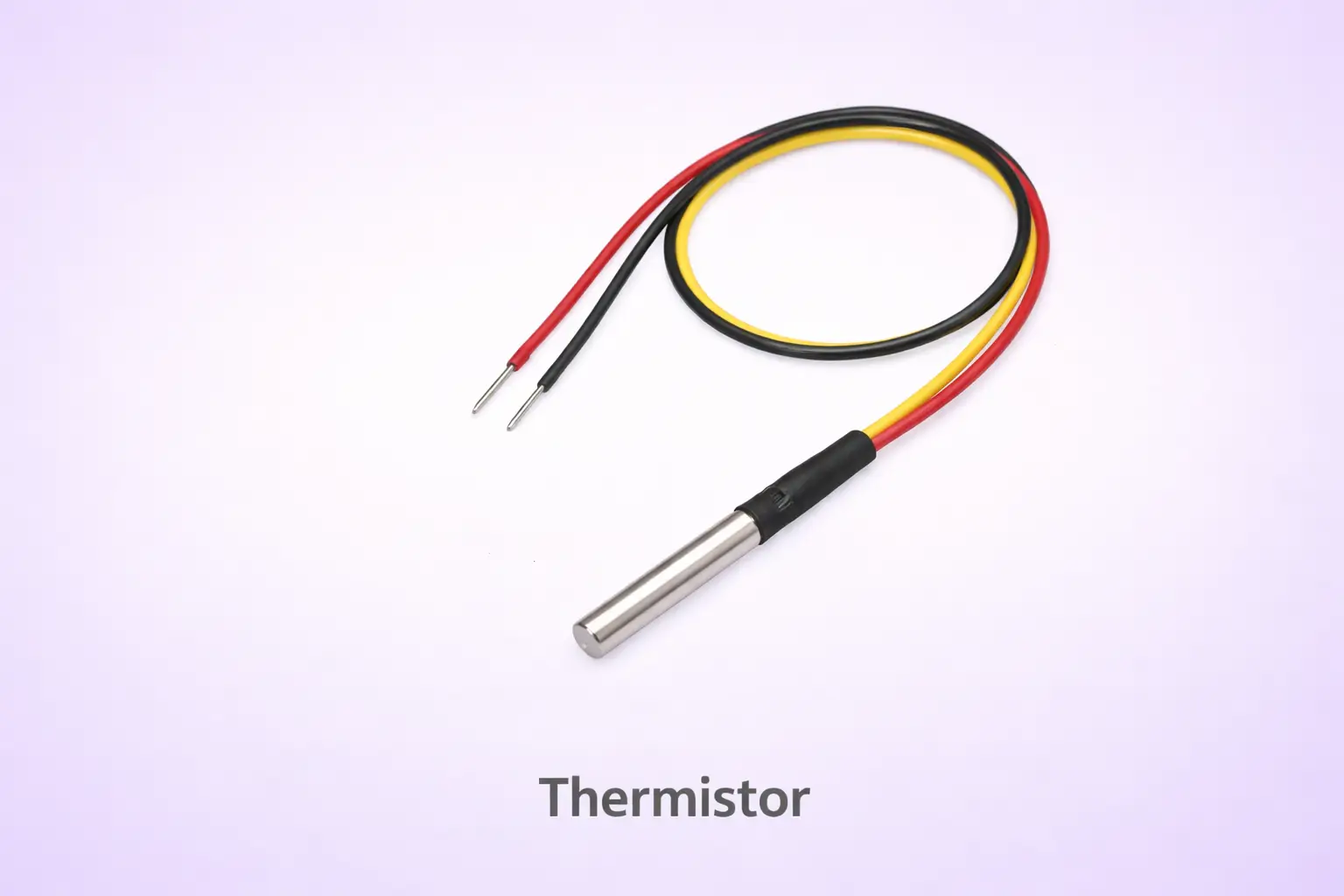
Thermistor
🔥 Thermistor: Construction, Working Principle, Types & Applications
🧩 What is a Thermistor?
A thermistor (thermal + resistor) is a temperature‑sensitive semiconductor device whose resistance changes significantly with temperature. They are widely used for precise temperature measurement, control, and compensation in industrial, medical, and electronic systems.
Thermistors are known for:
High sensitivity
Fast response
Low cost
Excellent accuracy in a limited temperature range
🏗️ Construction of a Thermistor
Thermistors are made from metal oxide semiconductor materials, typically:
Manganese oxide
Nickel oxide
Cobalt oxide
Copper oxide
Construction Process
Metal oxide powders are mixed and finely ground.
The mixture is shaped into beads, discs, rods, or chips.
The shaped material is sintered at high temperatures (700–1400°C).
Lead wires are attached for electrical connection.
The assembly is coated with epoxy resin or glass for protection.
Common Thermistor Shapes
Bead thermistors
Disc thermistors
Chip thermistors
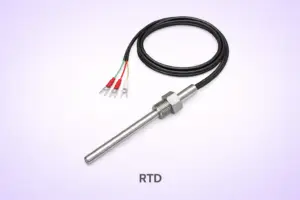
Probe-type thermistors
⚙️ Working Principle of Thermistor
Thermistor work on the principle that:
The resistance of semiconductor materials changes with temperature.
This happens because:
Temperature changes the number of charge carriers
Conductivity increases or decreases accordingly
The resistance–temperature relationship is non‑linear and often modeled using the Steinhart–Hart equation.
🧪 Types of Thermistors
Thermistors are classified based on how their resistance changes with temperature.
1️⃣ NTC Thermistor (Negative Temperature Coefficient)
Resistance decreases as temperature increases
Most commonly used type
Highly sensitive and accurate
Temperature Range: –55°C to +200°C Typical Uses: Temperature sensing, HVAC, battery packs, medical devices
2️⃣ PTC Thermistor (Positive Temperature Coefficient)
Resistance increases as temperature increases
Used for protection and switching applications
Temperature Range: –20°C to +150°C Typical Uses: Overcurrent protection, motor protection, degaussing circuits
📌 NTC vs PTC Thermistors
🛠️ Thermistors are temperature-sensitive resistors widely used for temperature measurement, control, and protection in electrical and electronic systems. Based on the direction of resistance change with temperature, thermistors are broadly classified into Negative Temperature Coefficient (NTC) and Positive Temperature Coefficient (PTC) types.
NTC and PTC thermistors differ in several ways. NTC thermistors have resistance that decreases as temperature rises, offering high sensitivity, and are mainly used for temperature measurement. PTC thermistors, on the other hand, have resistance that increases with temperature, have moderate sensitivity, and are typically used for protection and switching. NTCs are made from metal oxides, while PTCs are made from barium titanate ceramics.
NTC Thermistors
An NTC thermistor exhibits a decrease in electrical resistance as temperature increases. This behavior results from semiconductor materials whose charge carrier density rises with temperature. NTC thermistors are highly sensitive over a limited temperature range, making them suitable for precise temperature sensing.
Key characteristics include high sensitivity, fast response time, compact size, and relatively low cost. However, their resistance–temperature relationship is nonlinear, so signal conditioning or linearization is often required in measurement circuits.
Applications of NTC thermistors:
Temperature measurement and control in HVAC systems, boilers, and industrial process equipment.
Consumer electronics, such as smartphones, laptops, and battery packs, for temperature monitoring and thermal management.
Inrush current limiting, where an NTC thermistor initially limits high startup current and then heats up to reduce resistance during normal operation.
Automotive systems, including engine coolant temperature sensing and battery temperature monitoring.
PTC Thermistors
A PTC thermistor shows an increase in resistance as temperature rises. In many PTC devices, resistance increases sharply beyond a specific switching or Curie temperature. This unique property allows PTC thermistors to act as self-regulating and protective components.
Key characteristics include inherent current-limiting behavior, robustness, and suitability for protection functions rather than precise temperature measurement.
Applications of PTC thermistors:
Overcurrent and short-circuit protection in power supplies, chargers, and electronic circuits, where increased resistance limits current flow during fault conditions.
Self-regulating heaters, such as mirror heaters, defoggers, and small space heaters, where heat output stabilizes automatically with temperature.
Motor and transformer protection, preventing overheating by increasing resistance when safe temperature limits are exceeded.
Telecommunication and industrial electronics, for circuit protection and thermal safeguarding.
Summary
In practical use, NTC thermistors are preferred for accurate temperature sensing and measurement, while PTC thermistors are selected for protection and self-regulating applications. Their simplicity, reliability, and cost-effectiveness make both NTC and PTC thermistors indispensable components across industrial, automotive, and consumer electronic systems.