Thermal Properties of Matter
Thermal Properties of Matter
Understanding Temperature, Heat, Expansion, and Heat Transfer — A Complete Physics Guide
Thermal Properties of Matter-Every material object responds to heat in measurable, predictable ways — it expands, its temperature rises, and it exchanges thermal energy with its surroundings until equilibrium is reached. This chapter builds the physical framework for describing these responses: how we measure temperature, why materials expand differently, how heat is stored and transferred, and how radiation carries thermal energy even through empty space. These ideas underpin everything from thermometer design to engine efficiency to why a bimetallic strip bends when heated.
Learning Objectives
- Distinguish between temperature and heat, and convert between Celsius, Fahrenheit, and Kelvin scales
- Calculate linear, areal, and volumetric thermal expansion in solids and liquids
- Explain the anomalous expansion of water and its ecological importance
- Apply the principle of calorimetry using specific heat capacity
- Describe change of state, latent heat, and the triple point
- Compare conduction, convection, and radiation as heat transfer mechanisms
- State and apply Newton’s Law of Cooling, Stefan’s Law, and Wien’s Displacement Law
1. Temperature and Heat
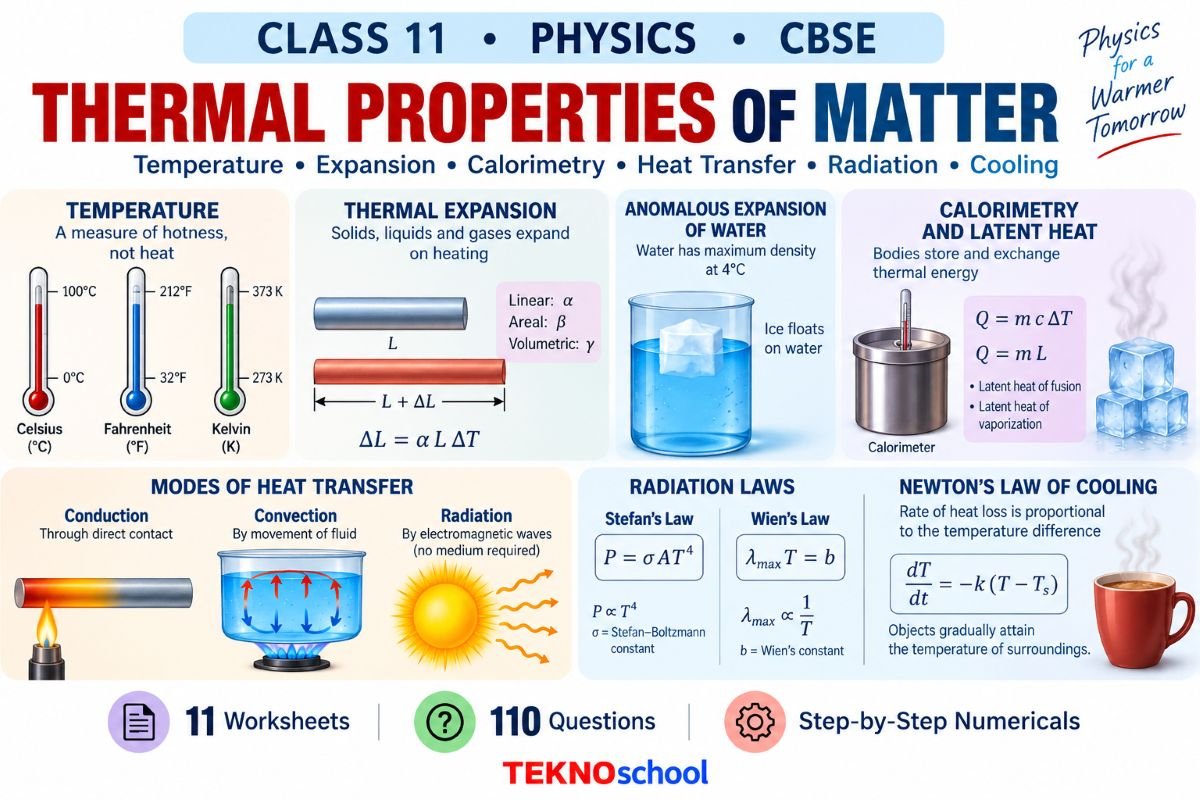
Temperature is a measure of the degree of hotness or coldness of a body — more precisely, it is the physical quantity that determines the direction of net heat flow between two bodies in thermal contact. Heat, by contrast, is the energy transferred between bodies (or a system and its surroundings) solely because of a temperature difference. Temperature is a state variable; heat is energy in transit.
⚡ Formula Box — Temperature Scale Conversion
C/5 = (F − 32)/9 = (K − 273.15)/5
where C = Celsius, F = Fahrenheit, K = Kelvin
Common Temperature Scale Values
| Reference Point | Celsius (°C) | Fahrenheit (°F) | Kelvin (K) |
|---|---|---|---|
| Ice point (freezing water) | 0 | 32 | 273.15 |
| Steam point (boiling water) | 100 | 212 | 373.15 |
| Absolute zero | −273.15 | −459.67 | 0 |
| Normal human body temperature | 37 | 98.6 | 310.15 |
2. Thermal Expansion
Most substances expand when heated because increased thermal energy raises average interatomic separation. Expansion is classified by dimension: linear (length), areal or superficial (area), and cubical or volumetric (volume).
⚡ Formula Box — Thermal Expansion
Linear: ΔL = L₀ α ΔT | Areal: ΔA = A₀ β ΔT | Volumetric: ΔV = V₀ γ ΔT
Relation: β = 2α, γ = 3α (for isotropic solids)
Coefficient of Linear Expansion (Approximate, per °C)
| Material | α (× 10⁻⁵ /°C) |
|---|---|
| Aluminium | 2.4 |
| Copper | 1.7 |
| Iron / Steel | 1.2 |
| Glass (ordinary) | 0.9 |
| Invar | 0.07 |
🌍 Real-Life Application
Railway tracks are laid with small gaps, and bridges use expansion joints, to accommodate thermal expansion in summer without buckling. Bimetallic strips (two metals with different α bonded together) bend when heated and are used in thermostats and circuit breakers.
Anomalous Expansion of Water
Water contracts on heating from 0°C to 4°C and expands above 4°C — its density is maximum at 4°C. This anomalous behaviour means ice forms at the top of a water body while denser water at 4°C sinks to the bottom, allowing aquatic life to survive under frozen lakes in winter.
3. Specific Heat Capacity and Calorimetry
Specific heat capacity (s) is the heat required to raise the temperature of unit mass of a substance by one degree. Molar specific heat is the same quantity defined per mole. Calorimetry is the technique of measuring heat exchanged, based on the principle that heat lost by a hot body equals heat gained by a cold body in an isolated system.
⚡ Formula Box — Calorimetry
Q = m s ΔT | Principle of calorimetry: Heat lost = Heat gained
Specific heat of water = 1 cal/g°C = 4186 J/kg K (highest among common substances)
⚠️ Common Mistake
Students often confuse heat capacity (property of a specific object, units J/K) with specific heat capacity (property of the material, units J/kg K). Always check which one a question asks for before substituting values.
4. Change of State and Latent Heat
When a substance changes state (solid ⇌ liquid ⇌ gas), temperature remains constant during the transition even though heat continues to flow — this heat changes molecular arrangement rather than kinetic energy, and is called latent heat.
⚡ Formula Box — Latent Heat
Q = mL | Latent heat of fusion of ice = 80 cal/g (336 J/g)
Latent heat of vaporization of water = 540 cal/g (2260 J/g)
Key State-Change Terms
| Term | Meaning |
|---|---|
| Melting point | Temperature at which solid and liquid coexist in equilibrium |
| Boiling point | Temperature at which vapour pressure equals atmospheric pressure |
| Sublimation | Direct solid-to-vapour transition without passing through liquid |
| Triple point | Unique temperature-pressure point where solid, liquid, vapour coexist (water: 273.16 K, 0.006 atm) |
5. Heat Transfer: Conduction, Convection, Radiation
Conduction
Conduction transfers heat through a medium without net movement of matter, via molecular collisions and, in metals, free electrons. It dominates in solids.
⚡ Formula Box — Conduction
H = KA(T₁ − T₂)/L
where K = thermal conductivity, A = cross-sectional area, L = length, H = rate of heat flow
Thermal Conductivity of Common Materials (W/m K)
| Material | K (W/m K) |
|---|---|
| Silver | 406 |
| Copper | 385 |
| Water | 0.6 |
| Air | 0.024 |
| Wood | 0.08 |
Convection
Convection transfers heat through actual movement of fluid particles (liquids and gases). Natural convection arises from density differences (hot fluid rises); forced convection uses external agents like fans or pumps.
Radiation
Radiation transfers heat via electromagnetic waves and requires no medium — this is how solar energy reaches Earth. Every body above absolute zero emits thermal radiation.
⚡ Formula Box — Stefan-Boltzmann and Wien’s Law
Stefan’s Law: E = σAT⁴ (ideal blackbody), σ = 5.67 × 10⁻⁸ W/m²K⁴
Wien’s Displacement Law: λₘT = b, b = 2.898 × 10⁻³ m K
📝 Exam Tip
A perfect blackbody is both a perfect absorber and perfect emitter of radiation. Wien’s Law explains why hotter stars (like blue-white stars) peak at shorter wavelengths than cooler red stars.
Newton’s Law of Cooling
The rate of loss of heat of a body is directly proportional to the temperature difference between the body and its surroundings, provided this difference is small.
⚡ Formula Box — Newton’s Law of Cooling
−dT/dt = k(T − T₀)
where T = body temperature, T₀ = surrounding temperature, k = cooling constant
Practice Worksheets — Thermal Properties of Matter
11 worksheet formats · 110 questions · answers included
Worksheet 1: Multiple Choice Questions
- The SI unit of thermal conductivity is:
(a) W/m (b) W/mK (c) J/kg K (d) W/K
Answer: (b) W/mK - Water has maximum density at:
(a) 0°C (b) 4°C (c) 100°C (d) −4°C
Answer: (b) 4°C - For an isotropic solid, the relation between γ (volume expansion) and α (linear expansion) is:
(a) γ = α (b) γ = 2α (c) γ = 3α (d) γ = α/3
Answer: (c) γ = 3α - Heat transfer without a medium occurs by:
(a) Conduction (b) Convection (c) Radiation (d) Diffusion
Answer: (c) Radiation - The latent heat of fusion of ice is approximately:
(a) 80 cal/g (b) 540 cal/g (c) 1 cal/g (d) 100 cal/g
Answer: (a) 80 cal/g - Wien’s displacement law relates:
(a) Temperature and pressure (b) Peak wavelength and temperature (c) Volume and temperature (d) Heat and specific heat
Answer: (b) Peak wavelength and temperature - Newton’s law of cooling is valid for:
(a) Any temperature difference (b) Only small temperature differences (c) Only liquids (d) Only radiation
Answer: (b) Only small temperature differences - The triple point of water occurs at:
(a) 0°C (b) 100°C (c) 0.01°C (d) −273°C
Answer: (c) 0.01°C (273.16 K) - A perfect blackbody is one that:
(a) Reflects all radiation (b) Absorbs and emits all radiation (c) Emits no radiation (d) Is always black in color
Answer: (b) Absorbs and emits all radiation - Specific heat capacity of water is:
(a) 1 cal/g°C (b) 0.5 cal/g°C (c) 2 cal/g°C (d) 4.2 cal/g°C
Answer: (a) 1 cal/g°C
Worksheet 2: Fill in the Blanks
- The coefficient of areal expansion is related to linear expansion as β = ______.
Answer: 2α - The SI unit of heat is ______.
Answer: Joule - Zero on the Kelvin scale corresponds to ______ °C.
Answer: −273.15 - Heat transfer through fluid motion is called ______.
Answer: Convection - The Stefan-Boltzmann constant has the symbol ______.
Answer: σ (sigma) - Ice melts and absorbs heat without change in ______.
Answer: temperature - The material with the lowest thermal conductivity among metals used commonly is ______ (from those listed in the guide).
Answer: (air is lowest overall; among solids, wood is lowest) - A bimetallic strip works on the principle of differing ______ of two metals.
Answer: coefficients of linear expansion - The direct change from solid to vapour is called ______.
Answer: Sublimation - Body temperature in Kelvin (normal human) is approximately ______ K.
Answer: 310.15 K
Worksheet 3: True or False
- Heat and temperature are the same physical quantity.
Answer: False - Water expands when cooled from 4°C to 0°C.
Answer: True - Radiation requires a medium to travel through.
Answer: False - Silver has higher thermal conductivity than copper.
Answer: True - Newton’s law of cooling holds even for very large temperature differences.
Answer: False - Latent heat changes the internal energy but not the temperature of a substance.
Answer: True - Invar has a high coefficient of linear expansion.
Answer: False (it has an unusually low value) - A blackbody at higher temperature emits radiation with shorter peak wavelength.
Answer: True - Specific heat capacity depends on the mass of the sample.
Answer: False (it is a property of the material, not the sample mass) - Conduction is the dominant mode of heat transfer in gases.
Answer: False (convection dominates in gases)
Worksheet 4: Match the Following
| Column A | Column B |
|---|---|
| 1. Conduction | A. Requires no medium |
| 2. Convection | B. Molecular collisions in a fixed medium |
| 3. Radiation | C. Bulk fluid motion |
| 4. Latent heat | D. Q = mL |
| 5. Wien’s law | E. λₘT = constant |
| 6. Stefan’s law | F. E = σAT⁴ |
| 7. Triple point | G. 273.16 K for water |
| 8. Newton’s cooling law | H. −dT/dt = k(T − T₀) |
| 9. Anomalous expansion | I. Water’s density peak at 4°C |
| 10. Invar | J. Low thermal expansion alloy |
Answers: 1-B, 2-C, 3-A, 4-D, 5-E, 6-F, 7-G, 8-H, 9-I, 10-J
Worksheet 5: One-Word / Very Short Answers
- Name the quantity measured in W/m²K⁴.
Answer: Stefan-Boltzmann constant - What is the SI unit of specific heat capacity?
Answer: J/kg K - Name the scale with no negative temperature values.
Answer: Kelvin scale - Name the device that uses a bimetallic strip.
Answer: Thermostat - What is the value of absolute zero in Celsius?
Answer: −273.15°C - Name the heat transfer mode dominant in solids.
Answer: Conduction - Give the symbol for coefficient of linear expansion.
Answer: α - Name the law that gives peak emission wavelength of a blackbody.
Answer: Wien’s Displacement Law - State the latent heat of vaporization of water.
Answer: 540 cal/g (2260 J/g) - Name the condition under which Newton’s law of cooling is valid.
Answer: Small temperature difference between body and surroundings
Worksheet 6: Short Answer Questions (2–3 marks)
- Differentiate between heat and temperature.
Answer: Temperature is a state variable indicating degree of hotness and determines direction of heat flow; heat is energy transferred between bodies due to temperature difference, measured in joules. - Why are gaps left between railway tracks?
Answer: To allow for thermal expansion of the steel rails in hot weather, preventing buckling and track damage. - Explain why water pipes burst in extremely cold climates.
Answer: Water expands anomalously on freezing (ice occupies more volume than water), exerting outward pressure that can crack pipes. - State the principle of calorimetry.
Answer: In an isolated system, heat lost by the hotter body equals heat gained by the colder body until thermal equilibrium is reached. - Why does a thermos flask have a silvered, evacuated double wall?
Answer: The vacuum prevents conduction and convection; the silvered surface minimizes radiation loss by reflecting thermal radiation back. - Why is the specific heat capacity of water important for coastal climates?
Answer: Water’s high specific heat lets it absorb/release large amounts of heat with small temperature change, moderating coastal temperatures. - Distinguish between conduction and convection with one example each.
Answer: Conduction: heat travels through a metal rod held in a flame without matter moving. Convection: heat travels through boiling water via rising and sinking currents. - What is meant by the triple point of a substance?
Answer: The unique combination of temperature and pressure at which solid, liquid, and vapour phases of a substance coexist in equilibrium. - Why does a body cool faster initially and slower later, when following Newton’s law of cooling?
Answer: The rate of cooling is proportional to the temperature difference with surroundings, which is largest initially and decreases as the body cools, so the cooling rate decreases with time. - Why is a black surface a better absorber and emitter of radiation than a shiny surface?
Answer: A black surface absorbs nearly all incident radiation (low reflectivity) and, by Kirchhoff’s law, is equally efficient at emitting radiation, unlike shiny surfaces which reflect most radiation.
Worksheet 7: Numerical Problems (4–5 marks)
- A steel rod of length 2 m at 20°C is heated to 120°C. Find its increase in length. (α for steel = 1.2 × 10⁻⁵ /°C)
Answer: ΔL = L₀αΔT = 2 × 1.2×10⁻⁵ × 100 = 2.4 × 10⁻³ m = 2.4 mm - Calculate the heat required to raise the temperature of 2 kg of water from 20°C to 80°C. (s = 4186 J/kg K)
Answer: Q = msΔT = 2 × 4186 × 60 = 502,320 J ≈ 502.3 kJ - Find the heat needed to convert 500 g of ice at 0°C into water at 0°C. (L = 336 J/g)
Answer: Q = mL = 500 × 336 = 168,000 J = 168 kJ - Convert 98.6°F (normal body temperature) to Celsius and Kelvin.
Answer: C = 5/9(98.6−32) = 37°C; K = 37 + 273.15 = 310.15 K - A metal sphere of surface area 0.05 m² at 500 K radiates as a blackbody. Find power radiated. (σ = 5.67×10⁻⁸ W/m²K⁴)
Answer: E = σAT⁴ = 5.67×10⁻⁸ × 0.05 × (500)⁴ = 5.67×10⁻⁸ × 0.05 × 6.25×10¹⁰ ≈ 177.2 W - A rod conducts heat at rate 40 W across a 0.5 m length with ends at 100°C and 20°C, cross-section 0.002 m². Find thermal conductivity K.
Answer: H = KA(T₁−T₂)/L → K = HL/(A×ΔT) = (40×0.5)/(0.002×80) = 20/0.16 = 125 W/mK - A hot body at 80°C cools to 70°C in 5 minutes in surroundings at 20°C. Using Newton’s law of cooling (approximate form), estimate the cooling constant k, given the average temperature excess is 55°C over the interval.
Answer: (80−70)/5 = k(55) → k = 10/(5×55) = 0.036 per minute (approx.) - Find the peak wavelength emitted by the Sun’s surface (T ≈ 5800 K), given Wien’s constant b = 2.898×10⁻³ m K.
Answer: λₘ = b/T = 2.898×10⁻³ / 5800 ≈ 5.0×10⁻⁷ m = 500 nm (visible green-blue light) - A brass sheet has area 4 m² at 10°C. Find its area at 60°C. (α for brass = 1.9×10⁻⁵/°C, so β = 3.8×10⁻⁵/°C)
Answer: ΔA = A₀βΔT = 4 × 3.8×10⁻⁵ × 50 = 7.6×10⁻³ m²; New area = 4.0076 m² - 200 g of water at 90°C is mixed with 300 g of water at 20°C. Find the final equilibrium temperature (no heat loss).
Answer: m₁(T₁−T) = m₂(T−T₂) → 200(90−T) = 300(T−20) → 18000−200T = 300T−6000 → 24000 = 500T → T = 48°C
Worksheet 8: Assertion-Reason
Choose: (A) Both true, R explains A (B) Both true, R does not explain A (C) A true, R false (D) A false, R true
- Assertion: Water is used in car radiators as a coolant.
Reason: Water has a very high specific heat capacity.
Answer: (A) - Assertion: A thermometer bulb is made of thin glass.
Reason: Thin glass has poor thermal conductivity.
Answer: (D) — thin glass responds faster to temperature changes because it conducts heat readily and has low heat capacity, not because it is a poor conductor - Assertion: Lakes freeze from the top downward.
Reason: Ice is less dense than water at 4°C.
Answer: (A) - Assertion: A polished, shiny surface is a poor emitter of radiation.
Reason: Good absorbers are poor emitters.
Answer: (D) — the assertion is true, but good absorbers are actually good emitters, so the reason as stated is false - Assertion: Sea breeze blows from sea to land during the day.
Reason: Land has a lower specific heat capacity than water and heats up faster.
Answer: (A) - Assertion: The Kelvin scale has no negative values in physical use.
Reason: Zero Kelvin represents the theoretical absence of all thermal molecular motion.
Answer: (A) - Assertion: A bimetallic strip bends when heated.
Reason: The two metals have equal coefficients of linear expansion.
Answer: (C) — assertion true, reason false since it works because the coefficients are different - Assertion: Woollen clothes keep us warm in winter.
Reason: Wool traps air, and air is a poor conductor of heat.
Answer: (A) - Assertion: The triple point of water is used to define the Kelvin scale.
Reason: The triple point occurs at a unique, reproducible temperature and pressure.
Answer: (A) - Assertion: Newton’s law of cooling fails for large temperature differences.
Reason: Heat loss by radiation is not linear with temperature difference at large ΔT.
Answer: (A)
Worksheet 9: Data / Table-Based Questions
Refer to the Thermal Conductivity table in Section 5 to answer:
- Which material listed has the highest thermal conductivity?
Answer: Silver (406 W/mK) - By what factor is copper’s conductivity greater than water’s?
Answer: 385/0.6 ≈ 642 times - Which listed material would make the best thermal insulator?
Answer: Air (0.024 W/mK) - Refer to the Linear Expansion table in Section 2. Which material expands least on heating?
Answer: Invar (0.07 × 10⁻⁵/°C) - Between aluminium and iron, which expands more for the same temperature rise?
Answer: Aluminium (2.4×10⁻⁵/°C vs 1.2×10⁻⁵/°C for iron) - Refer to the Temperature Scale table. What is the Fahrenheit value of the steam point?
Answer: 212°F - What is absolute zero expressed in Fahrenheit, per the table?
Answer: −459.67°F - Using the table, find the Kelvin equivalent of normal human body temperature.
Answer: 310.15 K - Why is glass’s coefficient of expansion (0.9×10⁻⁵/°C) relevant to cooking glassware?
Answer: Ordinary glass expands more than borosilicate glass, so rapid, uneven heating can cause cracking; low-expansion glass is preferred for ovenware. - Which two materials in the conductivity table would you choose for a cooking pot’s body and handle respectively, and why?
Answer: Copper (high K) for the body to conduct heat efficiently to food; wood (low K) for the handle to prevent heat reaching the hand.
Worksheet 10: Higher Order Thinking Skills (HOTS)
- A clock with a steel pendulum keeps correct time in winter. Will it gain or lose time in summer? Justify.
Answer: It will lose time. Heat causes the steel pendulum rod to expand, increasing its effective length, which increases the time period (T ∝ √L), making the clock run slower. - Why is a hole drilled in a metal plate found to expand, not shrink, when the plate is heated?
Answer: Every linear dimension of the plate, including the hole, expands proportionally on heating (like a photographic enlargement), so the hole’s diameter increases along with the rest of the plate. - Two identical containers hold equal masses of water and mercury, both heated with equal heat input. Which shows a greater temperature rise, and why?
Answer: Mercury, because it has a much lower specific heat capacity than water, so the same heat input produces a larger temperature rise (ΔT = Q/ms). - Explain why a thermos flask does not keep liquids hot or cold indefinitely.
Answer: Although conduction and convection are minimized by the vacuum, and radiation is reduced by silvering, some heat still leaks through the stopper, the container’s neck (a conduction path), and imperfect radiation shielding, so heat loss slowly continues. - Two stars have the same surface area, but Star A appears bluer and Star B appears redder. Which radiates more power, and why?
Answer: Star A radiates more power. A bluer color indicates shorter peak wavelength, which by Wien’s law means higher surface temperature, and power radiated scales as T⁴ (Stefan’s law), so the hotter, bluer star emits far more power. - Why do desert regions experience extreme temperature drops at night despite very hot days?
Answer: Dry desert air and sand have low specific heat capacity and lack the moderating effect of water vapour, so they heat up quickly by day and radiate heat away quickly at night, with little atmospheric moisture to trap outgoing radiation. - A metal ball and an equal-mass glass ball are heated to the same temperature and dropped into equal volumes of water. Which raises the water temperature more?
Answer: The metal ball generally has a lower specific heat capacity than glass, so for the same mass and temperature, it stores less heat and would raise the water temperature less than a substance with comparable heat content — the actual answer depends on comparing their specific heats; the ball with higher specific heat capacity releases more heat and raises the water temperature more. - Why does sweating cool the human body?
Answer: Sweat evaporating from the skin absorbs latent heat of vaporization from the body, and since this heat is drawn from the skin’s surface, the body cools down. - If Earth had no atmosphere, how would daytime and nighttime temperatures differ from present conditions?
Answer: Without an atmosphere to absorb, scatter, and re-radiate heat, daytime temperatures would be far higher (unfiltered solar radiation) and nighttime temperatures far lower (rapid radiative heat loss to space with nothing to retain it), similar to conditions on the Moon. - A cup of hot tea cools faster when a metal spoon is left in it than when it is removed. Explain.
Answer: The metal spoon conducts heat rapidly from the tea to its handle above the liquid surface, where it is lost to the air by convection and radiation, providing an extra heat-loss pathway beyond the cup’s surface alone.
Worksheet 11: Case Study / Passage-Based Questions
A student places a thermos of coffee (at 90°C) and an open mug of coffee (also at 90°C) side by side in a 20°C room. After 30 minutes, the thermos coffee is still at 75°C, while the mug’s coffee has dropped to 30°C. The student also notices condensation forming on the outside of a cold water bottle placed nearby.
- Why does the thermos coffee retain heat far better than the open mug?
Answer: The thermos uses a vacuum layer to block conduction and convection, and a silvered inner wall to minimize radiative heat loss, whereas the open mug loses heat freely by all three mechanisms plus evaporation. - Which heat transfer mechanism is primarily responsible for the mug’s rapid cooling that is absent in the thermos?
Answer: Convection (open air currents carrying heat away from the exposed surface) combined with evaporative cooling, both blocked in the sealed thermos. - Estimate which of the two coffee samples follows Newton’s Law of Cooling more closely during this interval, and why.
Answer: The mug’s coffee follows it more closely, since Newton’s law applies best to a body freely exchanging heat with surroundings through a relatively small, consistent temperature difference — though evaporation adds a complicating factor not covered by the basic law. - Explain the condensation forming on the cold water bottle in terms of heat transfer.
Answer: The bottle’s cold surface cools the surrounding humid air below its dew point, causing water vapour in contact with the surface to lose latent heat and condense into liquid droplets. - If the room temperature dropped to 10°C, how would the mug’s cooling rate change initially, per Newton’s law?
Answer: The initial cooling rate would increase, since the rate is proportional to the temperature difference between the coffee and surroundings, which is now larger (90−10=80°C instead of 90−20=70°C). - Would insulating the mug with a woollen cover significantly slow its cooling? Explain using thermal conductivity.
Answer: Yes, wool traps air (very low thermal conductivity), so covering the mug would substantially reduce conductive and convective heat loss, though it would not stop evaporative loss from any exposed liquid surface. - Why might the thermos coffee’s temperature curve deviate from a simple exponential decay predicted by Newton’s law?
Answer: Because heat loss pathways in a thermos (small conduction through the neck/stopper, minor radiation) are not uniformly proportional to temperature difference in the idealized way Newton’s law assumes, especially over longer time spans. - Which has a greater effect on cooling rate — surface area exposed to air or the material’s thermal conductivity? Justify using the mug and thermos comparison.
Answer: Both matter, but the comparison shows that blocking the heat-loss pathway (via low-conductivity vacuum and reduced convection) dominates over surface area alone, since the two containers likely have similar surface areas yet vastly different cooling rates. - If the student wanted to keep the mug’s coffee hot longer without a thermos, suggest one practical modification and the physics behind it.
Answer: Cover the mug with a lid; this reduces evaporative heat loss and convection currents carrying heat away from the exposed surface, slowing the overall cooling rate. - Relate the condensation observation to the concept of latent heat discussed in Section 4.
Answer: Condensation is the reverse of vaporization — water vapour releases its latent heat of vaporization to the cold bottle surface as it changes from gas to liquid, which is why the process occurs preferentially on the coldest nearby surface.
Chapter Summary
Temperature and heat are distinct physical quantities, linked through the three temperature scales. Materials expand predictably on heating, governed by α, β, and γ, with water’s anomalous behavior near 4°C being a notable exception. Calorimetry and latent heat describe how bodies store and exchange thermal energy, including during phase changes. Heat propagates by conduction, convection, and radiation, with radiation alone requiring no medium and following Stefan’s and Wien’s laws, while Newton’s law of cooling models gradual heat loss to surroundings.