
The 7 Principles of Quality Management: A Practical Guide
Quality Management Fundamentals
The 7 Principles of Quality Management: A Practical Guide
What each principle means, why it matters, how to apply it on the shop floor and in the office, and how to tell whether it is actually working.
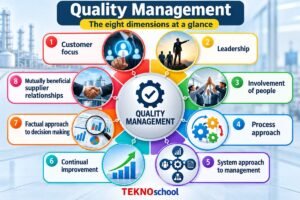
Every organisation says it cares about quality. Far fewer can explain what that commitment rests on. The answer, for most of the world, is a short list of seven ideas known as the quality management principles (QMPs). They sit underneath ISO 9001 and every standard built on it, and they are just as useful to a five-person workshop as to a multinational manufacturer.
This guide walks through all seven principles in plain language. For each one you will find the core idea, the reasoning behind it, practical actions, and a measure you can track. Tables and diagrams along the way show how the principles fit together into one working system rather than seven separate slogans.
Quick facts
The seven principles are defined in ISO 9000 (fundamentals and vocabulary) and published by ISO as a free guidance document. They replaced an earlier set of eight in 2015, when “system approach to management” was folded into the process approach. The new ISO 9001:2026 edition, published in September 2026, keeps the same seven principles while giving extra weight to quality culture and ethical behaviour.
The Seven Principles at a Glance
Before going deep, here is a one-line summary of each principle and the single question it asks of your organisation.
| # | Principle | Core idea | Question to ask |
|---|---|---|---|
| 1 | Customer Focus | Meet requirements and try to exceed expectations | Do we truly know what our customers value? |
| 2 | Leadership | Leaders set direction and create the conditions for quality | Do our leaders act as if quality matters? |
| 3 | Engagement of People | Competent, empowered, involved people create value | Can people improve their own work? |
| 4 | Process Approach | Manage activities as interrelated processes in one system | Do we manage the flow, not just the departments? |
| 5 | Improvement | Keep improving to stay relevant and resilient | Is improvement part of the routine? |
| 6 | Evidence-based Decision Making | Decisions rest on data analysed honestly | What does the data actually say? |
| 7 | Relationship Management | Manage relationships with suppliers and partners | Do our suppliers succeed when we succeed? |
Principle 1 of 7
Customer Focus
Statement: The primary focus of quality management is to meet customer requirements and to strive to exceed customer expectations.
Every product or service exists because someone is willing to pay for it. Customer focus means understanding both the stated requirements, such as a dimension on a drawing or a delivery date, and the unstated expectations, such as clear invoices or a quick reply when something goes wrong. It also covers future needs, because customers change faster than most organisations notice.
The principle is not limited to the paying customer. Regulators, end users and the local community are all interested parties whose needs shape what “good” looks like.
How to apply it
- Map who your customers are, including indirect ones
- Capture requirements through contracts, surveys, complaints and site visits
- Link quality objectives directly to customer needs
- Close the loop on every complaint and tell the customer what changed
In practice: A pump manufacturer noticed repeated complaints about installation delays rather than pump performance. Adding a one-page installation guide and pre-drilled base plates cut site complaints sharply without changing the pump itself.
Principle 2 of 7
Leadership
Statement: Leaders at all levels establish unity of purpose and direction and create conditions in which people are engaged in achieving the organisation’s quality objectives.
Quality cannot be delegated to a quality department. When senior managers skip management reviews or quietly push shipments past a failed inspection, everyone learns the real priority. When they ask about defects first and output second, people learn that too.
Leadership here means setting a clear quality policy, aligning it with strategy, providing resources and modelling ethical behaviour. ISO 9001:2026 makes the expectation explicit: top management must actively promote a quality culture, not just sign a policy document.
How to apply it
- Write a short quality policy that people can actually remember
- Attend and chair management reviews in person
- Fund training, tools and time for problem-solving
- Recognise people who stop the line to protect quality
In practice: A plant manager began each daily meeting with the previous day’s rejection rate before discussing output. Within a quarter, supervisors were raising quality issues before they were asked.
Principle 3 of 7
Engagement of People
Statement: Competent, empowered and engaged people at all levels throughout the organisation are essential to enhance its capability to create and deliver value.
The people closest to the work see problems first. Engagement means giving them the skills to spot issues, the authority to act and the channels to be heard. It is the difference between an operator who quietly scraps a bad part and one who explains why it went bad.
Competence and engagement reinforce each other. Training without authority produces frustration; authority without training produces risk.
How to apply it
- Maintain a skills matrix and close gaps with planned training
- Run suggestion schemes with fast, visible responses
- Include operators in root-cause investigations
- Share performance data openly on visual boards
In practice: A packaging line let operators adjust sealing temperature within a defined window instead of waiting for an engineer. Changeover scrap dropped because corrections happened in minutes rather than hours.
Principle 4 of 7
Process Approach
Statement: Consistent and predictable results are achieved more effectively and efficiently when activities are understood and managed as interrelated processes that function as a coherent system.
Most failures happen at hand-offs: between sales and design, design and purchasing, production and dispatch. The process approach looks at the whole chain of inputs, activities and outputs, so that each step is designed with the next one in mind.
Each process should have an owner, defined inputs and outputs, performance measures and known risks. Thinking in processes also makes risk-based thinking practical, because you can see exactly where things could go wrong.
How to apply it
- Draw a process map showing how core processes connect
- Assign an owner and a measure to each process
- Identify risks and controls at each hand-off
- Review the system as a whole, not department by department
In practice: An engineering firm mapped its order-to-delivery process and found that drawings waited four days on average for approval. A clear owner and a two-day rule halved total lead time.
Principle 5 of 7
Improvement
Statement: Successful organisations have an ongoing focus on improvement.
Standing still is going backwards, because customers, competitors and technology all keep moving. Improvement covers small daily fixes, structured projects using tools like PDCA, Six Sigma or 5 Whys, and occasional breakthrough change.
The key word is ongoing. Improvement should be built into normal management through objectives, audits, corrective actions and reviews, not saved for a special campaign once a year.
How to apply it
- Use PDCA as the standard method for any change
- Treat nonconformities as learning opportunities, with real root-cause analysis
- Set improvement objectives with owners and dates
- Check that corrective actions actually stopped the problem recurring
In practice: A foundry ran weekly Kaizen sessions on its highest-scrap casting. Small changes to gating and pouring temperature, tested one at a time, reduced scrap by more than half over six months.
Principle 6 of 7
Evidence-based Decision Making
Statement: Decisions based on the analysis and evaluation of data and information are more likely to produce desired results.
Opinions help generate ideas, but data should decide. This principle asks organisations to collect accurate and reliable data, analyse it with suitable methods and then make decisions that balance the evidence with experience.
It also accepts uncertainty. Data is rarely perfect, so decision-makers need to understand its limits: how it was collected, how big the sample is and whether a trend is real or just noise.
How to apply it
- Define a small set of key metrics for each process
- Verify measurement systems through calibration and checks
- Use simple tools such as Pareto charts, run charts and control charts
- Record the evidence behind major decisions
In practice: Managers at a bottling plant were convinced a new supplier’s caps were faulty. A Pareto analysis showed most leaks came from one capping head out of adjustment. Fixing the machine saved an unnecessary supplier change.
Principle 7 of 7
Relationship Management
Statement: For sustained success, an organisation manages its relationships with interested parties, such as suppliers.
Your quality is only as good as the materials, components and services you buy. Relationship management treats key suppliers and partners as part of the value chain rather than as interchangeable vendors chosen purely on price.
It also extends to investors, employees, regulators and the community. Balancing short-term savings against long-term trust and shared capability is the heart of this principle.
How to apply it
- Classify suppliers by risk and importance
- Share forecasts, specifications and feedback openly
- Develop critical suppliers through joint improvement projects
- Evaluate suppliers on quality and delivery, not only price
In practice: A switchgear maker invited its main enclosure supplier to joint design reviews. Tolerances were set to suit both sides, rework at final assembly fell, and the supplier’s yield improved too.
How the Principles Work Together
The principles are not a checklist to tick one at a time. They reinforce each other, and the easiest way to see this is through the Plan-Do-Check-Act (PDCA) cycle that drives ISO 9001.
Customer focus and leadership shape the plan. People and processes deliver it. Evidence shows whether it worked. Improvement and supplier relationships carry the learning into the next cycle. Remove any one principle and the loop weakens.
Principles and the ISO 9001 clauses
ISO 9001 turns the principles into auditable requirements. The 2026 edition keeps the familiar Clause 4 to 10 structure, so the mapping below holds for both the 2015 and 2026 editions.
| Principle | Main ISO 9001 clauses | What auditors look for |
|---|---|---|
| Customer Focus | 5.1.2, 8.2, 9.1.2 | Requirements reviewed; satisfaction monitored |
| Leadership | 5.1, 5.2, 5.3 | Policy, roles, management commitment, quality culture |
| Engagement of People | 7.1.2, 7.2, 7.3, 7.4 | Competence, awareness, communication |
| Process Approach | 4.4, 6.1, 8.1 | Defined processes, risks and controls |
| Improvement | 10.1, 10.2, 10.3 | Corrective action and continual improvement |
| Evidence-based Decisions | 9.1, 9.2, 9.3 | Monitoring, internal audit, management review |
| Relationship Management | 4.2, 8.4 | Interested parties; control of external providers |
Measuring Each Principle
A principle that cannot be measured tends to stay a slogan. These indicators give each principle a number you can trend over time.
| Principle | Example KPI | Typical source |
|---|---|---|
| Customer Focus | Complaints per 1,000 units; on-time delivery % | CRM, complaint log |
| Leadership | Management review actions closed on time | Review minutes |
| Engagement of People | Suggestions implemented per employee; training hours | HR, suggestion scheme |
| Process Approach | First-pass yield; process cycle time | Production records |
| Improvement | Corrective actions closed and effective; cost of poor quality | CAPA system, finance |
| Evidence-based Decisions | % of processes with defined, reviewed KPIs | Dashboards |
| Relationship Management | Supplier quality rating; incoming rejection % | Goods-in inspection |
Common Mistakes and Better Approaches
| Common mistake | Better approach |
|---|---|
| Treating quality as the quality department’s job | Make process owners accountable for their own results |
| Measuring customer satisfaction once a year | Combine complaints, returns and feedback continuously |
| Fixing symptoms instead of causes | Use structured root-cause analysis and verify effectiveness |
| Choosing suppliers on price alone | Weigh total cost, quality history and delivery reliability |
| Collecting data nobody reviews | Fewer metrics, each with an owner and a review rhythm |
| Writing procedures nobody follows | Build procedures with the people who do the work |
A Five-Step Roadmap to Put the Principles into Practice
Assess
Score your organisation 1 to 5 on each principle.
Prioritise
Pick the two weakest principles that hurt customers most.
Act
Run small PDCA projects with clear owners and dates.
Measure
Track one KPI per principle on a visible board.
Embed
Review in management meetings and repeat each year.
A small business can complete this cycle with a whiteboard and an hour a week. A larger organisation will use formal audits and dashboards, but the logic is identical.
Frequently Asked Questions
Are the seven principles requirements of ISO 9001?
No. They are guidance in ISO 9000. ISO 9001 converts them into specific requirements, so applying the principles makes certification much easier.
Which principle is the most important?
None ranks above the others. ISO deliberately lists them without priority, because each one depends on the rest.
Do the principles apply to service businesses?
Yes. Hospitals, banks, software firms and schools apply them as effectively as factories. Only the examples change.
Conclusion
The seven quality management principles are simple to state and demanding to live by. Focus on customers. Lead by example. Engage the people who do the work. Manage processes as a system. Improve continuously. Decide on evidence. Build strong relationships with the partners you depend on.
Organisations that treat these as everyday habits, rather than wall posters, find that certification, lower costs and loyal customers tend to follow. Start with an honest self-assessment, fix the weakest link first, and let the PDCA cycle do the rest.
Key takeaway
Quality is not a department or a certificate. It is the result of seven connected habits practised consistently across the whole organisation.