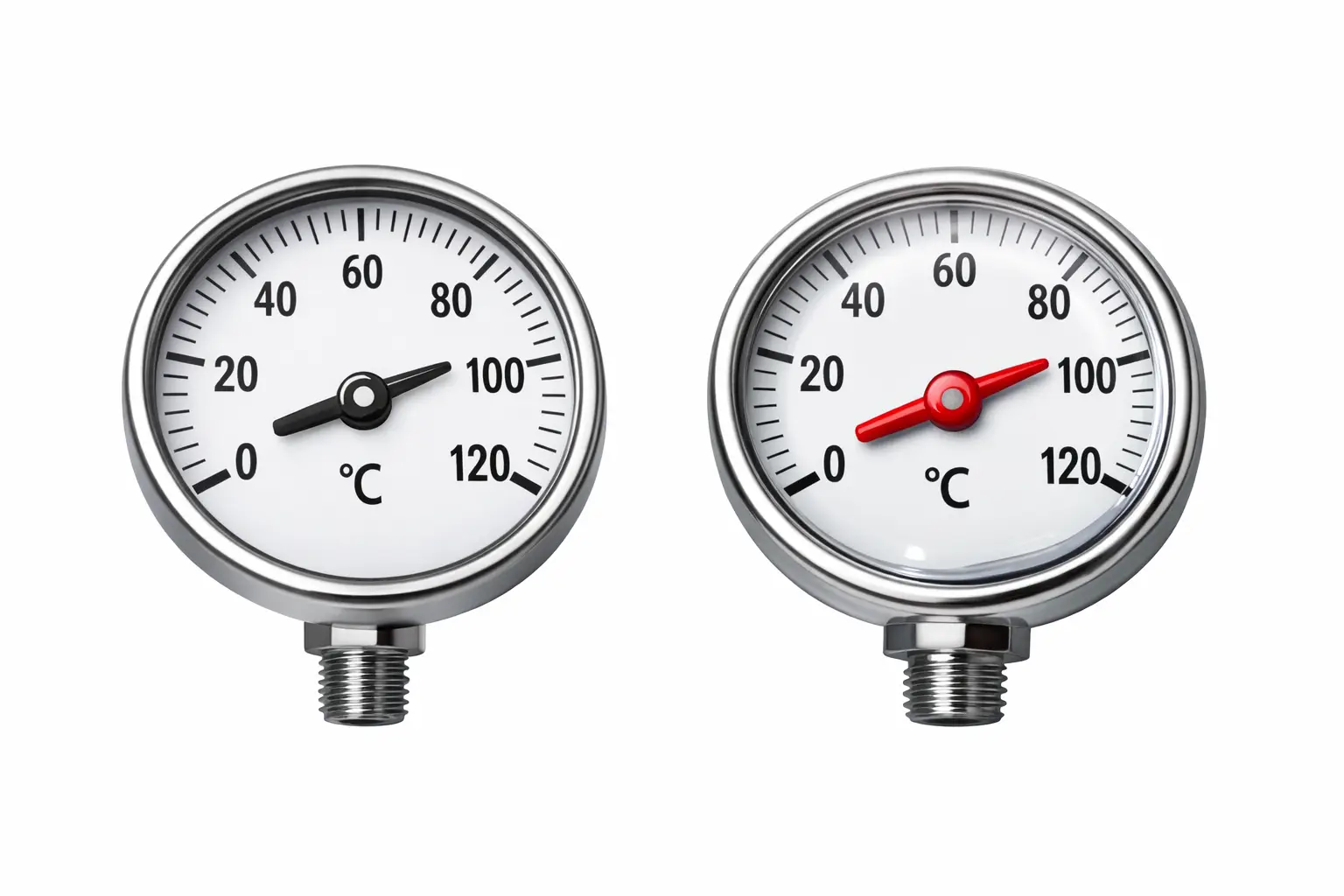
Temperature Gauge
🌡️ Complete Guide to Temperature Gauges: Types, Construction, Applications & Installation
🔎 Introduction
Temperature gauges are vital instruments for monitoring and controlling heat in industrial processes. From steam lines to corrosive chemicals, choosing the right gauge ensures safety, accuracy, and durability. This guide explores types of gauges, their construction, working principles, installation guidelines, materials of construction (MOC), and thermowell requirements.
📊 Types of Temperature Gauges
1) 🌡️ Bimetallic Temperature Gauge
🏗️ Construction: Helical/spiral bimetal strip
⚙️ Working Principle: Differential expansion of metal bends pointer
📈 Range: -50°C to 500°C
🎯 Accuracy: ±1.5% to ±2%
🏭 Applications: Air, water, HVAC, general industry
🛡️ MOC: SS304/SS316, brass
👍 Pros: Simple, rugged, low cost
👎 Cons: Lower accuracy, slower response
⭐ Best For: General-purpose indication
Industrial Grade (Standard Bimetal) made with, 🔥 High‑Thermal Expansion: Chrome–Nickel Steel❄️ Low‑Thermal Expansion: Invar (Nickel–Iron Alloy)
Economical Type made with, 🔥 High‑Thermal Expansion: Brass ❄️ Low‑Thermal Expansion: Carbon Steel
Moderate‑Range Type made with, 🔥 High‑Thermal Expansion: Copper❄️ Low‑Thermal Expansion: Steel
Precision Type made with, 🔥 High‑Thermal Expansion: Manganese–Copper Alloy / Nickel–Chromium Alloy❄️ Low‑Thermal Expansion: Invar or Super‑Invar
2) 🔥 Gas-Filled Temperature Gauge
🏗️ Construction: Bulb + capillary + Bourdon tube
⚙️ Working Principle: Nitrogen expansion increases pressure
📈 Range: -200°C to 700°C
🎯 Accuracy: ±1% to ±1.5%
🏭 Applications: Steam, high temperature, remote mounting
🛡️ MOC: SS316, Hastelloy
👍 Pros: Wide range, stable, long capillary support
👎 Cons: Capillary damage risk, higher cost
⭐ Best For: Steam lines, remote indication
3) 💧 Liquid-Filled Temperature Gauge
🏗️ Construction: Glycerin/silicone-filled Bourdon tube
⚙️ Working Principle: Liquid expansion + vibration damping
📈 Range: -50°C to 250°C
🎯 Accuracy: ±1.5%
🏭 Applications: Pumps, compressors, vibrating equipment
🛡️ MOC: Brass, SS304/SS316
👍 Pros: Excellent vibration resistance
👎 Cons: Limited temperature range ⭐ Best For: High-vibration environments
4) 🧪 Mercury-in-Steel Thermometer
🏗️ Construction: Mercury-filled capillary + Bourdon tube
⚙️ Working Principle: Mercury expansion creates pressure change
📈 Range: -40°C to 550°C
🎯 Accuracy: ±0.5% to ±1%
🏭 Applications: Labs, calibration, hazardous areas
🛡️ MOC: SS316, flameproof housings
👍 Pros: Very high accuracy
👎 Cons: Mercury restrictions, fragile capillary ⭐ Best For: Precision measurement
5) 🖥️ Digital Temperature Gauge
🏗️ Construction: RTD/Thermocouple + electronics
⚙️ Working Principle: Electrical resistance/EMF converted to display
📈 Range: -200°C to 1200°C
🎯 Accuracy: ±0.1% to ±0.5%
🏭 Applications: Corrosive, hazardous, remote monitoring
🛡️ MOC: SS316, PTFE-lined, Ex-proof housings
👍 Pros: Fast, accurate, remote monitoring
👎 Cons: Needs power, electronics may fail
⭐ Best For: Precision, hazardous areas, SCADA/PLC
⚙️ Construction & Working Principles
Bimetallic: Simple mechanical bending action; rugged and cost-effective.
Gas-Filled: Sealed system with nitrogen; stable over wide ranges.
Liquid-Filled: Silicone oil/glycerin dampens vibration; protects mechanism.
Mercury-in-Steel: High accuracy; mercury expansion drives Bourdon tube.
Digital: Fast response; remote monitoring possible.
🛠️ Installation & Mounting Guidelines
General: Install at representative points, avoid direct sunlight, vibration, and corrosive exposure.
Mounting Options: Direct stem, surface, panel, or remote capillary mounting.
Calibration: Always calibrate before commissioning.
🌍 Application-Specific Guidelines
1. Steam Applications
- Use bimetallic or gas-filled gauges with siphon tubes to protect from direct steam.
- Install vertically to avoid condensate accumulation.
- MOC: Stainless steel wetted parts recommended.
2. Slurry Applications
Use liquid-filled gauges with protective wells.
Ensure flushing connections to prevent clogging.
MOC: SS316 or Hastelloy for abrasion/corrosion resistance.
3. Corrosive Applications
- Use PTFE-lined or SS316 wetted parts.
- Digital gauges with remote sensors are preferred.
- MOC: Hastelloy, Monel, or PTFE coatings depending on chemical.
4. Air Applications
Bimetallic or digital gauges are sufficient.
Install away from drafts for accuracy.
MOC: Brass or SS depending on environment.
5. Water Applications
Use liquid-filled gauges for vibration resistance.
Protective thermowells recommended.
MOC: Brass for non-corrosive water, SS316 for treated/industrial water.
6. Flammable Applications
Use explosion-proof digital gauges or mercury-in-steel gauges.
Ensure compliance with ATEX/IECEx standards.
MOC: SS316 or flame-proof housings.
🧪 Materials of Construction (MOC) Guidelines
Brass: Suitable for non-corrosive media (air, clean water).
SS304/SS316: Standard for steam, industrial water, mild chemicals.
Hastelloy/Monel: For highly corrosive acids and slurries.
PTFE-lined: For aggressive chemicals where metal corrosion is severe.
🔄 Replacement Guidelines
Gas-Filled Gauges: Replace if leakage occurs, pointer becomes unstable, or calibration drifts.
Liquid-Filled Gauges: Replace if liquid leaks, dial fogs, or vibration damping fails.
Bimetallic Gauges: Replace if pointer sticks or mechanical fatigue sets in.
Digital Gauges: Replace sensor if drift exceeds tolerance or electronics fail.
🛡️ Thermowell Requirement
What is a Thermowell? A protective metal tube inserted into the process, housing the gauge stem or sensor.
Purpose: Protects gauge from pressure, corrosion, and mechanical damage; allows replacement without process shutdown.
When Required:
Steam lines (high pressure/temperature).
Slurries (abrasion).
Corrosive chemicals (protection).
Flammable media (safety compliance).
MOC for Thermowells: SS316 for general use, Hastelloy/Monel/PTFE-lined for corrosive media.
✅ Key Takeaways
Select gauge type based on medium, environment, and accuracy needs.
Always match MOC of wetted parts to process fluid.
Use thermowells for protection and easy maintenance.
Replace gauges when leakage, drift, or mechanical failure occurs.
Digital gauges are best for hazardous and precision applications.
✍️ Conclusion
Temperature gauges are more than just indicators—they are guardians of process safety and efficiency. By choosing the right type, material, and installation method, industries can ensure reliable performance across steam, slurry, corrosive, air, water, and flammable applications.