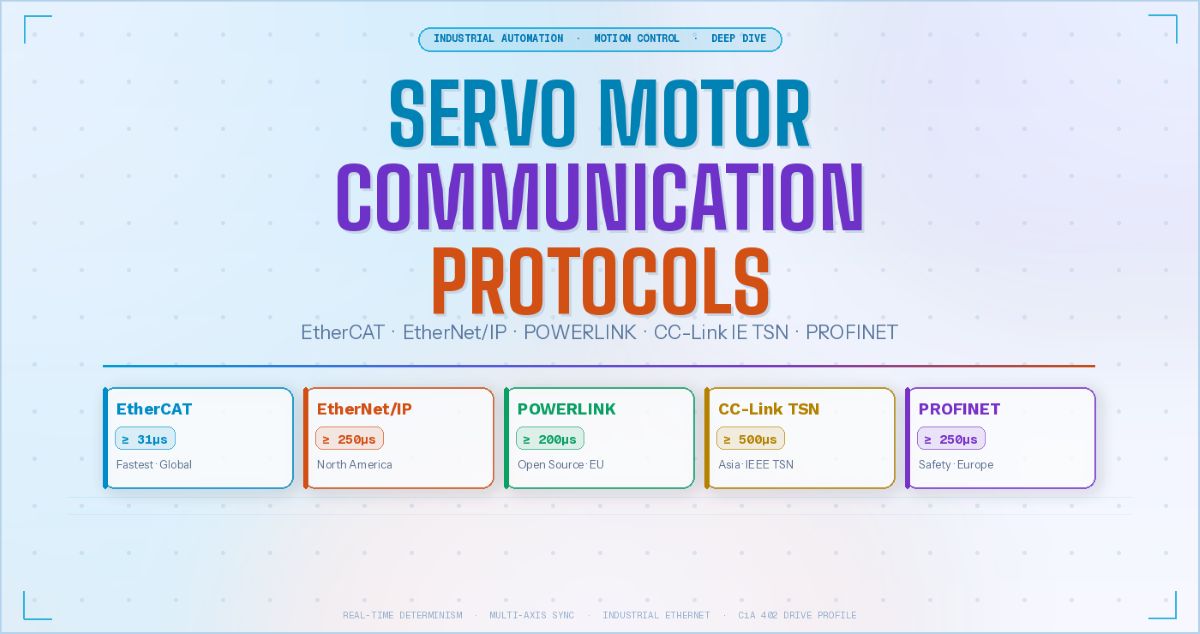
Servo Motor Control System Communication Protocol — EtherCAT, EtherNet/IP, POWERLINK, CC-Link & PROFINET
🔧 Servo Motor Control System Communication Protocol — The Complete Guide
EtherCAT | EtherNet/IP | POWERLINK | CC-Link | PROFINET
💡 Why Servo Motor Control System Communication Protocol Is Critical
Servo motors are the muscles of modern industrial automation — but muscles are nothing without nerves. Servo Motor Control System Communication Protocol.
Whether it’s a robotic arm assembling electronics, a CNC machine carving aerospace parts, or a packaging line running at full speed, the Servo motor control system communication protocol connecting your controller, drives, and motors determines everything:
✅ Performance ✅ Determinism ✅ Scalability ✅ Long-term interoperability
Any delay or jitter in communication means positional errors, oscillation, or catastrophic machine faults. This is why choosing the right protocol is one of the most important decisions in machine design.
🎯 What Servo Communication Demands
Before diving into protocols, understand what separates servo communication from ordinary industrial networking:
⏱️ Determinism — Data must arrive within a precisely defined time window, every single cycle, without exception.
🔄 Synchronization — Multi-axis systems need all drives sharing an identical clock reference for perfectly coordinated motion.
🚀 Cycle Time — Faster cycles allow tighter position control loops, higher accuracy, and smoother motion trajectories.
🔌 Interoperability — Standard drive profiles like CiA 402 ensure multi-vendor compatibility across servo drive manufacturers.
⚡ EtherCAT — The Speed King
Full Name: Ethernet for Control Automation Technology Standard: IEC 61158 | Developed by: Beckhoff Automation
| Spec | Value |
|---|---|
| ⏱️ Cycle Time | ≥ 31.25 µs |
| 🎯 Sync Accuracy | Sub-microsecond |
| 🔗 Topology | Line / Ring |
| 📡 Max Nodes | 65,535 |
EtherCAT is widely regarded as the fastest and most deterministic industrial Ethernet protocol available today. Its genius lies in “processing on the fly” — a single Ethernet frame travels through all nodes in a ring, and each device reads its data and writes its response as the frame passes through, all within nanoseconds.
🔹 Distributed Clock (DC) Technology — gives every drive across the network an identical time reference, enabling perfectly synchronized multi-axis motion. Essential for electronic gearing, cam profiling, and coordinated robotics.
🔹 Standard Ethernet Hardware — no special cabling or switches required. This keeps infrastructure costs low and simplifies deployment.
🔹 CiA 402 (DS402) Drive Profile — ensures plug-and-play interoperability across all major servo drive manufacturers.
🔹 Up to 65,535 devices on a single network with sub-microsecond jitter across all nodes.
🏆 Best For: High-speed robotics, CNC systems, semiconductor manufacturing, and any application demanding maximum precision and synchronization.
🌐 Ethernet/IP — The Ubiquitous Choice
Full Name: Ethernet Industrial Protocol Managed by: ODVA | Application Layer: Common Industrial Protocol (CIP)
| Spec | Value |
|---|---|
| ⏱️ Cycle Time | ≥ 250 µs |
| 🎯 Sync Accuracy | IEEE 1588 PTP |
| 🔗 Topology | Star |
| 🌍 Market Leader | North America |
EtherNet/IP is one of the most widely deployed industrial protocols globally, dominating the North American automation market. It uses completely standard, unmodified Ethernet and TCP/UDP/IP infrastructure — making it the most IT-friendly protocol on this list and easy to integrate into plant-wide networks.
🔸 Common Industrial Protocol (CIP) — the same protocol family as DeviceNet and ControlNet. Migration from legacy systems is seamless, especially for Allen-Bradley users.
🔸 CIP Motion — provides coordinated servo control with IEEE 1588 Precision Time Protocol synchronization. Performance is adequate for the vast majority of industrial servo applications.
🔸 Massive Ecosystem — virtually every servo drive manufacturer supports EtherNet/IP, with deep integration into Rockwell Automation and Omron platforms.
🔸 IT/OT Convergence Ready — fits naturally into enterprise networks without special gateways or configuration.
🏆 Best For: North American plants, Allen-Bradley/Rockwell Automation ecosystems, and factories where IT and OT network convergence is a priority.
🔗 POWERLINK — The Open Ethernet Pioneer
Full Name: Ethernet POWERLINK Managed by: EPSG | Developed by: B&R Industrial Automation
| Spec | Value |
|---|---|
| ⏱️ Cycle Time | ≥ 200 µs |
| 🎯 Sync Accuracy | Microsecond range |
| 🔗 Topology | Line / Star |
| 🔓 License | Fully Open-Source |
POWERLINK was one of the first protocols to achieve hard real-time performance over standard Ethernet hardware. Its Slot Communication Network Management (SCNM) mechanism has the Managing Node — typically the PLC — orchestrate all communication in strict time slots, completely preventing collisions without needing managed switches.
🟢 Fully Open-Source (openPOWERLINK) — no royalties, no vendor lock-in. Ideal for OEMs building proprietary machines and wanting complete control over their communication stack.
🟢 CiA 402 Drive Profile — supported natively, ensuring broad compatibility with the servo drive ecosystem.
🟢 Backbone of B&R Automation — deeply integrated into B&R’s entire automation stack, with excellent tooling, diagnostics, and commissioning support.
🟢 Strong in Packaging & Printing — proven in high-cycle-rate machines across European manufacturing.
🏆 Best For: European machine builders, printing and packaging lines, B&R-based systems, and projects needing a truly open and royalty-free real-time protocol.
🔌 CC-Link / CC-Link IE TSN — The Asian Market Standard
Full Name: Control & Communication Link IE TSN Managed by: CLPA | Developed by: Mitsubishi Electric
| Spec | Value |
|---|---|
| ⏱️ Cycle Time | ≥ 500 µs |
| 🎯 Sync Standard | IEEE 802.1 TSN |
| 🔗 Topology | Star |
| 🌏 Market Leader | Asia |
CC-Link and its evolved variants dominate the Asian automation market — particularly Japan, China, and Southeast Asia. The original CC-Link operated over RS-485. CC-Link IE Field brought Gigabit Ethernet. The latest CC-Link IE TSN integrates IEEE 802.1 Time-Sensitive Networking standards, making it the most future-ready protocol on this list.
🟡 CC-Link IE TSN + IEEE 802.1 TSN — the most forward-looking move in the industrial protocol landscape, pointing toward open, multi-vendor interoperability at the Ethernet layer across all vendors globally.
🟡 Gigabit Ethernet Backbone — CC-Link IE delivers 1 Gbps bandwidth, far exceeding legacy fieldbus solutions.
🟡 Deep Mitsubishi Integration — seamless connection to MELSEC PLCs, MELSERVO drives, and the complete iQ-R/iQ-F platform.
🟡 Growing Global Footprint — TSN adoption is expanding CC-Link’s reach well beyond Asia.
🏆 Best For: Asian markets, Mitsubishi-centric factories, and forward-thinking applications targeting TSN-based open interoperability as the industry standard.
🏭 PROFINET — The European Powerhouse
Full Name: Process Field Net Managed by: PI International | Developed by: Siemens
| Spec | Value |
|---|---|
| ⏱️ Cycle Time (IRT) | ≥ 250 µs |
| 🎯 Jitter (IRT) | < 1 µs |
| 🔗 Topology | Star (IRT switch) |
| 🔒 Safety | PROFIsafe Built-in |
PROFINET is arguably the most widely deployed industrial Ethernet protocol by installed base globally, with overwhelming dominance across Europe. It comes in two flavors: PROFINET RT (1–10 ms, software-based prioritization) for standard I/O tasks, and PROFINET IRT (Isochronous Real-Time, hardware-scheduled) for demanding servo control applications.
🟣 PROFIdrive Profile — covers everything from simple speed control to complex multi-axis positioning and synchronization. A mature, battle-tested standard trusted in critical applications worldwide.
🟣 PROFIsafe (SIL 2/3) — functional safety over the same cable. No separate hardwired safety networks needed, dramatically simplifying panel design and certification.
🟣 Siemens TIA Portal Integration — the deepest engineering tooling of any protocol. Automatic topology discovery, rich network diagnostics, and seamless commissioning all in one environment.
🟣 Widest Installed Base — millions of devices deployed globally with an enormous support and service ecosystem.
🏆 Best For: European facilities, Siemens SIMATIC S7 users, safety-critical applications, and large-scale plants requiring comprehensive diagnostics and integrated functional safety.
📊 Side-by-Side Comparison
| Protocol | Cycle Time | Sync | Topology | Key Strength | Market |
|---|---|---|---|---|---|
| ⚡ EtherCAT | ≥ 31.25 µs | Sub-µs | Line/Ring | Raw speed & sync | Global |
| 🌐 EtherNet/IP | ≥ 250 µs | IEEE 1588 | Star | Ecosystem breadth | North America |
| 🔗 POWERLINK | ≥ 200 µs | µs range | Line/Star | Open-source | Europe |
| 🔌 CC-Link IE TSN | ≥ 500 µs | TSN-based | Star | TSN-ready future | Asia |
| 🏭 PROFINET IRT | ≥ 250 µs | < 1 µs | Star (IRT) | Tooling + Safety | Europe/Global |
🏁 Final Verdict — Which Protocol Should You Choose?
There is no single “best” protocol — the right answer depends on your specific situation:
⚡ Choose EtherCAT if you need the absolute fastest cycle times and tightest synchronization for high-performance multi-axis motion.
🌐 Choose EtherNet/IP if you’re in North America, working within a Rockwell/Allen-Bradley ecosystem, or need seamless IT/OT integration.
🔗 Choose POWERLINK if you want a fully open-source, royalty-free real-time protocol with no vendor lock-in — especially in European machine building.
🔌 Choose CC-Link IE TSN if you’re operating in Asian markets, using Mitsubishi platforms, or building systems targeting the TSN-based open future.
🏭 Choose PROFINET if you’re in a Siemens environment, need integrated functional safety via PROFIsafe, or require the deepest engineering tooling available.
💬 As industrial automation pushes toward smarter, faster, and more connected factories, understanding these protocols is no longer a specialist skill — it’s a fundamental requirement for every engineer designing the next generation of servo-driven machinery.