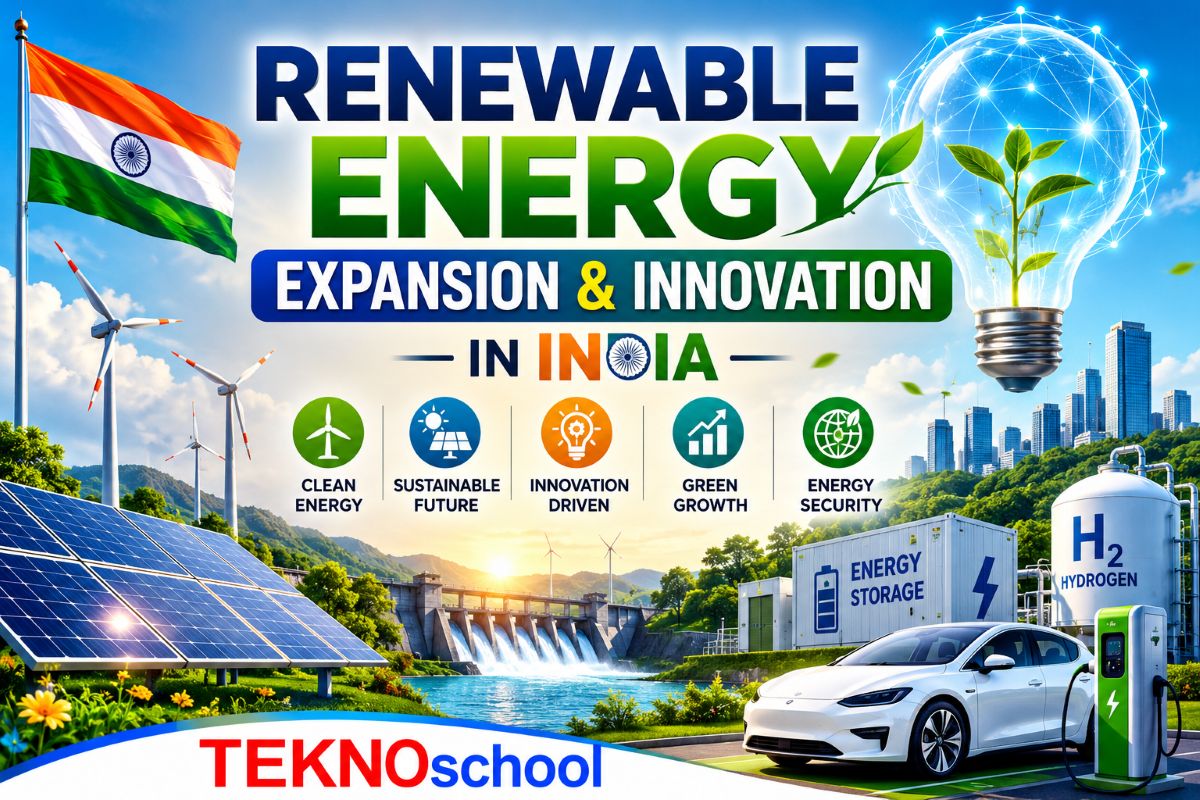
Renewable Energy Expansion & Innovation in India
Solar Power — The Centrepiece of India’s Clean Energy Vision
India receives an average solar insolation of 4–7 kWh/m²/day across most of its landmass, placing it among the highest solar-resource nations in the world. The Thar Desert in Rajasthan, the peninsular plateau, and the northwestern semi-arid zones record peak Global Horizontal Irradiance (GHI) values exceeding 6.5 kWh/m²/day, making utility-scale photovoltaic and concentrated solar power projects economically compelling without storage subsidies.
Solar capacity has grown from a negligible base in 2010 to over 73 GW of installed photovoltaic capacity by mid-2024, making India the third-largest solar market globally. The National Solar Mission, now embedded within the broader National Green Hydrogen Mission and PM-KUSUM framework, targets 280 GW of solar by 2030. Ultra-Mega Solar Parks — such as Bhadla (Rajasthan, 2.7 GW), Pavagada (Karnataka, 2.05 GW), and Rewa (Madhya Pradesh, 750 MW) — aggregate land acquisition, evacuation infrastructure, and grid interconnection under a single development framework, reducing per-MW project development cost substantially.
Modern utility-scale projects now deploy bifacial monocrystalline PERC modules mounted on horizontal single-axis trackers (HSATs). Bifacial gain of 8–15% combined with tracker yield improvement of 20–25% over fixed-tilt systems is routinely achievable in India’s high-albedo desert terrain. Module efficiency exceeding 22% at STC is now commercially standard, with TOPCon and HJT architectures pushing toward 25%+ in the near term.
Rooftop solar under the PM Surya Ghar: Muft Bijli Yojana aims for 10 million household installations by 2027, expanding distributed generation significantly. Floating solar — deployed on irrigation reservoirs in Maharashtra, Kerala, and Telangana — addresses the critical land availability constraint while reducing evaporation losses from the water bodies themselves.
Wind Energy — Onshore Maturity and the Offshore Frontier
India’s wind energy installed base of approximately 46 GW is concentrated in the wind-rich southern and western states — Tamil Nadu, Gujarat, Karnataka, Rajasthan, and Andhra Pradesh collectively account for over 85% of installed capacity. Wind power density exceeding 300 W/m² at hub heights of 100–120 m characterises the Deccan plateau escarpments, the Rann of Kutch, and the Palk Strait corridor. The national wind atlas, developed through the National Institute of Wind Energy (NIWE), maps India’s exploitable onshore potential at 695 GW at 120 m hub height.
Modern onshore turbines of 3–5 MW class with hub heights of 140–160 m and rotor diameters exceeding 145 m are now deployed in India to access higher, more consistent wind shear. Capacity factors of 30–42% are achievable at premium sites, making levelised cost of energy (LCOE) competitive with coal-fired generation in windy states.
India’s offshore wind programme — targeting 30 GW by 2030 in the Arabian Sea off Gujarat and Tamil Nadu — is nascent but strategically vital. Shallow waters in the Gulf of Khambhat offer monopile-compatible depths below 30 m. The Ministry of New and Renewable Energy (MNRE) has issued the first offshore wind zone notifications, with viability gap funding (VGF) mechanisms being finalised to bridge the LCOE gap versus onshore wind.
The concept of hybrid renewable energy parks — co-locating wind and solar on shared land with a combined grid interconnection — is rapidly gaining traction. Wind and solar generation profiles are naturally complementary: wind tends to peak in early morning and evening hours when solar output is low, flattening the combined generation curve and improving plant load factor. SECI’s hybrid tenders now routinely specify a minimum capacity factor guarantee, incentivising developers to optimise the wind-to-solar ratio on a site-specific basis.
Hydropower — Pumped Storage as the Grid’s Battery
India’s technically exploitable large hydro potential stands at 148 GW, of which approximately 47 GW is currently installed. The Himalayan river systems — Indus, Ganga, and Brahmaputra basins — account for nearly 70% of this potential. However, environmental clearance challenges, geological risks in seismically active terrains, and long gestation periods of 8–12 years constrain greenfield large hydro expansion.
The more strategically important development is Pumped Storage Projects (PSPs). With India’s variable renewable capacity expanding rapidly, PSPs function as large-scale, long-duration grid batteries — pumping water uphill during renewable surplus periods and releasing it through turbines during peak demand. India has identified over 96 GW of PSP potential, with projects like the 2.8 GW Koyna PSP (Maharashtra) and the 1.2 GW Tehri PSP (Uttarakhand) already in service. The CEA targets 35 GW of operational PSP by 2032 to firm up the intermittent RE portfolio.
Small Hydro Power (SHP) — projects below 25 MW — adds another dimension, with over 21 GW of potential in India’s northeastern states, Himachal Pradesh, and Uttarakhand, providing decentralised, run-of-river generation for remote grids where large transmission infrastructure is economically unviable.
Biomass & Bioenergy — Dispatchable Renewable Power
India generates approximately 750 million tonnes of agricultural residue annually — paddy straw, sugarcane bagasse, cotton stalks, and groundnut shells being the most energy-dense. Biomass-based power generation exploits this resource through direct combustion in dedicated power plants (typical capacity 5–30 MW), co-firing in existing coal stations, and gasification for combined heat and power (CHP) applications. Installed biomass and bagasse cogeneration capacity stands at approximately 10.7 GW.
The National Bioenergy Programme covers biogas, biopower, and upgraded biomass. Municipal Solid Waste (MSW)-to-energy plants and biogas upgrading to Compressed Biogas (CBG) under the SATAT scheme represent newer verticals. Biogas reforming to produce bio-hydrogen — using steam methane reforming (SMR) on renewable methane — is increasingly being explored as a bridge technology toward the green hydrogen economy.
Biomass power’s critical engineering advantage is dispatchability — unlike solar and wind, it can generate on demand, making it invaluable for grid balancing and providing firm capacity during monsoon-induced solar deficit periods and low-wind seasons.
Green Hydrogen — The Next Frontier of Energy Innovation
India’s National Green Hydrogen Mission, approved with an outlay of ₹19,744 crore, targets production of 5 MMT (million metric tonnes) of green hydrogen per annum by 2030 — positioning India as a global hub for production and export. Green hydrogen is produced through Proton Exchange Membrane (PEM) or Alkaline water electrolysis powered entirely by renewable electricity, yielding zero-carbon hydrogen (H₂) with water as the only by-product.
Alkaline electrolysers (AEL) offer lower capex; PEM electrolysers provide faster response to variable RE input. Current system efficiency is 65–75% (HHV basis). Solid Oxide Electrolysis Cells (SOEC) — operating at 700–850°C — can achieve >85% efficiency when integrated with industrial waste heat.
Hard-to-abate sectors — steel (DRI process), fertilisers (ammonia synthesis), refining (hydrocracking), and heavy transport (fuel cells) — are priority demand centres. Green ammonia for export via ports in Gujarat and Andhra Pradesh is an early revenue pathway for Indian producers.
Green hydrogen currently costs USD 4–6/kg in India. The mission targets USD 1/kg by 2030 through scale-up of renewable electricity, electrolyser manufacturing, and operational optimisation — competitive with grey hydrogen produced from fossil-fuel steam reforming.
Strategic Hydrogen Valleys — integrated industrial clusters co-locating renewable power, electrolysers, storage, and hydrogen-consuming industries — are being planned in Andhra Pradesh, Gujarat, and Odisha. Pipeline blending of up to 10–20% hydrogen in existing natural gas infrastructure is under regulatory consideration, providing an early utilisation pathway while dedicated hydrogen pipelines are developed.
Indigenous Manufacturing — Make in India for Clean Energy
India’s clean energy ambition is inextricably linked to its industrial policy — specifically the imperative to build a domestic manufacturing ecosystem that reduces import dependence, creates high-value employment, and positions India as a global clean technology exporter. The Production Linked Incentive (PLI) scheme for Advanced Chemistry Cells (ACC batteries), solar PV modules, electrolysers, and wind turbine components is the primary instrument of this industrial strategy.
India targets 100 GW/year of integrated solar manufacturing capacity — from polysilicon to module — by 2030. The PLI scheme (₹24,000 crore) incentivises fully integrated supply chains. Current module manufacturing capacity exceeds 70 GW/year, with companies like Adani Solar, Waaree, and First Solar’s Indian operations leading capacity expansion.
India’s wind manufacturing base — including nacelles, blades, towers, and generators — is among the most developed in Asia. Companies like Suzlon, Inox Wind, and GE Vernova’s Indian operations supply the domestic market. The transition to larger 5–7 MW turbines requires investment in blade manufacturing for lengths exceeding 80 m, where India is building new facilities.
The ACC PLI scheme targets 50 GWh of cell manufacturing by 2028. For electrolysers, the MNRE PLI supports 1,500 MW/year of alkaline and PEM electrolyser manufacturing capacity. Domestic production of critical minerals — lithium from Rajasthan deposits, cobalt and nickel refining — is being fast-tracked under the Critical Mineral Mission.
The Approved List of Models and Manufacturers (ALMM) for solar modules and cells is a demand-side policy tool that mandates domestic procurement for government-funded projects, creating guaranteed market pull for Indian manufacturers. From 2024, import duties of 40% on solar modules and 25% on cells further strengthen the economics of domestic production relative to Chinese imports.
RPO (Renewable Purchase Obligation): State distribution utilities are mandated to procure a minimum percentage of their energy from renewable sources — 43.33% by 2030 under revised RPO trajectories — creating a binding offtake mechanism for RE generators.
Green Energy Open Access: Industrial and commercial consumers above 100 kW can directly procure renewable energy from generators through open access, bypassing distribution utilities, at competitive tariffs — accelerating corporate RE procurement.
Transmission Infrastructure: The Green Energy Corridor (GEC) phases I and II dedicate inter-state transmission capacity to renewable-rich states, solving the evacuation bottleneck that historically delayed commissioning of completed RE projects.
PM-KUSUM & Agrovoltaics: The installation of solar pumps and agrivoltaic systems on agricultural land creates a dual revenue stream for farmers while expanding distributed generation, reducing feeder loading in rural distribution networks.
Engineering the Integrated Renewable Grid of Tomorrow
The convergence of solar, wind, hydro, biomass, and green hydrogen — underpinned by domestic manufacturing — represents more than a portfolio of energy technologies. It constitutes a systemic redesign of India’s power architecture: from a centralised, fossil-fuel baseload paradigm toward a geographically distributed, resource-coupled, variable-generation ecosystem requiring sophisticated grid balancing, energy storage, demand response, and smart interconnection infrastructure.
Hybrid renewable parks with co-located Battery Energy Storage Systems (BESS), pumped hydro firming, and dispatchable biomass backup address the core engineering challenge of reliability. The evolving role of the grid operator — from managing bulk thermal dispatch schedules to orchestrating millions of variable generators through advanced energy management systems, forecasting tools, and real-time ancillary service markets — defines the new frontier of power systems engineering in India.
India’s 500 GW renewable target is not merely an energy policy milestone — it is an industrial, technological, and infrastructural transformation that will define the country’s economic competitiveness, energy security, and carbon trajectory for the next fifty years. The technical, financial, and manufacturing foundations being laid today will determine whether that promise is fully realised.