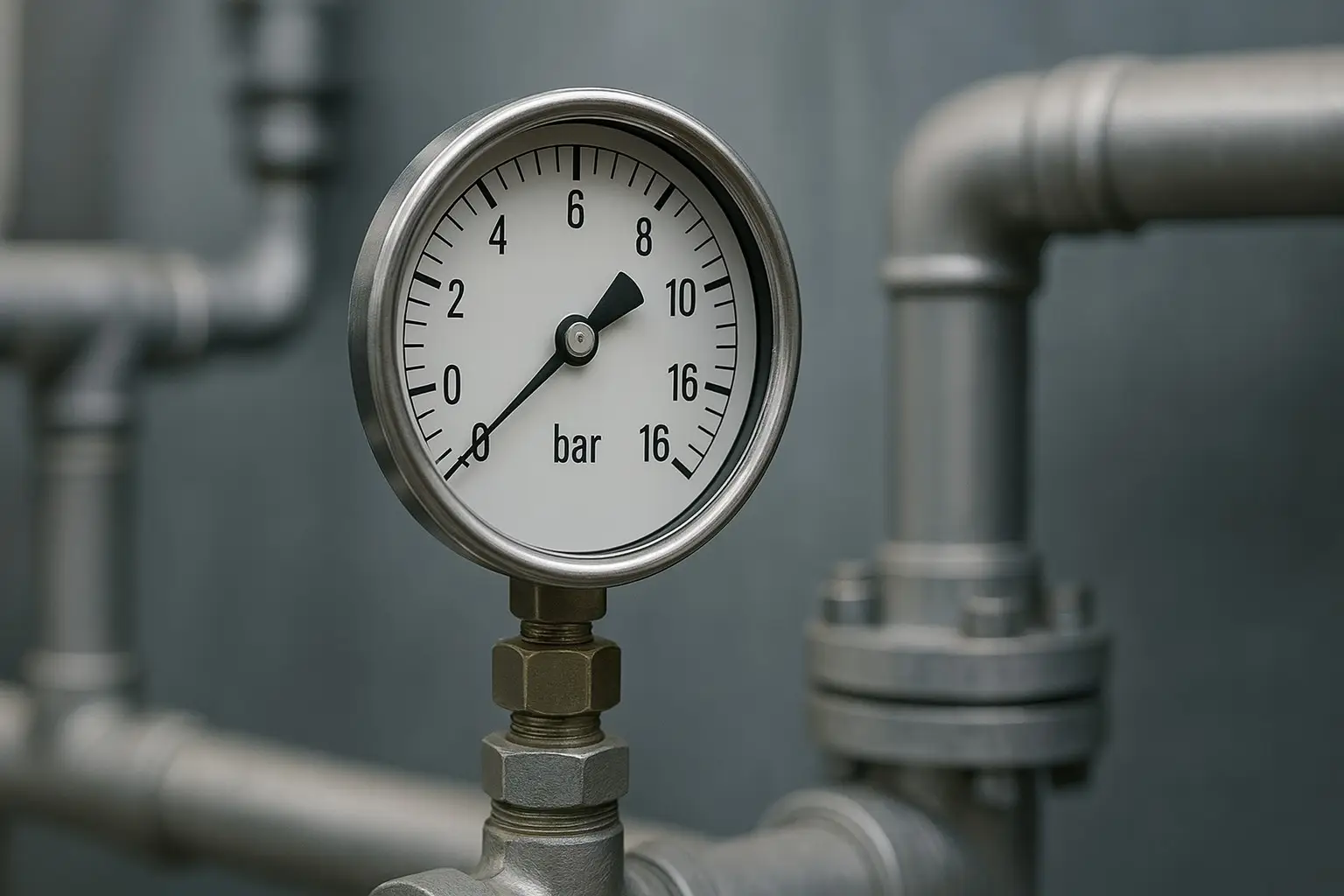
Pressure Gauge
📟 Pressure & Vacuum Gauges – Complete Industrial Guide
Gauge Pressure is measured above/below atmosphere
Absolute Pressure is measured from perfect vacuum
Vacuum Pressure is negative gauge pressure
Full vacuum= 0 bar (a)= -1 bar (g)
Below are all equivalent units expressed line‑by‑line:
Pascal (Pa): 101325 Pa
Kilopascal (kPa): 101.325 kPa
Megapascal (MPa): 0.101325 MPa
Bar: 1.01325 bar
Millibar (mbar): 1013.25 mbar
Standard atmosphere (atm): 1 atm
Technical atmosphere (at): 1.03323 at
Torr: 760 Torr
Millimeters of mercury (mmHg): 760 mmHg
Inches of mercury (inHg): 29.9213 inHg
Pounds per square inch (psi): 14.6959 psi
Pounds per square foot (psf): 2116.22 psf
Kilogram‑force per square centimeter (kgf/cm²): 1.03323 kgf/cm²
Kilogram‑force per square meter (kgf/m²): 10332.3 kgf/m²
Newton per square centimeter (N/cm²): 10.1325 N/cm²
Newton per square meter (N/m²): 101325 N/m² (same as Pa)
🔰 Introduction – Why Pressure & Vacuum Gauges Matter
🔵 Pressure gauges measure the force exerted by fluids, while
🟢 vacuum gauges measure pressure below atmospheric level. Though simple in appearance, these instruments are critical safety and control devices across industries.
✨ A correctly selected gauge protects equipment, ensures process stability, and prevents catastrophic failures.
📜 IBR, IS & ASME Compliance – What You Must Know
🟠 IBR (Indian Boiler Regulations) • Mandatory for steam pressure gauges used on boilers and steam lines
• Requires IBR stamping, calibration, and periodic inspection • Gauge range must be 1.5 to 2 times the maximum working pressure
🟢 IS Standards (BIS – India) • IS 3624 – Bourdon tube pressure gauges
• IS 3483 – Dial dimensions and accuracy• Ensures interchangeability, safety, and minimum quality benchmarks
🔵 ASME Standards (Global Acceptance) • ASME B40.100 – Pressure & vacuum gauges
• Defines accuracy classes, safety features, blow‑out protection• Widely accepted in oil & gas, refineries, EPC projects
✨ Compliance is not optional — it is a legal, safety, and insurance requirement.
🏭 Popular Manufacturers & Trusted Models
🔹 WIKA – Industrial benchmark for accuracy and safety
🔹 Ashcroft – Rugged gauges for harsh environments 🔹 Baumer – Hygienic and pharmaceutical applications 🔹 H. Guru / Nagman – Indian industry workhorses 🔹 Winters – Oil & gas focused designs
✨ Always verify certification, wetted material, and pressure range before procurement.
🧭 Types of Pressure & Vacuum Gauges – Explained Simply
🔵 Bourdon Tube Gauge
✔ Most common industrial gauge
✔ Ideal for medium to high pressure✔ Robust and economical
🟢 Diaphragm Gauge
✔ Best for corrosive, viscous, or slurry media
✔ Excellent for low pressure measurement✔ Can be combined with diaphragm seals
🟣 Capsule Gauge
✔ Extremely sensitive
✔ Used for very low pressure and vacuum✔ Common in laboratories and HVAC
🟠 Bellows Gauge
✔ Suitable for low pressure and vacuum✔ Used where higher sensitivity is required
✨ Selection depends on pressure range, media, and environment.
🔍 Comparison – Which Gauge Type Should You Choose?
🔵 Bourdon Tube
• High pressure capability• Not suitable for slurry or crystallizing fluids
🟢 Diaphragm
• Excellent chemical resistance• Limited high‑pressure range
🟣 Capsule
• Ultra‑low pressure accuracy• Not suitable for vibration
🟠 Bellows
• Good sensitivity• Moderate mechanical strength
✨ No single gauge fits all applications — process conditions decide.
🧱 Construction – Inside a Pressure /Vacuum Gauge
🔩 Pressure Sensing Element – Bourdon tube / diaphragm / capsule
🔩 Link & Lever /pinion/ sector Mechanism – Converts motion to pointer movement🔩 Pointer & Dial – Visual indication
🔩 Case & Window – Protection from environment🔩 Process Connection – Threaded or flanged
✨ Precision machining ensures repeatability and long service life.
⚙️ Working Principle – How the Gauge Thinks
🔹 Applied pressure /vacuum causes elastic deformation of the sensing element
🔹 Mechanical movement is amplified through linkage🔹 Pointer rotates proportionally on calibrated dial
✨ Simple physics, reliable performance — that’s why gauges still dominate industry.
🧰 Mounting & Installation Methods
🔵 Bottom Connection – Direct pipeline mounting🟢 Back Connection – Panel mounting
🟣 Flush Mount – Control room panels🟠 Remote Mount – With capillary for hot or vibrating services
⚠️ Correct mounting prevents false readings and premature failure.
🧪 Auxiliary Items – Protecting Your Gauge
✔️Snubber
• Dampens pressure pulsation• Essential for reciprocating pumps and compressors
✔️Syphon
• Mandatory for steam service• Prevents hot steam from damaging gauge internals
✔️Condensate Pot
• Collects condensate in steam lines• Ensures stable and accurate readings
✨ Accessories are not optional add‑ons — they are life‑extenders.
✔️Diaphragm Seal
• Process pressure acts on diaphragm surface • Diaphragm deflects proportionally • Fill fluid transmits pressure hydraulically • Gauge indicates pressure accurately
✨ No process fluid enters the gauge — only pressure is transmitted.
A diaphragm seal pressure gauge is used when the process media is corrosive, viscous, slurry‑type, or hazardous, where direct contact with the gauge sensing element is not acceptable. The diaphragm acts as a protective barrier, isolating the gauge from the process while accurately transmitting pressure through a fill fluid. This arrangement significantly improves gauge life, safety, and reliability in harsh applications. Diaphragm seal gauges are widely used in chemical, pharmaceutical, slurry, and high‑temperature services where conventional gauges cannot survive.
🧩 Internal & External Parts – Material of Construction
🔵 Internal Wetted Parts • Brass – Air, water, non‑corrosive fluids
• SS316 – Corrosive, high‑temperature, flammable media• Monel / Hastelloy – Highly aggressive chemicals
🟢 External Parts • SS Case – Outdoor, corrosive atmosphere
• Aluminum Case – Indoor panels• Glass / Acrylic Window – Visibility and impact resistance
✨ Material selection defines safety, accuracy, and lifespan.
🔥 Application in Flammable Environments
🛢 LPG, hydrocarbons, solvents, fuels
✔ SS316 wetted parts✔ Glycerin‑filled case
✔ Blow‑out back safety✔ Flameproof or ATEX‑rated where required
✨ Safety design prevents pressure release toward operator.
☣️ Application in Corrosive Environments
🧪 Acids, alkalis, chlorine, chemical slurry
✔ Diaphragm seal recommended
✔ PTFE / Hastelloy diaphragm✔ Fully welded construction
✨ Corrosion attacks silently — material compatibility is critical.
♨️ Application‑Wise Selection Guide
🔵 Steam – Bourdon gauge + syphon + IBR compliance
🟢 Water – Standard Bourdon gauge🟣 Slurry – Diaphragm seal gauge
🟠 Corrosive Liquid – SS316 / diaphragm seal🔴 Flammable Liquid – Filled SS gauge with safety features
🔵 Air – Dry gauge🟢 Vacuum – Capsule or compound gauge
✨ Always size gauge so normal pressure lies between 50–70% of full scale.
🧠 Best Practices from the Field
✔ Use root valve for isolation✔ Avoid over‑range pressure
✔ Calibrate periodically✔ Protect from vibration and temperature extremes
✨ A pressure gauge is a measurement device and a safety device.
🧾 Procurement Checklist – Pressure & Vacuum Gauges
🟢 Before raising PR / PO, always verify the following:
🔵 Process Data • Operating pressure & maximum pressure• Normal operating range (target 50–70% of full scale)
• Media type – gas / liquid / slurry / steam• Process temperature
🟠 Technical Specifications • Gauge type – Bourdon / Diaphragm / Capsule / Compound• Pressure range & unit (bar, kg/cm², psi, mmHg)
• Accuracy class (1.0%, 1.6%, etc.)• Dial size & mounting orientation
🟣 Material of Construction • Wetted parts MOC (Brass / SS316 / Monel / Hastelloy)
• Case material (SS / Aluminum)• Window material (Glass / Acrylic)
🟤 Compliance & Certification • IBR stamping (mandatory for steam service) • IS / BIS compliance
• ASME B40.100 compliance• Calibration certificate (traceable to NABL)
🟡 Accessories • Snubber (for pulsating service)• Syphon (for steam)
• Condensate pot (if required)• Root valve / isolation valve
✨ Procurement Tip: A cheaper gauge without correct MOC or compliance becomes the costliest failure later.
🏗 EPC Expectations – What Engineering Contractors Look For
🔷 Standardization • Approved vendor list (AVL)
• Standard dial sizes and pressure ranges• Uniform mounting across plant
🔷 Safety & Reliability • Blow‑out back design for hazardous areas
• Filled gauges for vibration• Over‑range protection
🔷 Documentation • Datasheet approval• GA drawing (if panel mounted)
• Calibration & test certificates• Compliance declarations
🔷 Maintainability • Easy isolation and replacement
• Availability of spares• Long‑term vendor support
✨ EPCs prefer robust, standardized, and auditable instruments over customized complexity.
🔍 Audit Expectations – What Inspectors Check
🟢 Physical Inspection • Correct pressure range installed• No pointer damage or zero shift
• Proper mounting and orientation• No leakage at process connection
🟠 Compliance Verification • IBR stamping visible (for steam)
• Calibration sticker with due date• Traceable calibration records
🟣 Installation Practices • Syphon installed for steam• Snubber installed for pulsation
• Root valve provided• Gauge readable from operating position
🔴 Safety Observations • No cracked window
• No corrosion on case• No direct exposure to excessive heat
✨ Audit Insight: Most audit non‑conformities arise from installation, not from gauge quality.
📐 Design Engineering Guidelines – Best Practices
🔵 Pressure Range Selection • Normal pressure ≈ 50–70% of full scale• Avoid selecting gauge equal to line MAWP
🟢 Gauge Type Selection • Bourdon – general industrial service
• Diaphragm – corrosive, slurry, viscous media• Capsule – low pressure & vacuum
🟣 Environmental Considerations • Filled gauges for vibration
• SS case for outdoor / corrosive atmosphere• Remote mounting for high temperature
🟠 Process Protection • Always provide isolation valve
• Use snubber for pulsating flow• Use syphon for steam
🟤 Human Factors • Dial size readable from operating distance
• Units familiar to operators• Clear scale markings
✨ Design Rule: A pressure gauge should protect the process first and inform the operator second.
🧠 Integrated Engineering Insight
🔔 Pressure gauges sit at the intersection of design, safety, procurement, and operations. Ignoring any one aspect leads to false readings, frequent failures, or audit observations.🟢 A pressure gauge is not a commodity item. 🟢 It is a safety‑critical engineered component.
⚠️ Failure Case Studies – Lessons from the Field
Even the best pressure gauge can fail if selection, installation, or maintenance is ignored. Understanding common failures helps prevent repeat mistakes.
🔴 Case 1: Gauge Failure Due to Over‑Range Pressure
• Gauge selected equal to line MAWP
• Frequent pressure spikes exceeded elastic limit• Result: Permanent pointer shift and false readings📝 Lesson Learned: Always select a gauge where normal operating pressure lies between 50–70% of full scale.
🔴 Case 2: Steam Gauge Damage Without Syphon
• Gauge directly connected to steam line
• High temperature softened Bourdon tube• Result: Rapid loss of accuracy and leakage📝 Lesson Learned: A syphon is mandatory for steam service — it protects the gauge from live steam temperature.
🔴 Case 3: Pulsation Damage in Pump Discharge
• Gauge installed on reciprocating pump discharge
• No snubber provided• Result: Pointer vibration, gear wear, early failure📝 Lesson Learned: Pressure pulsation must be dampened using a snubber or restrictor.
🔴 Case 4: Corrosion Failure in Chemical Service
• Brass wetted parts used for acidic media
• Internal corrosion unnoticed• Result: Sudden rupture and leakage📝 Lesson Learned: Material compatibility is critical — SS316 or diaphragm seal should be used for corrosive fluids.✨ Field Insight: Most pressure gauge failures are not manufacturing defects — they are application errors.
Maintenance & Calibration SOP – Best Practices
A pressure gauge is a measuring instrument, not a fit‑and‑forget item. Regular maintenance ensures accuracy and safety.
🟢 Routine Visual Inspection
• Check pointer zero position• Inspect window for cracks or fogging
• Look for corrosion on case and connection• Ensure gauge is readable from operating position
📝 Visual inspection should be part of daily or shift‑wise rounds.
🟠 Operational Checks
• Verify gauge response during process changes
• Observe abnormal pointer vibration• Compare with reference gauge if available
📝 Any sluggish or erratic movement indicates internal wear or blockage.
🔵 Calibration Procedure
• Isolate gauge using root valve
• Remove gauge carefully• Calibrate using certified pressure source
• Record as‑found and as‑left readings• Affix calibration sticker with due date
📝 Calibration should be traceable to NABL or equivalent standards.
🟣 Calibration Frequency
• General service – once per year
• Steam & critical service – every 6 months• Safety‑critical applications – as per plant SOP
📝 Frequency may increase based on audit or regulatory requirements.
🔴 Replacement Criteria
• Pointer does not return to zero• Leakage observed
• Corrosion on wetted parts• Failed calibration beyond acceptable limits
📝 Never attempt repair of Bourdon tube or diaphragm — replacement is safer.
🧠 Reliability Engineering Insight
✔ Correct selection prevents failure
✔ Proper installation extends life✔ Regular calibration ensures trust in readings
🔔 A pressure gauge that is not maintained becomes a decorative item, not an instrument.
📄 Vendor Datasheet Decoding Guide – Read Beyond the Numbers
A pressure gauge datasheet is more than a specification sheet — it is a design promise from the manufacturer. Knowing how to decode it separates a buyer from an engineer.
🔵 Basic Identification
• Model number – reveals gauge type, accuracy, and construction
• Dial size – impacts readability and operator safety• Pressure range – must align with process design philosophy
📝 A datasheet should immediately tell you where the gauge belongs — field, panel, or safety service.
🟢 Pressure Element & Wetted Parts
• Bourdon tube / diaphragm / capsule type
• Material of construction (Brass, SS316, Monel, Hastelloy)• Welded or brazed construction
📝 Wetted parts define chemical compatibility and service life — never treat this as a secondary detail.
🟣 Accuracy & Performance
• Accuracy class (1.0%, 1.6%, etc.)
• Temperature effect on accuracy• Over‑pressure limits
📝 Higher accuracy is not always better — stability and durability matter more in industrial service.
🟠 Environmental & Safety Features
• Liquid filling (glycerin / silicone)
• Blow‑out back or safety window• Vibration resistance
📝 Safety features are often hidden in footnotes — this is where experienced engineers look first.
🟤 Compliance & Certification
• IBR approval (for steam)• IS / BIS conformity
• ASME B40.100 compliance• Calibration traceability
📝 A gauge without compliance is invisible during audits — until it becomes a non‑conformance.
✨ Engineering Insight: A good datasheet answers questions before you ask them.
🏷 Instrument Index & Tagging Philosophy – Giving Identity to Instruments
An instrument tag is not a label — it is the language of the plant.
🔷 Why Tagging Matters
• Enables traceability• Simplifies maintenance & calibration
• Supports audits and shutdown planning• Creates engineering discipline
📝 A well‑tagged plant reflects engineering maturity.
🔵 Typical Pressure Gauge Tag Structure
• Area / Unit identification
• Instrument type (PG / VG / PIG)• Sequential number📝 Example philosophy:PG‑101A → Pressure Gauge in Unit‑1, loop 01, location A
🟢 Tagging Best Practices
• One tag = one physical instrument
• Tag must match P&ID, instrument index, and field label• Avoid reusing tags even after removal
📝 Consistency prevents confusion during maintenance and audits.
🟣 Instrument Index Expectations
• Tag number• Service description
• Pressure range• MOC
• Location• Calibration frequency
📝 The instrument index is the single source of truth for operations and engineering.
✨ Plant Insight: If the instrument index is clean, the plant usually is too.
🏁 Conclusion
Pressure and vacuum gauges may look simple, but their selection, compliance, and installation define plant safety and reliability.A well‑chosen gauge reduces downtime, improves control, and protects lives.
“A pressure gauge never fails suddenly — it warns you long before, if selected correctly.”
Pressure gauges silently protect plants every day.Failures speak loudly — often after damage is done.🟢 Design wisely
🟢 Install correctly 🟢 Maintain regularly
🏁 Final Reflection – Why This Matters
This is not just about gauges.
It’s about:
• Engineering responsibility• Safety culture
• Knowledge transfer• Professional pride
Good instruments measure pressure. Great engineering relieves it.