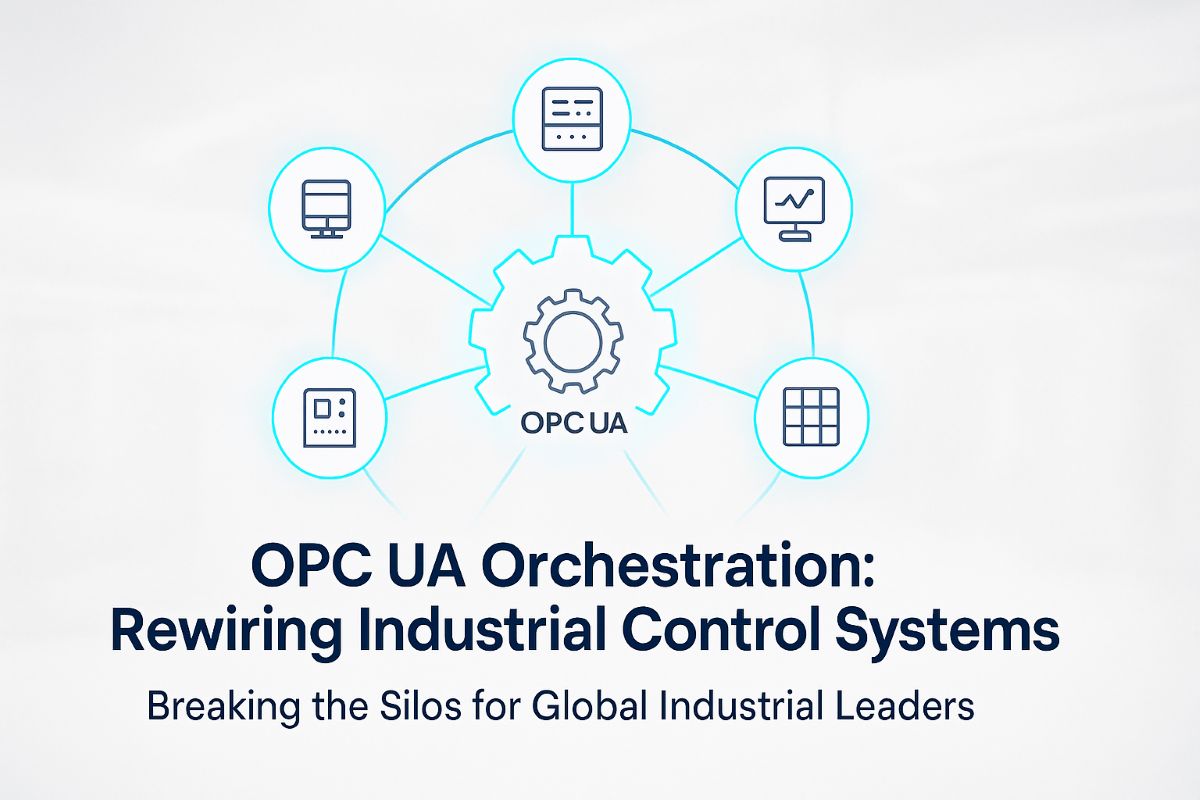
OPC UA Orchestration: How Global Giants Are Rewiring Industrial Control Systems
🚀 Breaking the Silos: How Global Giants are Rewiring Industrial Control Systems with OPC UA & Orchestration
In the high-stakes world of continuous manufacturing and process industries, downtime is the ultimate enemy. For decades, massive organizations like Merck, DuPont, Shell, BASF, Georgia-Pacific, and Reliance Industries Limited (RIL) relied on proprietary Distributed Control Systems (DCS) and Programmable Logic Controllers (PLCs). While reliable, these legacy Industrial Control Systems (ICS) were rigid, creating vendor lock-in and trapping valuable operational data in isolated silos.
Today, these industry heavyweights are driving a massive paradigm shift. Backed by global standard initiatives like the Open Process Automation Forum (OPAF) and NAMUR Open Architecture (NOA), they are demanding a transition from closed-loop legacy systems to open, software-defined architectures.
At the heart of this revolution are two critical technologies: OPC Unified Architecture (OPC UA) and IT/OT Orchestrators. Here is a deep dive into how these companies are successfully deploying these tools in real-world industrial environments to build the highly adaptable, intelligent factories of the future.
🪤 The Problem: The Legacy ICS Trap
Before diving into the solution, it is important to understand the pain points these manufacturing giants were facing. In a traditional plant environment, the automation architecture is heavily hierarchical.
🔒 Vendor Lock-in: Hardware and software were tightly coupled. If you bought a controller from a specific vendor, you were forced to use their proprietary software, networking protocols, and HMI (Human-Machine Interface).
🧱 Data Silos: Vital health and diagnostic data from field devices (often called “stranded data”) were incredibly difficult to extract without disrupting the core control processes.
🐌 Painful Upgrades: Upgrading a DCS required complete system shutdowns, costing millions of dollars in lost production time.
🛠️ The Solution: OPC UA Meets IT/OT Orchestration
To break free from this legacy trap, companies like Shell and ExxonMobil spearheaded pilot projects and “Lighthouse” field trials to validate a new, modular approach. The goal was to seamlessly integrate IT (Information Technology) concepts—like containerization, cloud computing, and automated orchestration—into OT (Operational Technology).
Here is how the dynamic duo of OPC UA and Orchestration makes this possible:
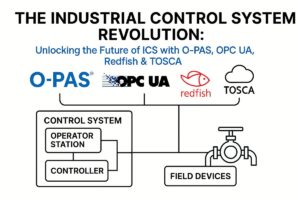
🌐 OPC UA (The Universal Translator): OPC UA is an open, platform-independent communication standard. Instead of just sending raw data (like “75”), OPC UA sends semantic, context-rich information (like “Temperature = 75°C, Sensor Status = Healthy”). It serves as the O-PAS Connectivity Framework (OCF), allowing hardware and software from entirely different vendors to communicate securely and natively.
🧠 The Orchestrator (The Master Conductor): In the IT world, orchestrators (like Kubernetes) manage the deployment of software applications. In this industrial use case, an Industrial Orchestrator manages the entire lifecycle of control software. It allows engineers to remotely deploy, configure, update, and manage process-control applications across hundreds of distributed edge-compute nodes without manual intervention.
🏭 Real-World Application Case Study: The OPA & NOA Revolution
Let’s look at how this plays out on the factory floor, drawing from the published frameworks and field trials championed by Shell, BASF, and their peers.
1. Decoupling Hardware and Software at the Edge 🖥️
Instead of buying proprietary PLCs, a chemical plant run by a company like DuPont or BASF installs standardized, commercial-off-the-shelf (COTS) industrial edge computers.
Using an Industrial Orchestrator, plant operators remotely push control logic (written in standard IEC 61131 languages) down to these edge nodes. The software is packaged in secure containers. If a hardware node fails, the orchestrator instantly spins up the control software on a redundant node nearby.
2. Establishing the “Nervous System” with OPC UA ⚡
Once the edge nodes are running, they need to communicate with field devices (valves, pumps, sensors) and higher-level systems (like AI predictive maintenance tools).
Peer-to-Peer Control: Using OPC UA over Time-Sensitive Networking (TSN), the edge nodes communicate with each other in real-time to execute complex control loops.
The NOA Diode: Following BASF’s NAMUR Open Architecture (NOA) blueprints, plants use OPC UA to create a secure, one-way “data diode.” This allows advanced analytics platforms to pull stranded diagnostic data from smart valves and positioners without any risk of interfering with the core production process.
3. Automated “Skill-Based” Engineering 🧩
Instead of hard-coding every interaction, machines are now integrated using Module Type Packages (MTP) over OPC UA. Think of it like a USB plug-and-play standard for massive industrial equipment.
If a Georgia-Pacific paper mill wants to add a new packaging module to an existing line, the module publishes its “skills” (e.g., Start Packaging, Stop, Report Speed) via its onboard OPC UA server.
The Orchestrator detects this new module, automatically reads its capabilities, and seamlessly integrates it into the master production workflow. What used to take weeks of custom engineering is reduced to days or hours.
📈 The Measurable ROI & Business Impact
By transitioning to orchestrator-managed, OPC UA-driven open architectures, these global manufacturers are reaping massive benefits:
🔄 Zero-Downtime Upgrades: Software can be patched, updated, or entirely replaced on the fly. The orchestrator simply routes control to a backup node while the primary node is updated.
💰 Massive Cost Reductions: By utilizing standard edge computing hardware rather than marked-up proprietary controllers, capital expenditures (CAPEX) drop significantly.
AI-Powered Optimization: With OPC UA securely feeding clean, contextualized data directly to the cloud, companies like Shell are utilizing AI to optimize production in real-time, predict equipment failures before they happen (“find small, fix small”), and significantly reduce CO2 emissions.
🛡️ Inherent Cybersecurity: OPC UA features built-in, military-grade encryption and certificate-based authentication, ensuring that only trusted applications and devices can communicate on the plant floor.
🔮 The Future is Open
The days of monolithic, closed industrial control systems are numbered. The collaboration between Merck, DuPont, Shell, BASF, Georgia-Pacific, Reliance Industries, and other massive industries and the broader OPAF ecosystem proves that open, interoperable systems are no longer just a theoretical concept—they are actively running the next generation of global manufacturing. By combining the universal language of OPC UA with the automated deployment power of IT orchestration, the process industry has finally unlocked true agility.