Inside Energy-Consuming Systems: Flows, Losses, and Savings
⚙️ Inside Energy-Consuming Systems: From Flows to Savings
Every facility is full of systems quietly converting energy into useful work, comfort, light, motion, and product. Behind each pump, fan, boiler, compressor, and motor, there is an energy story: where the energy comes from, how it is used, and where it leaks away. Understanding these stories at the system level is the key to turning a broad energy review into concrete, practical savings. This article, Inside Energy-Consuming Systems: Flows, Losses, and Savings opens up that system view and shows how to look at equipment not just as hardware, but as energy pathways.
🌐 Think in Energy Flows, Not Just Equipment
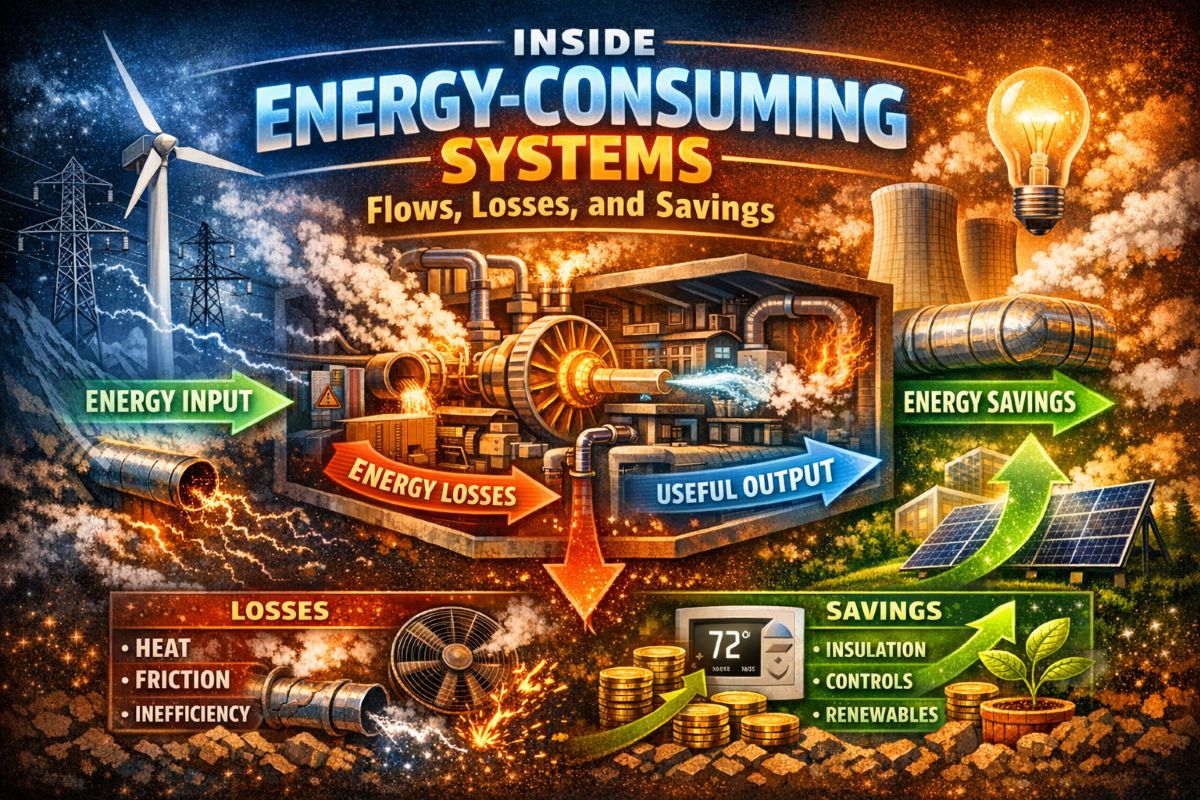
A useful way to study any major system is to picture energy flowing into it, through it, and out of it. Instead of seeing only pipes, ducts, or cables, imagine arrows of heat, electricity, and mechanical power moving and splitting. An energy flow diagram does exactly that: it shows main inputs, essential outputs, and all the losses that peel off along the way. When you map flows instead of only components, waste becomes visible and opportunities become much easier to explain.
- ✅ Start by identifying all energy inputs to the system.
- ✅ List the main useful outputs: heat, cooling, motion, compressed air, and light.
- ✅ Add the obvious losses: flue gases, leaks, standby, radiation, overflow.
- ✅ Check that total inputs roughly match total outputs and losses.
🔥 Boiler and Steam Systems: More Than Just a Flame
Boiler plants are classic examples of systems where a lot of energy can disappear quietly. Fuel enters the burner with a high energy content, but only part of it ends up as useful steam for processes, heating coils, or hot water production. The rest leaves through hot flue gases, stack losses, blowdown, radiation from hot surfaces, and inefficiencies in controls and operation. Looking at the boiler as an energy converter, not merely as a pressure vessel, reveals where to intervene.
- 🔥 Check excess air and flue gas temperature for combustion losses.
- 🔥 Look for uninsulated boiler surfaces, valves, and steam lines.
- 🔥 Review blowdown controls and water treatment practices.
- 🔥 Trace where steam goes and where condensate is returned or lost.
💨 HVAC and Ventilation: Invisible Energy Conveyors
Air-handling units, ventilation fans, and comfort cooling systems constantly move large amounts of air and heat in the background. These systems touch a mix of electrical and thermal energy: fans consume power to move air, coils add or remove heat, and controls decide when and how intensely everything runs. Because people rarely see the energy directly, HVAC can quietly become a large cost center if it is not watched carefully.
- 🌬️ Review supply and exhaust airflows and see if they match real needs.
- 🌬️ Check temperature and humidity setpoints against comfort and process needs.
- 🌬️ Evaluate night, weekend, and unoccupied mode operation.
- 🌬️ Inspect dampers, filters, and coils for conditions that cause extra fan power.
🧊 Refrigeration and Cooling: Cold Costs Heat Too
Cooling and refrigeration systems move heat from a cold place to a warm one using compressors, condensers, evaporators, and expansion devices. From an energy viewpoint, the compressor drive is the main input, and the rejected heat at the condenser plus any losses make up the outputs. A small improvement in temperature difference or control strategy can make a surprisingly large impact on energy use, because the system may run many hours a day.
- 🧊 Examine suction and discharge pressures and look for unnecessary lift.
- 🧊 Check condenser water or air temperatures and cleanliness.
- 🧊 Review defrost cycles, door openings, and infiltration in cold rooms.
- 🧊 Look for options to recover rejected heat for preheating water or air.
🔁 Motors, Fans, and Pumps: Matching Load and Drive
Electric motors sit at the heart of many systems: driving fans, pumps, conveyors, compressors, and mixers. The energy story here is about matching the motor and driven equipment to the real process demand. Oversized motors running lightly loaded, fans without speed control throttled by dampers, and pumps fighting against partly closed valves are all signs that energy is being burned without adding value.
- ⚙️ Compare motor sizes with measured or realistic load levels.
- ⚙️ Consider variable speed drives where loads vary over time.
- ⚙️ Remove unnecessary restrictions in piping and ductwork.
- ⚙️ Plan maintenance to keep belts, bearings, and alignment in good shape.
🏢 Building Envelope: Walls That Leak Energy
The building itself is an energy system. Heat flows through walls, roofs, windows, and floors by conduction, and through openings by infiltration and ventilation. Even when equipment is efficient, a poor envelope can waste a large share of heating or cooling energy. A structured look at the building envelope turns vague discomfort complaints into quantifiable heat loss paths that can be corrected and tracked.
- 🏠 Check insulation levels and thermal bridges in roofs and walls.
- 🏠 Review window types, shading, and air tightness.
- 🏠 Identify uncontrolled openings, gaps, and door usage patterns.
- 🏠 Estimate total heat loss and compare it with space-conditioning loads.
📊 Using Sankey Diagrams to Tell the Story
Once energy flows are quantified, a Sankey diagram becomes a powerful way to communicate the picture. In this type of diagram, the width of each arrow is proportional to the amount of energy it represents. Large arrows for losses immediately draw the eye and make it easy for managers and operators to understand why changes are needed. A simple boiler diagram, for example, might show fuel in, useful steam out, and separate thick arrows for stack loss, shell loss, and blowdown.
- 📈 Use Sankey diagrams to summarize complex systems in a single view.
- 📈 Highlight where the largest losses occur and attach practical ideas.
- 📈 Compare diagrams before and after improvements to show impact.
💡 Finding Real Opportunities in Each System
Looking at each major system as an energy pathway naturally leads to energy management opportunities. In some cases, the best option is operational: adjusting setpoints, schedules, or operating modes. In other cases, the right action is technical: adding controls, upgrading equipment, improving insulation, or redesigning a process step. The goal is not only to save energy, but to do it in a way that respects production, quality, and comfort.
- 💡 Start with no-cost and low-cost adjustments that can be implemented quickly.
- 💡 Build a list of deeper projects with savings estimates and paybacks.
- 💡 Consider interactions: fixing one system may change loads on another.
- 💡 Keep updating the system view as operations and equipment evolve.
🎯 Turning System Insight Into Action
In the end, the value of studying energy-consuming systems lies in what is done with the insight. When teams think in terms of flows, balances, and losses, they stop seeing energy as an unavoidable bill and start seeing it as a controllable resource. By mapping each major system, identifying its largest leaks, and framing clear actions, any facility can move step by step toward lower costs and better performance, without sacrificing reliability or output.