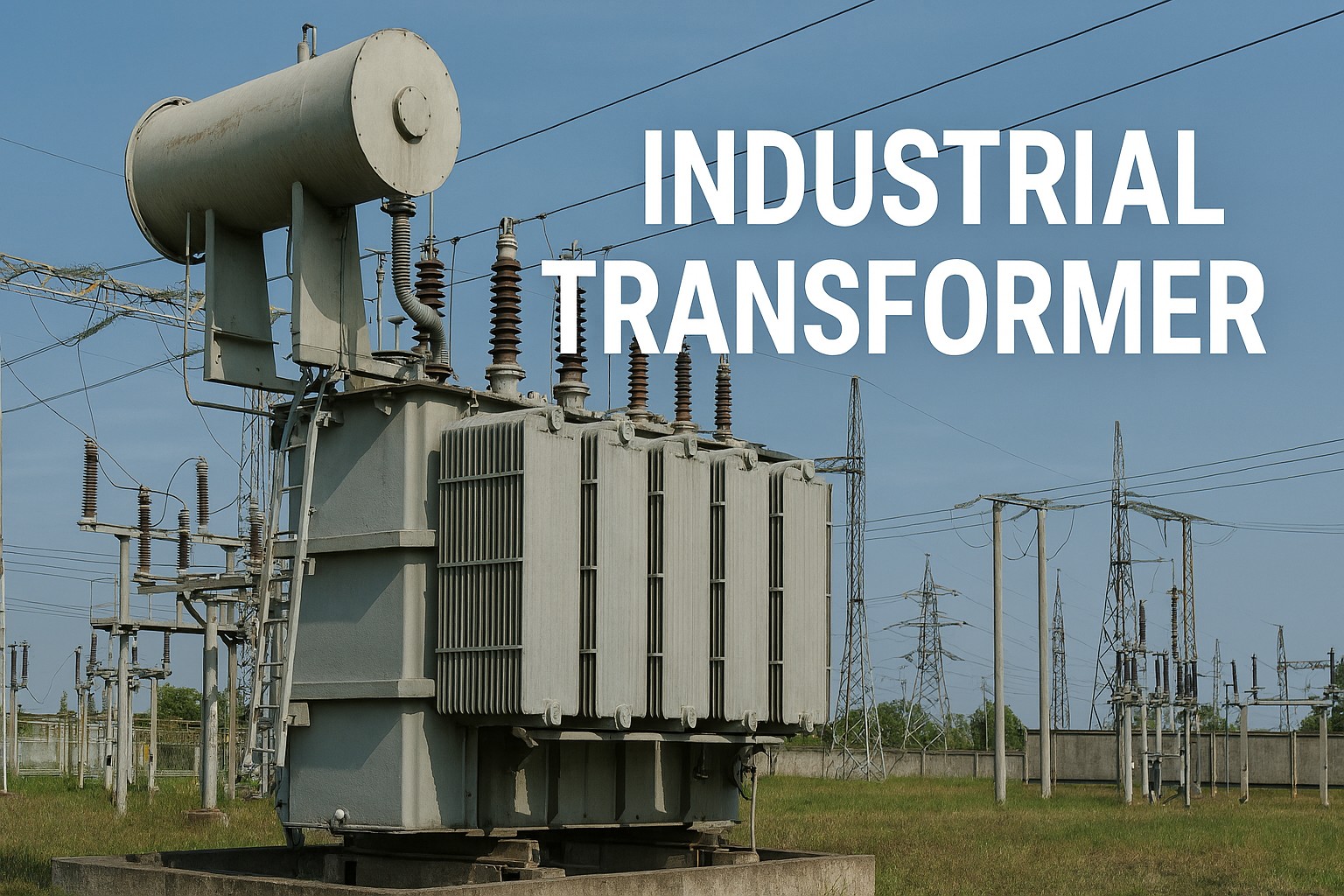
Industrial Transformer: Basics, Construction, Installation and Operation Guide
🔌 Complete Guide to INDUSTRIAL TRANSFORMER
Your go-to resource for understanding power transformers from basics to installation
⚡ WHAT IS A TRANSFORMER AND HOW DOES IT WORK?
The Heart of Electrical Distribution 💓
A transformer is an electrical device that transfers electrical energy between two or more circuits through electromagnetic induction. It’s the unsung hero that makes long-distance power transmission possible and brings electricity safely to your facility.
The Simple Working Principle 🧲
Think of a transformer as an “electrical gearbox” that changes voltage levels up or down without changing the frequency.
Here’s how the magic happens:
1️⃣ Primary Side Energized → Alternating current flows through the primary winding
2️⃣ Magnetic Field Created 🌀 → The current creates a changing magnetic field in the core
3️⃣ Flux Links Windings → The magnetic field passes through the laminated core
4️⃣ Secondary Induced ⚡ → The changing field induces voltage in the secondary winding
5️⃣ Power Transferred → Electrical energy transfers without a physical connection between windings
The Beautiful Part:
No moving parts (except cooling fans and tap changers)
Extremely efficient (95-99%)
Operates silently (minimal hum)
Can last 25-40 years with proper maintenance
Voltage transformation ratio depends on the turns ratio between windings
Step-Up vs Step-Down:
🔼 Step-Up: Increases voltage (fewer primary turns, more secondary turns) – used at power plants
🔽 Step-Down: Decreases voltage (more primary turns, fewer secondary turns) – used for distribution
🏗️ TRANSFORMER CONSTRUCTION
THE CORE – The Magnetic Highway 🧲
The transformer core is the backbone that provides a low-reluctance path for magnetic flux.
Material of Construction (MOC):
🔶 Cold-Rolled Grain-Oriented (CRGO) Silicon Steel – Most common, reduces losses
📄 Laminations: 0.23mm to 0.35mm thick sheets
🎯 Why Laminated? To reduce eddy current losses (swirling currents in the core)
🔒 Coating: Each lamination has an insulating coating
Core Types:
| Type | Description | Advantages | Typical Use |
|---|---|---|---|
| 🅰️ Core Type | Windings surround the core | Easier maintenance, better cooling | Distribution transformers |
| 🅱️ Shell Type | Core surrounds windings | Better mechanical strength | Power transformers, heavy-duty |
Core Assembly Process:
Laminations are stacked and clamped
Interlocked at corners for mechanical strength
Grounded at one point to prevent circulating currents
Treated with special varnish to prevent corrosion
THE WINDINGS – Current Carriers 🔌
Windings are the copper or aluminum coils that carry current and create/receive the magnetic field.
Winding Material Options:
🥇 COPPER (Premium Choice)
✅ Lower electrical resistance
✅ Better conductivity
✅ Smaller size for the same current
✅ Longer life
❌ Higher cost
🎯 Used in: High-efficiency transformers, power transformers
🥈 ALUMINUM (Economical Choice)
✅ 60% lighter than copper
✅ Lower material cost
✅ Non-magnetic
❌ Higher resistance (40% more than copper)
❌ Larger cross-section needed
🎯 Used in: Distribution transformers, cost-sensitive applications
Winding Types:
Concentric Windings (Cylindrical):
Low-voltage (LV) winding inside
High voltage (HV) winding outside
Separated by insulation cylinders
Most common configuration
Better cooling
Sandwich Windings (Disc Type):
Alternate HV and LV disc sections
Better for very high voltages
Superior mechanical strength
Used in large power transformers
Winding Construction Details:
Rectangular or round conductors
Continuously transposed cable (CTC) for large currents
Paper insulation between layers
Adequate spacing for oil circulation
Mechanical bracing to withstand short-circuit forces
INSULATION SYSTEM – The Safety Barrier 🛡️
The insulation system prevents electrical breakdown between:
Turn-to-turn (within the same winding)
Layer-to-layer
Winding-to-winding (HV to LV)
Winding-to-core
Winding-to-tank
Insulation Materials:
For Oil-Immersed Transformers:
📄 Kraft Paper: Oil-impregnated paper, main insulation
🎴 Pressboard: Thicker paper-based material for barriers
🛢️ Transformer Oil: Acts as both coolant and insulator
🧱 Insulation Cylinders: Separate windings
For Dry-Type Transformers:
🔴 Epoxy Resin: Cast directly onto windings
🟠 Nomex Paper: Heat-resistant aramid paper
🔵 Class F/H Insulation: Temperature-rated materials
🌬️ Air Gaps: For cooling circulation
Basic Insulation Level (BIL):
Measures ability to withstand voltage surges (lightning, switching)
Specified in kV peak
Example: 110kV transformer may have 450kV BIL
Critical for lightning-prone areas
TANK & FRAME – The Housing 🏠
Transformer Tank:
Heavy-gauge steel construction
Welded and pressure tested for leak-proof operation
Provides mechanical protection
Acts as a heat dissipator (radiator surface)
Houses all internal components
Tank Features:
🎨 Rust-resistant paint (multi-coat epoxy)
🔩 Lifting lugs for transportation
🚪 Inspection manholes (for large units)
💧 Oil drain valve at the bottom
🔌 Bushing mounting provisions on top
📦 Accessory mounting pads
Frame Construction:
🏗️ Heavy structural steel base
🛞 Wheels or skids for large transformers
🔧 Jacking pads for lifting
⚓ Anchor bolt provisions
TERMINALS & BUSHINGS – Connection Points 🔌
Bushings:
Bushings are insulated passages that allow conductors to pass through the grounded transformer tank.
Types by Voltage:
🟢 Porcelain Bushings: Up to 145kV, oil-filled or resin-filled
🔵 Condenser Bushings: Above 145kV, use capacitance grading
🟤 Resin Bushings: Modern polymer material, lighter
Bushing Components:
Porcelain or polymer insulator body
Central conductor (copper or aluminum)
Top terminal pad for cable connection
Bottom terminal inside tank
Oil sealing system
Terminal Designations:
HV Side: H1, H2, H3 (High Voltage)
LV Side: X1, X2, X3 (Low Voltage)
Neutral: H0 or X0
Tap Changer: 1, 2, 3, 4, 5 positions
🔧 MAJOR COMPONENTS & THEIR FUNCTIONS
Let’s break down what each part does:
| Component | Function | Why It Matters |
|---|---|---|
| 🧲 Core | Provides path for magnetic flux | Reduces losses, efficient energy transfer |
| 🔌 Primary Winding | Receives input power | Creates a magnetic field |
| ⚡ Secondary Winding | Delivers output power | Induced voltage output |
| 🛡️ Insulation | Prevents short circuits | Safety and reliability |
| 🏠 Tank | Houses all components | Mechanical protection, oil containment |
| 🔩 Bushings | Brings conductors out safely | Insulated high-voltage connections |
| 🛢️ Oil | Cools and insulates | Heat removal, arc quenching |
| 📦 Conservator | Accommodates oil expansion | Prevents oil oxidation |
| 🌡️ Temperature Sensors | Monitor heat | Protects from overheating |
| 🔍 Buchholz Relay | Detects internal faults | Early warning system |
🛠️ AUXILIARY EQUIPMENT & FUNCTIONS
Industrial transformers come with several protective and monitoring devices. Here’s what each one does:
1. CONSERVATOR TANK 📦
What it is:
Cylindrical drum mounted on top of the main tank
Connected via pipe
Partially filled with oil, partially with air
Function:
✅ Accommodates oil expansion/contraction with temperature
✅ Maintains positive pressure in main tank
✅ Prevents air contact with the main oil volume
✅ Provides space for “breathing.”
How it works:
Transformer heats → oil expands → extra oil flows to the conservator
Transformer cools down → oil contracts → oil returns from conservator
The air cushion in the conservator expands/contracts
2. BREATHER (SILICA GEL DEHYDRATOR) 🌬️
What it is:
Small container with silica gel crystals
Connected to the conservator
Has an oil seal cup at the bottom
Function:
✅ Removes moisture from incoming air
✅ Prevents oil contamination
✅ Maintains oil quality
✅ Indicates moisture saturation by color change
Color Indicators:
🔵 Blue: Fresh, dry silica gel (good condition)
🟣 Pink/White: Saturated, needs replacement
Maintenance:
Inspect monthly
Replace when 70% turns pink
Can be regenerated by heating at 150°C for 4 hours
3. BUCHHOLZ RELAY 🚨
What it is:
Gas-actuated relay
Mounted in a pipe between the main tank and the conservator
Contains two float chambers
Function:
✅ Detects internal faults (arcing, overheating)
✅ Collects gas generated by faults
✅ Provides alarm and trip signals
✅ Early warning before catastrophic failure
How it works:
Minor fault: Slow gas accumulation → upper float drops → ALARM
Major fault: Rapid oil surge (short circuit) → lower float drops → TRIP
What gases indicate:
Hydrogen (H₂) → Corona discharge
Methane (CH₄) → Oil overheating
Ethane (C₂H₆) → Insulation decomposition
Acetylene (C₂H₂) → Arcing, severe fault
4. PRESSURE RELIEF DEVICE (PRD) 💥
What it is:
Spring-loaded valve on tank roof
Rupture disc or explosion vent
Set pressure: typically 0.5-1.0 kg/cm²
Function:
✅ Prevents tank rupture from internal pressure
✅ Vents explosive gases safely
✅ Protects transformer structure
✅ Trips breaker when activated
Operation:
Internal fault → rapid gas generation → pressure builds → PRD opens → gas vents → contact trips breaker
5. OIL TEMPERATURE INDICATOR (OTI) 🌡️
What it is:
Dial-type thermometer
Bulb immersed in oil (top layer)
Electrical contacts for alarms
Function:
✅ Monitors top oil temperature continuously
✅ Provides alarm at set point (e.g., 90°C)
✅ Provides a trip at a higher set point (e.g., 105°C)
✅ Records maximum temperature
Typical Settings:
Normal operation: 50-70°C
Alarm: 85-95°C
Trip: 100-110°C
6. WINDING TEMPERATURE INDICATOR (WTI) 🌡️
What it is:
Similar to OTI but measures winding hotspot
Bulb in oil + current transformer (CT) input
Simulates winding temperature
Function:
✅ Monitors the hottest spot in winding
✅ More accurate than OTI
✅ Critical for overload protection
✅ Accounts for load current
Why separate from OTI:
Winding temperature is 10-15°C higher than the top oil
Insulation life depends on winding temperature
Overloading monitored accurately
7. OIL LEVEL INDICATOR 📊
What it is:
Magnetic float gauge on the conservator
Shows oil level visually
Electrical contacts for a low-level alarm
Function:
✅ Indicates oil level in conservator
✅ Detects leaks
✅ Prevents low-oil operation
✅ Alarm if level too low
8. TAP CHANGER 🎚️
Types:
Off-Load Tap Changer (OLTC):
Must de-energize the transformer to change the tap
Simpler, cheaper
Used in distribution transformers
Typical: ±5% in 2.5% steps
On-Load Tap Changer (OLTC):
Change taps under full load
Complex switching mechanism
Uses a diverter switch and transition resistors
Requires a separate oil compartment
Typical: ±10% in 1.25% steps
Function:
✅ Compensates for supply voltage variations
✅ Maintains constant secondary voltage
✅ Improves voltage regulation
✅ Optimizes transformer operation
9. RADIATORS WITH FANS 🌬️❄️
Radiator Banks:
Finned tubes mounted on tank sides
Increase the heat dissipation surface area
Oil circulates through natural convection
Cooling Fans:
Mounted below radiators
Blow air upward over the fins
Temperature or load-controlled
Automatic start/stop
Function:
✅ Enhanced heat removal
✅ Increases transformer capacity
✅ Maintains safe operating temperature
✅ Extends transformer life
10. MARSHALLING KIOSK/CABINET 📦
More details in the dedicated section below.
🏭 TYPES OF TRANSFORMERS BY VOLTAGE LEVEL
DISTRIBUTION TRANSFORMERS 🏘️
Voltage Levels:
Primary: 11kV, 22kV, 33kV
Secondary: 400V, 230V (consumer level)
Power Rating:
Typically: 25kVA to 2500kVA
Most common: 100kVA to 1000kVA
Characteristics:
🏠 Installed near load centers (neighborhoods, buildings)
🔽 Step-down from distribution to utilization voltage
📊 Designed for peak efficiency at 60-70% load
🌙 Operates 24/7 (mostly lightly loaded at night)
🧊 Usually ONAN cooling (oil natural, air natural)
Installation:
Pole-mounted (overhead lines)
Pad-mounted (underground cables)
Platform-mounted (substations)
Typical Applications:
Residential areas
Commercial buildings
Small industrial facilities
Agricultural connections
POWER TRANSFORMERS ⚡
Voltage Levels:
Primary: 66kV, 110kV, 132kV, 220kV, 400kV
Secondary: 11kV, 22kV, 33kV, 66kV
Power Rating:
5MVA to 1000MVA+
Transmission level: 100MVA to 500MVA common
Characteristics:
🏭 Installed at generating stations and substations
🔼🔽 Step-up (generation) or step-down (transmission)
📊 Designed for peak efficiency at 80-100% load
⚡ Handles bulk power transfer
❄️ Advanced cooling (ONAN/ONAF/OFAF)
Installation:
Outdoor substations
Indoor switching stations (large buildings)
Power plant switchyards
Typical Applications:
Power generation stations (step-up)
Primary substations (step-down)
Industrial captive power plants
Interconnection points between grids
COMPARISON TABLE 📊
| Feature | Distribution Transformer | Power Transformer |
|---|---|---|
| Rating | <2500kVA | >5MVA |
| Voltage | 11-33kV / 400V | 66-400kV / 11-66kV |
| Load Variation | High (0-100% daily) | Relatively constant |
| Efficiency Peak | 60-70% load | 80-100% load |
| Core Losses | Higher acceptable | Minimized |
| Copper Losses | Lower priority | Optimized |
| Size | Smaller, compact | Very large |
| Cooling | ONAN typically | ONAN/ONAF/OFAF |
| Protection | Basic (fuses/relays) | Comprehensive |
| Cost per kVA | Higher | Lower |
| Location | Near consumers | Substations |
| Duty | 24/7 variable | Continuous heavy |
Furnace Transformers:
Extremely high current, low voltage secondary
200V to 1000V secondary, up to 100kA
Used in: Arc furnaces, induction furnaces
Rectifier Transformers:
Feed rectifier circuits
Special windings for reduced harmonics
Used in: Electroplating, DC drives, HVDC stations
Earthing/Grounding Transformers:
Provide a neutral point for ungrounded systems
Zigzag or star-delta connected
Used in: Delta-connected systems needing ground
Instrument Transformers:
Current Transformers (CT): Step down current for metering/protection
Potential Transformers (PT/VT): Step down voltage for metering/protection
Not for power transfer
🔄 AUTO TRANSFORMERS – THE ECONOMIC CHOICE
What Makes It Different?
Unlike a regular (two-winding) transformer, an auto transformer has a single continuous winding with a tap. Part of the winding is common to both primary and secondary.
Construction:
One continuous winding on the core
The tap point divides it into two sections
Common winding + series winding
Electrically connected (not isolated)
How It Works:
Part of the winding (common section) carries both primary and secondary current
Only part of the energy is transformed electromagnetically
Rest passes conductively through the common winding
ADVANTAGES ✅
Lower Cost:
💰 20-30% cheaper than a two-winding transformer
Less copper/aluminum required
Smaller core
Smaller Size:
📦 30-40% lighter and more compact
Easier transportation
Less space required
Higher Efficiency:
⚡ 0.5-1% better efficiency
Lower losses (less copper)
Better voltage regulation
Lower Impedance:
Better short-circuit performance
Lower voltage drop under load
DISADVANTAGES ❌
No Electrical Isolation:
⚠️ Primary and secondary are electrically connected
HV fault can appear on the LV side
Safety concerns in some applications
Higher Short-Circuit Current:
⚡ Lower impedance means higher fault current
Requires larger breakers
More severe fault duty
Cannot use for a large ratio:
🚫 Economical only for ratios <3:1
Best for small voltage changes
Not suitable for 33kV to 400V
TYPICAL APPLICATIONS 🎯
Starting of Induction Motors:
Reduced voltage starting
70%, 80%, 90% taps common
Cheaper than a soft starter for simple applications
Interconnection of Power Systems:
400kV to 220kV
220kV to 132kV
132kV to 110kV
Small voltage ratio, large power
Boosting Voltage:
Adding a small voltage boost to feeders
Compensating voltage drop
11kV to 11.5kV type applications
Variable Voltage Supply:
Laboratory power supplies
Testing equipment
Adjustable AC sources
AUTO TRANSFORMER RATINGS 📊
| Application | Typical Ratio | Rating Range | Voltage Levels |
| Motor Starting | 70-90% of supply | 5kVA – 500kVA | 400V |
| Grid Interconnection | 1.5:1 to 2:1 | 50MVA – 500MVA | 110-400kV |
| Voltage Boosting | 1:1.1 to 1:1.2 | 1MVA – 50MVA | 11-33kV |
| Laboratory Use | Variable | 1kVA – 20kVA | 230V |
When NOT to Use an Auto Transformer:
Where electrical isolation is required
Large voltage ratios (>3:1)
Safety-critical applications
Medical equipment power supply
❄️ TRANSFORMER COOLING METHODS
Heat is the enemy of transformers. Proper cooling extends life and prevents failure.
COOLING METHOD CODES 🔤
The IEC/IEEE uses a 4-letter code: XXYY
First Letter (X): Internal cooling medium
Second Letter (X): Internal circulation method
Third Letter (Y): External cooling medium
Fourth Letter (Y): External circulation method
Letter Meanings:
O = Oil (mineral oil)
K = Synthetic fluid (like Midel)
A = Air
N = Natural circulation (convection)
F = Forced circulation (fans/pumps)
D = Directed (guided flow through windings)
1. ONAN (Oil Natural, Air Natural) 🌬️
How it works:
Oil circulates by natural convection (hot rises, cold sinks)
Air flows naturally around the tank/radiators
Simplest cooling method
No moving parts except oil circulation
Characteristics:
🔋 Rating: Up to 5MVA typically
🌡️ Efficiency: Basic cooling
💰 Cost: Lowest (no pumps/fans)
🔧 Maintenance: Minimal
Best for:
Small distribution transformers
Remote locations (no power for fans)
Quiet environment requirements
Low-maintenance applications
2. ONAF (Oil Natural, Air Forced) 🌪️
How it works:
Oil circulates naturally by convection
Fans blow air over radiators
Fans automatically start when the temperature rises
Multi-stage: ONAN → ONAF1 → ONAF2
Characteristics:
🔋 Rating: 5MVA to 100MVA
🌡️ Efficiency: Good cooling
💪 Capacity boost:
ONAN base rating
ONAF1: +25% (fans stage 1)
ONAF2: +33-67% (fans stage 2)
🔧 Maintenance: Fan motors, bearings
Best for:
Medium to large power transformers
Industrial substations
Where a capacity boost is needed
Most common for 10-100MVA range
Fan Control:
Temperature sensing (WTI/OTI)
Automatic start: 70-80°C
Multiple stages for load variation
3. OFAF (Oil Forced, Air Forced) 💨
How it works:
Oil is pumped forcibly through windings and coolers
Fans blow air over heat exchangers
Directed flow through specific cooling paths
Maximum heat removal
Characteristics:
🔋 Rating: 100MVA to 1000MVA+
🌡️ Efficiency: Highest cooling capacity
💪 Capacity: Multiple stages, up to 200% of base
🔧 Maintenance: Pumps, fans, motors
Best for:
Very large power transformers
Generating stations (step-up transformers)
Critical transmission substations
Where maximum capacity needed
Control:
Load-based pump/fan control
Multiple pump/fan combinations
Redundancy for reliability
4. ODAF (Oil Directed, Air Forced) 🎯
How it works:
Oil is pumped through directed cooling ducts in windings
Precise oil flow management
Air-forced cooling on heat exchangers
Optimized cooling efficiency
Best for:
Large transformers with complex winding arrangements
Where the hot-spot temperature is critical
Modern high-efficiency designs
5. OFWF (Oil Forced, Water Forced) 💧
How it works:
Oil pumped through windings
Water-cooled heat exchangers
Most compact cooling method
Requires a cooling water system
Characteristics:
🔋 Rating: 200MVA+
🌡️ Efficiency: Maximum heat removal
📦 Size: Most compact for rating
🔧 Maintenance: Complex (oil and water systems)
Best for:
Indoor transformers (limited space)
Generating stations (where cooling water is available)
Hydroelectric plants
Nuclear power stations
Challenges:
Water quality management
Leak prevention (water/oil)
Cooling tower/water supply needed
COOLING COMPARISON 📊
| Method | Rating Range | Complexity | Cost | Efficiency | Maintenance |
| ONAN | <5MVA | Simple | Low | 60% | Minimal |
| ONAF | 5-100MVA | Moderate | Medium | 80% | Low |
| OFAF | 100-500MVA | Complex | High | 90% | Moderate |
| ODAF | 100-1000MVA | Advanced | Higher | 95% | Moderate |
| OFWF | 200MVA+ | Very Complex | Highest | 98% | High |
DRY-TYPE TRANSFORMER COOLING 🌬️
For transformers without oil:
AN (Air Natural):
Natural air convection
Up to 1MVA
Indoor use
AF (Air Force):
Fans blow air through windings
Up to 10MVA
Indoor substations
Advantages of Dry-Type:
✅ No fire risk (no oil)
✅ Indoor installation allowed
✅ Less maintenance
✅ Environmentally friendly
Disadvantages:
❌ Lower efficiency
❌ Larger size for rating
❌ Lower insulation level
❌ Higher cost per kVA
📦 MARSHALLING CABINET/KIOSK DETAILS
What is a Marshalling Cabinet?
A marshalling cabinet (also called RTU kiosk or junction box) is a weatherproof enclosure housing:
All transformer control circuits
Protection relays
Metering equipment
Remote terminal unit (RTU) for SCADA
Terminal blocks for all field cables
Auxiliary power supply
Why a Separate Cabinet?
Instead of mounting everything on the transformer tank:
✅ Safer maintenance (work at ground level, away from HV)
✅ Better protection from the weather
✅ Organized wiring
✅ Easier troubleshooting
✅ Can service without transformer shutdown
TYPICAL MARSHALLING CABINET CONTENTS 📋
Protection & Control:
🔴 Buchholz relay trip/alarm contacts
🌡️ WTI/OTI trip/alarm contacts
💥 PRD trip contact
🔌 Overcurrent relays
🌍 Earth fault relays
⚡ Differential protection relays
🎚️ Tap changer controls (OLTC)
Monitoring & Metering:
📊 Digital/analog meters (V, A, kW, kVAR, PF)
🌡️ Temperature displays
📈 Load indicators
🔍 Oil level indication
🧪 Dissolved gas monitoring (DGA) interface
Control & Indication:
💚 Green: Transformer healthy
🟡 Amber: Warning/alarm
🔴 Red: Trip/fault
⚪ White: Position indication
🔵 Blue: Earthing switch position
Auxiliary Systems:
🔌 230V AC auxiliary supply
🔋 110V/220V DC battery supply
⚡ UPS for critical monitoring
🌬️ Space heater (prevent condensation)
💡 Internal lighting
Communication:
📡 RTU (Remote Terminal Unit) for SCADA
🌐 Modbus/DNP3/IEC 61850 protocols
📞 GSM/4G modem for remote monitoring
🖥️ HMI touchscreen (advanced systems)
MARSHALLING CABINET CONSTRUCTION 🏗️
Enclosure:
Material: 2-3mm galvanized steel or stainless steel
Protection: IP65 minimum (dust tight, jet proof)
Coating: Powder-coated RAL 7035 (light grey)
Size: Typically 1200×800×400mm to 2000×1200×600mm
Mounting: Floor-standing with base channel
Internal Layout:
Top section: Protection relays, meters
Middle section: Terminal blocks, RTU
Bottom section: Auxiliary power, cable entry
Separate door for HV and LV circuits (safety)
Cable trays for organized routing
Environmental Protection:
🌡️ Space heater with thermostat (prevent condensation)
🌬️ Ventilation grills with filters
🌧️ Rain shield over the roof
🔐 Three-point locking system
🔒 Padlock provision
Cable Entry:
Bottom entry with cable glands
Separate entry for:
Control cables
CT/PT cables
Power cables
Communication cables
TYPICAL WIRING TO/FROM TRANSFORMER 🔌
From Transformer to Marshalling Cabinet:
1️⃣ Temperature Monitoring:
WTI contacts (Alarm + Trip) → 4-6 cores
OTI contacts (Alarm + Trip) → 4-6 cores
Resistance thermometer (RTD) → 4 cores
2️⃣ Protection Devices:
Buchholz relay (Alarm + Trip) → 6-8 cores
PRD trip contact → 2 cores
Oil level low alarm → 2 cores
3️⃣ Cooling Control:
Radiator fan motors → 4 cores per fan
Thermostat control → 4-6 cores
Oil pump motor (OFAF) → 5 cores
4️⃣ Tap Changer (OLTC):
Motor drive supply → 5 cores
Position indication → 10-20 cores
Limit switches → 8-12 cores
Control signals → Multi-core cable
5️⃣ Metering:
Current transformer secondaries → 3+1 cores (per CT)
Voltage transformer secondaries → 3+1 cores
🏷️ TRANSFORMER NAMEPLATE SPECIFICATIONS
The nameplate is the transformer’s “birth certificate” and operating manual combined. Here’s how to read it:
1. BASIC IDENTIFICATION 🆔
Manufacturer Name:
The company that built the transformer
Example: ABB, Siemens, GE, Schneider Electric
Serial Number:
Unique identification
Format: YYYYMMXXXX (Year-Month-Serial)
Used for tracking, warranty, and spare parts
Manufacturing Year:
When it was built
Important for age assessment, expected life expectancy
Type/Model:
Manufacturer’s series designation
Example: GEAFOL (GE dry type), RESIBLOC (Schneider)
Standard:
IEC 60076 (International)
IS 2026 (Indian Standard)
IEEE C57.12.00 (North American)
2. ELECTRICAL RATINGS ⚡
Rated Power (kVA or MVA):
Maximum continuous power
Example: 1000kVA, 50MVA
May show multiple ratings for different cooling modes
Example: 50/62.5/75 MVA (ONAN/ONAF1/ONAF2)
Rated Voltage:
Primary: 11000V, 33000V, 132000V
Secondary: 415V, 11000V, 33000V
Format: “11000V / 415V” or “11kV / 0.415kV”
Rated Current:
Primary: Calculated from kVA and voltage
Secondary: Higher for step-down
Example: For 1000kVA, 11kV/415V
Primary: 52.5A
Secondary: 1390A
Frequency:
50 Hz (India, Europe, Asia, Africa, Australia)
60 Hz (USA, Canada, parts of South America)
Number of Phases:
1-phase (1φ) → Residential, small loads
3-phase (3φ) → Industrial, commercial (most common)
3. CONNECTION & CONFIGURATION 🔗
Vector Group:
This cryptic code tells you winding connections and phase shift.
Format: XxNn
X = HV connection (D=Delta, Y=Star, Z=Zigzag)
x = LV connection (d=delta, y=star, z=zigzag)
N/n = Neutral brought out
Number = Phase shift (clock notation, each hour = 30°)
Common Vector Groups:
| Vector Group | HV Connection | LV Connection | Phase Shift | Application |
| Dyn11 | Delta | Star with neutral | 330° (11 o’clock) | Most common distribution |
| Yy0 | Star | Star | 0° (12 o’clock) | Transmission |
| Yd11 | Star | Delta | 330° | Industrial |
| Dyn1 | Delta | Star | 30° (1 o’clock) | Alternative distribution |
Parallel operation: Only the same vector group can be parallel
Grounding: Dyn provides LV neutral for grounding
Harmonics: Certain connections reduce harmonics
Percentage Impedance (%Z):
Typically 4% to 12%
Critical for short-circuit calculations
Higher %Z = lower fault current
Lower %Z = better voltage regulation
Example: 8% impedance on 1000kVA means:
Internal voltage drop of 8% at full load short circuit
Limits fault current to 12.5 times rated current
4. TAP CHANGER INFORMATION 🎚️
Tap Range:
Example: ±5% in 5 steps of 2.5% each
Or: +5%, +2.5%, Rated, -2.5%, -5%
Tap Positions:
Position 1 (Highest voltage)
Position 2
Position 3 (Normal/Rated)
Position 4
Position 5 (Lowest voltage)
Tap Changer Type:
OLTC (On-Load Tap Changer) → Can change under load
DETC (De-Energized Tap Changer) → Must be off to change
5. COOLING & TEMPERATURE ❄️🌡️
Cooling Method:
ONAN, ONAF, OFAF (explained earlier)
May show multiple ratings: 50/62.5/75 MVA
Temperature Rise:
Oil temperature rise: 50K, 55K, 60K, 65K
Winding temperature rise: 55K, 60K, 65K
“K” means Kelvin (same as °C difference)
Example: “55K/65K” means:
The top oil rises 55°C above ambient
Winding hotspot rises 65°C above ambient
Ambient Temperature:
Usually designed for: 40°C maximum, 30°C average
If the site exceeds this, derating is required
Altitude:
Standard: Up to 1000m above sea level
Higher altitude → thinner air → reduced cooling → derating needed
6. INSULATION LEVELS 🛡️
Basic Impulse Level (BIL):
Lightning impulse withstand voltage
Specified in kV peak
Example: 75kV BIL, 170kV BIL, 450kV BIL
Power Frequency Withstand:
AC test voltage (1 minute)
Example: 28kV, 50kV, 140kV
Examples by Voltage Class:
| System Voltage | BIL (kV) | Power Frequency (kV) |
| 11kV | 75 | 28 |
| 33kV | 170 | 70 |
| 66kV | 325 | 140 |
| 132kV | 550 | 275 |
| 220kV | 1050 | 460 |
7. PHYSICAL SPECIFICATIONS 📏
Total Weight:
Core + windings + tank + oil + accessories
Example: 5000 kg (empty), 7000 kg (filled)
Important for: Transportation, foundation design, and lifting
Oil Volume:
Liters of insulating oil
Example: 1500 liters
Needed for: Oil replacement, fire protection planning
Oil Type:
Mineral oil (most common)
Synthetic ester (FR3, Midel)
Silicone oil (special applications)
Dimensions:
Length × Width × Height (mm)
Transport height with/without radiators
Clearances for installation
8. COMPLIANCE & TESTING ✅
Standards Compliance:
IEC 60076 (International)
IS 2026 (Indian)
BS 171 (British)
ANSI/IEEE C57.12.00 (American)
Tests Performed:
Routine tests (all units): Ratio, impedance, losses, insulation, voltage withstand
Type tests (per design): Temperature rise, impulse, short circuit
Special tests (on request): Noise, harmonics, seismic
SAMPLE NAMEPLATE READING 📄
ABB POWER TRANSFORMERS PVT. LTD.

Bengaluru, IndiaType: TRAFOSTAR Standard: IEC 60076
Rated Power: 31.5 / 40 MVA (ONAN/ONAF)
Frequency: 50 Hz
Phases: 3
Voltage: 132000V ± 10% (17 steps, OLTC)
Current: 138A (ONAN) / 175A (ONAF)
Connection: Star (Neutral solidly grounded)
Voltage: 11000V
Current: 1653A (ONAN) / 2100A (ONAF)
Connection: Delta
Impedance: 12.5% at 31.5MVA, 75°C
Cooling: ONAN / ONAF
Oil Temp Rise: 55K
Winding Rise: 65K
Ambient Max: 40 °C
Altitude Max: 1000m
HV BIL: 550 kV
LV BIL: 75 kV
HV Power Freq: 275 kV (1 min)
LV Power Freq: 28 kV (1 min)
Total Weight: 42,500 kg
Oil Volume: 18,500 liters
Oil Type: Mineral Insulating Oil, IS 335
🔧 INSTALLATION GUIDELINES & STANDARDS COMPLIANCE
PRE-INSTALLATION PLANNING 📋
Site Survey:
✅ Accessibility for transportation (road width, overhead clearance)
✅ Foundation capacity (soil bearing capacity)
✅ Clearances per standards (fire, safety)
✅ Cable routing pathways
✅ Drainage for oil containment
✅ Ventilation (for indoor)
Documentation Review:
📄 Nameplate data
📘 Installation manual
📗 Test reports
📙 GA (General Arrangement) drawings
📕 Wiring diagrams
FOUNDATION REQUIREMENTS 🏗️
Concrete Foundation:
Minimum thickness: 300mm for small, 600mm+ for large transformers
Compressive strength: M20 or higher
Reinforcement as per structural design
Anchor bolt sleeves cast in concrete
Level tolerance: ±5mm
Oil Containment:
Capacity: 100% of transformer oil + 10%
Depth: Typically 300-500mm
Drain to the oil-water separator
Minimum distance from transformer: 1m on all sides
Paved with non-combustible material
CLEARANCE REQUIREMENTS 📏
Per IEC/IS Standards:
| Direction | Minimum Clearance | Purpose |
| Front (operating side) | 3000mm | Maintenance access |
| Back | 1500mm | Inspection |
| Sides | 1500mm | Ventilation, fire safety |
| Top | 4000mm | BIL clearance, HV safety |
| Between transformers | 3000mm | Fire isolation |
Fire Safety Clearances:
From buildings: 12m minimum for outdoor transformers >1000kVA
Fire walls: If clearance is less, provide a 3-hour fire-rated wall
TRANSPORTATION & HANDLING 🚛
Inspection on Arrival:
Check for physical damage
Verify shock indicators (impact indicators)
Check oil level (conservator)
Inspect bushings for cracks
Verify accessories present
Lifting:
Use lifting lugs only (never lift by bushings!)
Spreader beams for large transformers
Check lifting lug markings for capacity
Four-point lift recommended
Crane capacity: 1.5× transformer weight minimum
Shock Monitoring:
Shock indicators on the transformer show if excessive impact occurred
If red/activated, internal inspection may be required
INSTALLATION STEPS 🔧
1. Foundation Preparation:
Clean foundation surface
Check the level with the precision level
Install anchor bolt templates
Verify dimensions against the GA drawing
2. Transformer Placement:
Lift carefully onto the foundation
Align with anchor bolt holes
Level using shims (max 3mm per shim)
Check the level in both directions
Tolerance: 1:1000 (1mm per meter)
3. Anchor Bolting:
Install anchor bolts
Tighten evenly in a cross pattern
Torque as per specifications
Lock with nuts and washers
Grout base after final positioning
4. Oil Filling (if transported dry/low):
Check oil quality (BDV test)
Filter oil through the filter press
Fill from the bottom valve slowly
Monitor the level in the conservator
Check for leaks during filling
Final level: 50-70% of conservator
5. Bushing Installation (if removed):
Clean the bushing and the mounting surface
Check gaskets/seals
Install carefully (brittle!)
Torque flange bolts evenly
Pressure test seals
6. Accessory Check:
Buchholz relay: Check orientation, vent air
Breather: Fill with fresh blue silica gel
PRD: Check setting, test mechanism
Temperature indicators: Set alarms/trips
Oil level gauge: Verify reading
7. Cable Terminations:
HV connections to bushings
LV connections to bushings or terminals
Earthing connections (two independent paths)
Control cable connections to the marshalling cabinet
Cable gland sealing
8. Earthing:
Connect the transformer tank to the earth grid
Minimum two separate earth connections
Separate neutral earthing (if required)
Check earth resistance: <1Ω recommended
Bond all metal parts
TESTING & COMMISSIONING 🧪
Pre-Energization Tests:
1. Insulation Resistance (IR) Test:
HV-LV: >1000MΩ at 5kV (for 132kV class)
HV-Earth: >1000MΩ
LV-Earth: >100MΩ
Test at 500V, 1000V, 2500V, 5000V as applicable
2. Transformer Turns Ratio (TTR):
Verify ratio matches nameplate
All tap positions
Tolerance: ±0.5%
3. Winding Resistance:
All windings
Compare with the factory test report
Check balance between phases (<2% variation)
4. Vector Group Verification:
Confirm phase relationships
Ensure correct vector group (Dyn11, Yy0, etc.)
5. Oil Tests:
Breakdown Voltage (BDV): >60kV (minimum 50kV for 132kV class)
Moisture content: <10ppm
Dissolved Gas Analysis (DGA): Baseline reading
Acidity: <0.1 mg KOH/g
Resistivity: >1000 GΩ.m at 90°C
6. Protection Settings:
Overcurrent relays
Earth fault relays
Differential protection
Buchholz relay functional test
Temperature alarm/trip settings
7. Auxiliary System Checks:
Cooling fans operation (auto/manual)
Oil pumps (if OFAF)
OLTC operation (if applicable)
Marshalling cabinet indications
SCADA communication
ENERGIZATION PROCEDURE ⚡
Step 1: No-Load Energization
Energize from HV side first (standard practice)
Secondary unloaded
Monitor:
No-load current: Should match the test report
Noise/vibration: Should be a smooth hum
Temperature: Monitor for 2-4 hours
Any unusual smell or sound
Step 2: Load Application
Start with 25% load
Monitor temperatures stabilization
Gradually increase to 50%, 75%, 100%
Check:
Load current balance (<5% difference)
Temperature rise as expected
No hotspots (thermal scan)
Voltage regulation acceptable
Step 3: 24-Hour Observation
Run at rated load for 24 hours
Log temperatures every hour
Check cooling system operation
Verify protection systems
Take oil samples after 72 hours
COMPLIANCE STANDARDS 📜
International Standards:
IEC 60076 Series:
Part 1: General requirements
Part 2: Temperature rise
Part 3: Insulation levels
Part 5: Ability to withstand short circuit
Part 7: Loading guide
Part 11: Dry-type transformers
IEEE Standards:
IEEE C57.12.00: General requirements for liquid-immersed distribution, power, and regulating transformers
IEEE C57.12.10: Safety requirements
IEEE C57.91: Loading guide for mineral-oil-immersed transformers
IEEE C57.93: Installation and maintenance guide
Indian Standards:
IS 2026 (Parts 1-5):
Power transformers general requirements
Based on IEC 60076
Covers voltage levels up to 765kV
IS 1180:
Distribution transformers up to 33kV
IS 11171:
Dry-type transformers
IS 335:
Specification for new insulating oil
IS 1866:
Code of practice for transformer installation and maintenance
Installation Codes:
National Electrical Code (NEC) – USA:
Article 450: Transformers and transformer vaults
Clearances, protection, grounding
IEC 61936-1:
Power installations exceeding 1kV AC
General requirements for substations
IS 3043:
Code of practice for earthing
Fire Safety:
NFPA 850: Fire protection for electric generating plants
Transformer fire protection and spacing requirements
🏭 MAJOR TRANSFORMER MANUFACTURERS
GLOBAL LEADERS 🌍
1. ABB (ASEA Brown Boveri) 🇨🇭🇸🇪
Headquarters: Zurich, Switzerland
Product Range: 1kVA to 1200MVA+
Specialization: HVDC converter transformers, power transformers
Notable Series: TRAFOSTAR (power transformers), RESIBLOC (dry-type), GEAFOL (cast resin)
Voltage Range: Up to 800kV
Global Presence: 100+ countries, manufacturing in India, China, USA, Germany
Innovation: Digital transformers with condition monitoring
2. SIEMENS AG 🇩🇪
Headquarters: Munich, Germany
Product Range: 5kVA to 1000MVA
Specialization: Railway transformers, HVDC, renewable integration
Notable Series: GEAFOL (acquired from ABB’s dry-type business), SIMOSEC (dry-type distribution), SIEMOSEC (power transformers)
Voltage Range: Up to 765kV
Strengths: Digitalization, Industry 4.0 integration, predictive maintenance
3. SCHNEIDER ELECTRIC 🇫🇷
Headquarters: Rueil-Malmaison, France
Product Range: 100VA to 36MVA (focus on distribution)
Specialization: Compact substations, dry-type transformers
Notable Series: TRIHAL (dry-type cast resin), Minera (oil-immersed distribution), Green Transformers (eco-design)
Strengths: Energy efficiency, EcoStruxure IoT platform, smart grid solutions
4. HITACHI ENERGY (formerly ABB Power Grids) 🇯🇵🇨🇭
Headquarters: Tokyo, Japan / Zurich, Switzerland
Product Range: Distribution to 1200MVA, HVDC
Specialization: Extra-high voltage transformers, special applications
Voltage Range: Up to 1200kV
Notable Projects: HVDC links, renewable energy integration
5. GENERAL ELECTRIC (GE) 🇺🇸
Headquarters: Boston, USA
Product Range: 500kVA to 1000MVA
Specialization: Large power transformers, mobile transformers
Notable: Prolec GE brand (Mexico), strong in the Americas
Innovation: Transformer asset management solutions
6. HYOSUNG (South Korea) 🇰🇷
Major supplier to utilities
Large power transformers
Competitive pricing
Strong in Asian markets
7. TOSHIBA 🇯🇵
High-quality power transformers
Advanced materials
Compact designs
Strong in Japan and Asia
8. CG POWER (Formerly Crompton Greaves) 🇮🇳
Global presence
Recently acquired by the Murugappa Group
Manufacturing in India, Europe
Wide product range
INDIAN MANUFACTURERS 🇮🇳
1. BHARAT HEAVY ELECTRICALS LIMITED (BHEL) 🏭
Type: PSU (Government-owned)
Headquarters: New Delhi
Product Range: 10kVA to 500MVA
Specialization: Power plant transformers, large power transformers
Voltage Range: Up to 765kV
Strengths: Largest integrated power plant equipment manufacturer in India, In-house R&D and testing facilities, Strong after-sales support
Major Projects: Nuclear power plant transformers, HVDC stations
2. TRANSFORMER & ELECTRICALS KERALA LTD (TELK) ⚡
Type: PSU (Kerala Government)
Location: Kochi, Kerala
Product Range: 5kVA to 300MVA
Specialization: Distribution and power transformers
Strengths: Quality reputation, used by state electricity boards
3. ABB INDIA LIMITED 🇮🇳
Type: MNC subsidiary
Manufacturing: Vadodara, Bengaluru
Product Range: Full ABB global range adapted for India
Voltage: Up to 400kV manufactured locally
Strengths: Global technology, local manufacturing, wide service network
4. SIEMENS LIMITED (India) 🇮🇳
Manufacturing: Kalwa (Mumbai), Goa
Product Range: Distribution to 220kV
Specialization: Industrial transformers, dry-type
Strengths: German engineering, local support
5. VOLTAMP TRANSFORMERS LIMITED 🔋
Type: Indian private company
Headquarters: Vadodara, Gujarat
Product Range: 5kVA to 160MVA
Specialization: Distribution, power, special transformers
Export: 60+ countries
Strengths: Export quality, competitive pricing, good track record
6. SCHNEIDER ELECTRIC INDIA 🇮🇳
Manufacturing: Multiple locations
Product Range: Distribution transformers, compact substations
Strengths: Energy efficiency, digital solutions
7. EMCO LIMITED ⚡
Type: Indian private (Vishwanath Group)
Headquarters: Thane, Maharashtra
Product Range: 5kVA to 160MVA
Specialization: Distribution, power, furnace transformers
Strengths: Custom designs, Indian Railways approved
8. UTTAM GALVA ELECTRICALS (UGES) 🔧
Product Range: 25kVA to 100MVA
Specialization: Power transformers
Strengths: Cost-effective solutions
9. KIRLOSKAR ELECTRIC COMPANY ⚙️
Legacy Indian brand
Distribution transformers
Industrial applications
Good service network in India
10. VIJAY ELECTRICALS ⚡
Distribution transformers
Affordable range
Regional presence
MANUFACTURER COMPARISON 📊
| Manufacturer | Origin | Voltage Range | Specialization | Price Range | Service |
|---|---|---|---|---|---|
| ABB | Global | Up to 800kV | HVDC, Power | Premium | Excellent |
| Siemens | Global | Up to 765kV | Digital, Railway | Premium | Excellent |
| Schneider | Global | Up to 36kV | Distribution, Dry | Medium-High | Good |
| BHEL | India | Up to 765kV | Power plants | Medium | Good |
| TELK | India | Up to 300MVA | Distribution | Medium | Regional |
| Voltamp | India | Up to 160MVA | Export quality | Medium | Good |
| EMCO | India | Up to 160MVA | Custom designs | Medium | Good |
| CG Power | India | Wide range | All types | Medium | Good |
SELECTION CRITERIA ✅
Choose Global Brands (ABB, Siemens, Schneider) if:
✅ Critical application (power plant, data center)
✅ Need latest technology/digitalization
✅ Budget allows premium pricing
✅ Long-term reliability priority
✅ Global service support needed
Choose BHEL/TELK if:
✅ Government/PSU project (preference)
✅ Large power transformer for substation
✅ Long-term support is important
✅ “Make in India” requirement
Choose Voltamp/EMCO/CG if:
✅ Industrial application
✅ Balance of quality and cost
✅ Standard specifications
✅ Good after-sales support needed in India
Choose Local Brands if:
✅ Budget constrained
✅ Distribution transformer for rural area
✅ Standard application
✅ Local service access is important
✅ FINAL TIPS & BEST PRACTICES
SELECTION TIPS 🎯
Right-Sizing:
🔋 Don’t oversize (higher losses, lower efficiency at part load)
📈 Allow 20-30% margin for future load growth
🌡️ Consider ambient temperature and altitude derating
⚡ Check the short-circuit capacity of the system matches the transformer impedance
Efficiency Considerations:
💡 Distribution transformer: Optimize for 60-70% load
💡 Power transformer: Optimize for 80-100% load
📊 Calculate total ownership cost (purchase + 20 years losses)
🌿 High-efficiency transformers pay back in 5-7 years
Location-Specific:
🏖️ Coastal areas: Corrosion-resistant finish, higher IP rating
🏔️ High altitude (>1000m): Derate or specify for altitude
🔥 High ambient (>40°C): Higher insulation class or forced cooling
💧 Flood-prone: Plinth height >1m above max flood level
INSTALLATION CHECKLIST ✅
Before Installation:
Foundation is ready and level
Oil containment pit complete
Lifting equipment arranged
All clearances verified
Cable trenches ready
Earthing system complete
During Installation:
Shock monitors checked
Lifted by lugs only
Leveled accurately
Anchor bolts tightened
Oil quality tested
Bushings installed carefully
All accessories connected
Earthing completed
Before Energization:
All installation tests done
IR values acceptable
TTR verified
Oil tests passed
Protection settings done
Cooling system tested
Documentation complete
Commissioning checklist signed
MAINTENANCE SCHEDULE 🗓️
Monthly:
👁️ Visual inspection (oil level, leaks, abnormal sound)
🌬️ Check breather silica gel color
🔍 Check oil level indicator
📊 Record temperatures under load
Quarterly:
🌡️ Check alarm/trip settings
🔌 Tighten all electrical connections
🧹 Clean bushings and insulators
🔍 Inspect gaskets and seals
Yearly:
🧪 Oil sample for dissolved gas analysis (DGA)
🔬 Oil tests: BDV, moisture, acidity
🧲 IR test (during shutdown)
🔧 Check tap changer operation (OLTC: 10,000 ops or 1 year)
📸 Thermal imaging scan
5-Yearly:
🏠 Internal inspection (if possible)
🧪 Comprehensive oil treatment/regeneration
🔩 Retighten core and coil clamping
🔍 Inspect active parts
TROUBLESHOOTING GUIDE 🔧
Overheating:
Cause: Overloading, cooling system failure, poor ventilation
Solution: Check load, verify fans/pumps, clean radiators, check oil level
Oil Level Low:
Cause: Leak, temperature drop, oil loss during maintenance
Solution: Find and fix the leak, top up with the same grade oil, and filter before adding
Buchholz Alarm:
Cause: Internal fault, air accumulation, oil flow disturbance
Solution: Collect a gas sample for analysis, check DGA, and investigate the cause
High Noise:
Cause: Loose core/coil, magnetostriction, overexcitation
Solution: Check voltage, tighten core bolts, verify no DC component
Low IR Value:
Cause: Moisture ingress, insulation degradation, contamination
Solution: Oil filtration/drying, hot air circulation, oil replacement if severe
SAFETY REMINDERS ⚠️
Always:
✅ De-energize before any maintenance (both HV and LV)
✅ Use lockout/tagout procedures
✅ Verify isolation with a voltage tester
✅ Apply safety earths
✅ Use appropriate PPE
Never:
❌ Work alone on transformer maintenance
❌ Lift by bushings
❌ Open Buchholz relay under load
❌ Mix different grades of oil
❌ Ignore temperature alarms
RECORD KEEPING 📝
Maintain Logbook With:
📅 Installation date and initial test results
📊 Monthly load readings
🌡️ Temperature records
🧪 Oil test results with dates
🔧 All maintenance activities
⚡ Abnormal events or trips
📄 DGA trending graphs
🖼️ Thermal scan images
Why Important:
Identify developing problems early
Plan predictive maintenance
Justify insurance claims
Meet regulatory requirements
Transfer knowledge during personnel changes
🎓 CONCLUSION
Transformers are the workhorses of the electrical system—silent, efficient, and reliable when properly selected, installed, and maintained. Understanding their construction, operation, and care ensures decades of trouble-free service.
Key Takeaways:
✅ Selection: Match transformer specifications to load, environment, and future growth
✅ Installation: Follow standards rigorously, don’t compromise on testing
✅ Operation: Monitor temperatures, protect from overload, maintain cooling systems
✅ Maintenance: Regular oil testing and DGA trending catch problems early
✅ Safety: Always de-energize and follow lockout-tagout procedures
✅ Documentation: Keep complete records for asset management
USEFUL REFERENCES 📚
Standards:
IEC 60076 series
IEEE C57.12 series
IS 2026 (Indian Standard)
Books:
“Transformer Engineering” by S.V. Kulkarni
“Power Transformer Handbook” by Georgi Milushev
Online Resources:
Manufacturer technical libraries
IEEE Transformers Committee papers
CIGRE working group documents
🔌 POWERING INDUSTRIES, ENABLING PROGRESS – THE TRANSFORMER STORY 🔌
From power plants to your factory floor, transformers make it all possible.