Green Hydrogen
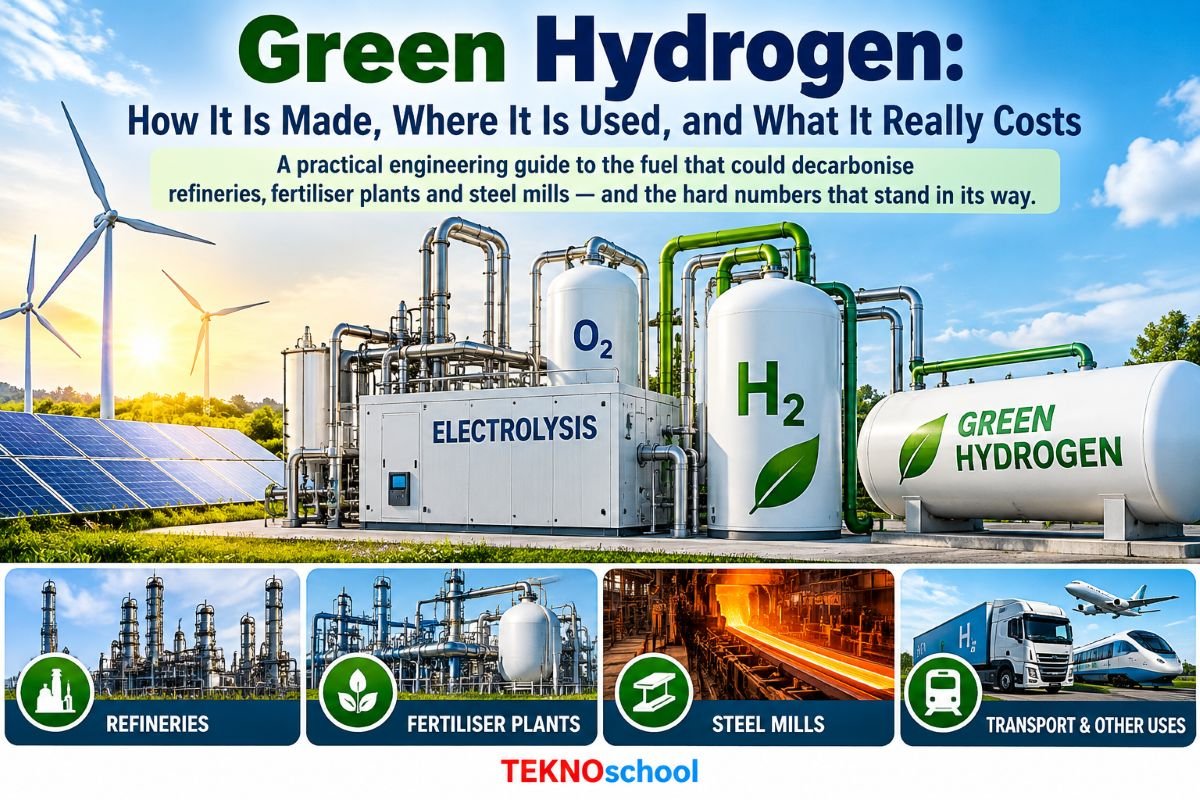
Green Hydrogen: How It Is Made, Where It Is Used, and What It Really Costs
Green Hydrogen – A practical engineering guide to the fuel that could decarbonise refineries, fertiliser plants and steel mills — and the hard numbers that stand in its way.
Hydrogen is the most abundant element in the universe, yet on Earth it almost never exists on its own. It is locked inside water, natural gas, coal and biomass, and we have to spend energy to pull it out. Today the world produces close to 100 million tonnes of hydrogen every year, and almost all of it comes from fossil fuels. That makes the hydrogen industry one of the largest single sources of industrial carbon dioxide on the planet.
Green hydrogen changes the source. Instead of reforming natural gas or gasifying coal, it splits water using electricity from solar, wind or hydro power. The only by-product is oxygen. If the power is genuinely renewable, the hydrogen carries a near-zero carbon footprint. That simple idea has turned green hydrogen into one of the most talked-about technologies in the energy transition — and one of the most debated.
This article explains what green hydrogen is, how electrolysis works, which electrolyser technologies compete for the market, where the fuel actually makes sense, what it costs, and where India stands in 2026.
The Hydrogen Colour Spectrum
Hydrogen gas is colourless whichever way it is made. The “colours” are an industry shorthand for the production route and its carbon intensity.
| Colour | Production route | Carbon footprint |
|---|---|---|
| Grey | Steam methane reforming (SMR) of natural gas, CO₂ vented | About 9–12 kg CO₂ per kg H₂ |
| Black / Brown | Coal or lignite gasification | About 18–25 kg CO₂ per kg H₂ |
| Blue | SMR with carbon capture and storage | Reduced, depends on capture rate and methane leakage |
| Green | Water electrolysis powered by renewable electricity | Near zero at the plant; low over the full life cycle |
| Pink | Electrolysis powered by nuclear energy | Near zero |
Most regulators now prefer a measured emissions threshold over a colour label. India’s Green Hydrogen Standard, for example, defines green hydrogen by a well-to-gate emission limit of 2 kg CO₂-equivalent per kg of hydrogen, averaged over a twelve-month period.
How Water Electrolysis Works
An electrolyser is a stack of cells. Each cell has two electrodes — an anode and a cathode — separated by an electrolyte or membrane. When direct current flows, water splits into its elements:
Hydrogen gas forms at the cathode and oxygen at the anode. The theoretical minimum cell voltage is about 1.23 V, but real cells run at roughly 1.8–2.2 V because of electrode overpotentials and ohmic losses. That extra voltage is the main reason electrolysis is not perfectly efficient.
The energy numbers every engineer should know
- Energy content of hydrogen: about 33.3 kWh/kg on a lower heating value basis and 39.4 kWh/kg on a higher heating value basis.
- Practical electricity demand: commercial systems consume roughly 50–55 kWh per kg of hydrogen at the system level, including rectifiers, pumps, cooling and gas treatment.
- Water demand: the stoichiometric requirement is about 9 litres of pure water per kg of hydrogen; with purification losses the real figure is closer to 15–20 litres of raw water.
- By-product: 8 kg of oxygen for every 1 kg of hydrogen.
Put those together and the scale becomes clear. Producing one million tonnes of green hydrogen a year needs around 52 terawatt-hours of electricity — roughly the annual output of 20 GW of solar plants in a sunny region.
The Four Main Electrolyser Technologies
1. Alkaline electrolysers (AEL)
The oldest and most mature design. Electrodes sit in a 25–30% potassium hydroxide solution separated by a porous diaphragm. Alkaline units use nickel-based catalysts instead of precious metals, which keeps capital cost low. Their weakness is slow response and a limited minimum load — typically 15–20% — below which hydrogen can cross the diaphragm and contaminate the oxygen stream.
2. Proton exchange membrane electrolysers (PEM)
PEM cells use a thin solid polymer membrane that conducts protons. They are compact, deliver high-purity hydrogen at elevated pressure and follow load changes in seconds — a strong match for fluctuating solar and wind power. The trade-off is cost: the anode needs iridium and the cathode platinum, both scarce and expensive.
3. Solid oxide electrolysers (SOEC)
SOECs operate at 700–850 °C with a ceramic electrolyte. Because part of the energy for splitting water arrives as heat, electricity consumption can fall towards 40 kWh/kg. They suit sites with abundant waste heat, such as steel plants or nuclear stations, but thermal cycling and material degradation still limit commercial deployment.
4. Anion exchange membrane electrolysers (AEM)
AEM technology tries to combine the cheap catalysts of alkaline systems with the compact membrane design of PEM. It is the newest of the four and still being proven at scale, but it attracts strong research interest because it avoids precious metals.
| Feature | Alkaline | PEM | SOEC |
|---|---|---|---|
| Operating temperature | 60–90 °C | 50–80 °C | 700–850 °C |
| Load flexibility | Moderate | Excellent | Limited |
| Catalysts | Nickel | Iridium, platinum | Ceramics, nickel |
| Maturity | Fully commercial | Commercial | Early commercial |
Inside the Plant: More Than Just a Stack
The electrolyser stack gets the headlines, but a working green hydrogen plant is a full process facility. The balance of plant typically includes:
- Power conversion: transformers and rectifiers that turn AC grid or plant power into regulated DC.
- Water treatment: reverse osmosis followed by demineralisation to reach a conductivity below about 1 µS/cm.
- Gas–liquid separators on both hydrogen and oxygen sides, with level control to keep the electrolyte circulating.
- Gas purification: a catalytic deoxidiser to remove traces of oxygen, followed by a dryer to bring moisture down to the dew point the user requires.
- Compression and storage, since electrolysers usually deliver hydrogen at 1–30 bar while users may need far more.
Control and safety focus
The most critical loop in any electrolyser is gas purity. Hydrogen is flammable in air between 4% and 75% by volume, so plants continuously analyse the hydrogen content of the oxygen stream and trip the stack well below the 4% lower flammability limit — typically at around 2%. Stack temperature control, differential pressure control between the hydrogen and oxygen sides, and electrolyte level control in the separators round out the core control scheme.
Where Green Hydrogen Actually Makes Sense
Because every conversion step loses energy, green hydrogen works best where direct electrification is impossible or impractical. The strongest use cases are:
- Oil refineries: already large hydrogen users for hydrotreating and hydrocracking. Swapping grey for green hydrogen requires no change in process chemistry.
- Fertilisers: ammonia synthesis via the Haber–Bosch process consumes about 0.18 tonnes of hydrogen per tonne of ammonia. Green ammonia is likely the first large-scale market.
- Steel: hydrogen-based direct reduction of iron ore (H₂-DRI) can replace coking coal, with water vapour instead of CO₂ leaving the shaft furnace.
- Shipping and aviation: through derivatives such as green methanol, green ammonia and synthetic kerosene.
- Seasonal energy storage: converting surplus renewable power into hydrogen for use months later.
Passenger cars and home heating, by contrast, are poor matches. A battery electric vehicle uses roughly three times less primary electricity per kilometre than a hydrogen fuel-cell car, and heat pumps beat hydrogen boilers by a similar margin.
The Economics: Why Cost Is the Real Barrier
The climate case for green hydrogen is settled; the cost case is not. Globally, green hydrogen in 2026 typically costs USD 3.5–6 per kg, while grey hydrogen sits around USD 1.5–2.5 per kg. In India, prices discovered through competitive bidding for refinery supply have been about ₹387–397 per kg, against roughly ₹150–200 per kg for grey hydrogen.
Three factors drive the levelised cost of hydrogen (LCOH):
- Electricity price: renewable power accounts for roughly 50–70% of production cost in India.
- Electrolyser capital cost: including stack replacement every 7–10 years.
- Utilisation: the fraction of the year the electrolyser actually runs.
A quick worked example
Consider a 100 MW electrolyser consuming 52 kWh per kg.
Solar only, 25% utilisation: 100,000 kW × 8,760 h × 0.25 ÷ 52 ≈ 4,210 tonnes per year
Solar–wind hybrid with storage, 60% utilisation: 100,000 kW × 8,760 h × 0.60 ÷ 52 ≈ 10,110 tonnes per year
The same capital investment yields about 2.4 times more hydrogen, so the capital charge per kilogram drops by more than half.
Electricity component: at ₹3.50 per kWh, power alone contributes 52 × 3.50 = ₹182 per kg. Every ₹0.50 reduction in tariff saves ₹26 per kg.
This is why developers chase round-the-clock renewable supply, why open-access transmission charge waivers matter so much, and why analysts broadly expect unsubsidised green hydrogen to reach USD 2 per kg only around 2030–2035 in the best locations.
India’s Green Hydrogen Push
India approved the National Green Hydrogen Mission in January 2023 with an outlay of ₹19,744 crore up to 2029–30. The headline target is at least 5 million tonnes of green hydrogen a year by 2030, supported by around 125 GW of dedicated renewable capacity.
The mission’s main instrument is SIGHT — Strategic Interventions for Green Hydrogen Transition — which offers incentives for both hydrogen production and domestic electrolyser manufacturing. By late 2025, production incentives had been awarded for about 8.62 lakh tonnes per year of capacity across 18 companies, and electrolyser manufacturing capacity of 3,000 MW per year had been allotted to 15 companies. India has also signed agreements for about 7.24 lakh tonnes per year of green ammonia supply, one of the largest such procurement exercises globally.
The gap between ambition and delivery, however, is wide. As of February 2026, commissioned production capacity stood at only about 8,000 tonnes per year — a tiny fraction of the 2030 goal. Fund utilisation has also been slow in the early years, though it picked up sharply in 2025–26.
India still has real advantages. It has some of the world’s lowest solar tariffs, strong wind resources in Gujarat, Rajasthan and Tamil Nadu, large existing hydrogen demand in refining and fertilisers, and port-based hubs such as Kandla, Paradip and Tuticorin being developed for export of green ammonia and methanol.
The Technical Challenges Still Ahead
- Storage and transport: hydrogen has a very low volumetric energy density. Storing it needs compression to 350–700 bar or liquefaction at −253 °C, both energy-intensive.
- Material compatibility: hydrogen embrittlement can crack high-strength steels, so pipelines, valves and vessels need careful material selection.
- Round-trip efficiency: power-to-hydrogen-to-power returns only about 30–40% of the original electricity.
- Water in arid regions: many of the best solar sites are water-stressed, pushing projects towards desalination.
- Demand certainty: without long-term offtake contracts, projects struggle to secure financing.
- Critical materials: iridium supply could constrain large-scale PEM deployment unless catalyst loadings fall sharply.
The Road Ahead
Green hydrogen is neither a miracle fuel nor a failed hype cycle. It is a specialised industrial tool. Where hydrogen is already used — refineries and fertiliser plants — or where no electric alternative exists — steelmaking, long-distance shipping and seasonal storage — it offers one of the few credible paths to deep decarbonisation.
The next few years will be decided by three levers: cheaper round-the-clock renewable power, cheaper and more durable electrolysers built at gigawatt scale, and firm long-term demand from industry. Electrolyser prices are expected to keep falling as manufacturing scales up, and higher utilisation through hybrid renewable supply is already proving to be the most powerful cost lever available to developers.
Key Takeaways
- Green hydrogen is made by splitting water with renewable electricity, emitting only oxygen.
- Real-world electrolysers need about 50–55 kWh of electricity per kilogram of hydrogen.
- Alkaline and PEM dominate today; SOEC and AEM promise efficiency and cost gains.
- Electricity price and electrolyser utilisation are the biggest cost drivers.
- The best uses are refining, fertilisers, steel and shipping fuels — not cars or home heating.
- India has set a 5-million-tonne target for 2030, but commissioned capacity is still at a very early stage.
For engineers, the opportunity is enormous. Every green hydrogen plant combines power electronics, electrochemistry, water treatment, gas processing, compression and safety instrumentation in one integrated facility. The people who understand how these systems fit together — and how to control them reliably on a variable renewable supply — will shape how quickly this fuel moves from pilot plants to the backbone of heavy industry.