
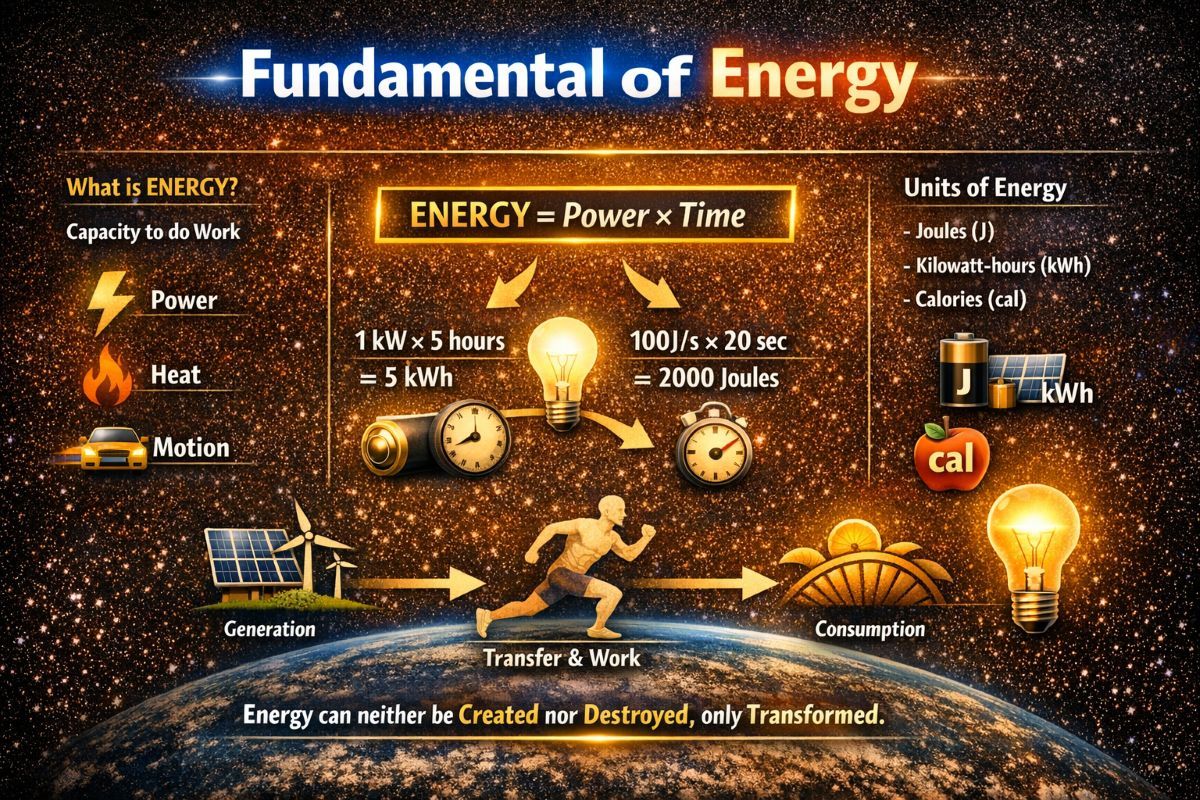
Fundamental of Energy
🌈⚡ Fundamental of Energy
This guide, Fundamental of Energy, simplifies complex concepts into easy and practical knowledge.
Energy is the invisible force that powers industries, homes, and machines. Whether it’s the electricity running motors or the heat driving boilers, every form of energy has its own behaviour, units, and conversion rules. Understanding these basics helps reduce wastage, improve efficiency, and lower operating costs.
🧪 Chemical Energy
Chemical energy is stored inside fuels like coal, diesel, natural gas, and even batteries. When these fuels burn or react, they release heat or electricity. Industries rely heavily on chemical energy because it is dense, transportable, and easy to store.
Units: Joule (J), kJ, kcal
Conversions:
- 1 kcal = 4.186 kJ
- Diesel ≈ 10,000 kcal per litre
Chemical energy is the starting point for many processes, especially in boilers, furnaces, and engines.
⚙️ Mechanical Energy
Mechanical energy is the energy of motion or force. Whenever something moves, rotates, or lifts, mechanical energy is involved. Pumps, compressors, turbines, and conveyors all convert electrical or chemical energy into mechanical work.
Units: Joule (J), Nm
Mechanical energy is essential because it directly performs physical tasks like pumping water or compressing air.
⚡ Electrical Energy
Electrical energy is the most versatile form of energy. It can be transported over long distances, controlled easily, and converted into almost any other form. Industries purchase electricity in kWh and use it for motors, lighting, HVAC, and automation.
Units: kWh, kW
Conversions:
- 1 kWh = 860 kcal
- 1 kWh = 3.6 MJ
Electricity is clean at the point of use and extremely efficient for powering equipment.
🔥 Thermal Energy
Thermal energy is heat stored in steam, hot water, flue gases, or heated materials. It is essential for processes like drying, heating, boiling, sterilizing, and melting.
Units: kcal, kJ, BTU
Conversions:
- 1 kcal = 3.97 BTU
- 1 kWh = 860 kcal
Thermal energy is often produced by burning fuels or using electricity.
🔄 Energy Conversions
Energy frequently changes from one form to another.
- Electrical → Thermal: Heaters
- Thermal → Electrical: Steam turbine generator, gas turbine generators
- Chemical → Thermal: Fuel combustion
- Chemical → Electrical: Batteries, fuel cells
Each conversion has efficiency losses, so understanding them helps reduce energy waste.
⚡🔌 Voltage, Current & Power
Electricity behaves like water in a pipe.
- Voltage (V): Pressure that pushes electrons
- Current (A): Flow of electrons
- Power (kW): Rate of doing work
Higher voltage reduces current and lowers losses, which is why industries use 415V or higher.
⚡📐 Active, Reactive & Apparent Power
Electrical loads need different types of power:
- Active Power (kW): Useful work, like rotation or heating
- Reactive Power (kVAR): Needed for magnetizing motors
- Apparent Power (kVA): A combination of both
A healthy electrical system balances these powers to avoid penalties and inefficiencies.
📉 Power Factor & What Affects It
Power factor (PF) shows how efficiently electricity is used.
PF = kW/kVA
Low PF means more current, more losses, and higher bills.
Causes of low PF:
- Induction motors
- Welding machines
- Transformers
- Fluorescent lamps
Improvement methods:
- Capacitors
- APFC panels
- VFDs
- Correct motor sizing
A good PF reduces demand charges and improves system stability.
📈⏱️ Demand, Maximum Demand & TOU
Demand is the instantaneous power drawn by a facility.
Maximum Demand (MD) is the highest average demand recorded in a 15‑ or 30‑minute interval. Utilities charge extra if MD exceeds limits.
Time-of-Use (TOU) metering encourages shifting loads to off‑peak hours by offering cheaper rates during low‑demand periods.
Interval metering helps industries identify wastage, idle running, and peak loads.
🔥🏭 Thermal Energy: Purchase to End Use
Industries purchase thermal energy in the form of fuels or steam. This energy is then used for heating, boiling, drying, and chemical reactions. Efficient thermal systems reduce fuel consumption and improve product quality.
🌡️ Temperature Basics
Temperature measures how hot or cold something is.
Units: °C, °F, K
Conversions:
- °F = (°C × 1.8) + 32
- K = °C + 273.15
Temperature control is crucial for safety, quality, and efficiency.
🧯 Pressure Basics
Pressure is the force applied by a fluid per unit area.
Units: bar, kg/cm², psi, Pa
Conversions:
- 1 bar = 14.7 psi
- 1 kg/cm² = 0.98 bar
Pressure is vital in boilers, compressors, and steam systems.
🔥💧 Sensible Heat, Latent Heat & Heat Capacity
Sensible heat changes temperature without changing phase.
Latent heat changes phase (water to steam) without changing temperature.
Heat capacity (Cp) is the heat needed to raise 1 kg of a substance by 1°C.
Understanding these helps calculate heating loads and boiler efficiency.
💨 Evaporation & Condensation
Evaporation absorbs heat as liquid turns to vapour.
Condensation releases heat as vapour turns back to liquid.
These principles are used in boilers, cooling towers, dryers, and heat exchangers.
💦🌬️ Moist Air, Humidity & Psychrometry
Moist air contains water vapour.
Humidity affects comfort, drying, cooling, and product quality.
A psychrometer measures dry-bulb and wet-bulb temperatures to calculate humidity, enthalpy, and moisture content.
Psychrometry is essential in HVAC, drying, and ventilation systems.
🔥🌍 Importance of Thermal Energy
Thermal energy drives industrial processes like sterilization, distillation, and drying. It influences product quality and energy cost. Efficient thermal systems reduce fuel bills and environmental impact.
🔥➡️🌬️ Heat Transfer: Conduction, Convection & Radiation
Heat moves in three ways:
- Conduction: Through solids
- Convection: Through liquids and gases
- Radiation: Through electromagnetic waves
Understanding heat transfer helps design insulation, boilers, ovens, and HVAC systems.
🔥📡 Radiance- Absorption, Reflection & Transmission
Surfaces behave differently with heat:
- Dark surfaces absorb more
- Shiny surfaces reflect heat
- Transparent materials transmit heat
- All bodies emit radiation based on temperature
These principles help in insulation, solar heating, and building design.
🧮 Heat Loss Calculation
Heat loss depends on temperature difference, surface area, insulation, and material conductivity.
Q = U x A x ∆T
This formula represents the heat transfer rate (Q) through a surface, where:
- (Q) is the heat transfer rate (amount of heat transferred per unit time).
- (U) is the overall heat transfer coefficient, which indicates how well heat is conducted through the material and convection combined.
- (A) is the surface area through which heat transfer occurs.
- ∆T is the temperature difference across the surface.
In simple terms, the heat transferred (Q) is proportional to the heat transfer coefficient (U), the area (A), and the temperature difference ∆T . This formula is widely used in thermal engineering to calculate heat loss or gain through walls, pipes, or other surfaces.
Reducing heat loss saves fuel and improves system efficiency.
🌟 Conclusion
Energy fundamentals form the backbone of energy management. Whether it’s electricity powering motors or steam heating processes, understanding how energy behaves helps industries reduce costs, improve efficiency, and operate sustainably. Mastering these basics empowers engineers, auditors, and plant managers to make smarter decisions every day.