DOL and Star Delta starter
DOL and Star‑Delta Starter: Working, SLD, Components & Industrial Applications
Among the most widely used starters in industries are the DOL and Star Delta starter. Motor starters are essential elements in any industrial electrical system. They ensure that induction motors start safely, operate reliably, and remain protected from electrical and mechanical stresses.
Although both serve the same purpose—starting and protecting motors—their working principles, components, and applications differ significantly. This article provides a complete, standalone explanation of both starters, including their Single Line Diagrams (SLDs), operation, advantages, limitations, and selection guidelines.
⭐ 1. Direct‑On‑Line (DOL) Starter
A Direct‑On‑Line starter is the simplest and most commonly used method for starting small‑ to medium‑sized induction motors. In this method, the motor is connected directly to the full supply voltage.
1.1 SLD & Components
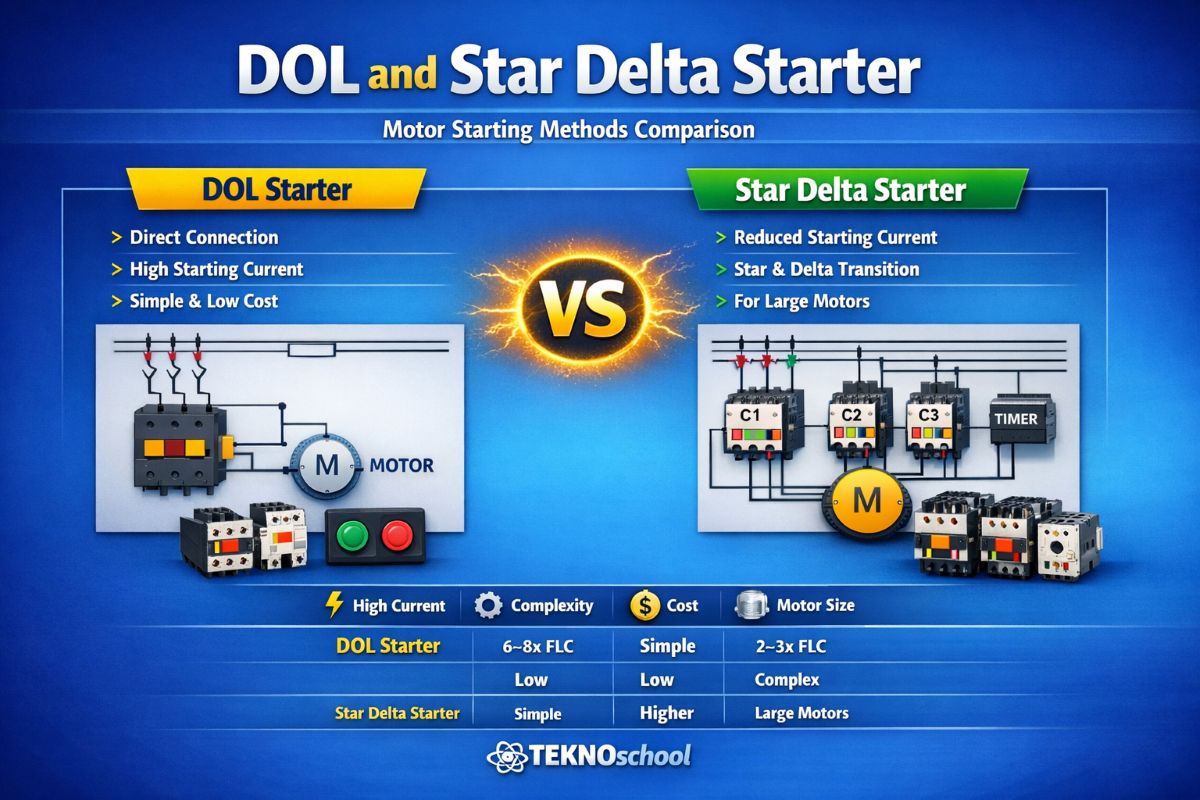
A typical DOL starter SLD includes:
- 3‑phase supply (R‑Y‑B)
- Switch Fuse Unit (SFU) or MCCB
- Contactor (C1)
- Thermal Overload Relay
- Start Push Button (NO)
- Stop Push Button (NC)
- Indicating lamps (ON/OFF/TRIP)
- Current Transformer (optional for metering)
- Motor terminals
The SLD is straightforward: the contactor connects the motor directly to the supply, and the overload relay provides protection.
1.2 Working Principle
- Press START PB → energizes the contactor coil.
- Contactor closes → motor receives full line voltage.
- Overload relay monitors current and trips if an overload occurs.
- Press STOP PB → de‑energizes the contactor and stops the motor.
1.3 Advantages
- Very simple design
- Low cost
- Easy to install and maintain
- High reliability
- Suitable for small motors (typically up to 7.5–10 HP)
1.4 Limitations
- High inrush current (6–8 times full load current)
- High starting torque may stress mechanical equipment
- Not suitable for weak power systems
- Not recommended for large motors
⭐ 2. Star‑Delta Starter
A Star‑Delta starter is a reduced‑voltage starter used for medium‑ to large‑size induction motors. It reduces starting current by initially connecting the motor windings in a star configuration and later switching to a delta.
2.1 SLD & Components
A typical Star‑Delta starter SLD includes:
- 3‑phase supply
- SFU or MCCB
- Main Contactor (C1)
- Star Contactor (C2)
- Delta Contactor (C3)
- Timer (ON‑delay)
- Thermal Overload Relay
- Start/Stop Push Buttons
- Interlocking (electrical + mechanical)
- Motor with 6 terminals (U1, V1, W1, U2, V2, W2)
The SLD shows three contactors arranged so that the motor starts in star and then transitions to delta after a preset time.
2.2 Working Principle
- Press START PB → Main Contactor (C1) and Star Contactor (C2) energize.
- Motor starts in star, reducing voltage to 58% and current to 33%.
- After the timer completes its delay:
- Star Contactor (C2) opens
- Delta Contactor (C3) closes
- Motor now runs in delta at full voltage.
2.3 Advantages
- The starting current is reduced to one‑third
- Lower mechanical stress on the motor and load
- Smooth acceleration
- Suitable for large motors (15 kW to 75 kW and above)
2.4 Limitations
- Requires motors with 6 accessible terminals
- More complex wiring
- Transition dip may occur during the star‑to‑delta changeover
- Not suitable for high‑starting‑torque loads
⭐ 3. Comparison: DOL vs Star‑Delta Starter
| Feature | DOL Starter | Star‑Delta Starter |
|---|---|---|
| Starting Current | Very high (6–8× FLC) | Low (2–3× FLC) |
| Starting Torque | High | Low |
| Complexity | Simple | Medium |
| Cost | Low | Higher |
| Motor Size | Small motors | Medium–large motors |
| Components | 1 contactor | 3 contactors + timer |
| Mechanical Stress | High | Low |
| Suitable For | Pumps, fans, small machinery | Compressors, blowers, chillers |
⭐ 4. Understanding the SLD (Single Line Diagram)
4.1 DOL SLD Interpretation
The DOL SLD is minimalistic:
- The contactor directly connects the motor to the supply.
- The overload relay protects against excessive current.
- The control circuit uses simple start/stop push buttons.
- Interlocking ensures safe operation.
4.2 Star‑Delta SLD Interpretation
The Star‑Delta SLD is more elaborate:
- Three contactors (main, star, delta) are arranged to switch the motor winding configuration.
- A timer ensures proper delay between star and delta.
- Electrical interlocks prevent star and delta contactors from energizing simultaneously.
- The motor must have six terminals accessible for reconfiguration.
⭐ 5. Protection & Interlocking
Both starters include:
- Thermal overload protection
- Short‑circuit protection via SFU/MCCB
- Control interlocking
- Indicating lamps for status
Star‑Delta starters additionally require:
- Mechanical interlock between star and delta contactors
- Timer‑based logic for transition
These ensure safe and reliable operation.
⭐ 6. Applications
DOL Starter Applications
- Small pumps
- Small blowers
- Fans
- Mixers
- Workshop machinery
- Domestic/utility motors
Star‑Delta Starter Applications
- Large pumps
- Compressors
- Chillers
- Large blowers
- Industrial mixers
- HVAC systems
- Conveyors with low starting torque
⭐ 7. How to Select Between DOL and Star‑Delta
Choose DOL when:
- Motor rating is small
- High starting torque is required
- A power system can handle high inrush current
- Simplicity and low cost are priorities
Choose Star‑Delta when:
- Motor rating is medium to large
- Reduced starting current is required
- The load allows a low starting torque
- Motor has 6 terminals
- A smooth start is desired
⭐ 8. Conclusion
Both DOL and Star‑Delta starters play crucial roles in industrial motor control. The DOL starter is ideal for small motors where simplicity and cost‑effectiveness matter. The Star‑Delta starter is preferred for larger motors where reduced starting current and smoother acceleration are essential.
Understanding their SLDs, components, and operating principles helps engineers select the right starter for each application, ensuring safety, reliability, and energy efficiency.