
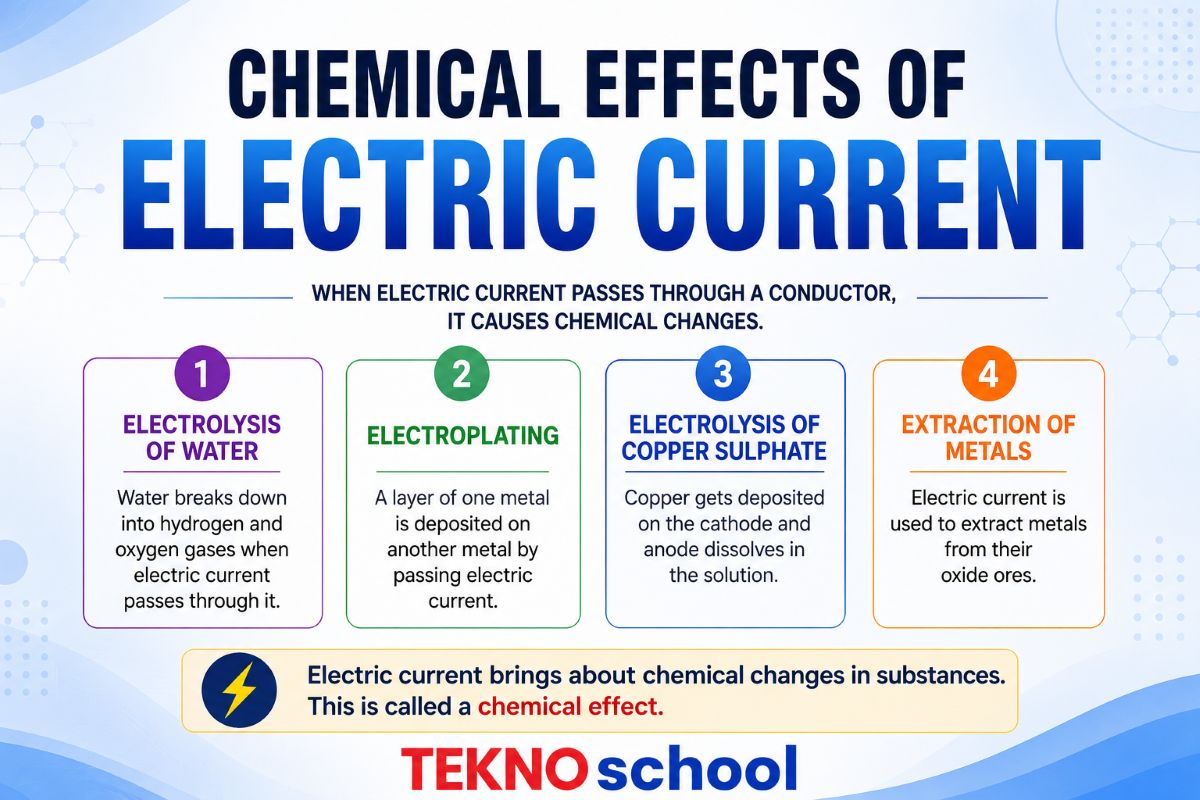
Chemical Effects of Electric Current
CBSE CLASS 8 SCIENCE
Chemical Effects of
Electric Current
Electric Current
Chemical Effects of Electric Current- Electrolysis, Electroplating & Conducting Liquids
Section 1
Do Liquids Conduct Electricity?
We know that metals like copper and aluminium are good conductors of electricity. But what about liquids? Some liquids allow electric current to pass through them while others do not. Liquids that conduct electricity are called conducting liquids or electrolytes. Liquids that do not conduct electricity are called poor conductors or non-electrolytes.
| 🔌 Parts of a Simple Tester | |
|---|---|
| 🔋 Battery (Cell) | Provides the electric current that flows through the circuit |
| 🔌 Connecting Wires | Connect the battery, bulb, and electrodes to form a complete circuit |
| 💡 Bulb | Glows when current flows through the circuit — confirms the liquid is a conductor |
| ⚗️ Two Electrodes | Two free ends of the wire dipped into the liquid to be tested |
✅ How it works: Connect a battery, bulb, and two wires in a circuit. Leave the two free ends of the wire (electrodes) apart. Dip both electrodes into the liquid. If the bulb glows, the liquid conducts electricity. If it does not glow, the liquid may still be a weak conductor — use a more sensitive tester. | |
📚 Key Idea: The two wires dipped in the liquid are called electrodes. The electrode connected to the positive terminal of the battery is the anode (+) and the one connected to the negative terminal is the cathode (−).
Section 2
More Sensitive Testers
Sometimes the current flowing through a liquid is too weak to make a bulb glow. In such cases, we need more sensitive devices to detect the flow of current. Two common methods are using an LED (Light Emitting Diode) and a magnetic compass needle.
💡
LED Tester
An LED glows even when a very small current flows through it. Replace the bulb in the tester circuit with an LED. If the LED glows, the liquid conducts electricity — even weakly.
⚡ More sensitive than a bulb
🧭
Compass Needle Tester
Place a magnetic compass near the wire connected to the tester. When current flows, the compass needle deflects (moves) from its normal position due to the magnetic effect of current.
🔎 Detects even very weak currents
⚠️ Remember: An LED must be connected in the correct direction — the longer leg (positive) goes to the positive terminal of the battery. If connected in reverse, it will not glow even if current flows.
Section 3
Good & Poor Conducting Liquids
Not all liquids conduct electricity equally. Some are excellent conductors while others are very poor. The ability of a liquid to conduct electricity depends on whether it contains free ions — charged particles that can carry electric current.
💡 Why the difference? Liquids that conduct electricity contain ions — atoms or groups of atoms that carry positive or negative charges. Acids, bases, and salts break up into ions when dissolved in water. Pure water, oils, and sugar solutions have no free ions, so they do not conduct.
Section 4
Ions & Electrolytes
When certain substances are dissolved in water, their molecules break apart into electrically charged particles called ions. Positive ions are called cations and they move towards the cathode. Negative ions are called anions and they move towards the anode. This movement of ions through the liquid constitutes the electric current.
⚖️ Salt Dissolving in Water — Ion Formation
NaCl
(Solid salt)
➔
dissolves
in water
in water
Na⁺
Cation (+)
+
Cl⁻
Anion (−)
🔬 Na⁺ ions move towards the cathode (−) and Cl⁻ ions move towards the anode (+). This flow of ions = electric current in the liquid!
📚 Electrolyte vs Non-Electrolyte: A substance that produces ions when dissolved in water and allows current to flow is called an electrolyte (e.g., acids, bases, salts). A substance that does not produce ions is a non-electrolyte (e.g., sugar, alcohol).
Section 5
Three Chemical Effects of Electric Current
When electric current passes through a conducting liquid, it can cause three important chemical changes. These changes are together called the chemical effects of electric current.
🌌
1. Gas Bubbles
Bubbles of gas are formed at the electrodes. For example, when current passes through water, hydrogen gas forms at the cathode and oxygen gas forms at the anode.
H₂ : O₂ = 2 : 1 ratio
🧩
2. Metal Deposit
A thin layer of metal gets deposited on the electrode. When current passes through copper sulphate solution, a layer of copper is deposited on the electrode connected to the negative terminal.
Basis of Electroplating
🎨
3. Colour Change
The colour of the solution may change. For example, when current passes through copper sulphate solution using copper electrodes, the blue colour gradually fades as copper ions get deposited.
Blue ➔ Lighter / Colourless
⚡ Electrolysis of Water
H₂O
Water (add a little acid)
➔
pass current
H₂ ↑
At Cathode (−)
2 parts by volume
+
O₂ ↑
At Anode (+)
1 part by volume
🧪 A few drops of dilute sulphuric acid are added to make pure water a conductor. The volume of hydrogen collected is double the volume of oxygen — confirming water is H₂O.
🚨 Important: The process of decomposing a chemical substance by passing electric current through it is called electrolysis. This is a key chemical effect and the basis of many industrial processes including electroplating, metal refining, and production of chemicals.
Section 6
Electroplating
Electroplating is the process of coating a thin layer of a desired metal on another metal by using electric current. It is one of the most useful applications of the chemical effects of electric current.
🔌 Electroplating Setup — Copper Plating on Iron
ANODE (+)
Copper plate
Metal to be coated
Cu²⁺ ions
➔
travel through
solution
➔
travel through
solution
CATHODE (−)
Iron object
Object to be plated
🧪 Solution: Copper Sulphate (CuSO₄)
Step 1
Cu atoms at anode lose electrons and enter solution as Cu²⁺ ions
Step 2
Cu²⁺ ions travel through the CuSO₄ solution towards cathode
Step 3
Cu²⁺ ions gain electrons at cathode and deposit as solid copper
Step 4
Iron object gets a shiny copper coating!
📝 Three Rules of Electroplating:
● The object to be coated is always the cathode (−)
● The metal to be coated with is the anode (+)
● The solution must contain a salt of the coating metal
● The object to be coated is always the cathode (−)
● The metal to be coated with is the anode (+)
● The solution must contain a salt of the coating metal
Section 7
Applications of Electroplating
Electroplating has many practical applications in everyday life and industry. Different metals are plated for different purposes — from preventing rust to making jewellery look attractive.
| Coating Metal | Coated On | Purpose |
|---|---|---|
| Chromium | Car parts, taps, bicycle handlebars | Shiny finish, rust prevention, scratch resistance |
| Zinc | Iron pipes, sheets, bridges | Prevents rusting (galvanisation) |
| Tin | Iron cans for food storage | Prevents food contamination, non-toxic |
| Silver / Gold | Cheap metal jewellery | Attractive appearance at low cost |
| Copper | Printed circuit boards (PCBs) | Excellent electrical conductivity |
| Nickel | Kitchen utensils, bathroom fittings | Corrosion resistance, good appearance |
⚠️ Did You Know? Electroplating factories release harmful chemicals and metals into water bodies, causing water pollution. Laws require factories to treat their waste water before releasing it. Improper disposal of electroplating waste is a serious environmental concern.
Section 8
Conducting Liquids Around Us
Understanding which common liquids conduct electricity helps us stay safe and apply this knowledge in daily life.
⚡ Conductivity of Common Liquids
Salt Solution
Excellent
Lemon Juice
Good
Vinegar
Moderate
Tap Water
Weak
Sugar Solution
Poor
Distilled Water
None
💧 This is why you should NEVER touch electrical switches or appliances with wet hands — even tap water can conduct enough current to give you a dangerous electric shock!
🚨 Safety Warning: Never experiment with mains electricity or high-voltage batteries. Chemical effect experiments should only be done with low-voltage cells (1.5V or 3V) under adult supervision. Some chemicals used in electrolysis are corrosive and can cause burns.
📋 Quick Revision Table
| Term / Concept | Meaning / Explanation |
|---|---|
| Electrode | A metal or carbon rod dipped in a liquid to allow current to enter or leave |
| Anode | Electrode connected to the positive (+) terminal of the battery |
| Cathode | Electrode connected to the negative (−) terminal of the battery |
| Electrolyte | A liquid that conducts electricity due to the presence of ions (acids, bases, salts) |
| Non-Electrolyte | A liquid that does not conduct electricity (sugar solution, distilled water) |
| Ions | Electrically charged atoms — cations (+) and anions (−) |
| Electrolysis | Decomposition of a substance by passing electric current through it |
| Electroplating | Coating one metal with another using electric current |
| Galvanisation | Coating iron with zinc to prevent rusting |
| LED Tester | A more sensitive tester that can detect very weak electric currents |
| Compass Tester | Uses magnetic effect to detect current — needle deflects when current flows |
| H₂ : O₂ ratio | In electrolysis of water, hydrogen and oxygen are produced in 2:1 volume ratio |
| Chromium Plating | Coating with chromium for shine, scratch resistance and rust prevention |
| Tin Plating | Coating iron food cans with tin — non-toxic and prevents contamination |
✍️ Exercise Zone
6 Question Types • 10 Questions Each • 60 Total
TYPE A — One-Sentence Answers
Q1. What are electrodes?
✔ Electrodes are the two metal or carbon rods dipped into a liquid through which electric current enters or leaves the liquid.
Q2. What is an electrolyte?
✔ An electrolyte is a liquid that conducts electricity because it contains free ions, such as salt solution, acids, or bases dissolved in water.
Q3. What is electroplating?
✔ Electroplating is the process of depositing a thin layer of a desired metal on another metal object by passing electric current through a suitable salt solution.
Q4. Why is an LED a better tester than a bulb?
✔ An LED glows even when a very small current flows through it, making it more sensitive than a bulb for detecting weak currents in liquids.
Q5. What is electrolysis?
✔ Electrolysis is the chemical decomposition of a substance by passing electric current through it, such as splitting water into hydrogen and oxygen.
Q6. What is galvanisation?
✔ Galvanisation is the process of coating iron objects with a layer of zinc to protect them from rusting.
Q7. Name the gas collected at the cathode during electrolysis of water.
✔ Hydrogen gas is collected at the cathode during the electrolysis of water.
Q8. Why do we add a few drops of acid to water before electrolysis?
✔ A few drops of dilute sulphuric acid are added to make pure water a better conductor of electricity, as pure water has very few free ions.
Q9. What are cations?
✔ Cations are positively charged ions that move towards the cathode when electric current is passed through a liquid.
Q10. Why is tin used to coat iron food cans?
✔ Tin is non-toxic and does not react with food substances, so it prevents contamination and keeps the food safe for consumption.
TYPE B — Two-Sentence Answers
Q1. How does a magnetic compass needle help detect electric current in a liquid?
✔ When a compass needle is placed near a wire carrying current, it gets deflected from its normal position due to the magnetic effect of the current. If the needle deflects when electrodes are dipped in a liquid, it confirms that the liquid is conducting electricity.
Q2. Explain why salt solution conducts electricity but sugar solution does not.
✔ When salt (NaCl) dissolves in water, it breaks into Na⁺ and Cl⁻ ions which are free to move and carry electric current. Sugar dissolves in water but does not produce ions, so it cannot carry current and remains a non-electrolyte.
Q3. Why is distilled water a poor conductor while tap water conducts electricity?
✔ Distilled water is pure and contains almost no dissolved salts or minerals, so it has very few free ions to carry current. Tap water contains dissolved salts and minerals that produce ions, making it a reasonably good conductor of electricity.
Q4. What happens when electric current is passed through copper sulphate solution?
✔ Copper from the solution gets deposited on the electrode connected to the negative terminal (cathode) of the battery. The blue colour of the copper sulphate solution gradually becomes lighter as copper ions are removed from the solution.
Q5. In electroplating, why is the object to be plated connected to the negative terminal?
✔ Metal ions in the solution are positively charged (cations) and they naturally move towards the negative electrode (cathode). When these positive metal ions reach the cathode, they gain electrons and deposit as a solid metal layer on the object.
Q6. What are the three chemical effects observed when current flows through a liquid?
✔ The three chemical effects are: formation of gas bubbles at the electrodes, deposition of metal on the electrode, and change in the colour of the solution. These effects confirm that a chemical change is taking place due to the flow of electric current.
Q7. Why are chromium-plated objects popular?
✔ Chromium plating gives objects a shiny, lustrous appearance and makes them look very attractive. Additionally, chromium does not corrode easily and is scratch-resistant, which protects the underlying metal from rust and damage.
Q8. What role does the solution play in electroplating?
✔ The solution used in electroplating must contain a salt of the metal that is to be coated, as this salt provides the metal ions needed for deposition. For example, copper sulphate solution provides Cu²⁺ ions when copper plating is required.
Q9. How is the ratio of hydrogen to oxygen in water confirmed through electrolysis?
✔ During electrolysis of water, the volume of hydrogen gas collected at the cathode is exactly double the volume of oxygen gas collected at the anode. This 2:1 ratio confirms that water is made up of two parts hydrogen and one part oxygen (H₂O).
Q10. Why should electroplating factories treat their waste water?
✔ Electroplating factories use chemicals and metal salts that are harmful to aquatic life and human health if released into rivers and lakes. Laws require them to treat waste water to remove toxic metals and chemicals before disposal to protect the environment.
TYPE C — Yes / No with Reasons
Q1. Does distilled water conduct electricity?
✔ No. Distilled water is pure and contains no dissolved salts or impurities to provide free ions, so it is a very poor conductor of electricity.
Q2. Can lemon juice conduct electricity?
✔ Yes. Lemon juice contains citric acid, which produces hydrogen ions (H⁺) and citrate ions when dissolved in water, making it a good conductor.
Q3. Is electroplating useful only for decoration?
✔ No. Besides decoration, electroplating is used for rust prevention (zinc coating), food safety (tin coating on cans), and improving electrical conductivity (copper on PCBs).
Q4. Can a magnetic compass detect whether a liquid conducts electricity?
✔ Yes. When current flows through the wire near a compass, the needle deflects from its normal position due to the magnetic effect of current, confirming current flow.
Q5. Does oil conduct electricity?
✔ No. Vegetable oil and other oils do not contain free ions and therefore cannot carry electric current — they are non-electrolytes.
Q6. Is it safe to touch electrical appliances with wet hands?
✔ No. Water on our hands contains dissolved salts that make it a conductor, so touching electrical appliances with wet hands can cause a dangerous electric shock.
Q7. Can we use copper electrodes for electroplating gold?
✔ No. For gold electroplating, the anode must be made of gold and the solution must contain a gold salt — copper electrodes would deposit copper, not gold.
Q8. Does the colour of copper sulphate solution change during electrolysis?
✔ Yes. The blue colour gradually fades because copper ions (Cu²⁺) from the solution get deposited at the cathode, reducing their concentration in the solution.
Q9. Is pure water an electrolyte?
✔ No. Pure (distilled) water contains almost no free ions, so it does not conduct electricity and is classified as a non-electrolyte.
Q10. Can electrolysis be used to produce hydrogen gas?
✔ Yes. When electric current is passed through acidified water, hydrogen gas is produced at the cathode — this is one of the practical uses of electrolysis.
TYPE D — True / False with Corrections
Q1. Distilled water is a good conductor of electricity.
✘ False. Distilled water is a poor conductor because it has no dissolved salts or ions to carry electric current.
Q2. The electrode connected to the negative terminal of the battery is called the anode.
✘ False. The electrode connected to the negative terminal is called the cathode. The anode is connected to the positive terminal.
Q3. In electrolysis of water, hydrogen gas is produced in double the volume of oxygen.
✔ True. The H₂:O₂ ratio by volume is 2:1, confirming the formula of water as H₂O.
Q4. Electroplating is used only for making jewellery look attractive.
✘ False. Electroplating has many purposes including rust prevention (zinc/chromium), food safety (tin coating), and improving electrical conductivity (copper on PCBs).
Q5. An LED can detect weaker currents than a bulb.
✔ True. An LED requires much less current to glow compared to a bulb, so it can detect even very weak currents flowing through a liquid.
Q6. Sugar dissolves in water and forms ions.
✘ False. Sugar dissolves in water but does not form ions. It remains as sugar molecules and therefore sugar solution does not conduct electricity.
Q7. In electroplating, the object to be coated is made the anode.
✘ False. The object to be coated is made the cathode (connected to the negative terminal). The coating metal is made the anode.
Q8. Galvanisation means coating iron with tin.
✘ False. Galvanisation means coating iron with zinc (not tin) to prevent rusting. Tin is used for coating food cans.
Q9. Acids and bases are electrolytes.
✔ True. Acids and bases dissociate into ions when dissolved in water, making them good conductors of electricity and therefore electrolytes.
Q10. Copper sulphate solution becomes darker in colour during electrolysis with carbon electrodes.
✘ False. The blue colour of copper sulphate solution becomes lighter (fades) during electrolysis as copper ions get deposited on the cathode.
TYPE E — Fill in the Blanks
📚 Word Bank:
electrodes • cathode • anode • electrolyte • electroplating • galvanisation • ions • hydrogen • oxygen • LED • chromium • zinc • tin • copper sulphate
Q1. The two rods dipped in a liquid to test its conductivity are called __________.
✔ electrodes
Q2. The electrode connected to the positive terminal of the battery is called the __________.
✔ anode
Q3. A liquid that conducts electricity due to the presence of free ions is called an __________.
✔ electrolyte
Q4. During electrolysis of water, __________ gas is produced at the cathode.
✔ hydrogen
Q5. Coating iron with zinc to prevent rusting is called __________.
✔ galvanisation
Q6. The process of coating one metal with another using electric current is called __________.
✔ electroplating
Q7. An __________ is a more sensitive tester than a bulb because it glows with very little current.
✔ LED
Q8. Car bumpers and bicycle handlebars are often coated with __________ for a shiny finish.
✔ chromium
Q9. Iron food cans are coated with __________ to prevent food contamination.
✔ tin
Q10. For copper electroplating, the solution used is __________ solution.
✔ copper sulphate
TYPE F — Four-Sentence Answers
Q1. Describe the process of electroplating a steel spoon with silver.
✔ The steel spoon is connected to the negative terminal (cathode) and a pure silver plate is connected to the positive terminal (anode) of the battery. The electrolyte used is a silver salt solution such as silver nitrate (AgNO₃). When current flows, silver atoms at the anode lose electrons and enter the solution as silver ions (Ag⁺). These silver ions travel through the solution to the cathode where they gain electrons and get deposited as a thin uniform layer of silver on the steel spoon.
Q2. Explain how electrolysis of water proves that water contains hydrogen and oxygen.