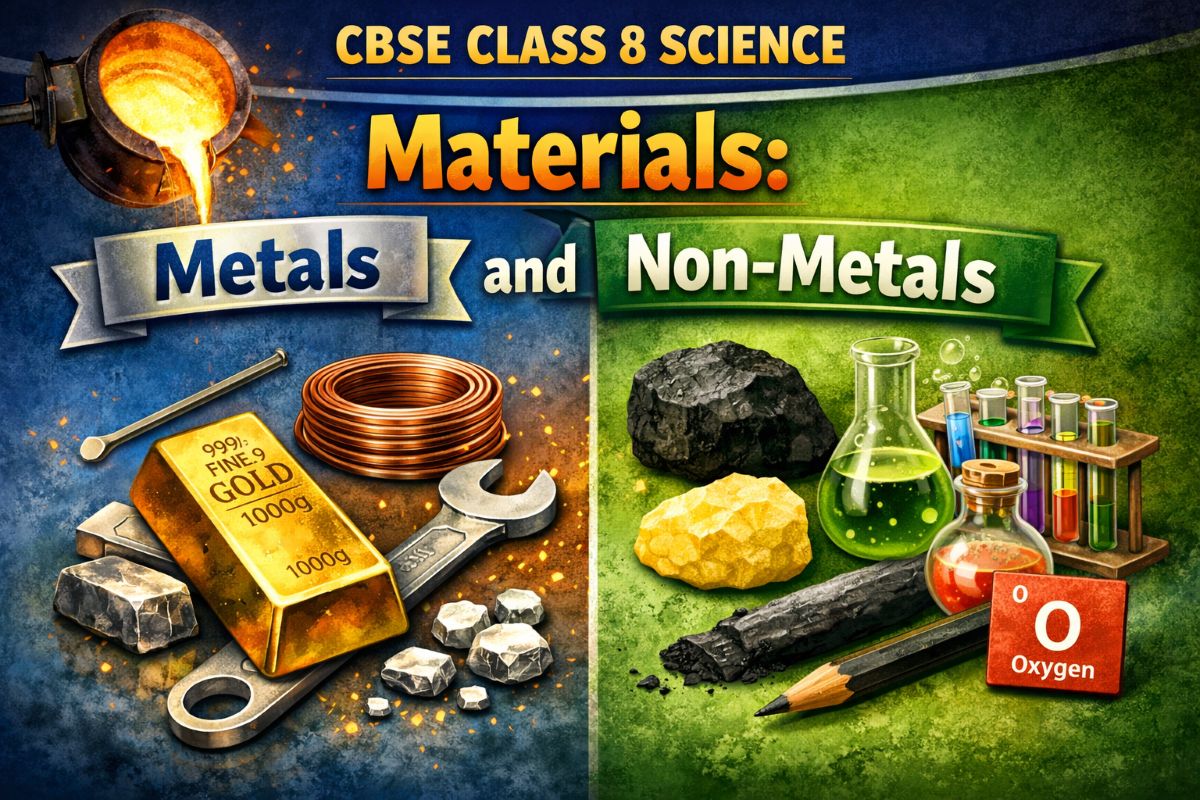
CBSE Class 8 Science Chapter Materials Metals and Non-Metals
CBSE Class 8 Science CHAPTER
⚗️ Materials Metals and Non-Metals
Complete Chapter Notes · Tables · Quick Revision · Quiz · Worksheets
📊 8 Tables
🎯 Quick Revision
❓ 15-Q Quiz
📝 5 Worksheets
📋 Table of Contents
- Introduction to Materials
- Physical Properties of Metals
- Metals vs Non-Metals — Big Comparison Table
- Chemical Properties of Metals
- Reactivity Series
- Physical & Chemical Properties of Non-Metals
- Uses of Metals & Non-Metals
- Corrosion, Prevention & Alloys
- ⚡ Quick Revision
- ❓ Quiz (15 MCQs with Answers)
- 📝 Worksheets (5 Types × 10 Questions)
Welcome to CBSE CLASS 8 SCIENCE Chapter Materials, Metals and Non-Metals,
📖 1. Introduction to Materials
All materials around us can be broadly classified into two major categories — Metals and Non-metals. This classification is based on their physical and chemical properties. Understanding these properties helps us explain why iron is used to make bridges, copper is used in electrical wires, and why graphite is used in pencils!
| Category | Examples | Common Uses |
|---|---|---|
| 🔩 Metals | Iron, Copper, Gold, Silver, Aluminium, Zinc | Bridges, wires, jewellery, utensils |
| 🧪 Non-metals | Carbon, Sulphur, Oxygen, Nitrogen, Phosphorus | Pencils, matches, breathing, fertilisers |
| ⚡ Metalloids | Silicon, Germanium, Arsenic | Semiconductors, electronics |
⚙️ 2. Physical Properties of Metals
✨ 2.1 Lustre (Shine)
- 🔆Metals have a shiny surface called metallic lustre.
- 🔆Freshly cut metals reflect light and appear bright.
- 🔆Examples: Gold, Silver, Copper, Aluminium all appear shiny.
🔨 2.2 Malleability
- 🟢Gold and Silver are the most malleable metals.
- 🟢Gold can be beaten into extremely thin sheets called gold leaf.
- 🟢Aluminium foil used in kitchens demonstrates malleability.
- 🔴Non-metals are NOT malleable — they break into pieces when hammered (brittle).
🧵 2.3 Ductility
- 🟣Gold is the most ductile — 1g of gold can be drawn into 2 km of wire!
- 🟣Electrical wires are made of copper due to its high ductility and conductivity.
⚡ 2.4 Conductivity
- 🟠Heat: Metals are good conductors of heat. Silver is the best thermal conductor.
- 🟠Electricity: Silver > Copper > Gold > Aluminium (order of electrical conductivity).
- 🟠Copper and Aluminium wires are used in homes & power lines.
🔊 2.5 Sonority
- 🔵Metals produce a ringing sound when struck — this property is called sonority.
- 🔵School bells, temple bells, tuning forks — all made of metals.
🌡️ 2.6 High Melting & Boiling Points
- 🔴Tungsten (W) has the highest melting point (3422°C) — used in bulb filaments.
- 🔴Gallium melts in your hand at 29.76°C — a cool exception!
- 🔴Mercury has the lowest melting point among metals (−38.83°C).
📊 3. Metals vs Non-Metals — Complete Comparison
| Property | 🔩 Metals | 🧪 Non-Metals | ⚠️ Exceptions |
|---|---|---|---|
| Lustre | Shiny | Dull | Iodine Graphite is shiny |
| Hardness | Hard | Soft/Brittle | Na, K are soft metals |
| Physical State | Solid (mostly) | Solid/Gas/Liquid | Mercury = liquid metal; Bromine = liquid non-metal |
| Malleability | ✅ Malleable | ❌ Brittle | No exception |
| Ductility | ✅ Ductile | ❌ Not ductile | No common exception |
| Heat Conductivity | ✅ Good | ❌ Poor | Graphite conducts heat |
| Electrical Conductivity | ✅ Good | ❌ Poor | Graphite conducts electricity |
| Sonority | ✅ Sonorous | ❌ Non-sonorous | — |
| Melting Point | High | Generally low | Gallium & Cs have low MP |
| Density | High | Low | Li, Na, and K float on water |
| Oxide Nature | Basic oxides | Acidic oxides | CO and NO are neutral |
⚗️ 4. Chemical Properties of Metals
🔥 4.1 Reaction with Oxygen
- 🔴4Na + O₂ → 2Na₂O — Sodium oxide (stored in kerosene to prevent reaction)
- 🔴2Mg + O₂ → 2MgO — Burns with a bright white dazzling flame
- 🔴4Fe + 3O₂ + 6H₂O → 4Fe(OH)₃ — Rusting of Iron
- 🟢Gold and Silver do NOT react with oxygen — they remain shiny for years!
💧 4.2 Reaction with Water
| Metal | Equation | Observations |
|---|---|---|
| Potassium (K) | 2K + 2H₂O → 2KOH + H₂↑ | ⚡ Most violent reaction, sparks |
| Sodium (Na) | 2Na + 2H₂O → 2NaOH + H₂↑ | ⚡ Reacts very violently, catches fire |
| Calcium (Ca) | Ca + 2H₂O → Ca(OH)₂ + H₂↑ | Bubbles, less violent |
| Magnesium (Mg) | Mg + 2H₂O → Mg(OH)₂ + H₂↑ | Only with hot water/steam |
| Iron (Fe) | 3Fe + 4H₂O → Fe₃O₄ + 4H₂↑ | Only with steam |
| Copper (Cu) | No reaction | ❌ Does not react with water |
| Gold / Silver | No reaction | ❌ Noble metals — completely inert |
🧪 4.3 Reaction with Acids
- 🟣Zn + H₂SO₄ → ZnSO₄ + H₂↑
- 🟣Fe + 2HCl → FeCl₂ + H₂↑
- 🟣Mg + 2HCl → MgCl₂ + H₂↑ (reacts vigorously)
- 🔴Copper does NOT react with dilute HCl or H₂SO₄.
- 🔴Gold & Platinum dissolve only in Aqua Regia (3:1 mix of HCl + HNO₃).
🏆 5. Reactivity Series of Metals
| Rank | Metal | Symbol | Reactivity |
|---|---|---|---|
| 1 | Potassium | K | ⚡⚡⚡ Most Reactive |
| 2 | Sodium | Na | ⚡⚡⚡ Very Reactive |
| 3 | Calcium | Ca | ⚡⚡ Highly Reactive |
| 4 | Magnesium | Mg | ⚡⚡ Highly Reactive |
| 5 | Aluminium | Al | ⚡ Moderately Reactive |
| 6 | Zinc | Zn | ⚡ Moderately Reactive |
| 7 | Iron | Fe | ⚡ Moderately Reactive |
| 8 | Lead | Pb | 💧 Less Reactive |
| 9 | Copper | Cu | 💧 Less Reactive |
| 10 | Mercury | Hg | 😴 Very Low |
| 11 | Silver | Ag | 😴 Very Low |
| 12 | Gold | Au | 😴 Least Reactive (Noble) |
“Please Stop Calling Me A Zebra Instead, Let Copper Hear Good Sense”
→ K, Na, Ca, Mg, Al, Zn, Fe, Pb, Cu, Hg, Ag, Au
🔄 5.1 Displacement Reactions
- 🔵Fe + CuSO₄ → FeSO₄ + Cu — Iron displaces Copper (blue colour fades; nail turns brown)
- 🔵Zn + CuSO₄ → ZnSO₄ + Cu — Zinc displaces Copper
- 🔴Cu + ZnSO₄ → No reaction — Copper is less reactive than Zinc
🧪 6. Properties of Non-Metals
- 🟣Non-metals exist in all three states: Solid, Liquid, Gas
- 🟣Solid: Carbon (C), Sulphur (S), Phosphorus (P), Iodine (I)
- 🟣Liquid: Bromine (Br₂) — reddish-brown liquid
- 🟣Gaseous: Oxygen (O₂), Nitrogen (N₂), Hydrogen (H₂), Chlorine (Cl₂)
🔥 Chemical Reactions of Non-Metals
- 🔴C + O₂ → CO₂ (Carbon dioxide — acidic oxide)
- 🔴S + O₂ → SO₂ (Sulphur dioxide — acidic oxide, causes acid rain)
- 🟢H₂ + Cl₂ → 2HCl (Hydrogen Chloride)
- 🟢N₂ + 3H₂ → 2NH₃ (Ammonia — used in fertilisers)
🏭 7. Uses of Metals & Non-Metals
🔩 Important Metals & Their Uses
| Metal | Key Property | Main Uses |
|---|---|---|
| Iron (Fe) | Hard, Strong, Magnetic | Buildings, bridges, ships, vehicles |
| Copper (Cu) | Ductile, conducts electricity | Electrical wires, cables, coins |
| Aluminium (Al) | Light, Malleable, Corrosion-resistant | Aircraft, foil, cans, kitchen utensils |
| Gold (Au) | Lustrous, Non-reactive | Jewellery, electronics, dentistry |
| Mercury (Hg) | Liquid metal expands uniformly | Thermometers, barometers |
| Zinc (Zn) | Corrosion-resistant | Galvanising iron, dry cells, and paints |
| Tungsten (W) | Highest melting point | Electric bulb filaments, cutting tools |
| Silver (Ag) | Best conductor, lustrous | Jewellery, mirrors, photography |
🧪 Important Non-Metals & Their Uses
| Non-Metal | Key Property | Main Uses |
|---|---|---|
| Oxygen (O₂) | Supports life, combustion | Hospitals, welding, rockets, breathing |
| Nitrogen (N₂) | Inert, abundant in air | Fertilisers, fire extinguishers, and food packaging |
| Carbon (C) | Multiple allotropes | Pencils (graphite), jewellery (diamond), fuel (coal) |
| Sulphur (S) | Reactive | Medicines, fertilisers, gunpowder, and rubber vulcanisation |
| Chlorine (Cl₂) | Disinfectant | Water purification, PVC plastics, antiseptics |
| Iodine (I₂) | Antiseptic | Tincture iodine, thyroid medicine |
| Silicon (Si) | Semiconductor | Computer chips, solar cells, glass |
| Phosphorus (P) | Reactive | Matches, fertilisers, detergents |
🦺 8. Corrosion, Prevention & Alloys
- 🔴Rusting: 4Fe + 3O₂ + 6H₂O → 4Fe(OH)₃ → Fe₂O₃.xH₂O (Hydrated iron oxide)
- 🔴Silver tarnish: 2Ag + H₂S → Ag₂S + H₂ (turns black)
- 🔴Copper verdigris: Green coating of basic copper carbonate forms
🛡️ Methods of Preventing Corrosion
- 🟢Painting: Applied to iron gates and bridges to prevent contact with air/moisture.
- 🟢 Galvanising: Coating iron with zinc (Zn). Used in water pipes and roofing sheets.
- 🟢Electroplating: Depositing chromium, nickel, or silver onto metals via electrolysis.
- 🟢Alloying: Making corrosion-resistant mixtures (e.g., Stainless Steel = Fe + Cr + Ni).
- 🟢Oiling & Greasing: Applied to machine parts and tools.
⚗️ Important Alloys
| Alloy | Composition | Properties | Uses |
|---|---|---|---|
| Steel | Fe + C (0.1–2%) | Strong, hard | Buildings, vehicles, tools |
| Stainless Steel | Fe + Cr + Ni | Rust-resistant, shiny | Kitchen utensils, surgical instruments |
| Bronze | Cu + Sn | Hard, corrosion-resistant | Coins, statues, bells, medals |
| Brass | Cu + Zn | Hard, gold-coloured | Musical instruments, taps, hinges |
| Solder | Pb + Sn (1:1) | Low melting point | Joining electrical components |
| Duralumin | Al + Cu + Mg + Mn | Light, strong | Aircraft, spacecraft parts |
⚡ 9. QUICK REVISION — Key Points
🔩 METALS at a Glance
✅ Lustrous (shiny)
✅ Hard (mostly)
✅ Malleable
✅ Ductile
✅ Sonorous
✅ Good conductors of heat & electricity
✅ High melting & boiling points
✅ High density
✅ Form basic oxides
🧪 NON-METALS at a Glance
❌ Dull (mostly)
❌ Brittle
❌ Non-malleable
❌ Non-ductile
❌ Non-sonorous
❌ Poor conductors (insulators)
❌ Low melting & boiling points
❌ Low density
❌ Form acidic oxides
🔑 Key Exceptions — Must Remember!
| Exception | Fact |
|---|---|
| Na & K are soft metals | Can be cut with a knife — unlike most metals |
| Mercury is a liquid metal | Only metal liquid at room temperature |
| Graphite conducts electricity | Non-metal yet conducts — used as an electrode |
| Diamond is the hardest substance | Non-metal (allotrope of C), yet extremely hard |
| Iodine has a metallic lustre | Non-metal but appears shiny |
| Gallium melts in your hand | Metal with a very low melting point (29.76°C) |
| Li, Na, and K float on water | Metals with a density less than that of water |
| Bromine is a liquid non-metal | Only non-metal liquid at room temperature |
| Tungsten has the highest MP | 3422°C — used in bulb filaments |
❓ 10. Quiz — 15 Multiple Choice Questions
📝 Try answering before revealing the answer!
Q1. Which of the following is the most malleable metal?
A) Iron B) Gold C) Copper D) Zinc
Q2. The property by which metals can be drawn into thin wires is called:
A) Malleability B) Sonority C) Ductility D) Conductivity
Q3. Which metal is liquid at room temperature?
A) Gallium B) Mercury C) Caesium D) Sodium
Q4. Which non-metal is a good conductor of electricity?
A) Sulphur B) Phosphorus C) Diamond D) Graphite
Q5. When an iron nail is dipped in a copper sulphate solution:
A) Solution turns more blue. B) Iron nail disappears. C) Blue colour fades, and nail turns brown. D) No change
Q6. Which gas is produced when zinc reacts with dilute sulphuric acid?
A) Oxygen B) CO₂ C) Hydrogen D) SO₂
Q7. The alloy of copper and zinc is called:
A) Bronze B) Brass C) Solder D) Duralumin
Q8. Which method of preventing corrosion involves coating iron with zinc?
A) Painting B) Electroplating C) Galvanising D) Alloying
Q9. Non-metals generally form which type of oxides?
A) Basic oxides B) Neutral oxides C) Acidic oxides D) Amphoteric oxides
Q10. Which of the following metals can float on water?
A) Iron B) Copper C) Sodium D) Zinc
Q11. What is the hardest natural substance?
A) Iron B) Graphite C) Quartz D) Diamond
Q12. Which metal has the highest melting point?
A) Iron B) Gold C) Tungsten D) Platinum
Q13. The rusting of iron is an example of:
A) Displacement reaction B) Corrosion C) Alloying D) Reduction
Q14. Which metal is stored in kerosene oil?
A) Gold B) Iron C) Sodium D) Copper
Q15. Which of the following is NOT a metal?
A) Calcium B) Magnesium C) Phosphorus D) Aluminium
📝 11. Worksheets (5 Types × 10 Questions Each)
📋 Worksheet 1: Fill in the Blanks
Instructions: Fill in the blanks with the correct word/term.
- The ability of metals to be beaten into thin sheets is called ___________.Ans: Malleability
- ___________ is the only metal that is liquid at room temperature.Ans: Mercury (Hg)
- Non-metals form ___________ oxides when they react with oxygen.Ans: Acidic
- The process of coating iron with zinc to prevent rusting is called ___________.Ans: Galvanization
- Graphite is a good conductor of ___________, making it an exception among non-metals.Ans: Electricity
- The alloy made of copper and tin is called ___________.Ans: Bronze
- The most reactive metal in the reactivity series is ___________.Ans: Potassium (K)
- ___________ is the hardest known natural substance.Ans: Diamond
- When a burning splint is placed near hydrogen gas, it produces a ___________ sound.Ans: Pop
- Metals that can be soft and cut with a knife are ___________ and ___________.Ans: Sodium (Na) and Potassium (K)
✅ Worksheet 2: True or False
Instructions: Write True or False for each statement.
- All metals are solid at room temperature.❌ False — Mercury is liquid at room temperature.
- Non-metals are generally good conductors of heat and electricity.❌ False — Non-metals are poor conductors. Exception: Graphite.
- Gold is placed at the bottom (least reactive) of the reactivity series.✅ True — Gold (Au) is one of the least reactive metals.
- Iron reacts vigorously with cold water.❌ False — Iron only reacts with steam, not cold or hot water.
- Brass is an alloy of copper and tin.❌ False — Brass = Cu + Zn. Bronze = Cu + Sn.
- Malleability and ductility are properties of metals only.✅ True — Non-metals are brittle and do not show these properties.
- Carbon dioxide (CO₂) is a basic oxide.❌ False — CO₂ is an acidic oxide (non-metal oxide).
- Silver is the best conductor of electricity among all metals.✅ True — Silver > Copper > Gold in electrical conductivity.
- Corrosion can be prevented by painting the surface of metals.✅ True — Paint forms a protective layer preventing contact with air and moisture.
- A less reactive metal can displace a more reactive metal from its salt solution.❌ False — Only a MORE reactive metal can displace a LESS reactive metal.
📖 Worksheet 3: Short Answer Questions
Instructions: Answer each question in 2–3 sentences.
- What is malleability? Give one example.Ans: Malleability is the property of metals by which they can be beaten into thin sheets without breaking. Gold is the most malleable metal — it can be beaten into ultra-thin gold leaf used in decorations and food.
- Why is copper used for making electrical wires?Ans: Copper is highly ductile (can be drawn into thin wires) and is an excellent conductor of electricity. It is also affordable and abundant, making it ideal for electrical wiring in homes and industries.
- What happens when sodium is placed in water? Write the equation.Ans: Sodium reacts very vigorously with cold water, releasing hydrogen gas and forming sodium hydroxide. The reaction: 2Na + 2H₂O → 2NaOH + H₂↑. The hydrogen gas may catch fire.
- Differentiate between malleability and ductility.Ans: Malleability is the property by which a metal can be beaten into thin sheets (e.g., gold leaf). Ductility is the property by which a metal can be drawn into thin wires (e.g., copper wire). Both are exclusive physical properties of metals.
- What is a displacement reaction? Give one example.Ans: A displacement reaction occurs when a more reactive metal displaces a less reactive metal from its salt solution. Example: Fe + CuSO₄ → FeSO₄ + Cu. Iron displaces copper — the blue colour fades and a brown copper deposit forms.
- Why does the blue colour of copper sulphate solution fade when an iron nail is placed in it?Ans: Iron is more reactive than copper and displaces it from the solution. The blue Cu²⁺ ions are replaced by Fe²⁺ ions (pale green), and copper metal deposits on the iron nail, making it turn brown.
- Name two alloys and their compositions.Ans: (1) Brass: Cu + Zn, used in musical instruments and taps. (2) Stainless Steel: Fe + Cr + Ni, used in kitchen utensils and surgical instruments.
- What is corrosion? How does it affect metals?Ans: Corrosion is the gradual deterioration of metals through chemical reactions with air, moisture, or chemicals. For example, iron forms rust (Fe₂O₃.xH₂O) and copper forms a green coating (verdigris). Corrosion weakens metals and reduces their lifespan.
- Explain why non-metals are generally not used to make cooking utensils.Ans: Cooking utensils need to conduct heat efficiently and withstand high temperatures. Non-metals are poor conductors of heat and are generally brittle or gaseous. Metals like aluminium and stainless steel are preferred for their heat conductivity, malleability, and durability.
- What is the reactivity series? Why is it important?Ans: The reactivity series arranges metals in decreasing order of reactivity (K > Na > Ca > Mg > Al > Zn > Fe > Pb > Cu > Hg > Ag > Au). It helps predict displacement reactions, metal-acid reactions, and guides selection of metals for specific industrial uses.
🔗 Worksheet 4: Match the Following
Instructions: Match Column A with the correct option from Column B.
| Column A | Column B |
|---|---|
| 1. Galvanisation | a. Hardest natural substance |
| 2. Ductility | b. Cu + Zn alloy |
| 3. Diamond | c. Coating iron with zinc |
| 4. Brass | d. Drawing metal into wires |
| 5. Mercury | e. Used in thermometers |
| 6. Rusting | f. Sodium reacts violently with it |
| 7. Graphite | g. Hydrated iron oxide |
| 8. Water | h. Liquid metal at room temperature |
| 9. Tungsten | i. Conducts electricity (non-metal) |
| 10. Aqua Regia | j. Dissolves gold and platinum |
🤔 Worksheet 5: Give Reasons
Instructions: Explain the reason for each observation in 2–3 sentences.
- Sodium is stored in kerosene oil.Reason: Sodium is extremely reactive and reacts vigorously with oxygen and moisture in air. Kerosene oil does not react with sodium, so storing it in kerosene prevents unwanted reactions and ensures safety.
- Gold and silver are used to make jewellery.Reason: Gold and silver are lustrous, highly malleable (can be shaped into intricate designs), non-reactive (don’t tarnish), and durable — making them ideal for jewellery.
- Electrical wires are made of copper but covered with PVC plastic.Reason: Copper is an excellent conductor of electricity. PVC (polyvinyl chloride) is a poor conductor (insulator) that prevents electric shocks and short circuits when people handle the wires.
- Iron articles are painted before use.Reason: Iron reacts with oxygen and moisture to form rust, which weakens the metal. Paint forms a protective barrier that prevents iron from coming in contact with air and water, thus preventing corrosion.
- Cooking utensil bodies are metal but handles are plastic or wood.Reason: Metals conduct heat well, making them ideal for the cooking surface. Plastic and wood are poor conductors (insulators) of heat, so they are used for handles to prevent burns.
- Non-metals cannot be beaten into sheets.Reason: Non-metals are brittle due to their covalent bonding structure. When force is applied, the layers shift and repel each other, causing the material to shatter rather than deform.
- Copper vessel turns green on long exposure to air.Reason: Copper reacts slowly with oxygen, CO₂, and moisture in air to form a green coating of basic copper carbonate (verdigris): 2Cu + H₂O + CO₂ + O₂ → Cu(OH)₂.CuCO₃. This is a form of corrosion.
- Aluminium is preferred over iron for making aircraft.Reason: Aluminium is much lighter than iron (low density), strong, malleable, and corrosion-resistant due to a natural oxide layer. Light weight and strength are critical for aircraft performance and fuel efficiency.
- Metals are generally sonorous.Reason: Metals have tightly packed atoms in a regular lattice. When struck, energy travels as vibrations through this lattice, producing a ringing/bell-like sound (sonority). School bells and tuning forks use this property.
- Carbon dioxide is called an acidic oxide.Reason: CO₂ reacts with water to form carbonic acid: CO₂ + H₂O → H₂CO₃. Since the product is acidic, CO₂ is called an acidic oxide. Non-metal oxides generally form acidic solutions with water.
🌟 Chapter Summary
Metals
Lustrous · Malleable · Ductile · Sonorous · Conductors · High MP · Basic Oxides
Non-Metals
Brittle · Non-ductile · Insulators · Low density · Acidic Oxides
Reactivity Order
K > Na > Ca > Mg > Al > Zn > Fe > Pb > Cu > Hg > Ag > Au
Corrosion Prevention
Painting · Galvanizing · Electroplating · Alloying · Oiling
CBSE Class 8 Science | Chapter: Materials — Metals & Non-Metals