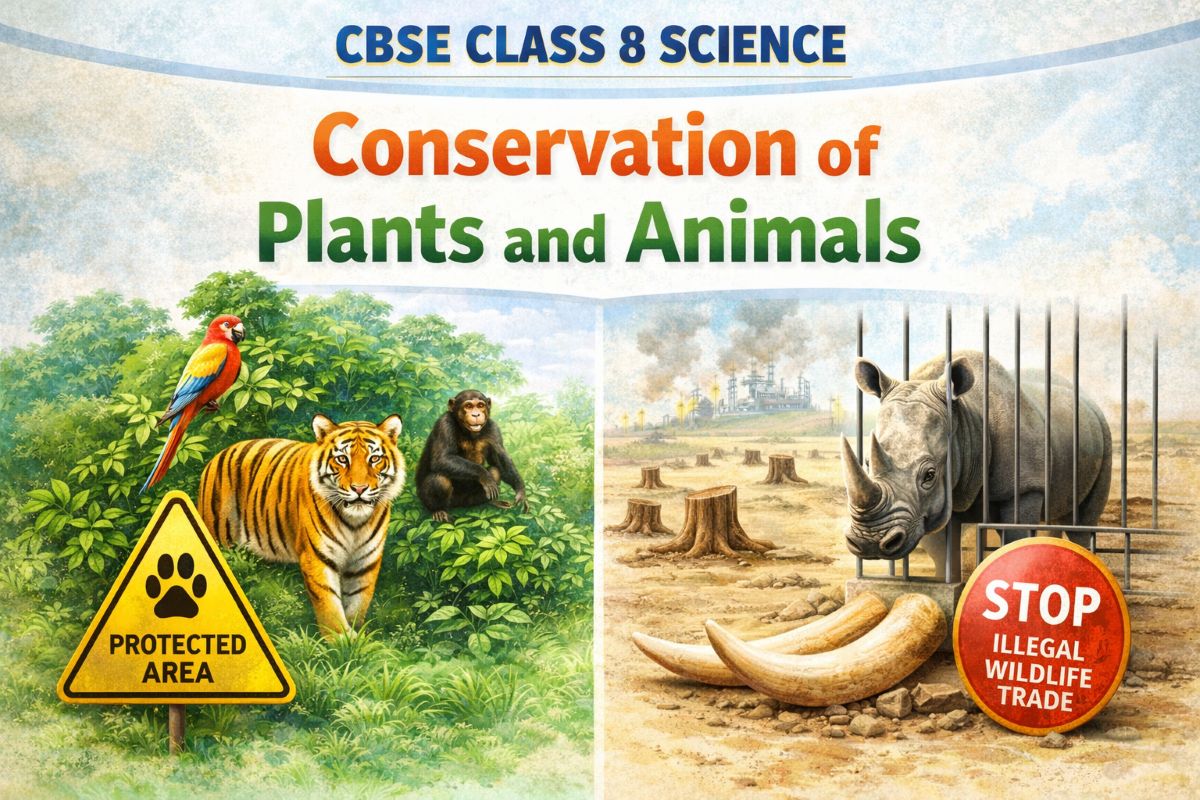
CBSE Class 8 Science Chapter Conservation of Plants and Animals
🌿🌍 CBSE Class 8 Science Chapter Conservation of Plants and Animals 🌳🦁
Welcome to CBSE Class 8 Science Chapter Conservation of Plants and Animals,
🎯 Chapter Learning Objectives
you will confidently understand:
🔬 Biodiversity, ecosystems, and why they matter
🪵 Deforestation – causes, consequences, and solutions
🌿 Flora, fauna, endemic species, Red Data Book (definitions + examples)
🛡️ Wildlife sanctuaries, national parks, biosphere reserves (comparison table)
♻️ Reforestation, afforestation, paper recycling (practical solutions)
✏️ 50+ exam questions – MCQs, short answers, long answers with detailed solutions
🌿 1. What is Conservation of Plants & Animals?
Conservation means protecting and wisely using plants, animals, forests, and natural resources so future generations can enjoy them too.
Earth’s biodiversity includes 8.7 million species – plants, animals, insects, birds, fish, and microbes living together in ecosystems (forests, rivers, deserts, oceans).
Why conserve?
🌬️ Trees give oxygen and clean air
💧 Forests store water and prevent floods
🦋 Animals control pests and pollinate crops
🌍 Healthy ecosystems = stable climate
Example: If bees disappear (due to pesticides), crops won’t grow → food crisis worldwide.
🪵 2. Deforestation – The Silent Killer (Most Important Topic)
Deforestation = large-scale cutting/removal of forests, converting forest land into farms, cities, or barren land.
📊 Causes of Deforestation
| Cause | Detailed Explanation | Real Example | % Contribution |
|---|---|---|---|
| 🌾 Agriculture | Forests cleared for crops (rice, wheat, soy). Slash-and-burn common. | Amazon rainforest → soybean farms | 50% |
| 🏗️ Infrastructure | Roads, dams, cities, and industries were built on forest land. | Narmada dam → tribal forest loss | 20% |
| 🪵 Commercial Logging | Timber for furniture, paper, and construction. | Sundarbans → illegal timber mafia | 15% |
| 🔥 Fuelwood | Villages use wood for cooking/heating daily. | Rural India → 200 million tons/year | 10% |
| ⛏️ Mining | Coal, iron ore, and bauxite extraction destroy forests. | Goa → iron ore mining disaster | 5% |
🌡️ Global Warming – Trees absorb CO₂. Fewer trees = more CO₂ → temperature rise
🌧️ Rainfall Reduction – Trees release water vapor → less rain, droughts
🏜️ Soil Erosion – Roots hold soil → landslides, desertification
🦁 Habitat Loss – Animals lose homes → extinction risk
🌊 Floods – No trees = fast water flow → river flooding
💧 Water Crisis – Forests recharge groundwater → dry wells
🩺 Less Medicine – 25% drugs from plants → future health crisis
💸 Economic Loss – Tourism, timber industries collapse
Real Data: India lost 2.33 million hectares of forest (1990-2020). Amazon loses 11% of its rainforest every decade!
🌿 3. Important Terms
| Term | Meaning | Example |
|---|---|---|
| Flora | All plants in a region | Flora of Western Ghats = 7,500+ plants |
| Fauna | All animals in a region | Fauna of India = tiger, elephant, peacock |
| Endemic Species | Found ONLY in one area | Lion-tailed macaque → Western Ghats only |
| Endangered | At risk of extinction | Tiger (1,400 left in the wild) |
| Extinct | Completely gone | Dodo bird, passenger pigeon |
| Vulnerable | Likely to become endangered | Indian elephant |
| Red Data Book | List of endangered species | Published by IUCN |
Memory Trick: “FRED” – Flora, Red Data Book, Endemic, Deforestation!
🛡️ 4. Protected Areas
| Feature | Wildlife Sanctuary | National Park | Biosphere Reserve |
|---|---|---|---|
| Main Focus | Animals mainly | Flora + Fauna | Entire ecosystem |
| Human Activity | Tourism allowed | Strictly limited | 3 zones (living, buffer, transition) |
| Example | Gir Lion Sanctuary | Kaziranga NP (rhino) | Sundarbans (tiger+mangrove) |
| Size | Medium | Large | Very Large |
| Purpose | Protect specific animals | Complete protection | Biodiversity + human life |
India has:
🌿 89 National Parks
🦁 492 Wildlife Sanctuaries
🌍 18 Biosphere Reserves
Famous Examples:
Jim Corbett → Tigers
Ranthambore → Tigers
Periyar → Elephants
Manas → Golden langur (endemic)
♻️ 5. Solutions to Save Forests
🌱 Reforestation vs Afforestation
| Term | Meaning | Example |
|---|---|---|
| Reforestation | Replant where forests were cut | Replace teak forests in Madhya Pradesh |
| Afforestation | Plant trees where NO forest existed | Plant mangroves on the Gujarat coast |
Collect old newspapers, notebooks
Sort by quality (white, colored)
Shred into pulp with water
Clean chemicals to remove ink
Press into thin sheets
Dry → new paper ready!
Benefits: 1 tree = 40,000 pages → Recycling saves 17 trees per ton!
⚡ Quick Revision (25 One-Line Points – Exam Ready)
Conservation = protecting plants, animals, and ecosystems
Biodiversity = variety of life forms in an area
Deforestation = large-scale forest removal
5 main causes: agriculture, logging, infrastructure, fuelwood, mining
Global warming due to excess CO₂ from deforestation
Flora = plants of a region
Fauna = animals of a region
Endemic = species found only in one place
Red Data Book = endangered species list
Wildlife sanctuary → mainly animals, tourism allowed
National park → flora+fauna, strict protection
Biosphere reserve → biodiversity + human life balance
Reforestation = replanting cut forests
Afforestation = planting trees on barren land
Paper recycling saves 17 trees per ton
Gir Forest → Asiatic lions
Kaziranga → one-horned rhino
Sundarbans → Royal Bengal tiger
Soil erosion major deforestation effect
Floods + droughts due to deforestation
Van Mahotsav = tree planting festival
Western Ghats = biodiversity hotspot
IUCN publishes Red Data Book
The Wildlife Protection Act 1972 protects animals
Every tree counts – plant today! 🌳
📝 WORKSHEET (50 Questions with Answers)
🟦 Part A: MCQs (10 Questions)
A1. Large-scale removal of forest is called:
a) Afforestation b) Deforestation c) Reforestation d) Conservation
✅ Answer: b) Deforestation
A2. Plants of a particular region are called:
a) Fauna b) Flora c) Species d) Endemic
✅ Answer: b) Flora
A3. Which is NOT a cause of deforestation?
a) Agriculture b) Mining c) Paper recycling d) Logging
✅ Answer: c) Paper recycling
A4. Red Data Book records:
a) All animals b) Endangered species c) Forests d) Plants only
✅ Answer: b) Endangered species
A5. National Parks protect:
a) Both flora+fauna b) Only animals c) Only plants d) Humans
✅ Answer: a) Both flora+fauna
A6. Ranthambore is famous for:
a) Lions b) Rhinos c) Tigers d) Elephants
✅ Answer: c) Tigers
A7. Planting trees on barren land =
a) Reforestation b) Afforestation c) Deforestation d) Conservation
✅ Answer: b) Afforestation
A8. Which is endemic to the Western Ghats?
a) Tiger b) Lion-tailed macaque c) Elephant d) Peacock
✅ Answer: b) Lion-tailed macaque
A9. Wildlife corridor connects:
a) Two forests b) Cities c) Rivers d) Farms
✅ Answer: a) Two forests
A10. 1 ton of paper recycling saves:
a) 5 trees b) 10 trees c) 17 trees d) 50 trees
✅ Answer: c) 17 trees
🟨 Part B: Fill in Blanks (10 Questions)
B1. Variety of plants and animals in an area is called ______
✅ Answer: biodiversity
B2. Large scale cutting of trees is ______
✅ Answer: deforestation
B3. Animals of a region are called _____
✅ Answer: fauna
B4. _____ are found only in one particular area.
✅ Answer: Endemic species
B5. ______contains list of endangered species.
✅ Answer: Red Data Book
B6. ______National Park is famous for the one-horned rhinoceros.
✅ Answer: Kaziranga
B7. Planting trees where forest existed before is _______
✅ Answer: reforestation
B8. ______is a major consequence of deforestation.
✅ Answer: Soil erosion
B9. ______ is tree planting festival in July.
✅ Answer: Van Mahotsav
B10. ______publishes Red Data Book.
✅ Answer: IUCN
🟥 Part C: True/False (10 Questions)
C1. Agriculture is the main cause of deforestation. ✅ True
C2. Wildlife sanctuaries allow tourism. ✅ True
C3. National Parks protect only animals. ✅ False (flora+fauna)
C4. Endemic species are found everywhere. ✅ False (one place only)
C5. Paper recycling saves trees. ✅ True
C6. Reforestation = planting barren land. ✅ False (existing forest land)
C7. The Red Data Book lists all animals. ✅ False (endangered only)
C8. Floods are caused by deforestation. ✅ True
C9. Biosphere reserves have no human activity. ✅ False (3 zones)
C10. Gir Forest protects Asiatic lions. ✅ True
🟩 Part D: Short Answers (10 Questions)
D1. Define biodiversity.
✅ Answer: A variety of different species of plants, animals, and microorganisms living in a particular area.
D2. Name 3 causes of deforestation.
✅ Answer: Agriculture, logging, and infrastructure development.
D3. What is the Red Data Book?
✅ Answer: Book containing a list of endangered plant and animal species.
D4. Differentiate flora and fauna.
✅ Answer: Flora = plants of region; Fauna = animals of region.
D5. What is an endemic species? Give an example.
✅ Answer: Species found only in one area. Ex: Lion-tailed macaque (Western Ghats).
D6. Why are national parks stricter than sanctuaries?
✅ Answer: Protect both flora+fauna with minimal human interference.
D7. Define reforestation.
✅ Answer: Restocking the destroyed forest by planting trees on the same land.
D8. 2 consequences of deforestation.
✅ Answer: Soil erosion, global warming (or floods, habitat loss).
D9. What is a biosphere reserve?
✅ Answer: Large area protecting biodiversity + allowing sustainable human activity.
D10. How does paper recycling help conservation?
✅ Answer: Reduces need to cut trees for paper production (1 ton = 17 trees saved).
🟧 Part E: Long Answers (5 Questions)
E1. Explain 5 causes and 5 consequences of deforestation.
✅ Answer:
Causes: 1) Agriculture – forests → crop fields; 2) Logging – timber industry; 3) Infrastructure – roads/dams/cities; 4) Fuelwood – cooking in villages; 5) Mining – minerals extraction.
Consequences: 1) Global warming (CO₂ increase); 2) Soil erosion (roots gone); 3) Floods (fast water flow); 4) Habitat loss (animals homeless); 5) Less rainfall (water cycle disturbed).
E2. Compare Wildlife Sanctuary, National Park, and Biosphere Reserve.
✅ Answer: (Use table from notes above – perfect 5-mark answer)
E3. What is biodiversity? Why conserve it?
✅ Answer: Biodiversity = variety of life forms. Conserve because: 1) Food chain balance; 2) Medicine from plants; 3) Clean air (photosynthesis); 4) Water cycle regulation; 5) Aesthetic/recreational value; 6) Economic benefits (tourism, timber).
E4. Explain reforestation, afforestation, and paper recycling with examples.
✅ Answer: Reforestation = replant cut forest (Teak in MP). Afforestation = barren land trees (mangroves, Gujarat). Paper recycling = old paper → new paper (saves 17 trees/ton).
E5. “Every student is environment protector.” Explain 5 ways.
✅ Answer: 1) Use both notebook sides; 2) Plant a tree yearly; 3) Avoid plastic; 4) Report tree cutting; 5) Join Van Mahotsav; 6) Save paper/electricity/water.