ABB System 800xA 7.0
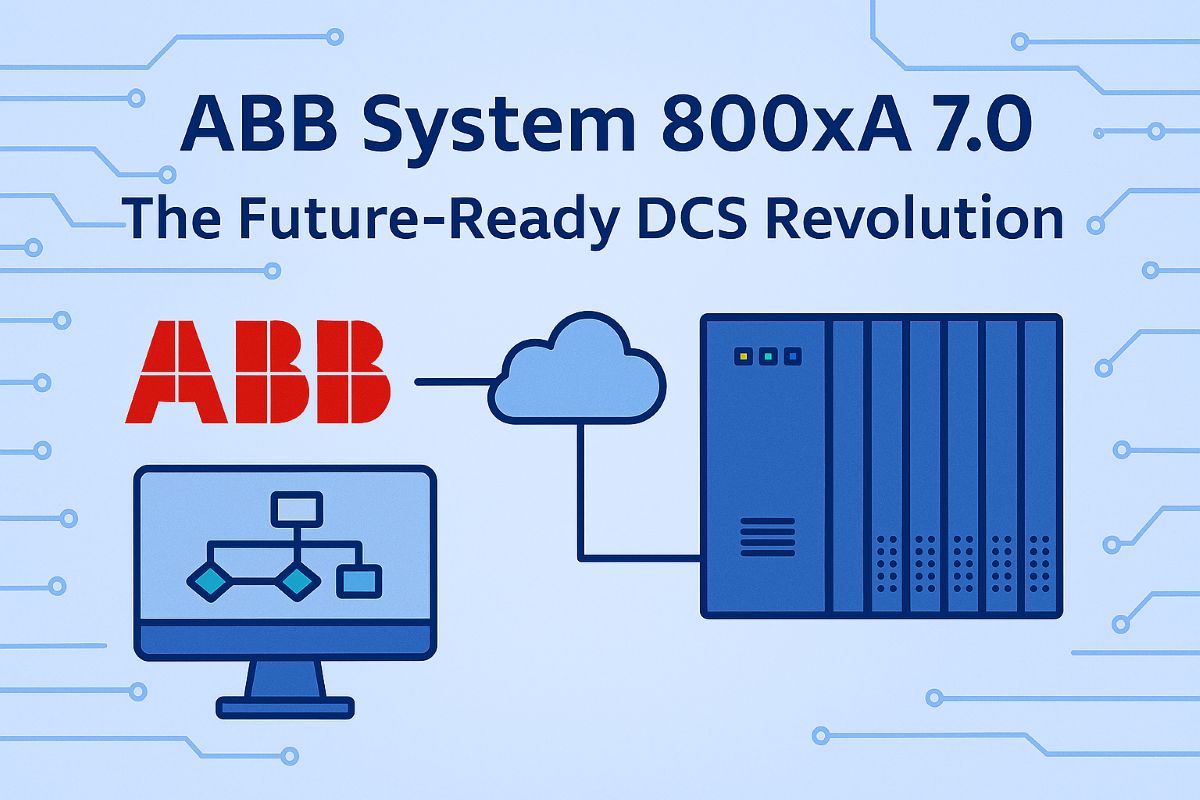
ABB System 800xA 7.0: The Future-Ready DCS Revolution 🚀
1. Introduction to ABB System 800xA 7.0 💡
What is System 800xA?
ABB Ability™ System 800xA is the world’s most scalable and integrated distributed control system (DCS), recognized as the No.1 DCS vendor by ARC Advisory Group. Unlike traditional control systems that handle only process automation, System 800xA unifies process control, electrical power management, safety systems, telecommunications, and even video surveillance into a single, seamless platform. This convergence eliminates the need for multiple standalone systems, reducing engineering complexity, operator training requirements, and lifecycle costs while boosting operational efficiency.
The system uses ABB’s patented Aspect Object technology to create a truly collaborative automation environment where all domains—DCS, PLC, safety instrumented systems (SIS), electrical SCADA, batch management—share common operator workplaces, engineering tools, and asset management databases. Operators can monitor a boiler’s electrical performance, process safety interlocks, and production quality metrics from the same screen, with context-sensitive navigation that streamlines troubleshooting and decision-making.
Why Version 7.0 is a Major Milestone 🎯
Launched in February 2026, System 800xA 7.0 represents a paradigm shift in how DCS platforms evolve. As the first Long-Term Support (LTS) release under ABB’s groundbreaking Automation Extended program, version 7.0 introduces a “separation of concerns” architecture that fundamentally changes the modernization game.
Here’s what makes 7.0 revolutionary:
🔹 Automation Extended Program
This is ABB’s vision realized—enabling stepwise digital transformation without touching the mission-critical control layer. The architecture separates deterministic real-time control (which must remain ultra-reliable) from optimization layers like AI analytics, advanced monitoring, and cloud connectivity. Think of it as containerized technology: you can deploy performance monitoring dashboards, predictive maintenance algorithms, or machine learning models in the upper layers while your core PID loops, safety logic, and interlocks continue operating with zero disruption.
🔹 Extension Packs for Non-Disruptive Innovation
Instead of forcing customers into risky, all-or-nothing system upgrades every few years, Extension Packs allow you to adopt new capabilities on your existing base software version incrementally. Need advanced alarm analytics? Install the Alarm Management Extension Pack. Want AI-driven process optimization? Add the Analytics Extension Pack—without shutting down operations or revalidating your entire control strategy. For chemical plants managing continuous production like HF or sulphur conversion (topics familiar from your work), this eliminates the nightmare of planned outages for system upgrades.
🔹 Enhanced Cybersecurity & IT Integration
Version 7.0 expands OS support to Windows Server 2025/2022, adds advanced virtualization compatibility (VMware ESXi, Hyper-V), integrates Microsoft Defender for Endpoint, and supports Ethernet-APL (Advanced Physical Layer) for intrinsically safe fieldbuses. OPC UA connectivity enhancements allow secure, firewall-friendly enterprise integration—critical for ISO 27001 compliance and Industry 4.0 initiatives.
🔹 Long-Term Support Commitment
LTS provides a stable, predictable upgrade path with extended support lifecycles, reducing operational risk and long-term costs. Existing installations can migrate to 7.0 confident they won’t face forced upgrades for years, while new projects get a future-proof foundation.
Industries Where 800xA Dominates 🏭
System 800xA’s flexibility and scalability make it the control system of choice across diverse industries:
⚗️ Chemical & Petrochemical
From commodity chemicals to specialty polymers, 800xA handles complex batch recipes, continuous processes, and hazardous material controls. A major US chemical producer uses 800xA Performance Services to monitor system health automatically via ServicePort, ensuring product quality and regulatory compliance across an exceptionally wide chemical portfolio. The system’s tight integration with safety instrumented systems (SIS) and advanced control libraries (cascade, ratio, feedforward) optimizes yield while maintaining SIL-rated protection.
💊 Pharmaceutical & Life Sciences
Batch management capabilities with built-in ISA-88 compliance, electronic batch records (EBR), and 21 CFR Part 11 audit trails make 800xA ideal for GMP environments. Asset management tracks calibration schedules and equipment genealogy for validation purposes.
⚡ Power Generation & Distribution
IEC 61850 integration brings substations, switchgear, and intelligent electronic devices (IEDs) into the same control environment as boilers, turbines, and auxiliary systems. Mining operations use the Power Control Library to automate electrical infrastructure alongside ore processing. Singapore’s Marina Bay district cooling network—a massive water resource management system—runs entirely on 800xA.
🔩 Metals & Mining
From crushers and mills to smelters and refineries, 800xA integrates MES (Manufacturing Execution Systems), quality labs, and production tracking. Simulator systems allow operators to train on exact replicas of control rooms without risking production.
🛢️ Oil & Gas
Upstream production platforms, midstream pipeline networks, and downstream refineries leverage 800xA’s deterministic control, high-availability redundancy, and scalability across distributed sites. SCADA functionality and OPC UA enable remote monitoring across geographic regions.
2. System Architecture: The Four-Layer Foundation 🏗️
System 800xA’s architecture follows a classic layered design, but with unique integration capabilities that blur traditional boundaries.
2.1 Layered Architecture Overview 📊
🔧 Field Layer: The Physical World Interface
This is where automation meets reality—sensors, transmitters, actuators, motors, and final control elements like valves or dampers. Signals flow via:
Hardwired I/O: Traditional 4-20mA analog, 24VDC digital signals through marshalling cabinets to controller I/O cards.
Fieldbus Protocols: PROFIBUS DP/PA, FOUNDATION Fieldbus HSE/H1, Modbus RTU, DeviceNet, HART-over-analog, AS-i.
Industrial Ethernet: PROFINET IO, EtherNet/IP, IEC 61850 (for electrical), Ethernet-APL (new in 7.0) for hazardous area fieldbuses.
The field layer can extend hundreds of meters from control rooms using remote I/O systems like S900 (more on this below).
⚡ Control Layer: Deterministic Real-Time Processing
AC 800M controllers execute control logic—PID loops, interlocks, sequences, complex calculations—with deterministic scan times measured in milliseconds. Controllers communicate horizontally using ABB’s Manufacturing Message Specification (MMS) protocol over Ethernet, sharing process variables (e.g., reactor temperature from Controller A feeds ratio control on Controller B). Redundant communication channels ensure no single point of failure.
💻 Application/Server Layer: Visualization & Data Management
This layer hosts:
Operator Servers: Run the Workplace for Process Portal (HMI) delivering graphics, trends, faceplates to operator clients.
Aspect Servers: Manage the object-oriented database that defines all assets, control strategies, and system configuration.
History Servers: Collect and archive time-series data from controllers, with embedded collectors in redundant pairs.
Engineering Workstations: Control Builder for programming AC 800M, Graphics Builder for HMIs, Configuration tools.
Asset Management Servers: Condition monitoring, diagnostics, maintenance scheduling.
In version 7.0, Automation Extended environments run containerized apps here—think Docker-style deployments of AI analytics that pull historian data but never touch control loops.
🌐 Enterprise/IT Layer: Business System Integration
OPC UA servers (with firewall-friendly security) expose plant data to ERP systems (SAP), MES, LIMS, corporate historians, and cloud analytics platforms. ServicePort connects securely to ABB’s cloud for remote diagnostics and performance services. Version 7.0 enhances OPC UA with expanded information models for richer context.
2.2 AC 800M Controller Platform: The Control Workhorse 🧠
The AC 800M is System 800xA’s primary process controller—a modular, DIN-rail-mounted powerhouse designed for both standalone and fully redundant architectures.
🔹 Modular Design Philosophy
Each AC 800M system comprises:
CPU Module: Brains of the operation—processor, memory, Ethernet ports, serial ports (RS-232C).
Communication Modules (CEX Bus): Up to 12 modules for fieldbus interfaces—PROFIBUS CI854A, Foundation Fieldbus CI860, Modbus CI853, IEC 61850 CI868, PROFINET IO CI871, etc.
I/O Modules (ModuleBus): Up to 7 local I/O clusters directly on the controller rack, each cluster holding 12 modules (S800L or S800 I/O).
This modularity means you configure exactly what you need: a small skid might use one CPU with local I/O, while a major plant uses redundant CPUs, multiple fieldbus masters, and distributed remote I/O stations.
🔹 CPU Variants for Every Application
ABB offers a range of CPU modules (current models include PM866, PM867, PM891, and more):
| CPU Model | Clock Speed | RAM | Redundancy | Performance* | Best For |
|---|---|---|---|---|---|
| PM866 | 48 MHz | 8-16 MB | Yes (some variants) | 0.23 ms | Small-medium processes |
| PM867 | 96 MHz | 32 MB | Yes | 0.15 ms | Medium-large with redundancy |
| PM891 | 450 MHz | 256 MB | Yes | 0.043 ms | High-speed, complex control |
For High Integrity applications (SIL 1-3 safety), the AC 800M HI variant provides TÜV-certified safety control (IEC 61508, DIN V 19250) in the same hardware platform—enabling integration of safety and process control without sacrificing integrity.
🔹 Redundancy Features
Mission-critical plants demand zero downtime:
Redundant CPUs: Active-standby pairs with automatic failover in < 10 ms—operators won’t notice switchovers.
Dual Ethernet Channels: Two independent network paths using RNRP (Redundant Network Routing Protocol) automatically reroute traffic if one fails.
Redundant Fieldbus: Dual PROFIBUS or Foundation Fieldbus links to field devices ensure communication continuity.
Dual Power Supplies: Integrated hot-swappable supplies keep controllers alive during maintenance.
🔹 Rich Function Block Library
Control Builder provides IEC 61131-3 programming (Function Block Diagram, Structured Text, Ladder Logic) with extensive libraries:
Basic: AND/OR, timers, counters, math.
Analog: PID, split-range, ramp-soak, auto-tune.
Advanced: Cascade, ratio, feedforward, model predictive control (MPC) blocks.
Integration: Drive blocks for ABB ACS800/ACS880 VFDs, motor control.
For your HF production applications, ratio control between fluorspar feed and sulphuric acid—or cascaded pressure-flow control on reactor jackets—leverages these proven blocks.
2.3 I/O Families: Connecting to the Real World 🔌
ABB offers three I/O systems optimized for different installation scenarios, all fully integrated with AC 800M controllers.
🟢 S800 I/O: The Versatile Workhorse
S800 is a distributed, modular I/O system communicating via PROFIBUS DP-V1, Foundation Fieldbus, or direct ModuleBus (local to AC 800M). Each cluster (Termination Unit TU) holds up to 12 modules—analog inputs (AI), analog outputs (AO), digital inputs (DI), digital outputs (DO), specialty modules like HART, pulse counters, RTD/thermocouple.
Key modules include:
AI895: 8-channel analog input with HART interface, 4-20mA with transmitter power supply—perfect for smart transmitters.
AO890: 8-channel analog output, 0/4-20mA, short-circuit proof, up to 725Ω load.
DI/DO modules: Various voltage/current ratings, optically isolated.
S800 mounts in control room cabinets (IP20 protection) or marshalling panels near the field.
🟠 S900 I/O: Harsh Environment Champion
S900 is designed for direct mounting in the field and hazardous areas (Zone 1, Zone 2 ATEX). Its ruggedized IP65/66 enclosure withstands extreme temperatures (-40°C to +70°C), humidity (93% RH), vibration (IEC 60068-2-6), and most importantly, corrosive gases per ANSI/ISA S71.04 G3 Harsh—the standard for severely corrosive industrial atmospheres (Class A per DIN EN 60068-2-60).
For chemical plants handling HCl, chlorine, or fluorine compounds—environments you’re familiar with—S900’s G3 compliance prevents the early failures typical of non-hardened electronics. All I/O modules provide intrinsically safe (IS) field connections, amplifying and isolating signals before transmitting digitally via PROFIBUS DP-V1 to controllers.
Hot-swappable power supplies and modules allow maintenance without shutdown—critical when S900 stations are mounted on towers, in pipe racks, or remote skid locations.
🔵 Select I/O: Single-Channel Granularity
Select I/O is ABB’s latest innovation—an Ethernet-networked, single-channel I/O system that redefines flexibility. Instead of 8- or 16-channel modules where one failure or late change impacts multiple loops, Select I/O uses individual Signal Conditioning Modules (SCMs) per channel, mounted in 16-slot Module Termination Units (MTUs).
Benefits:
Late-Change Tolerance: Add or modify individual channels without reterminating entire modules—huge time-saver during commissioning.
Project Task Decoupling: I/O cabinet design can proceed before final I/O lists are frozen.
Standardized Cabinetry: Reduces spare parts inventory.
Ethernet-Based: Direct connection to controllers via standard industrial Ethernet, eliminating proprietary fieldbus interfaces.
Each SCM plugs into a Field Terminal Block (FTB) that’s removable without tools, so technicians can swap channels while the system runs.
3. Standard AC 800M Controller Rack Configuration 🗄️⚙️
Let me walk you through a typical DCS controller rack as you’d find in a chemical plant control room—this is the heart of the System 800xA control layer.
Physical Rack Layout (Top to Bottom) 📏
A standard AC 800M rack is a 19-inch or 21-inch cabinet mounted on DIN rails. The configuration follows a logical arrangement for optimal signal flow and serviceability:
🔷 Position 1-2: REDUNDANT POWER SUPPLY MODULES
Module Type: SD823 or SD832 Power Supply Units (PSUs)
Voltage Input: 24 VDC or 110-230 VAC (depending on plant standard)
Output: Regulated DC power for all controller components
Redundancy: Two PSUs run in load-sharing mode; if one fails, the other seamlessly takes full load
LED Indicators:
Green = Normal operation
Red = Fault condition
Yellow = Warning (load imbalance)
These power supplies distribute voltage via a backplane (CEX Bus and ModuleBus), eliminating individual wiring to modules.
🔷 Position 3-4: REDUNDANT CPU MODULES (if high-availability system)
Module Type: PM867K01 (example—redundant controller)
Processor: 96 MHz RISC processor
Memory: 32 MB application memory
Ethernet Ports:
Port 1 (CN1): Control Network A (primary)
Port 2 (CN2): Control Network B (secondary/redundant)
Both ports auto-negotiate 10/100 Mbps
Serial Port: RS-232C for local programming/diagnostics
Redundancy Mode:
One CPU is Active (executes control, communicates with I/O)
One CPU is Standby (synchronized, ready for immediate takeover)
Synchronization via dedicated CEX-Bus connection
Switchover time: <10 milliseconds (bumpless transfer)
LED Panel on Each CPU:
PWR (Power): Green when powered
RUN (Running): Green when executing scan cycle
FAULT: Red if CPU detected an error
COMM: Flashing green during network activity
SYNC: Green when redundant pair synchronized
Memory Card Slot: Removable Compact Flash (CF) card stores application programs—allows quick replacement during maintenance.
🔷 Position 5-10: COMMUNICATION INTERFACE MODULES (CEX-Bus)
These modules connect the AC 800M to various fieldbuses and networks. Up to 12 communication modules can be installed. Here’s a typical mix:
Position 5: CI854AK01 – PROFIBUS DP-V1 Master
Function: Master PROFIBUS DP fieldbus for remote I/O (S900 stations)
Baud Rate: Auto-detect up to 12 Mbps
Slaves: Up to 125 PROFIBUS slaves per module
Ports: Two optical fiber ports for redundant ring topology or dual channels
Use Case: Connects to 15 remote S900 I/O stations distributed across your HF reactor skid
Position 6: CI854AK01 – Second PROFIBUS DP Master (Redundant)
Mirrors Position 5 for Channel B redundancy
If the primary PROFIBUS cable cuts, control switches to backup instantly
Position 7: CI860K01 – FOUNDATION Fieldbus HSE/H1
Function: Connects FOUNDATION Fieldbus field devices (smart transmitters, valves)
Protocol: High-Speed Ethernet (HSE) linking to H1 segments via linking devices
Device Count: Up to 240 devices across 16 H1 segments
Use Case: Integrates Rosemount smart pressure transmitters with advanced diagnostics
Position 8: CI853K01 – Modbus RTU Master
Function: Communicates with third-party PLCs or legacy systems via Modbus
Ports: RS-485 serial (half-duplex)
Baud Rate: 9600-115200 bps
Use Case: Reads data from a Siemens S7-300 PLC controlling auxiliary boiler system
Position 9: CI868K01 – IEC 61850 Interface
Function: Integrates electrical substation IEDs (Intelligent Electronic Devices)
Protocol: MMS (Manufacturing Message Specification) and GOOSE (Generic Object-Oriented Substation Events)
Use Case: Monitors circuit breakers, transformer tap positions, power quality meters in your plant electrical distribution
Position 10: CI871K01 – PROFINET IO Controller
Function: Connects PROFINET-compatible devices (modern VFDs, I/O blocks)
Speed: 100 Mbps full-duplex Ethernet
Use Case: Controls ABB ACS880 variable frequency drives for reactor agitator motors
🔷 Position 11-12: MODULEBUS INTERFACE (TU810V1 Termination Units)
The ModuleBus is ABB’s proprietary I/O bus for local I/O clusters mounted directly in the same cabinet as the controller. Think of it as a high-speed backplane.
TU810V1: Termination Unit (cluster baseplate)
Provides mechanical mounting and electrical connection for up to 12 I/O modules
One ModuleBus cable connects TU810 to the CPU
Hot-swappable I/O modules
Diagnostic LEDs per slot (green = OK, red = fault)
🔷 Position 13-24: S800 I/O MODULES (Local I/O Cluster)
These are the actual input/output cards that wire to field instruments. A typical process control cabinet might include:
Position 13-14: AI893 Analog Input Modules (2 units)
Channels: 8 analog inputs per module = 16 AI total
Signal Type: 4-20mA, HART-compatible
Resolution: 16-bit (0.0015% accuracy)
Isolation: Channel-to-channel and channel-to-bus isolation (2500 VDC)
Transmitter Power: Built-in 24 VDC loop power supply
Wiring: Each channel wired to terminal blocks on side of module
Use Case:
Channels 1-4: Reactor pressure transmitters (PT-101, PT-102, PT-103, PT-104)
Channels 5-8: Temperature transmitters (TT-201 to TT-204)
Channels 9-12: Flow transmitters (FT-301 to FT-304)
Channels 13-16: Level transmitters (LT-401 to LT-404)
Position 15-16: AO890 Analog Output Modules (2 units)
Channels: 8 analog outputs per module = 16 AO total
Signal Type: 4-20mA current output
Load Capability: Up to 750Ω per channel
Accuracy: ±0.1% of span
Short-Circuit Protection: Auto-shutdown per channel
Use Case:
Channels 1-4: Control valve positioners (FV-101, FV-102, FV-103, FV-104)
Channels 5-8: VFD speed references (Speed-M1, Speed-M2, Speed-M3, Speed-M4)
Channels 9-12: Pneumatic damper actuators (DMP-201 to DMP-204)
Channels 13-16: Spare outputs for future expansion
Position 17-19: DI814 Digital Input Modules (3 units)
Channels: 16 digital inputs per module = 48 DI total
Signal Type: 24 VDC (dry contact or wet contact)
Response Time: <5 milliseconds
Isolation: Opto-isolated per channel group (4 channels per group)
Use Case:
Limit switches from valves (open/closed confirmations)
Motor run status feedback from MCCs
Emergency stop circuit monitoring (hardwired safety interlocks)
High/low level switch inputs from tanks
Pressure switches (PSH, PSL)
Pump trip signals
Position 20-21: DO814 Digital Output Modules (2 units)
Channels: 16 digital outputs per module = 32 DO total
Signal Type: 24 VDC, sinking outputs (NPN)
Load Current: 0.5A per channel
Protection: Overload and short-circuit per channel
Use Case:
Solenoid valve commands (ON/OFF control)
Motor starter commands (start/stop to MCCs)
Alarm horn/beacon outputs
Interlock bypass relay commands
Position 22: AI843 RTD/Thermocouple Input Module
Channels: 4 temperature inputs
Signal Type: RTD (Pt100, Pt1000) or Thermocouple (Type J, K, T, E, R, S, B)
Resolution: 0.1°C
Cold Junction Compensation: Automatic for thermocouples
Use Case:
Reactor wall thermocouples (TI-501, TI-502, TI-503, TI-504)
Critical bearing temperature RTDs
Position 23: DP820 Pulse Counter Module
Channels: 2 high-speed counters
Frequency: Up to 20 kHz
Function: Totalizes pulses from turbine flow meters or encoders
Use Case:
Totalizing raw material feed (cumulative flow)
Conveyor belt position encoder
Position 24: Spare Slot
Purpose: Future expansion or emergency spare location
Behind-the-Scenes: Backplane Connections 🔌
CEX-Bus (Communication Extension Bus):
50-pin ribbon cable running vertically behind all modules
Carries power (24 VDC) and high-speed serial data between CPU and communication modules
Allows hot-swappable communication modules without disturbing I/O
ModuleBus:
Parallel bus connecting CPU to each TU810 Termination Unit
Each TU810 can be up to 10 meters from the CPU (using ModuleBus cable)
Scan cycle: All I/O modules read/written every controller scan (typically 10-50 ms depending on program size)
Front Panel & Maintenance Access 🛠️
Cabinet Door:
Transparent polycarbonate window for LED visibility without opening
Key-locked for security
Terminal Blocks:
Spring-cage terminals on I/O modules (tool-free wire insertion for 1.5mm² conductors)
Removable terminal blocks allow module replacement without disconnecting field wires
Module Extraction:
Each module has plastic latch tabs—pull forward to release from backplane
Hot-swappable during operation (ModuleBus designed for live insertion/removal)
Labeling:
Each module slot labeled with tag numbers matching P&IDs
Example: “AI893-Slot13-CH1: PT-101 Reactor Pressure”
Cable Connections Exiting Rack 📡
From the bottom or side of the cabinet:
Dual Ethernet Cables: CAT6 shielded to redundant control network switches (RNRP rings)
PROFIBUS Cables: Fiber-optic cables to remote S900 I/O stations
24 VDC Power Input: From plant UPS or redundant power distribution
Field Wiring: Multi-core cables from marshalling panels to I/O terminal blocks (hundreds of wires organized in cable trays)
Typical Rack Summary 📋
| Zone | Modules | Function |
|---|---|---|
| Power | 2x SD823 PSU | Redundant 24 VDC supply |
| CPU | 2x PM867 | Redundant controllers |
| Fieldbus | 6x CI85x modules | PROFIBUS, FF, Modbus, IEC61850, PROFINET |
| Local I/O Cluster | TU810 + 12 I/O modules | 16 AI, 16 AO, 48 DI, 32 DO, 4 RTD, 2 Pulse |
Scan Time: ~20 milliseconds
Redundancy Level: Full (CPU, networks, power)
Suitable For: Medium-sized process unit (reactor section with 50-100 field instruments)
Why This Matters for Your Work 🎓
As a process engineer working with PLCs, instrumentation, and chemical production systems, System 800xA 7.0 offers:
✅ Integration: Eliminate silos between DCS, PLC, and electrical—manage everything from one workplace.
✅ Reliability: ISA G3-compliant I/O survives corrosive HF/chlorine environments; redundancy ensures 24/7 uptime.
✅ Scalability: Start with AC 800M + S800 I/O for a new unit, expand to plant-wide with distributed S900 and Select I/O.
✅ Future-Proofing: Automation Extended lets you add AI analytics, predictive maintenance, cloud connectivity without touching validated control logic—critical for ISO/GMP compliance.
✅ Familiar Programming: IEC 61131-3 ladder logic, function blocks—transferable skills from SIEMENS S7-1200 work.
System 800xA 7.0 isn’t just an upgrade—it’s a strategic platform that bridges today’s operational needs with tomorrow’s digital transformation, all while respecting the non-negotiable reliability demands of process industries. 🚀🏭