Resistance Temperature Detector
Introduction to Temperature Sensors
Temperature sensors play a critical role in monitoring and regulating thermal conditions across various industries. They are essential for ensuring processes operate within specified limits, which is pivotal in maintaining product quality, safety, and efficiency. Among the numerous types of temperature sensors, Resistance Temperature Detectors (RTDs) and Thermocouples (TCs) are among the most commonly utilized instruments due to their distinct advantages and applications.
RTDs function based on the principle that the electrical resistance of a metal changes with temperature. These sensors are known for their accuracy and stability over a wide range of temperatures. They are widely used in applications that require precise temperature measurements, such as in laboratories, food processing, and pharmaceuticals. In contrast, thermocouples operate by generating a voltage when two dissimilar metals are joined at one end and exposed to varying temperatures. They are often favored in high-temperature applications, such as in industrial furnaces, due to their broad temperature range and durability.
The choice between using RTDs and thermocouples often depends on the specific requirements of the application, including factors such as temperature range, required accuracy, and response time. For example, while RTDs provide high accuracy, their response time can be longer due to their mass compared to thermocouples. On the other hand, thermocouples may not provide the same level of precision, but their rapid response times can be advantageous in dynamic temperature measurements.
As industries continue to evolve, the demand for reliable temperature measurements remains a constant. Understanding the strengths and limitations of different temperature sensors—including RTDs and TCs—helps engineers and decision-makers choose the most suitable technology for their specific needs. This foundational knowledge is crucial for optimizing processes and ensuring compliance with safety and quality standards across various fields.
Working Principle of RTDs
Resistance Temperature Detectors (RTDs) are temperature sensors that operate based on the principle that a material’s electrical resistance changes with variations in temperature. Typically, RTDs consist of a metallic element, commonly platinum, which exhibits a predictable increase in resistance as the temperature rises. This behavior is due to the intrinsic property of metals, where the resistance is influenced by thermal agitation of atoms within the material.
The core working principle of RTDs can be articulated through the relationship defined by the temperature coefficient of resistance (TCR). The TCR is a factor that quantifies how much the resistance of the metal will change with a change in temperature. For platinum RTDs, the TCR is approximately 0.00385 ohm/ohm/°C, indicating that for every degree Celsius increase in temperature, the resistance will increase by 0.00385 times the initial resistance. This predictable change allows for accurate temperature measurements across a broad temperature range.
Common materials used for RTDs include platinum, nickel, and copper, each chosen for their unique resistance-temperature characteristics. Among these, platinum is the most prevalent due to its stability, repeatability, and linear response over a wide range of temperatures. The resistance-temperature characteristics of platinum RTDs are often highly linear, which simplifies the interpretation of readings and enhances measurement accuracy. This makes platinum RTDs highly suitable for precise temperature applications in laboratory, industrial, or aerospace settings.
In conclusion, the ability of RTDs to utilize the resistance changes in metal as a function of temperature change plays a crucial role in their effectiveness as temperature-measuring devices. Their construction, often incorporating specific materials like platinum, fundamentally supports their operational reliability and accuracy.
Construction Types of RTDs
Resistance Temperature Detectors (RTDs) are highly accurate temperature sensors, and their construction can significantly influence their performance characteristics. The three primary types of RTDs include wire-wound, thin-film, and semiconductor constructions. Each type has unique features that suit different applications.
The wire-wound RTD consists of a fine wire coiled around a ceramic or glass core. This construction provides a high degree of accuracy and stability; however, wire-wound RTDs can be relatively large and more susceptible to mechanical shock. The advantages of wire-wound types include their excellent linearity over wide temperature ranges and high durability, making them ideal for laboratory and industrial applications where precision is paramount.
On the other hand, thin-film RTDs are constructed by depositing a thin layer of resistive material onto a substrate, typically a ceramic or plastic base. This method allows for a compact design, which is advantageous in applications with limited space. Thin-film RTDs provide rapid response times and good accuracy, making them suitable for use in HVAC systems, medical equipment, and other settings where quick temperature readings are essential. However, their sensitivity to environmental conditions requires careful handling and protective measures.
Lastly, semiconductor RTDs, which utilize materials like silicon, are less common than wire-wound and thin-film types. They operate on the principle of using the temperature coefficient of resistance in semiconductors. These sensors can provide high sensitivity and are particularly useful in applications requiring very precise temperature measurements within a small range. However, semiconductor RTDs can be affected by changes in the power supply and noise, limiting their use in some industrial settings.
In summary, the choice of RTD type largely depends on the specific application requirements, including accuracy, size, and environmental considerations. By understanding these construction types, users can select the most suitable RTD for their temperature measurement needs.
Comparative Analysis: RTDs vs Thermocouples
Resistance Temperature Detectors (RTDs) and thermocouples are two popular temperature-sensing devices, each with distinct characteristics that make them suitable for various applications. One of the primary differences between these two sensors is their accuracy. RTDs are known for their high accuracy, often achieving precision within ±0.1°C, owing to their predictable and linear resistance-temperature relationship. In contrast, thermocouples typically have lower accuracy, usually ±1°C, which can be attributed to their different construction and operating principles.
Another critical aspect is their response time. Thermocouples generally exhibit faster response times than RTDs due to their smaller thermal mass and simple construction. While RTDs may take longer to provide an accurate reading due to their thicker sensing element, they compensate for this with stability and repeatability in measurements. Thus, in applications requiring instant temperature readings, thermocouples may be more appropriate.
When considering temperature ranges, thermocouples excel in extreme environments, with some types capable of measuring temperatures from -200°C to over 2,000°C, while RTDs typically operate effectively within the range of -200°C to 850°C. This makes thermocouples a better choice for high-temperature applications. However, the limited range of RTDs can be advantageous in applications requiring high accuracy within a narrower range.
Environmental factors also play a significant role in sensor selection. RTDs are sensitive to humidity and can be susceptible to corrosion in harsh environments; however, they perform best in stable and safe conditions. On the other hand, thermocouples are more robust and can tolerate harsher conditions, including exposure to vibrations and shock. Their versatility in extreme situations often makes thermocouples the favored choice in industrial applications.
Applications of RTDs and Thermocouples
Resistance Temperature Detectors (RTDs) and thermocouples are two of the most widely used temperature-sensing devices in various industrial applications. Their use is paramount in fields such as manufacturing, HVAC (Heating, Ventilation, and Air Conditioning), and food processing, due to their unique characteristics that cater to different operational requirements.
In manufacturing environments, accuracy and stability are critical. RTDs, known for their precise temperature measurements, are often preferred for applications such as monitoring the temperature of critical machinery and processes. Their ability to maintain accuracy over a range of temperatures makes them suitable for quality control in production lines. On the other hand, thermocouples are immensely popular in manufacturing due to their wide temperature range and durability, making them ideal for applications involving extreme temperatures, such as metal processing and welding.
The HVAC industry utilizes both RTDs and thermocouples for temperature control and monitoring within systems. RTDs are often employed in situations where precise temperature readings are necessary for regulating indoor climates and ensuring energy efficiency. Meanwhile, thermocouples find their place in various HVAC applications due to their rapid response time and robustness, which is essential for environments subject to temperature fluctuations.
In the food processing sector, temperature control is vital for ensuring product safety and compliance with health standards. RTDs provide reliable temperature readings necessary for cooking and storage processes, ensuring food is kept at safe temperatures. Conversely, thermocouples prove advantageous in cooking applications where immediate temperature changes occur, such as in ovens and fryers.
Overall, the choice between RTDs and thermocouples ultimately depends on the specific requirements of the application, including factors such as temperature range, accuracy, response time, and environmental conditions. Understanding these applications can aid industries in selecting the appropriate temperature sensing solution for their needs.
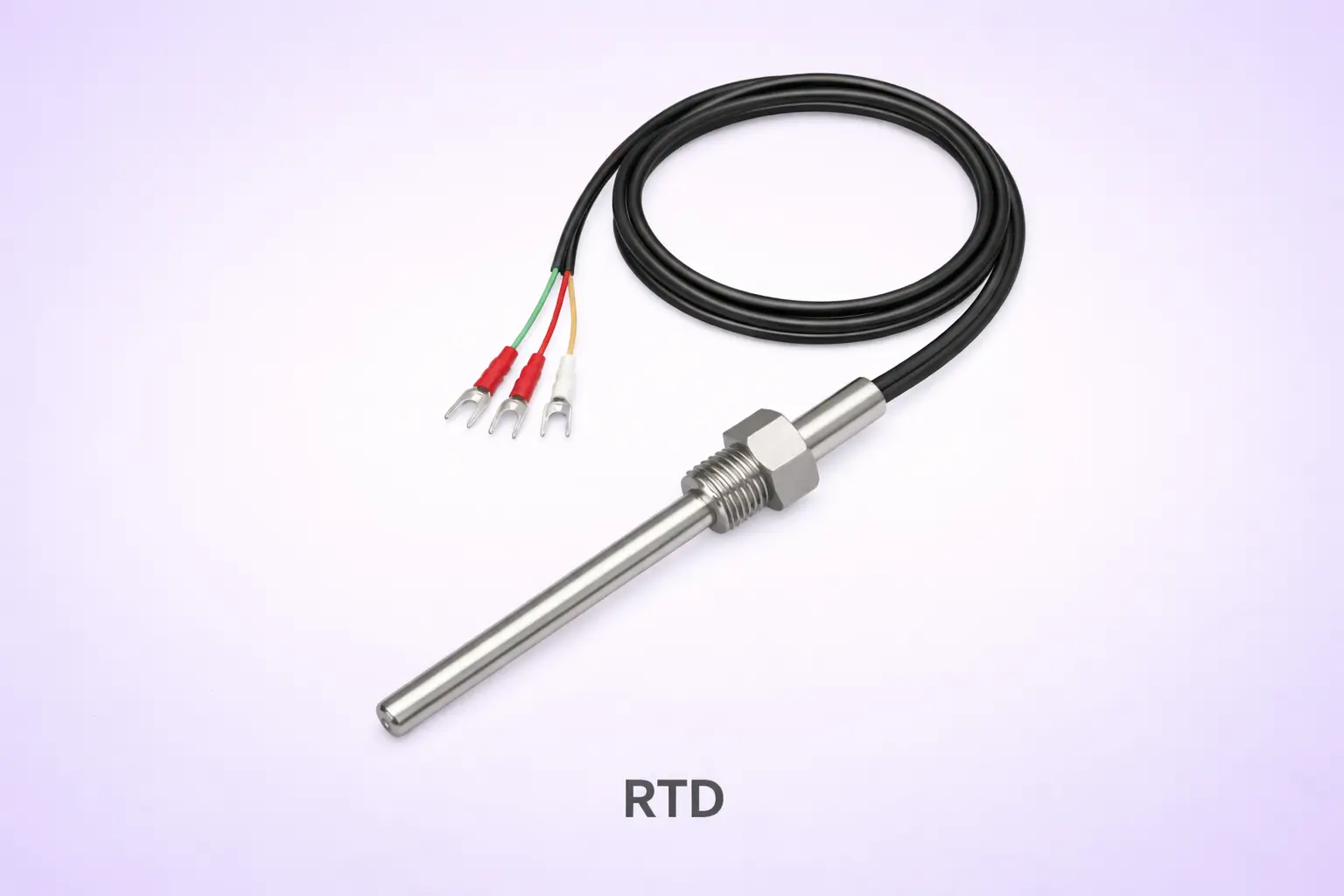
Two‑Wire, Three‑Wire & Four‑Wire RTD
Two‑Wire RTD
Two‑wire RTDs use only two leads, where the lead‑wire resistance adds directly to the sensor resistance. This reduces accuracy, especially over long cable runs.
Applications: Used in non‑critical measurements, short‑distance installations, HVAC systems, and OEM equipment where high accuracy is not required.
Three‑Wire RTD
Three‑wire RTDs are the most widely used in industrial applications. The third wire allows compensation for lead‑wire resistance (assuming equal resistance in two leads), improving accuracy without a significant cost increase.
Applications: Ideal for industrial process control, PLC/DCS inputs, medium‑accuracy measurements, and installations with long cable runs.
Four‑Wire RTD
Four‑wire RTDs provide the highest accuracy. Two wires supply current, and the other two sense voltage, eliminating the effect of lead‑wire resistance.
Applications: Used in laboratories, calibration setups, R&D, aerospace, and any application requiring precision temperature measurement.
Conclusion and Future Trends
Throughout this blog post, we have explored the intricate working principles and construction types of Resistance Temperature Detectors (RTDs) and how they compare with thermocouples. RTDs, known for their accuracy and stability, function based on the principle of resistance change with temperature variations. They find extensive applications in environments that require precise temperature measurements. In contrast, thermocouples operate on the thermoelectric effect, proving ideal for high-temperature applications due to their greater temperature range and rapid response times.
As industries continue to evolve, the demand for reliable and efficient temperature sensing technologies is paramount. Future trends in this domain point towards the integration of digital technology and the Internet of Things (IoT). Innovations such as wireless RTDs and advanced data analytics for real-time monitoring stand to enhance the capabilities of temperature sensors significantly. Furthermore, the development of miniature sensors will undoubtedly expand the applicability of both RTDs and thermocouples in compact spaces without compromising accuracy.
Moreover, advancements in materials science may result in improved sensitivity and performance of these sensors, leading to their adoption in even more critical operations across various industries, such as aerospace, healthcare, and automotive. As regulatory standards become more stringent, the evolution of RTDs and thermocouples is expected to align closely with industry needs for enhanced precision and safety. This convergence illustrates the continual push for innovation and excellence in temperature measurement technology, highlighting a promising future for both RTDs and thermocouples in an ever-growing array of applications.