Waste Heat Recovery
🔥 Turning Up the Heat: Your Friendly Guide to Waste Heat Recovery
Have you ever thought about how much energy just… disappears? In the industrial world, we burn fuel, run chemical reactions, and operate massive machinery. But a huge chunk of that heat often gets dumped right into the environment. 💸
This is what we call Waste Heat. It’s heat generated in a process that isn’t reused, even though it has massive potential to save money and energy.
In this guide, we’re going to explore the fascinating world of Waste Heat Recovery (WHR). We’ll look at where this heat hides, how we can measure its quality, and the incredible gadgets engineers use to capture it. Let’s dive in!
🧐 What Exactly is Waste Heat?
Simply put, waste heat is the thermal energy generated in a process (like fuel combustion or a chemical reaction) that is “dumped” rather than being put to good use.
Here is the golden rule of WHR: The value is in the quality, not just the quantity.
Think of it this way: You might have a massive amount of lukewarm water, but it’s hard to do much with it. Conversely, a smaller amount of incredibly hot steam can power a turbine or heat a building. The strategy for recovering this heat depends entirely on its temperature and the economics involved.
💡 Why Should We Care?
- Fuel Savings: Recovering heat reduces the amount of primary fuel (like oil or gas) you need to buy.
- Cost Reduction: Less fuel means lower operating costs.
- Reduced Pollution: Lower fuel consumption leads to fewer emissions.
🌡️ The Hierarchy of Heat: Quality & Sources
Not all waste heat is created equal. We categorize it into three ranges based on temperature: High, Medium, and Low. The higher the temperature, the higher the “quality” and the more cost-effective it is to recover.
1. High Temperature Heat Recovery (1200°F – 2800°F / 650°C – 1500°C)
This is the “gold standard” of waste heat. It usually comes from direct fuel-fired processes. Because the temperature is so high, we can do a lot with it!
Common Sources:
- Solid Waste Incinerators: 650°C – 1000°C.
- Fume Incinerators: 650°C – 1450°C.
- Glass Melting Furnaces: 1000°C – 1550°C.
- Cement Kilns (Dry Process): 620°C – 730°C.
- Aluminum Refining Furnaces: 650°C – 760°C.
2. Medium Temperature Heat Recovery (450°F – 1200°F / 230°C – 650°C)
This heat mostly comes from the exhaust of process units. It’s still very valuable but requires different handling than the high-temp stuff.
Common Sources:
- Steam Boiler Exhausts: 230°C – 480°C.
- Gas Turbine Exhausts: 370°C – 540°C.
- Drying & Baking Ovens: 230°C – 600°C.
- Catalytic Crackers: 425°C – 650°C.
3. Low Temperature Heat Recovery (< 450°F / < 230°C)
This is the tricky zone. Usually, it’s not practical to extract work (like electricity) from this source, but it is excellent for preheating purposes.
Common Sources:
- Process Steam Condensate: 55°C – 88°C.
- Cooling Water from Furnace Doors: 32°C – 55°C.
- Air Compressors: 27°C – 50°C.
- Forming Dies: 27°C – 88°C.
🛠️ The Toolkit: Commercial Recovery Devices
So, how do we catch this heat before it escapes? Engineers have developed some amazing devices. Let’s look at the most popular ones available commercially.
🔄 1. Recuperators
A recuperator transfers heat from flue gases to incoming air through metallic or ceramic walls. The air that needs to be heated passes through ducts or tubes, while the hot waste gas passes on the other side.
- Metallic Radiation Recuperators: This is the simplest type. It consists of two metal tubes (one inside the other). Hot exhaust gas flows through the inner tube, and incoming air flows through the outer ring. Heat is transferred by radiation from the hot gas to the inner tube wall.
- Convective Recuperators: Here, hot gas flows through parallel small-diameter tubes, while air flows around them. Engineers often use “baffling” (obstacles) to force the air to pass over the tubes multiple times, increasing heat exchange.
- Ceramic Recuperators: Metal has limits—it can melt or degrade above 1100°C. Ceramic tubes allow operation on the gas side up to 1550°C, making them perfect for extreme heat applications.
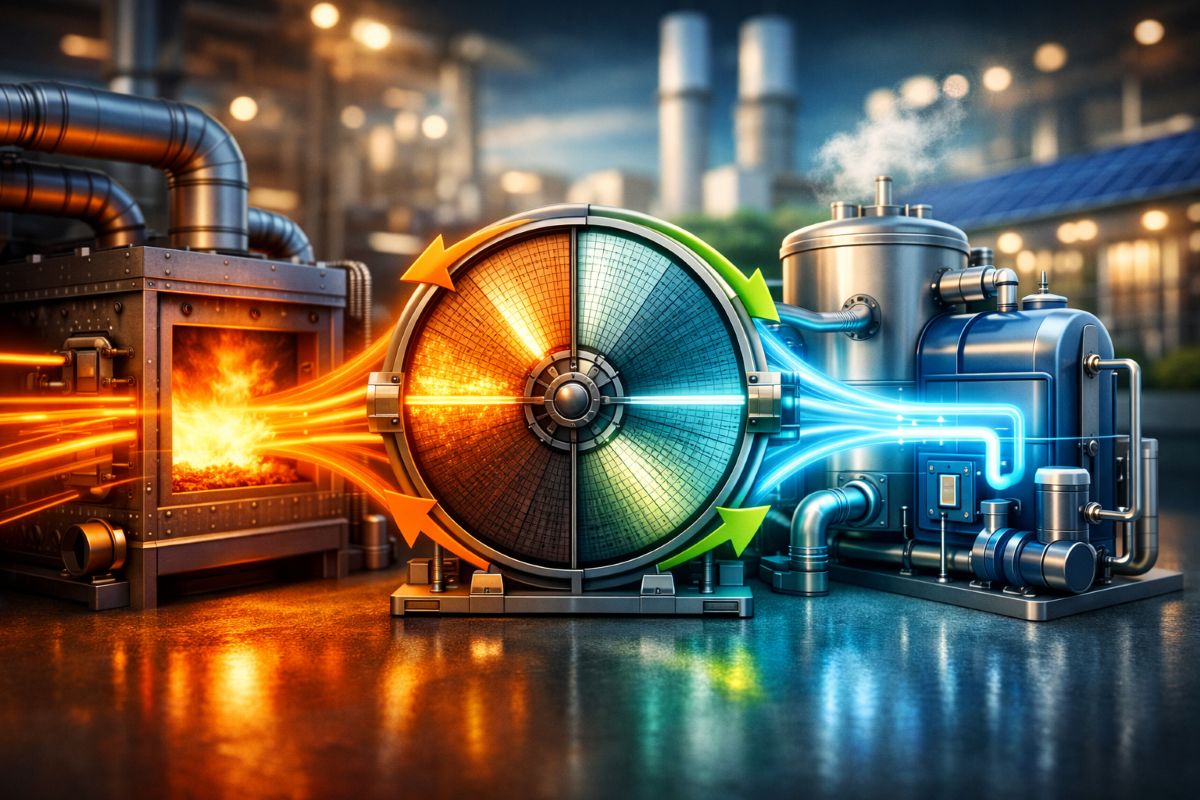
🎡 2. Regenerators & Heat Wheels
Regenerators are preferred for large capacities, like glass and steel melting furnaces.
- How they work: They store heat in a medium (like bricks or a porous disk) and then release it to the cold air stream.
- The Heat Wheel: Imagine a large porous disk rotating between two ducts—one with hot gas and one with cold air. As the disk spins, it absorbs heat from the hot side and physically moves it to the cold side to release it. These can have a heat transfer efficiency as high as 85%!.
🧪 3. Heat Pipes
This is a fascinating thermal super-conductor! A heat pipe can transfer up to 100 times more thermal energy than copper.
- The Design: It is a sealed container with a capillary wick structure inside and a working fluid.
- The Magic: When heat hits one end, the fluid inside evaporates instantly. The vapor travels to the cold end, condenses back into liquid (releasing its latent heat), and flows back to the start.
- Why use it? It has no moving parts, requires no input power, and is virtually maintenance-free.
💧 4. Economizers
If you work with boilers, this is your best friend. An economizer utilizes flue gas heat to pre-heat the boiler feed water.
- The Savings Rule: For every 60°C rise in feed water temperature through an economizer, or a 200°C rise in combustion air temperature, there is a 1% saving of fuel in the boiler.
🐚 5. Shell and Tube Heat Exchangers
This is the classic design used when the waste heat is in a liquid or vapor form that needs to heat another liquid.
- The Setup: One fluid flows through a bundle of tubes, while the other flows around them inside a shell.
- Application: If the waste heat is a vapor, it usually condenses inside the shell, giving up its latent heat to the liquid inside the tubes.
🍽️ 6. Plate Heat Exchangers
When temperature differences are small, large heat exchange surfaces are needed, which can get expensive. The plate heat exchanger solves this.
- The Design: Parallel corrugated plates form thin flow passages. Hot fluid flows between every even plate, and cold fluid flows between every odd plate.
- Best For: Low-temperature applications like pasteurization in the food industry.
⚙️ 7. Heat Pumps
Developed originally for space heating, heat pumps can upgrade low-temperature energy to a useful level. They work on a vapor compression cycle (just like your refrigerator, but in reverse!).
- The Cycle: A working fluid is evaporated by the waste heat source, compressed (which raises its temperature and pressure), condensed to release that heat where it’s needed, and then expanded to repeat the cycle.
- The Benefit: It can upgrade heat to a value more than twice the energy consumed by the compressor.
💨 8. Thermo Compressors
In many factories, low-pressure steam is just condensed into water because it’s too weak to use. A thermo compressor uses a jet of very high-pressure steam to accelerate and compress this low-pressure steam, allowing it to be reused as medium-pressure steam.
💰 The Bottom Line: Assessing the Savings
Okay, the tech is cool, but how does this help the wallet? To figure that out, we need to calculate the Heat Saving (Q).
Heat Content Formula
Where:
- Q = Heat content (kCal)
- V = Flow rate of the substance (m³/hr)
- ρ (rho) = Density of the flue gas (kg/m³)
- Cₚ = Specific heat of the substance (kCal/(kg·°C))
- ΔT = Temperature difference (°C)
Real‑World Example
A paper manufacturing company discharges hot wastewater.
- Wastewater: 10,000 kg/hr at 75°C
- Fresh water needs preheating from 20°C
- Heat Recovery Factor: 58%
- Operation: 5000 hours/year
Calculation
Energy Savings (Converted to INR)
If the Gross Calorific Value (GCV) of oil is 10,200 kCal/kg, this heat recovery saves approximately:
156,372 liters of oil per year
At a cost of 0.35 USD/L, the annual saving is:
54,730 USD per year
Now converting to Indian Rupees:
✅ ₹45.49 lakh per year saved
🎉 This waste‑heat recovery system saves approximately ₹45.5 lakh per year in fuel cost.
🌍 Conclusion
Waste heat recovery isn’t just about nifty engineering; it’s about smart business and sustainability. Whether you are using a simple metallic recuperator or a sophisticated heat pump, the goal is the same: stop dumping value into the atmosphere and start putting it back into your process.
Next time you see steam rising from a factory stack, remember: that’s not just cloud—it’s potential energy waiting to be recovered!
Reference: This content is based on the “Energy Efficiency Guide for Industry in Asia” – UNEP 2006.