Some Basic Concepts of Chemistry
Some Basic Concepts of Chemistry
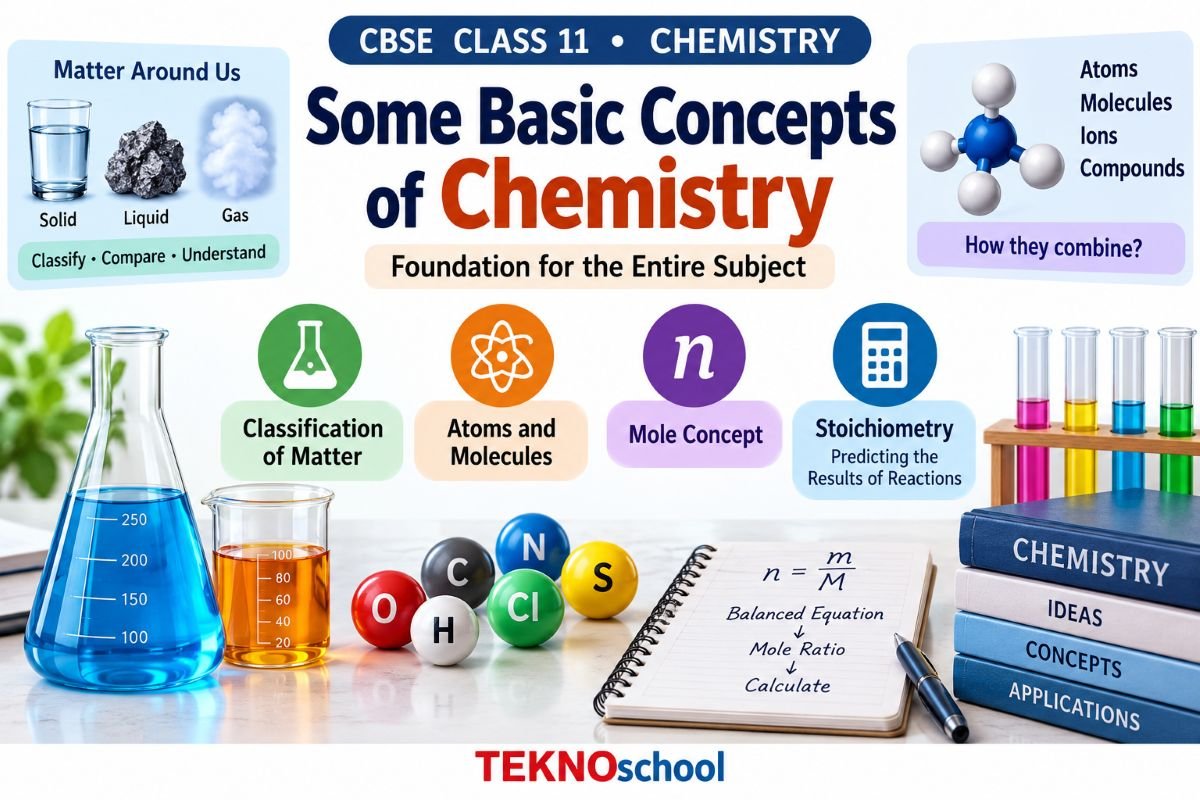
Some Basic Concepts of Chemistry-Chemistry is the science that studies the composition, structure, properties, and transformation of matter. This chapter lays the foundation for the entire subject: how we classify matter, how atoms and molecules combine, how we measure amounts of substances using the mole concept, and how we use stoichiometry to predict the outcome of chemical reactions. Every calculation you will do in Chemistry — from Class 11 through competitive exams — traces back to the ideas in this chapter. Master this chapter, and the numerical parts of Physical Chemistry become dramatically easier.
1. Importance and Scope of Chemistry
Chemistry touches nearly every aspect of daily life — the food we eat, the medicines we take, the fuels we burn, the fabrics we wear, and the fertilizers that grow our crops all depend on chemical processes. As a science, Chemistry occupies a central position: it connects Physics (through atomic structure, energy and thermodynamics) with Biology (through biochemistry, enzymes and metabolism), and it underpins entire industries such as pharmaceuticals, petrochemicals, agriculture, and materials science.
Chemistry is called the “central science” because it links physical sciences with life sciences and applied sciences like engineering and medicine.
2. Nature of Matter
Matter is anything that occupies space and has mass. Long before modern atomic theory, matter was classified based on its physical state and its chemical composition.
2.1 Classification by Physical State
- Solids — definite shape and volume; particles closely packed with strong intermolecular forces.
- Liquids — definite volume but no fixed shape; particles are close together but can move past one another.
- Gases — neither definite shape nor definite volume; particles are far apart with weak intermolecular forces and move randomly at high speed.
2.2 Classification by Composition
At the chemical level, matter is classified as follows:
| Category | Description | Example |
|---|---|---|
| Element | Cannot be broken into simpler substances by chemical means | Hydrogen, Oxygen, Sodium |
| Compound | Two or more elements combined in a fixed ratio, forming a new substance | Water (H₂O), Carbon dioxide (CO₂) |
| Homogeneous Mixture | Uniform composition throughout | Salt solution, Air |
| Heterogeneous Mixture | Non-uniform composition; components remain distinguishable | Sand and water, Oil and water |
3. Laws of Chemical Combination
Before atoms could be directly observed, chemists established several quantitative laws by carefully weighing reactants and products. These laws became the experimental foundation for Dalton’s atomic theory.
Matter can neither be created nor destroyed in a chemical reaction. The total mass of reactants equals the total mass of products.
A given compound always contains exactly the same proportion of elements by mass, regardless of the source or method of preparation. For example, pure water always contains hydrogen and oxygen in a mass ratio of 1:8.
When two elements combine to form more than one compound, the masses of one element that combine with a fixed mass of the other are in a ratio of small whole numbers. For example, carbon and oxygen form CO and CO₂: for a fixed mass of carbon, the masses of oxygen are in the ratio 1:2.
When gases react, the volumes of reactants and products (at the same temperature and pressure) are in a ratio of small whole numbers. For example, two volumes of hydrogen react with one volume of oxygen to give two volumes of water vapour.
Equal volumes of all gases, at the same temperature and pressure, contain an equal number of molecules. This law successfully explained Gay Lussac’s results and resolved earlier inconsistencies in Dalton’s theory regarding diatomic elements.
4. Dalton’s Atomic Theory
In 1808, John Dalton proposed an atomic theory to explain the laws of chemical combination. Its main postulates were:
- Matter consists of indivisible particles called atoms.
- Atoms of a given element are identical in mass and properties; atoms of different elements differ in mass and properties.
- Atoms combine in simple whole-number ratios to form compounds.
- Atoms can neither be created nor destroyed in a chemical reaction (explains the law of conservation of mass).
Dalton’s theory successfully explained the laws of definite and multiple proportions, but it could not explain Gay Lussac’s law of gaseous volumes for elements like hydrogen and oxygen, since it assumed atoms (not molecules) were the smallest reacting units. This gap was resolved by Avogadro, who introduced the concept of molecules as the smallest particles capable of independent existence.
5. Atomic and Molecular Masses
Atomic mass is the mass of an atom relative to the mass of a carbon-12 atom, taken as exactly 12 units. The unit used is the atomic mass unit (amu) or unified mass (u), where 1u = 1/12th the mass of one carbon-12 atom = 1.66 × 10⁻²⁴ g.
Molecular mass is the sum of the atomic masses of all atoms in a molecule. For example, the molecular mass of water (H₂O) = 2(1) + 16 = 18 u.
For ionic compounds that do not exist as discrete molecules (such as NaCl), we use the term formula mass instead of molecular mass, calculated the same way from the formula unit.
6. Mole Concept and Molar Mass
Since atoms and molecules are extremely small, chemists needed a convenient counting unit for large numbers of particles — this is the mole.
One mole is the amount of substance that contains exactly 6.022 × 10²³ elementary entities (atoms, molecules, ions, or particles). This number, 6.022 × 10²³ mol-1, is called Avogadro’s constant (NA).
Molar mass is the mass of one mole of a substance, expressed in grams per mole (g/mol). Numerically, the molar mass of a substance in grams equals its atomic or molecular mass in atomic mass units.
Number of moles (n) = Given mass (m) ÷ Molar mass (M)
Number of particles = Number of moles × NA
At STP, 1 mole of any gas occupies 22.4 litres (molar volume)
7. Percentage Composition, Empirical and Molecular Formula
Percentage composition tells us the percentage by mass of each element in a compound:
Empirical formula shows the simplest whole-number ratio of atoms of each element in a compound. Molecular formula shows the actual number of atoms of each element in one molecule. The molecular formula is always a whole-number multiple (n) of the empirical formula:
A compound has the empirical formula CH₂O and a molecular mass of 180 u. Empirical formula mass = 12 + 2(1) + 16 = 30 u. n = 180 ÷ 30 = 6. Molecular formula = C₆H₁₂O₆ (glucose).
8. Chemical Reactions and Stoichiometry
A balanced chemical equation shows the exact mole ratio in which reactants combine and products form. Stoichiometry is the calculation of quantities of reactants and products in a chemical reaction using this mole ratio.
Consider the reaction: N₂ + 3H₂ → 2NH₃
If 2 moles of N₂ react completely, they require 3 × 2 = 6 moles of H₂ and will produce 2 × 2 = 4 moles of NH₃. This direct mole-to-mole reasoning, using the coefficients of the balanced equation, is the essence of stoichiometric calculation.
8.1 Limiting Reagent
When reactants are not present in the exact stoichiometric ratio, one reactant gets used up first and stops the reaction — this is the limiting reagent. The other reactant, present in excess, is called the excess reagent. The amount of product formed is always determined by the limiting reagent.
8.2 Concentration in Solutions
| Term | Formula |
|---|---|
| Molarity (M) | Moles of solute ÷ Volume of solution (in litres) |
| Molality (m) | Moles of solute ÷ Mass of solvent (in kg) |
| Mole Fraction (x) | Moles of component ÷ Total moles of all components |
| Mass Percentage | (Mass of solute ÷ Mass of solution) × 100 |
9. Summary
Chemistry is the central science connecting the physical and life sciences. Matter is classified by physical state (solid, liquid, gas) and composition (elements, compounds, mixtures).
Five foundational laws — conservation of mass, definite proportions, multiple proportions, gaseous volumes, and Avogadro’s law — provided the experimental basis for Dalton’s atomic theory.
The mole concept links the microscopic world of atoms to macroscopic, measurable quantities using Avogadro’s constant (6.022 × 10²³).
Percentage composition, empirical/molecular formulas, and stoichiometric calculations (including limiting reagent and concentration terms) are the practical tools built on the mole concept, used throughout Physical Chemistry.
Practice Worksheet
110 questions across eleven formats, with answers provided inline for self-assessment.
A. Multiple Choice Questions (10)
- The law that states “matter can neither be created nor destroyed” is:
(a) Law of definite proportions (b) Law of conservation of mass (c) Law of multiple proportions (d) Avogadro’s law
Answer: (b) - 1 mole of any gas at STP occupies:
(a) 11.2 L (b) 22.4 L (c) 44.8 L (d) 6.022 L
Answer: (b) - Avogadro’s constant has the value:
(a) 6.022 × 10²² (b) 6.022 × 10²³ (c) 3.011 × 10²³ (d) 1.66 × 10⁻²⁴
Answer: (b) - The empirical formula mass of glucose (C₆H₁₂O₆) is:
(a) 180 u (b) 30 u (c) 60 u (d) 90 u
Answer: (b) - Which law explains that CO and CO₂ have oxygen masses in ratio 1:2 for the same mass of carbon?
(a) Law of definite proportions (b) Law of multiple proportions (c) Gay Lussac’s law (d) Avogadro’s law
Answer: (b) - Molarity is defined as moles of solute per:
(a) kg of solvent (b) litre of solution (c) kg of solution (d) mole of solvent
Answer: (b) - 1 atomic mass unit is equal to:
(a) 1/12th mass of C-12 atom (b) mass of one hydrogen atom (c) 1/16th mass of O-16 atom (d) mass of one proton
Answer: (a) - The reactant that gets completely consumed first in a reaction is called the:
(a) excess reagent (b) limiting reagent (c) catalyst (d) product
Answer: (b) - Dalton’s atomic theory failed to explain:
(a) Law of conservation of mass (b) Law of definite proportions (c) Gay Lussac’s law of gaseous volumes (d) Law of multiple proportions
Answer: (c) - Molality is defined with respect to:
(a) volume of solution (b) mass of solvent (c) mass of solution (d) volume of solvent
Answer: (b)
B. Fill in the Blanks (10)
- The SI unit for amount of substance is the __________. (Answer: mole)
- One mole of a substance contains __________ elementary particles. (Answer: 6.022 × 10²³)
- The law of __________ proportions was given by Proust. (Answer: definite)
- Percentage composition is calculated with respect to the __________ mass of the compound. (Answer: molar/molecular)
- The molecular formula is always a whole number multiple of the __________ formula. (Answer: empirical)
- __________’s law states that equal volumes of gases at the same temperature and pressure contain equal numbers of molecules. (Answer: Avogadro)
- Molar volume of an ideal gas at STP is __________ litres. (Answer: 22.4)
- Mass percentage of solute = (mass of solute ÷ mass of __________) × 100. (Answer: solution)
- Water always contains hydrogen and oxygen in the mass ratio __________. (Answer: 1:8)
- Atoms of the same element are __________ in mass and properties, according to Dalton. (Answer: identical)
C. True or False (10)
- The molecular mass of water is 18 u. (True)
- Dalton’s theory could fully explain Gay Lussac’s law of gaseous volumes. (False)
- Empirical formula always equals the molecular formula. (False)
- Avogadro’s number is 6.022 × 10²³ per mole. (True)
- Mixtures have a fixed, definite composition like compounds. (False)
- The limiting reagent determines the maximum amount of product formed. (True)
- Molarity changes with temperature because volume changes. (True)
- Molality does not change with temperature. (True)
- An element can be broken down into simpler substances by chemical means. (False)
- 1 u = 1.66 × 10⁻²⁴ g approximately. (True)
D. Match the Following (10)
Match Column A (Law/Concept) with Column B (Statement).
| Column A | Column B |
|---|---|
| 1. Lavoisier | (f) Conservation of mass |
| 2. Proust | (g) Definite proportions |
| 3. Dalton | (h) Multiple proportions / Atomic theory |
| 4. Gay Lussac | (i) Gaseous volumes |
| 5. Avogadro | (j) Equal volumes, equal molecules |
Answers: 1-f, 2-g, 3-h, 4-i, 5-j
E. Very Short Answer Questions (10)
- Define atomic mass unit. (1/12th the mass of a C-12 atom)
- What is a mole? (Amount containing 6.022 × 10²³ particles)
- State the law of conservation of mass. (Mass of reactants = mass of products)
- What is molar mass? (Mass of one mole of a substance in g/mol)
- What is a limiting reagent? (The reactant fully consumed first, limiting product amount)
- Give the formula for molarity. (Moles of solute ÷ volume of solution in L)
- Define empirical formula. (Simplest whole-number ratio of atoms in a compound)
- What is Avogadro’s constant? (6.022 × 10²³ mol-1)
- State the law of multiple proportions. (Masses of one element combining with fixed mass of other are in small whole number ratio)
- What is molar volume at STP? (22.4 L per mole)
F. Short Answer Questions (10)
- Differentiate between empirical and molecular formula with an example. (Empirical = simplest ratio, e.g. CH₂O; Molecular = actual atoms, e.g. C₆H₁₂O₆, a multiple of empirical)
- Explain why Dalton’s atomic theory needed modification. (Could not explain gaseous volume combinations; resolved by Avogadro’s molecule concept)
- State and explain the law of multiple proportions with an example. (CO and CO₂: oxygen masses in ratio 1:2 for same carbon mass)
- How is percentage composition calculated? ((mass of element in 1 mole compound ÷ molar mass) × 100)
- Differentiate molarity and molality. (Molarity: per litre of solution, temperature-dependent; Molality: per kg of solvent, temperature-independent)
- What is the significance of Avogadro’s law? (Resolved Dalton’s theory gap by introducing molecules as reacting units)
- Define mole fraction and give its formula. (Moles of one component ÷ total moles of all components)
- Explain the concept of limiting reagent with an example. (In N₂+3H₂→2NH₃, whichever reactant runs out first limits NH₃ formed)
- Why is water always H₂O regardless of source? (Law of definite proportions — fixed 1:8 mass ratio of H:O)
- What is the difference between an element and a compound? (Element: single type of atom; Compound: two+ elements in fixed ratio, new properties)
G. Long Answer Questions (10)
- State Dalton’s atomic theory. Discuss which postulates explain which laws of chemical combination, and describe its limitations.Answer: Dalton’s atomic theory (1808) has four main postulates:
(i) Matter consists of indivisible particles called atoms.
(ii) Atoms of a given element are identical in mass and properties; atoms of different elements differ.
(iii) Atoms combine in simple whole-number ratios to form compounds.
(iv) Atoms can neither be created nor destroyed in a chemical reaction.Postulate-to-law mapping: Postulate (iv) directly explains the Law of Conservation of Mass, because if atoms are only rearranged and never created or destroyed, the total mass before and after a reaction must stay the same. Postulate (ii), combined with (iii), explains the Law of Definite Proportions — since every atom of an element has a fixed mass and atoms combine in a fixed ratio, any sample of a compound must always have the same mass ratio of elements. Postulate (iii) also explains the Law of Multiple Proportions: because atoms combine only in small whole-number ratios, two elements can form more than one compound (like CO and CO₂) where the masses of one element combining with a fixed mass of the other fall in a simple whole-number ratio (1:2 in this case).
Limitation: The theory could not explain Gay Lussac’s Law of Gaseous Volumes. For example, 2 volumes of hydrogen react with 1 volume of oxygen to give 2 volumes of water vapour. If atoms were the smallest reacting unit as Dalton claimed, this ratio could not be produced, because splitting a single oxygen atom into two water molecules is impossible. This contradiction was only resolved later by Avogadro, who introduced the idea of molecules (groups of atoms) as the smallest independently existing particles of an element or compound.
- Describe the classification of matter with suitable examples and a comparison table.Answer: Matter is first classified by chemical composition into pure substances and mixtures.
Pure substances have a fixed composition and definite properties. These are further divided into:
• Elements — made of only one kind of atom and cannot be broken into simpler substances by chemical means. Example: Hydrogen (H), Oxygen (O), Sodium (Na).
• Compounds — two or more elements chemically combined in a fixed ratio, forming a new substance with properties different from its constituent elements. Example: Water (H₂O) is a liquid at room temperature even though it is made from two gases, hydrogen and oxygen.Mixtures contain two or more substances physically combined (not chemically bonded), and can be separated by physical methods. These are divided into:
• Homogeneous mixtures — uniform composition throughout, with no visible boundary between components. Example: salt dissolved in water, air (a mixture of N₂, O₂, CO₂ and other gases).
• Heterogeneous mixtures — non-uniform composition, where components remain visibly distinct. Example: sand mixed with water, oil floating on water.Comparison Table:
Category Composition Example Element Single type of atom Sodium (Na) Compound Fixed ratio of 2+ elements Water (H₂O) Homogeneous mixture Uniform, variable ratio Salt solution Heterogeneous mixture Non-uniform, variable ratio Sand + water - Explain all five laws of chemical combination with one example each.Answer:
1. Law of Conservation of Mass (Lavoisier, 1789): Mass is neither created nor destroyed in a chemical reaction. Example: when 12 g of carbon burns completely with 32 g of oxygen, exactly 44 g of carbon dioxide is formed (12 + 32 = 44), with no mass gained or lost.
2. Law of Definite Proportions (Proust, 1799): A compound always contains the same elements in the same fixed mass ratio, regardless of its source. Example: water prepared in a laboratory or found in a river always has hydrogen and oxygen combined in the mass ratio 1:8.
3. Law of Multiple Proportions (Dalton, 1803): When two elements form more than one compound, the masses of one element that combine with a fixed mass of the other are in a ratio of small whole numbers. Example: in CO, 12 g of carbon combines with 16 g of oxygen; in CO₂, 12 g of carbon combines with 32 g of oxygen. The oxygen masses (16 and 32) are in the ratio 1:2, a simple whole number ratio.
4. Gay Lussac’s Law of Gaseous Volumes (1808): When gases react, their volumes (at the same temperature and pressure) are in a simple whole-number ratio to each other and to the product, if gaseous. Example: 2 volumes of hydrogen gas react with 1 volume of oxygen gas to produce 2 volumes of water vapour (2:1:2 ratio).
5. Avogadro’s Law (1811): Equal volumes of all gases, at the same temperature and pressure, contain an equal number of molecules. Example: 1 litre of hydrogen gas and 1 litre of nitrogen gas, at the same temperature and pressure, contain the exact same number of gas molecules, even though the two gases have different masses.
- Derive the relationship between empirical formula and molecular formula, and solve for a compound with empirical formula CH and molecular mass 78.Answer — Derivation: The molecular formula represents the actual number of atoms of each element in one molecule, while the empirical formula represents the simplest whole-number ratio of those atoms. Since the molecular formula must contain the same ratio of atoms as the empirical formula (just possibly scaled up), we can write:
Molecular formula = n × (Empirical formula)
where n is a positive integer. Taking masses on both sides:
Molecular mass = n × Empirical formula mass
Therefore: n = Molecular mass ÷ Empirical formula massCalculation for CH, molecular mass = 78:
Step 1 — Empirical formula mass of CH = mass of C + mass of H = 12 + 1 = 13 u
Step 2 — n = Molecular mass ÷ Empirical formula mass = 78 ÷ 13 = 6
Step 3 — Molecular formula = n × (CH) = 6 × (CH) = C₆H₆
This is benzene, a compound whose empirical formula (CH) is 6 times smaller than its actual molecular formula (C₆H₆). - Explain the mole concept and its role in relating microscopic particles to macroscopic mass.Answer: A single atom or molecule is far too small to weigh directly on any laboratory balance — a single carbon atom has a mass of only 1.99 × 10⁻²³ g. To make chemical quantities measurable and usable in the laboratory, chemists needed a counting unit that connects the microscopic scale (individual atoms/molecules) to the macroscopic scale (grams that can be weighed).
This unit is the mole. One mole is defined as the amount of substance containing exactly 6.022 × 10²³ elementary particles (atoms, molecules, or ions) — this fixed number is called Avogadro’s constant (NA).
The molar mass (mass of 1 mole, in g/mol) of any substance is numerically equal to its atomic or molecular mass in atomic mass units. This gives the key relationship:
Number of moles (n) = Given mass (m) ÷ Molar mass (M)
Number of particles = n × NAFor example, 12 g of carbon (its molar mass) always contains exactly 6.022 × 10²³ carbon atoms — no matter how the carbon sample is obtained. This is what makes the mole so powerful: it lets a chemist weigh out a measurable mass on a balance and know precisely how many particles of the substance are present, which is essential for predicting reaction quantities.
- Discuss the various methods of expressing concentration of solutions with formulas.Answer: Concentration expresses how much solute is dissolved in a given amount of solvent or solution. The common methods are:
1. Molarity (M) = Moles of solute ÷ Volume of solution (in litres). Unit: mol/L. Molarity changes slightly with temperature because the volume of a liquid expands or contracts with temperature.
2. Molality (m) = Moles of solute ÷ Mass of solvent (in kg). Unit: mol/kg. Molality does NOT change with temperature, since it is based on mass, not volume — this makes it more reliable for precise work across varying temperatures.
3. Mole Fraction (x) = Moles of one component ÷ Total moles of all components in the solution. It is unitless, and the mole fractions of all components in a solution always add up to 1.
4. Mass Percentage = (Mass of solute ÷ Mass of solution) × 100. This expresses concentration as a percentage by weight, commonly used for commercial solutions (e.g., a “10% salt solution”).
Each of these is used in different contexts — molarity is most common in the laboratory for titrations, molality is preferred when temperature varies (such as in colligative property calculations), mole fraction is used in vapour pressure and Raoult’s law calculations, and mass percentage is common in industrial and everyday labeling.
- With a suitable example, explain the concept of limiting reagent and how it determines product yield.Answer: In most real reactions, reactants are not mixed in the exact mole ratio given by the balanced equation. The reactant that gets completely used up first is called the limiting reagent, because it “limits” how much product can form — once it is exhausted, the reaction stops, even if some of the other reactant remains unused (called the excess reagent).
Worked Example: Consider N₂ + 3H₂ → 2NH₃. Suppose we start with 5 moles of N₂ and 12 moles of H₂.
Step 1 — Find how much H₂ is needed to react completely with 5 moles of N₂: since the ratio is 1 N₂ : 3 H₂, we need 5 × 3 = 15 moles of H₂.
Step 2 — Compare with what is available: only 12 moles of H₂ are available, which is less than the 15 moles required.
Step 3 — Conclusion: H₂ runs out first, so H₂ is the limiting reagent, and N₂ is in excess.
Step 4 — Calculate product formed based on the limiting reagent (H₂): 12 moles H₂ × (2 moles NH₃ ÷ 3 moles H₂) = 8 moles of NH₃ produced.
Even though 5 moles of N₂ were available (which could theoretically give 10 moles of NH₃ if H₂ were unlimited), only 8 moles of NH₃ actually form, because H₂ ran out first. This shows why identifying the limiting reagent is essential for correctly predicting product yield. - Explain how Avogadro’s hypothesis resolved the conflict between Dalton’s atomic theory and Gay Lussac’s law.Answer: Gay Lussac observed that 2 volumes of hydrogen react with 1 volume of oxygen to give 2 volumes of water vapour. Under Dalton’s theory, where atoms were treated as the smallest indivisible reacting units, this was impossible to explain: if 1 volume of oxygen contained, say, N oxygen atoms, and each water molecule needed only one oxygen atom, then N oxygen atoms could make at most N water molecules — not 2N (i.e., double the volume of oxygen used).
Avogadro resolved this in 1811 by proposing two key ideas: (i) equal volumes of gases at the same temperature and pressure contain equal numbers of molecules (not atoms), and (ii) elemental gases like hydrogen and oxygen exist as diatomic molecules (H₂ and O₂), not single atoms.
With this correction, the reaction becomes: 2H₂ + O₂ → 2H₂O. Here, 2 volumes of H₂ (containing 2N molecules of H₂) react with 1 volume of O₂ (containing N molecules of O₂) to give 2 volumes of water vapour (2N molecules of H₂O) — because each O₂ molecule splits to provide oxygen atoms for two separate water molecules. This matched Gay Lussac’s experimental volume ratios exactly, and by distinguishing atoms from molecules, Avogadro’s hypothesis rescued Dalton’s atomic theory from an apparent contradiction.
- Describe the importance and scope of Chemistry in daily life and other branches of science.Answer: Chemistry plays a role in nearly every aspect of daily life. The food we eat undergoes chemical digestion; the medicines we take work through specific chemical interactions with the body; the fuels that power vehicles and generate electricity release energy through combustion reactions; synthetic fabrics like polyester and nylon are manufactured through polymer chemistry; and fertilizers that boost crop yields are produced using nitrogen-fixation chemistry.
Beyond daily life, Chemistry is often called the “central science” because it bridges other scientific disciplines. It connects to Physics through the study of atomic structure, energy changes, and thermodynamics. It connects to Biology through biochemistry — the chemical reactions inside living cells, enzyme action, and metabolism. It connects to Geology through the chemical composition of minerals and rocks, and to Environmental Science through the study of pollution, atmospheric reactions, and climate chemistry.
Industrially, Chemistry underpins the pharmaceutical industry (drug synthesis and testing), the petrochemical industry (refining crude oil into fuels and plastics), agriculture (fertilizers and pesticides), and materials science (developing new alloys, polymers, and nanomaterials). This wide-reaching relevance is why Chemistry is considered foundational to both scientific progress and everyday technology.
- Explain atomic mass and molecular mass with the modern reference standard, and calculate the molecular mass of CaCO₃.Answer: Atomic mass is the mass of one atom of an element, expressed relative to a fixed reference standard. The modern reference standard is the carbon-12 isotope (₁₂C), whose mass is defined as exactly 12 atomic mass units (u). So 1 atomic mass unit (1 u) = 1/12th the mass of one carbon-12 atom = 1.66 × 10⁻²⁴ g. All other atomic masses are measured relative to this standard — for example, a hydrogen atom has a mass of approximately 1 u because it is roughly 1/12th as heavy as a carbon-12 atom.
Molecular mass is the sum of the atomic masses of all atoms present in one molecule of a substance, again expressed in atomic mass units.
Calculation for CaCO₃ (calcium carbonate):
Step 1 — Identify atomic masses: Ca = 40 u, C = 12 u, O = 16 u.
Step 2 — Count atoms in the formula: 1 Ca atom, 1 C atom, and 3 O atoms (from CO₃).
Step 3 — Add up the masses: Molecular mass = 40 (Ca) + 12 (C) + 3 × 16 (O) = 40 + 12 + 48
Step 4 — Final sum: 40 + 12 + 48 = 100 u
So the molecular mass (strictly, formula mass, since CaCO₃ is ionic) of calcium carbonate is 100 u.
H. Numerical Problems (10)
- Calculate the number of moles in 44 g of CO₂ (molar mass 44 g/mol).Solution:
Formula: n = Given mass (m) ÷ Molar mass (M)
n = 44 g ÷ 44 g/mol
n = 1 mole - Calculate the number of molecules in 2 moles of water.Solution:
Formula: Number of molecules = n × NA
Number of molecules = 2 mol × 6.022 × 1023 mol-1
Number of molecules = 1.2044 × 1024 molecules - Find the molar mass of NaOH (Na = 23, O = 16, H = 1).Solution:
Molar mass = mass of Na + mass of O + mass of H
Molar mass = 23 + 16 + 1
Molar mass = 40 g/mol - Calculate the volume occupied by 0.5 mole of a gas at STP.Solution:
Formula: Volume = n × Molar volume at STP
Volume = 0.5 mol × 22.4 L/mol
Volume = 11.2 L - A compound contains 40% C, 6.7% H, and 53.3% O by mass. Find its empirical formula.Solution:
Step 1 — Assume a 100 g sample, so: mass of C = 40 g, mass of H = 6.7 g, mass of O = 53.3 g.
Step 2 — Convert each mass to moles (moles = mass ÷ atomic mass):
Moles of C = 40 ÷ 12 = 3.33
Moles of H = 6.7 ÷ 1 = 6.7
Moles of O = 53.3 ÷ 16 = 3.33
Step 3 — Divide each mole value by the smallest one (3.33) to get the simplest ratio:
C: 3.33 ÷ 3.33 = 1
H: 6.7 ÷ 3.33 = 2.01 ≈ 2
O: 3.33 ÷ 3.33 = 1
Step 4 — Ratio of C : H : O = 1 : 2 : 1
Empirical formula = CH₂O - Calculate the molarity of a solution containing 4 g NaOH in 500 mL of solution (molar mass NaOH = 40).Solution:
Step 1 — Find moles of NaOH: n = mass ÷ molar mass = 4 ÷ 40 = 0.1 mol
Step 2 — Convert volume to litres: 500 mL = 0.5 L
Step 3 — Apply molarity formula: M = moles of solute ÷ volume of solution (L)
M = 0.1 ÷ 0.5
M = 0.2 mol/L (0.2 M) - How many grams of oxygen are needed to completely burn 16 g of methane (CH₃ + 2O₂ → CO₂ + 2H₂O)?Solution:
Step 1 — Molar mass of CH₃ = 12 + 4(1) = 16 g/mol
Step 2 — Moles of CH₃ = given mass ÷ molar mass = 16 ÷ 16 = 1 mol
Step 3 — From the balanced equation, 1 mole of CH₃ requires 2 moles of O₂. So moles of O₂ needed = 1 × 2 = 2 mol
Step 4 — Molar mass of O₂ = 2 × 16 = 32 g/mol
Step 5 — Mass of O₂ required = moles × molar mass = 2 × 32
Mass of O₂ = 64 g - Calculate the mass percentage of nitrogen in ammonia, NH₃ (N = 14, H = 1).Solution:
Step 1 — Molar mass of NH₃ = 14 + 3(1) = 14 + 3 = 17 g/mol
Step 2 — Mass of nitrogen in one mole of NH₃ = 14 g
Step 3 — Apply the formula: % N = (mass of N ÷ molar mass of compound) × 100
% N = (14 ÷ 17) × 100
% N = 0.8235 × 100
% N = 82.35% - If 5 moles of N₂ react with 12 moles of H₂ in N₂ + 3H₂ → 2NH₃, identify the limiting reagent.Solution:
Step 1 — From the balanced equation, the required mole ratio is 1 N₂ : 3 H₂.
Step 2 — Moles of H₂ required for 5 moles of N₂ = 5 × 3 = 15 mol
Step 3 — Moles of H₂ actually available = 12 mol, which is less than the 15 mol required.
Step 4 — Since H₂ would run out first, H₂ is the limiting reagent (and N₂ is in excess).
Step 5 (bonus) — Moles of NH₃ formed = 12 × (2 ÷ 3) = 8 moles of NH₃ - Calculate the molality of a solution containing 10 g of glucose (molar mass 180) dissolved in 250 g of water.Solution:
Step 1 — Moles of glucose = mass ÷ molar mass = 10 ÷ 180 = 0.0556 mol
Step 2 — Convert mass of solvent (water) to kg: 250 g = 0.250 kg
Step 3 — Apply molality formula: m = moles of solute ÷ mass of solvent (kg)
m = 0.0556 ÷ 0.250
m = 0.222 mol/kg (0.222 m)
I. Assertion-Reason (10)
For each, choose: (a) Both A and R true, R explains A (b) Both true, R does not explain A (c) A true, R false (d) A false, R true
- A: The mole is a counting unit. R: 1 mole contains 6.022 × 10²³ particles. (Answer: a)
- A: Dalton’s theory fully explains all gas reactions. R: Gay Lussac’s law was explained by atoms combining in whole ratios. (Answer: d)
- A: Molarity is temperature dependent. R: Volume of a solution changes with temperature. (Answer: a)
- A: Water always has a fixed H:O mass ratio. R: This follows the law of definite proportions. (Answer: a)
- A: CO and CO₂ illustrate the law of multiple proportions. R: The oxygen masses combining with fixed carbon mass are in a simple whole number ratio. (Answer: a)
- A: Empirical and molecular formulas are always identical. R: Molecular formula is always n times the empirical formula. (Answer: d)
- A: Elements can be broken into simpler substances chemically. R: Elements consist of only one kind of atom. (Answer: d)
- A: Avogadro’s law explains why hydrogen and oxygen exist as diatomic molecules. R: It distinguishes atoms from molecules as the smallest independently existing particles. (Answer: a)
- A: Limiting reagent determines the amount of product formed. R: It is the reactant present in excess. (Answer: c)
- A: Molality does not change with temperature. R: It is defined using mass of solvent, not volume. (Answer: a)
J. Diagram/Table-Based Questions (10)
- Construct a table comparing the physical states of matter (solid, liquid, gas) based on shape, volume, and particle arrangement.
State Shape Volume Particle Arrangement Solid Definite Definite Closely packed, fixed positions Liquid Not definite (takes container shape) Definite Close but able to move past each other Gas Not definite Not definite Far apart, moving randomly at high speed - Tabulate the five laws of chemical combination with their discoverers and years.
Law Discoverer Year Conservation of Mass Lavoisier 1789 Definite Proportions Proust 1799 Multiple Proportions Dalton 1803 Gaseous Volumes Gay Lussac 1808 Avogadro’s Law Avogadro 1811 - Draw a flowchart classifying matter into elements, compounds, and mixtures.Answer (flow structure):
MATTER
→ Pure Substances (fixed composition)
→ Elements (one kind of atom) — e.g., Na, O₂
→ Compounds (fixed ratio of 2+ elements) — e.g., H₂O, NaCl
→ Mixtures (variable composition)
→ Homogeneous (uniform) — e.g., salt solution, air
→ Heterogeneous (non-uniform) — e.g., sand + water - Tabulate the four concentration terms with their formulas.
Term Formula Molarity (M) Moles of solute ÷ Volume of solution (L) Molality (m) Moles of solute ÷ Mass of solvent (kg) Mole Fraction (x) Moles of component ÷ Total moles of all components Mass Percentage (Mass of solute ÷ Mass of solution) × 100 - Prepare a comparison table between atomic mass, molecular mass, and formula mass.
Term Meaning Example Atomic mass Mass of a single atom relative to C-12 O = 16 u Molecular mass Sum of atomic masses of all atoms in a molecule H₂O = 18 u Formula mass Sum of atomic masses in a formula unit of an ionic compound (no discrete molecule exists) NaCl = 58.5 u - Show, in tabular form, how empirical formula mass relates to molecular mass through the value of n.
Compound Empirical Formula Empirical Mass Molecular Mass n = Molecular ÷ Empirical Molecular Formula Glucose CH₂O 30 180 180 ÷ 30 = 6 C₆H₁₂O₆ Benzene CH 13 78 78 ÷ 13 = 6 C₆H₆ - Construct a summary table of Dalton’s four postulates and the law each one explains.
Postulate Law it Explains Atoms cannot be created or destroyed Law of Conservation of Mass Atoms of an element are identical in mass Law of Definite Proportions Atoms combine in whole-number ratios Law of Multiple Proportions Atoms are indivisible particles (This assumption was later disproved by discovery of subatomic particles; also caused the theory’s failure to explain Gay Lussac’s law) - Tabulate the relationship: moles, mass, molar mass, and number of particles.
Quantity Formula Moles (n) n = Mass (m) ÷ Molar mass (M) Mass (m) m = n × M Number of particles n × NA (NA = 6.022 × 10²³) - Draw a simple diagram showing how percentage composition leads to empirical formula determination.Answer (step flow):
Step 1: % composition of each element (given)
↓
Step 2: Assume 100 g sample → % becomes grams
↓
Step 3: Convert grams of each element to moles (mass ÷ atomic mass)
↓
Step 4: Divide all mole values by the smallest mole value
↓
Step 5: Round to nearest whole numbers → simplest ratio
↓
Step 6: Write empirical formula using this ratio - Tabulate the differences between homogeneous and heterogeneous mixtures with two examples each.
Feature Homogeneous Mixture Heterogeneous Mixture Composition Uniform throughout Non-uniform, visibly distinct parts Visible boundary No Yes Examples Salt solution, Air Sand + water, Oil + water
K. Application-Based / HOTS Questions (10)
- Why do we need the mole concept when atoms and molecules already have defined masses? (Individual atomic masses are too small to measure directly; the mole bridges microscopic mass to measurable macroscopic quantities)
- A student weighs two samples of water from different sources and finds identical H:O mass ratios. Which law does this confirm? (Law of definite proportions)
- If a compound’s empirical and molecular formula are the same, what does this indicate about n? (n = 1)
- Explain why Avogadro’s number is essential for converting laboratory-scale masses into particle counts. (It provides the fixed conversion factor between moles and actual particle numbers)
- In industrial ammonia synthesis, why is it important to identify the limiting reagent? (To calculate maximum theoretical yield and optimize reactant costs)
- Two flasks of equal volume contain H₂ and O₂ gas at the same temperature and pressure. Do they contain the same number of molecules? Explain. (Yes, by Avogadro’s law, regardless of gas identity)
- Why might the experimentally determined molar mass differ slightly from the calculated theoretical value? (Due to impurities, measurement error, or isotopic composition variations)
- A compound is found to have percentage composition inconsistent with any known compound. What might this suggest? (Possible impure sample, experimental error, or an unidentified new compound)
- Explain why the law of conservation of mass appears to be violated in nuclear reactions but not ordinary chemical reactions. (Chemical reactions rearrange atoms without changing their identity or mass; nuclear reactions convert mass to energy per Einstein’s E=mc², which chemical laws don’t account for)
- Why is stoichiometry critical in pharmaceutical manufacturing? (Ensures precise reactant ratios for correct drug dosage, purity, and yield)