Gravitation
Gravitation
CBSE Class 11 Physics | Complete Chapter Tutorial with Worksheet
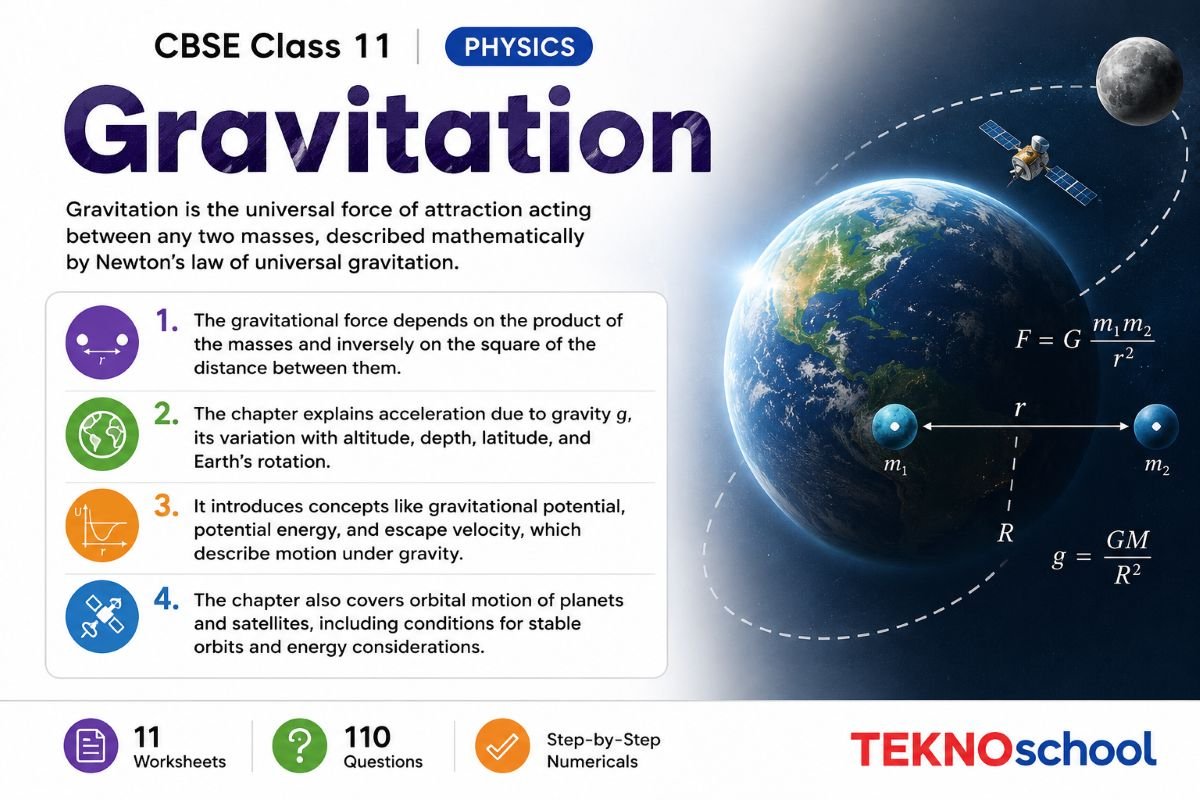
This chapter Gravitation explains why every object in the universe attracts every other object through the force of gravitation, and how this single force governs falling apples, ocean tides, and the orbits of planets alike. It builds up from Kepler’s three laws describing planetary motion to Newton’s universal law of gravitation, which quantifies the attractive force between any two masses. It then examines how the acceleration due to gravity changes with height, depth, and location on Earth, and develops the ideas of gravitational potential energy and escape velocity for objects trying to leave a planet’s pull. Finally, it applies these ideas to artificial satellites, deriving orbital velocity, time period, and the special case of geostationary satellites. Throughout, the chapter reinforces that gravity is a universal, always-attractive, action-at-a-distance force that weakens with the square of separation.
1. Kepler’s Laws of Planetary Motion
Before Newton, Johannes Kepler analysed decades of planetary observation data and arrived at three empirical laws describing how planets move around the Sun.
| Law | Statement |
|---|---|
| Law of Orbits | Every planet moves in an elliptical orbit with the Sun at one focus. |
| Law of Areas | The line joining a planet to the Sun sweeps out equal areas in equal intervals of time (a consequence of conservation of angular momentum). |
| Law of Periods | The square of a planet’s orbital period is proportional to the cube of the semi-major axis of its orbit: T² ∝ a³. |
Key Concept: The Law of Areas is really conservation of angular momentum in disguise — since gravity acts along the line joining Sun and planet, it produces zero torque about the Sun, so angular momentum, and hence areal velocity, stays constant.
2. Newton’s Universal Law of Gravitation
Newton generalised Kepler’s observations into a single force law: every particle in the universe attracts every other particle with a force that is directly proportional to the product of their masses and inversely proportional to the square of the distance between them.
F = G m₁m₂ / r²
G = universal gravitational constant = 6.67 × 10⁻¹&sup9; N m² kg⁻²
Common Misconception: G and g are not the same quantity. G is a universal constant that never changes anywhere in the universe, while g (acceleration due to gravity) depends on the mass and radius of the attracting body and varies from place to place.
This force obeys Newton’s third law — the two masses pull on each other with equal and opposite forces — and it acts along the line joining the two particles, making it a central force. Gravitation is the weakest of the four fundamental forces, yet it dominates on astronomical scales because it is always attractive and has an infinite range.
3. Acceleration Due to Gravity and Its Variation
Near the Earth’s surface, every freely falling body experiences the same acceleration g, obtained by equating the gravitational force on a body of mass m to mg:
g = GM / R²
| Variation With | Relation | Effect |
|---|---|---|
| Altitude h (h << R) | gℎ = g(1 − 2h/R) | g decreases with height |
| Depth d | g_d = g(1 − d/R) | g decreases with depth; zero at the centre |
| Latitude (rotation) | g′ = g − ω²R cos²φ | Minimum at equator, maximum at poles |
Exam Tip: For small heights, g decreases twice as fast with altitude as it does with an equal depth below the surface — the height formula has a factor of 2h/R while the depth formula has just d/R. Students frequently apply the wrong formula when a question mixes height and depth in the same problem.
4. Gravitational Potential Energy and Escape Velocity
The gravitational potential energy of a mass m at distance r from a mass M is taken as zero at infinite separation and becomes increasingly negative as the bodies come closer, reflecting the attractive, binding nature of the force:
U = −GMm / r
Escape velocity is the minimum speed a body needs at a planet’s surface to break free of its gravitational pull entirely, reaching infinity with zero kinetic energy left over. Setting total mechanical energy to zero gives:
v_e = √(2GM/R) = √(2gR)
For Earth, v_e ≈ 11.2 km/s
Real-World Application: Escape velocity is why the Moon has essentially no atmosphere. Its escape velocity is only about 2.4 km/s, far below the average thermal speed of light gas molecules like hydrogen and helium, so any such gases present long ago simply drifted off into space over geological time.
5. Orbital Velocity, Time Period, and Satellites
A satellite in a circular orbit stays up because gravity supplies exactly the centripetal force it needs. Equating the two gives the orbital velocity and period for an orbit of radius r = R + h:
v_o = √(GM/r) T = 2π√(r³/GM)
| Satellite Type | Orbital Plane | Time Period | Typical Use |
|---|---|---|---|
| Geostationary | Equatorial | 24 hours (matches Earth’s rotation) | Communication, weather |
| Polar | Passes over both poles | About 100 minutes (low orbit) | Remote sensing, mapping |
Common Misconception: Astronauts in orbit are not “beyond gravity.” Gravity is very much acting on them — it is precisely what curves their path into an orbit. The floating sensation is weightlessness caused by continuous free fall, not the absence of gravitational force.
Key Terms Glossary
| Term | Meaning |
|---|---|
| Gravitational constant (G) | Universal constant fixing the strength of gravitational attraction between two masses |
| Weightlessness | State of apparent zero weight experienced during free fall, such as in an orbiting satellite |
| Geostationary satellite | Satellite orbiting in the equatorial plane with a 24-hour period, appearing fixed above one point on Earth |
| Escape velocity | Minimum launch speed needed for a body to permanently escape a planet’s gravitational field |
| Binding energy | Minimum energy needed to free an orbiting body from a gravitational field, equal in magnitude to its total mechanical energy |
Complete Practice Worksheet
110 Questions Across 11 Formats | Answers Included
Worksheet 1: Multiple Choice Questions
1. The value of G was first experimentally determined by:
(a) Newton (b) Kepler (c) Henry Cavendish (d) Galileo
Answer: (c) Henry Cavendish
2. Kepler’s second law is a direct consequence of conservation of:
(a) Energy (b) Linear momentum (c) Angular momentum (d) Mass
Answer: (c) Angular momentum
3. Acceleration due to gravity at the centre of the Earth is:
(a) Maximum (b) Zero (c) Equal to g on the surface (d) Infinite
Answer: (b) Zero
4. The time period of a geostationary satellite is:
(a) 12 hours (b) 24 hours (c) 6 hours (d) 365 days
Answer: (b) 24 hours
5. If the mass of a planet is doubled and radius unchanged, escape velocity becomes:
(a) Same (b) Doubled (c) √2 times (d) Halved
Answer: (c) √2 times
6. Gravitational potential energy at infinite distance is taken as:
(a) Maximum positive (b) Zero (c) Undefined (d) Negative infinity
Answer: (b) Zero
7. The weight of a body becomes zero at the:
(a) Poles (b) Equator (c) Centre of Earth (d) Surface
Answer: (c) Centre of Earth
8. Which orbit does a polar satellite NOT pass over regularly?
(a) North Pole (b) South Pole (c) Equator (d) None of these—it covers the whole globe over time
Answer: (d) None of these—it covers the whole globe over time
9. For a satellite very close to Earth’s surface, orbital velocity is approximately:
(a) 3 km/s (b) 7.9 km/s (c) 11.2 km/s (d) 15 km/s
Answer: (b) 7.9 km/s
10. As altitude h approaches infinity, gℎ approaches:
(a) g (b) 2g (c) Zero (d) Negative value
Answer: (c) Zero
Worksheet 2: Fill in the Blanks
1. The SI unit of the universal gravitational constant G is __________.
Answer: N m² kg⁻²
2. Kepler’s first law states that planetary orbits are __________ in shape.
Answer: elliptical
3. The value of g is greater at the __________ than at the equator.
Answer: poles
4. Gravitational force between two bodies is always __________ in nature.
Answer: attractive
5. Escape velocity of Earth is approximately __________ km/s.
Answer: 11.2
6. A geostationary satellite is launched in the __________ plane.
Answer: equatorial
7. Total mechanical energy of a satellite in a stable orbit is __________ energy.
Answer: negative
8. Weightlessness experienced by astronauts in orbit is due to a state of continuous __________.
Answer: free fall
9. Newton’s law of gravitation obeys Newton’s __________ law of motion regarding the mutual forces.
Answer: third
10. The value of G was measured experimentally using a __________ balance.
Answer: torsion
Worksheet 3: True or False
1. G and g represent the same physical quantity.
Answer: False
2. Kepler’s laws were derived purely from observational data, not from a force law.
Answer: True
3. g increases with increasing altitude above Earth’s surface.
Answer: False
4. Gravitational potential energy is always negative for a bound system.
Answer: True
5. A geostationary satellite can be placed in any orbital plane.
Answer: False
6. The Moon has almost no atmosphere partly because of its low escape velocity.
Answer: True
7. Astronauts in orbit feel weightless because gravity is absent there.
Answer: False
8. The value of g at the Earth’s centre is zero.
Answer: True
9. Orbital velocity depends only on the mass of the orbiting satellite.
Answer: False
10. Polar satellites are useful for remote sensing and mapping the entire Earth.
Answer: True
Worksheet 4: Match the Following
| Column A | Column B |
|---|---|
| 1. Law of Areas | (a) T² ∝ a³ |
| 2. Law of Periods | (b) Conservation of angular momentum |
| 3. Escape velocity | (c) √(2gR) |
| 4. Orbital velocity | (d) √(GM/r) |
| 5. Geostationary satellite | (e) 24-hour equatorial orbit |
Answers: 1–b, 2–a, 3–c, 4–d, 5–e
Worksheet 5: Assertion-Reason
Options: (a) Both A and R true, R is correct explanation of A (b) Both A and R true, R is NOT correct explanation of A (c) A true, R false (d) A false, R true
1. Assertion: A satellite in orbit around Earth experiences weightlessness.
Reason: The satellite is beyond the gravitational field of Earth.
Answer: (c) A true, R false
2. Assertion: The value of g is zero at the centre of the Earth.
Reason: At the centre, effective mass causing gravitational pull is zero.
Answer: (a) Both A and R true, R is correct explanation of A
3. Assertion: The escape velocity from a planet does not depend on the direction of projection.
Reason: Gravitational potential energy is a scalar quantity depending only on distance.
Answer: (a) Both A and R true, R is correct explanation of A
4. Assertion: G is called a universal constant.
Reason: Its value is the same everywhere in the universe and does not depend on the medium.
Answer: (a) Both A and R true, R is correct explanation of A
5. Assertion: Polar satellites orbit at a lower altitude than geostationary satellites.
Reason: Lower altitude gives higher resolution imaging useful for mapping.
Answer: (b) Both A and R true, R is NOT correct explanation of A
6. Assertion: A body weighs less at the equator than at the poles.
Reason: Earth’s equatorial radius is greater than its polar radius.
Answer: (a) Both A and R true, R is correct explanation of A
7. Assertion: Two masses placed close together in a vacuum will accelerate towards each other.
Reason: Gravitational force acts even in the absence of a medium.
Answer: (a) Both A and R true, R is correct explanation of A
8. Assertion: The orbital period of a satellite depends on the mass of the satellite itself.
Reason: Orbital period is derived by equating gravitational force to centripetal force.
Answer: (d) A false, R true
9. Assertion: Kepler’s laws apply only to planets orbiting the Sun.
Reason: The same laws apply to any body orbiting under an inverse-square force, including moons and satellites.
Answer: (d) A false, R true
10. Assertion: The Moon does not fly off into space despite moving in a curved path.
Reason: Earth’s gravity provides the necessary centripetal force to keep it in orbit.
Answer: (a) Both A and R true, R is correct explanation of A
Worksheet 6: Very Short Answer Questions
1. State Newton’s law of gravitation in words.
Answer: Every particle attracts every other particle with a force directly proportional to the product of their masses and inversely proportional to the square of the distance between them.
2. What is the value of G in SI units?
Answer: 6.67 × 10⁻¹&sup9; N m² kg⁻²
3. Define escape velocity.
Answer: The minimum velocity with which a body must be projected so that it permanently overcomes the gravitational pull of the planet.
4. Why is a geostationary satellite always launched in the equatorial plane?
Answer: Because only in the equatorial plane can its orbital period exactly match Earth’s 24-hour rotation while keeping it appearing stationary over one point.
5. What is the nature of gravitational potential energy for a bound system?
Answer: It is negative, indicating that energy must be supplied to separate the bodies to infinity.
6. Name the scientist who experimentally verified the value of G.
Answer: Henry Cavendish.
7. Why does g vary with latitude?
Answer: Because Earth’s radius is larger at the equator and its rotation produces an outward centrifugal effect that is maximum at the equator, both reducing effective g there.
8. What is meant by a polar satellite?
Answer: A satellite that orbits Earth in a north-south path passing near both poles, covering the entire globe as Earth rotates beneath it.
9. Is the gravitational force a central force? Justify briefly.
Answer: Yes, because it acts along the line joining the two interacting masses.
10. What happens to the weight of a body at the centre of the Earth?
Answer: It becomes zero, since the effective gravitational pull there is zero.
Worksheet 7: Short Answer Questions
1. Derive the relationship between g and G.
Answer: The gravitational force on a body of mass m at Earth’s surface is F = GMm/R². Since this force also equals the weight mg, equating gives mg = GMm/R², so g = GM/R², showing g depends on Earth’s mass and radius, not on the falling body’s mass.
2. Explain why g decreases with both height and depth, but by different formulas.
Answer: Above the surface, the entire mass of Earth still attracts the body but from a larger distance, giving gℎ = g(1−2h/R). Below the surface, only the mass enclosed within radius (R−d) contributes to gravity since the outer shell exerts no net force, giving g_d = g(1−d/R), a slower rate of decrease for the same magnitude of change.
3. Show that Kepler’s second law follows from conservation of angular momentum.
Answer: Gravitational force acts along the line joining Sun and planet, so it exerts zero torque about the Sun. With no external torque, angular momentum L = mvr sinθ stays constant, and since the area swept per unit time equals L/2m, areal velocity is also constant, giving equal areas in equal times.
4. Why can a geostationary satellite not be placed over a non-equatorial city like Delhi?
Answer: A satellite’s orbital plane must pass through Earth’s centre. Only the equatorial plane, when combined with the correct altitude, produces a 24-hour period synchronized with Earth’s spin axis; any other plane would cause the satellite to drift north-south relative to the ground over each cycle rather than stay fixed above one point.
5. Distinguish between escape velocity and orbital velocity.
Answer: Escape velocity is the speed needed for a body to leave a planet’s gravity permanently and is given by √(2gR), while orbital velocity is the speed needed to maintain a circular orbit at a given radius, given by √(gR) near the surface. Escape velocity is always √2 times the orbital velocity at the same radius.
6. Explain why astronauts in an orbiting spacecraft experience weightlessness.
Answer: Both the astronaut and the spacecraft fall freely towards Earth under gravity while also moving forward fast enough that they continuously miss the surface. Since gravity provides exactly the centripetal acceleration needed and there is no normal contact force from a floor pushing back, the astronaut experiences zero apparent weight, not zero gravity.
7. What is meant by the binding energy of a satellite?
Answer: The binding energy is the minimum energy that must be supplied to a satellite to free it completely from the planet’s gravitational field, moving it to infinity with zero kinetic energy. It equals the magnitude of the satellite’s total mechanical energy, since total energy in orbit is negative.
8. Why is gravitational potential energy taken as negative rather than positive?
Answer: The reference point of zero potential energy is chosen at infinite separation, where the bodies are unbound. As they come closer under an attractive force, the system loses potential energy relative to that reference, making the potential energy negative for all finite separations.
9. State two applications each of geostationary and polar satellites.
Answer: Geostationary satellites are used for telecommunications relay and continuous weather monitoring of a fixed region. Polar satellites are used for Earth resource mapping and reconnaissance/surveillance imaging, since their low altitude and full-globe coverage over time give high-resolution scans of the entire planet.
10. Why is the gravitational force considered the weakest of the fundamental forces, yet dominant at large scales?
Answer: Gravitational force between everyday objects is negligibly small compared to electromagnetic or nuclear forces at the same scale, but unlike those forces it is always attractive and never cancels out, and it also has infinite range, so its cumulative effect over astronomical masses and distances becomes the dominant force shaping stars, planets, and galaxies.
Worksheet 8: Long Answer Questions
1. Derive an expression for the orbital velocity and time period of a satellite revolving close to the Earth’s surface.
Answer: For a satellite of mass m orbiting at radius r = R + h, gravity supplies the centripetal force: GMm/r² = mv²/r, giving v_o = √(GM/r). For an orbit close to the surface, r ≈ R, so v_o ≈ √(GM/R) = √(gR), which evaluates to about 7.9 km/s for Earth. The time period is the orbit’s circumference divided by speed: T = 2πr/v_o = 2π√(r³/GM). Substituting r ≈ R gives T ≈ 2π√(R/g), approximately 84 minutes, matching the observed period of low-Earth-orbit satellites.
2. Derive the expression for escape velocity of a body from the surface of a planet using the energy method.
Answer: A body of mass m at the surface has kinetic energy ½mv² and gravitational potential energy −GMm/R. For it to just escape to infinity where both kinetic and potential energy become zero, total mechanical energy must be conserved at zero: ½mv_e² − GMm/R = 0. Solving gives v_e = √(2GM/R). Since g = GM/R², this can be rewritten as v_e = √(2gR). For Earth, using g = 9.8 m/s² and R = 6400 km, this evaluates to approximately 11.2 km/s, independent of the mass of the escaping body.
3. State Kepler’s three laws of planetary motion and explain how the law of periods was later confirmed by Newton’s law of gravitation.
Answer: Kepler’s laws state that planets move in elliptical orbits with the Sun at one focus (Law of Orbits), that the radius vector from Sun to planet sweeps equal areas in equal times (Law of Areas), and that T² is proportional to a³ for all planets (Law of Periods). Newton showed that for a circular orbit of radius r, equating gravitational force to centripetal force, GMm/r² = m(4π²r/T²), rearranges to T² = (4π²/GM)r³. Since 4π²/GM is constant for all planets orbiting the same Sun, this confirms T² ∝ r³, deriving Kepler’s empirical third law directly from the inverse-square force law.
4. Explain how the acceleration due to gravity varies with height and depth, deriving both expressions.
Answer: At height h, distance from Earth’s centre becomes R+h, so gℎ = GM/(R+h)² = g/(1+h/R)². For h << R, using the binomial approximation (1+x)⁻² ≈ 1−2x, this simplifies to gℎ ≈ g(1−2h/R), showing g decreases roughly linearly with small heights. At depth d, only the mass enclosed within radius (R−d) contributes to the gravitational pull, since a uniform spherical shell outside this radius exerts zero net gravitational force on an interior point. Assuming uniform density, the enclosed mass scales as (R−d)³/R³ times total mass, and combining with the inverse-square law for the reduced radius gives g_d = g(1−d/R), which decreases linearly with depth and reaches zero exactly at the centre.
5. Discuss geostationary and polar satellites, comparing their orbital characteristics and applications.
Answer: A geostationary satellite orbits in the equatorial plane at an altitude of about 36,000 km, with a period of exactly 24 hours matching Earth’s rotation, so it appears fixed above a single point on the equator; this makes it ideal for continuous communication links and weather observation of one region. A polar satellite orbits at a much lower altitude, typically a few hundred kilometres, in a plane passing near both poles, completing an orbit in roughly 100 minutes; because Earth rotates beneath its orbital plane, it eventually passes over every point on the globe, making it suited to full-Earth mapping, resource surveying, and reconnaissance where complete coverage matters more than a fixed viewing angle.
Worksheet 9: Classify and Connect
Classify each quantity below as depending on the mass of the orbiting/falling body (M_body) or independent of it (Independent).
1. Acceleration due to gravity g at a given location
Answer: Independent
2. Escape velocity from a planet
Answer: Independent
3. Orbital velocity of a satellite at radius r
Answer: Independent
4. Weight of a body (force, not acceleration)
Answer: M_body (weight = mg, proportional to the body’s own mass)
5. Gravitational potential energy of a body at distance r
Answer: M_body (U = −GMm/r, proportional to the body’s own mass m)
6. Time period of a satellite in a given orbit
Answer: Independent
7. Gravitational force between two given masses
Answer: M_body (proportional to product of both masses, including the body’s own mass)
8. Binding energy of a satellite in orbit
Answer: M_body (proportional to the satellite’s own mass)
9. Value of the universal gravitational constant G
Answer: Independent (G is a universal constant, unrelated to any specific body)
10. Angular momentum of a planet about the Sun
Answer: M_body (L = mvr, proportional to the planet’s own mass)
Worksheet 10: Case-Based Questions
Case Study: ISRO plans to launch a communication satellite that must remain fixed above a ground station in India throughout the day, and separately launches a second satellite meant to photograph the entire Earth’s surface for disaster mapping over successive days.
1. Which type of orbit should the communication satellite use, and why?
Answer: A geostationary orbit in the equatorial plane with a 24-hour period, so it stays fixed relative to the ground station and requires no tracking antenna.
2. Can a geostationary satellite be placed directly above the ground station’s exact latitude if the station is not on the equator? Explain.
Answer: No. A geostationary orbit must lie in the equatorial plane, so the satellite will appear at a fixed longitude on the equator, not directly overhead of a non-equatorial station; the station’s antenna must be tilted to point towards it.
3. Which orbit type suits the disaster-mapping satellite, and why?
Answer: A polar orbit, since it passes near both poles at low altitude and, combined with Earth’s rotation beneath it, allows the satellite to image every region of the globe over successive orbits.
4. Which of the two satellites has the shorter time period, and roughly what is it?
Answer: The polar (mapping) satellite, since it orbits at a much lower altitude; its time period is roughly 100 minutes compared to the 24-hour period of the geostationary satellite.
5. Both satellites experience weightlessness in orbit. Explain why this is true regardless of altitude.
Answer: In any stable circular orbit, gravity provides exactly the centripetal force needed to keep the satellite (and anything inside it) in continuous free fall around Earth. Since there is no supporting normal force acting against gravity, objects inside experience zero apparent weight, irrespective of the orbit’s altitude or period.
Worksheet 11: Higher Order Thinking Skills (HOTS)
1. A tunnel is drilled straight through the centre of the Earth from one side to the other. If a ball is dropped into it, describe its subsequent motion.
Answer: Since g decreases linearly with depth and becomes zero at the centre, the restoring force on the ball is proportional to its displacement from the centre, exactly the condition for simple harmonic motion. The ball would oscillate back and forth through the centre, emerging briefly at the opposite side before falling back, repeating indefinitely if air resistance and friction are ignored.
2. Two planets have the same mass but planet B has twice the radius of planet A. Compare their escape velocities and explain which planet is easier to leave.
Answer: Since v_e = √(2GM/R), for equal mass M, escape velocity is inversely proportional to √R. Doubling the radius reduces escape velocity by a factor of √2, so planet B has a smaller escape velocity and is easier to leave, despite having identical mass to planet A, because its surface lies farther from its own centre of mass.
3. If Earth’s rotation suddenly stopped, how would the measured value of g at the equator change, and why?
Answer: The apparent value of g at the equator would increase slightly. Currently, Earth’s rotation produces an outward centrifugal effect that is maximum at the equator, subtracting from the true gravitational pull to give a slightly lower effective g there. If rotation stopped, this reduction would vanish, and effective g at the equator would rise to match the value calculated purely from GM/R² at that radius.
4. A satellite’s orbit decays slightly due to atmospheric drag, causing it to spiral to a lower altitude. Does its speed increase or decrease as it does so, and why does this seem counter-intuitive?
Answer: As the satellite spirals to a lower orbit, its orbital velocity actually increases, since v_o = √(GM/r) grows as r decreases. This feels counter-intuitive because drag is removing energy from the system, yet the satellite speeds up; the resolution is that total mechanical energy (kinetic plus potential) still decreases as expected, because potential energy becomes more negative faster than kinetic energy increases, so the net energy loss is consistent even though speed rises.
5. Explain why interplanetary spacecraft use gravitational “slingshot” manoeuvres around planets to gain speed, even though the planet’s gravity is conservative and should return all the energy it gives.
Answer: In the planet’s own reference frame, the spacecraft’s speed is indeed unchanged after the encounter, since gravity does no net work over a full pass. However, the planet itself is moving relative to the Sun, and this motion gets partially transferred to the spacecraft when viewed from the Sun’s frame — the spacecraft effectively “borrows” a small amount of the planet’s orbital momentum, gaining speed in the Sun’s frame while the planet loses an immeasurably tiny amount of its own orbital speed in return.
Quick Revision
Key Formulae
| Gravitational force | F = Gm₁m₂/r² |
| Acceleration due to gravity | g = GM/R² |
| Variation with height | gℎ = g(1−2h/R) |
| Variation with depth | g_d = g(1−d/R) |
| Gravitational potential energy | U = −GMm/r |
| Escape velocity | v_e = √(2GM/R) = √(2gR) |
| Orbital velocity | v_o = √(GM/r) |
| Time period of satellite | T = 2π√(r³/GM) |
| Kepler’s third law | T² ∝ a³ |
Facts Worth Memorising
G = 6.67 × 10⁻¹&sup9; N m² kg⁻² | Escape velocity of Earth ≈ 11.2 km/s | Orbital velocity near Earth’s surface ≈ 7.9 km/s | Geostationary period = 24 hours | v_e = √2 × v_o at the same radius
Ten Common Mark-Losers
- Confusing G (universal constant) with g (location-dependent acceleration)
- Using the height formula for a depth problem or vice versa
- Forgetting that g at Earth’s centre is exactly zero, not merely small
- Believing astronauts are weightless because “there is no gravity” in orbit
- Forgetting the negative sign in gravitational potential energy expressions
- Assuming escape velocity depends on the mass or direction of the projected body
- Thinking a geostationary satellite can be placed above any city, not just the equator
- Mixing up orbital velocity and escape velocity formulas (missing the factor of 2)
- Forgetting that Kepler’s second law comes from angular momentum conservation, not energy conservation
- Treating time period of a satellite as depending on the satellite’s own mass