CBSE Class 9 · Science
Motion
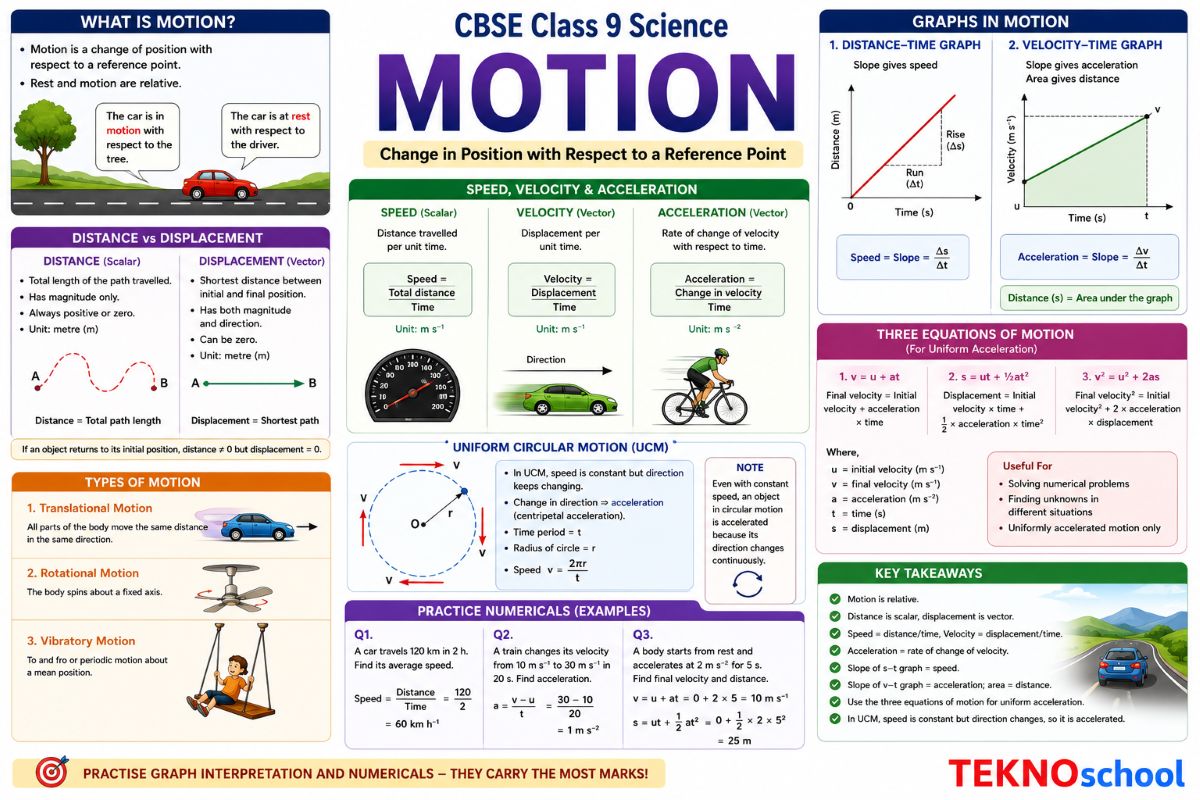
Motion-A complete tutorial on distance, displacement, speed, velocity, acceleration, graphs and the equations of motion, plus 11 worksheet types — MCQs, Assertion–Reason, Fill-ups, True/False, Match, VSA, SA, LA, Case-Based, HOTS and Numericals — each with answers.
What this chapter is about
A bus pulling away, a ball rolling down a slope, the Earth going round the Sun — everything around us is in motion. In this chapter you learn how to describe motion precisely: how far something travelled versus how far it ended up, how fast it moved, how its speed changed, how all this looks on a graph, and the three equations that let you predict where a moving object will be.
1 · Describing Motion
An object is said to be in motion if its position changes with time with respect to a fixed point called the reference point or origin. If its position does not change, it is at rest.
Rest and motion are relative
A passenger sitting in a moving bus is at rest relative to the other passengers, but in motion relative to a person standing on the road. So whether an object is at rest or in motion depends entirely on the chosen reference point.
2 · Distance and Displacement
| Feature | Distance | Displacement |
|---|
| Meaning | Total path length covered | Shortest distance from initial to final position |
| Type of quantity | Scalar (magnitude only) | Vector (magnitude and direction) |
| Can it be zero? | Never zero if the body moves | Zero if the body returns to its starting point |
| Depends on path? | Yes | No — only on end points |
| SI unit | metre (m) | metre (m) |
Worked example
A boy runs 4 m east, then 3 m north. Distance = 4 + 3 = 7 m. Displacement = √(4² + 3²) = 5 m towards the north-east. If he runs once around a circular track of circumference 400 m and returns to the start, distance = 400 m but displacement = zero.
3 · Uniform and Non-uniform Motion
In uniform motion, an object covers equal distances in equal intervals of time, however small the intervals. In non-uniform motion, it covers unequal distances in equal intervals of time — like a car moving through city traffic.
4 · Speed and Velocity
Speed = Distance ÷ Time
Velocity = Displacement ÷ Time
SI unit of both = m/s · 1 km/h = 5/18 m/s
| Feature | Speed | Velocity |
|---|
| Definition | Rate of change of distance | Rate of change of displacement |
| Type | Scalar | Vector |
| Can it be zero or negative? | Never negative | Can be zero or negative |
Average speed and average velocity
Average speed = Total distance ÷ Total time.
Average velocity = Total displacement ÷ Total time.
When velocity changes at a uniform rate, average velocity can also be found as (u + v) ÷ 2, where u is initial and v is final velocity.
5 · Acceleration
Acceleration is the rate of change of velocity with time. It is a vector quantity and its SI unit is m/s².
a = (v − u) ÷ t
If velocity increases, acceleration is positive. If velocity decreases, acceleration is negative — this is called retardation or deceleration. In uniform acceleration, velocity changes by equal amounts in equal intervals of time (for example, a freely falling body). In non-uniform acceleration, the change is unequal. An object moving with constant velocity has zero acceleration.
6 · Graphical Representation of Motion
Distance–Time Graph
Time is plotted on the x-axis and distance on the y-axis. The slope of the graph gives the speed.
| Shape of graph | What it means |
|---|
| Straight line parallel to the time axis | The object is at rest (zero speed) |
| Straight line inclined to the time axis | Uniform speed — the steeper the line, the greater the speed |
| Curved line | Non-uniform speed (accelerated motion) |
Velocity–Time Graph
Time is on the x-axis and velocity on the y-axis. Here the slope gives the acceleration, and the area under the graph gives the distance (or displacement) travelled.
| Shape of graph | What it means |
|---|
| Straight line parallel to the time axis | Uniform velocity, zero acceleration |
| Straight line sloping upward | Uniform acceleration |
| Straight line sloping downward | Uniform retardation |
| Curved line | Non-uniform acceleration |
7 · Equations of Motion
For an object moving with uniform acceleration in a straight line, three equations connect initial velocity (u), final velocity (v), acceleration (a), time (t) and distance (s):
① v = u + at (velocity–time)
② s = ut + ½at² (position–time)
③ v² = u² + 2as (position–velocity)
Worked example
A car starts from rest and accelerates uniformly at 2 m/s² for 5 s.
Final velocity: v = u + at = 0 + 2 × 5 = 10 m/s
Distance covered: s = ut + ½at² = 0 + ½ × 2 × 25 = 25 m
Check with the third equation: v² = u² + 2as → 100 = 0 + 2 × 2 × 25 ✓
8 · Uniform Circular Motion
When an object moves along a circular path with constant speed, its motion is called uniform circular motion. Even though the speed does not change, the direction of motion changes continuously — so the velocity changes, and the motion is an accelerated motion.
v = 2πr ÷ t
where r is the radius of the circular path and t is the time taken for one complete revolution. Examples include the moon revolving around the Earth, a stone whirled on a string, and the tip of a clock’s second hand.
PRACTICE ZONE
Worksheets with Answers
11 types · 10 questions each · answers given inline
Worksheet A · Multiple Choice Questions (10)
1. The SI unit of velocity is:
(a) m (b) m/s (c) m/s² (d) km
✓ Answer: (b) m/s
2. Which of the following is a vector quantity?
(a) Distance (b) Speed (c) Displacement (d) Time
✓ Answer: (c) Displacement
3. The displacement of a body moving once around a circular track is:
(a) Equal to the circumference (b) Zero (c) Twice the radius (d) Equal to the diameter
✓ Answer: (b) Zero
4. The slope of a distance–time graph gives:
(a) Acceleration (b) Speed (c) Displacement (d) Distance
✓ Answer: (b) Speed
5. The area under a velocity–time graph gives:
(a) Acceleration (b) Speed (c) Distance travelled (d) Time
✓ Answer: (c) Distance travelled
6. The SI unit of acceleration is:
(a) m/s (b) m/s² (c) m²/s (d) s/m
✓ Answer: (b) m/s²
7. A body moving with uniform velocity has an acceleration of:
(a) Zero (b) 1 m/s² (c) 9.8 m/s² (d) Constant non-zero value
✓ Answer: (a) Zero
8. 36 km/h equals:
(a) 5 m/s (b) 10 m/s (c) 20 m/s (d) 36 m/s
✓ Answer: (b) 10 m/s
9. Uniform circular motion is an example of:
(a) Motion with zero acceleration (b) Accelerated motion (c) Motion at rest (d) Non-uniform speed
✓ Answer: (b) Accelerated motion
10. Which equation of motion does not involve time?
(a) v = u + at (b) s = ut + ½at² (c) v² = u² + 2as (d) s = vt
✓ Answer: (c) v² = u² + 2as
Worksheet B · Assertion–Reason (10)
Choose: (a) Both A and R true, R correctly explains A · (b) Both true, R not the correct explanation · (c) A true, R false · (d) A false, R true.
1. A: Rest and motion are relative terms. R: Whether a body is at rest or in motion depends on the reference point chosen.
✓ Answer: (a)
2. A: Displacement can be zero even when distance is not. R: Displacement depends only on the initial and final positions.
✓ Answer: (a)
3. A: Speed can be negative. R: Speed is a scalar quantity with magnitude only.
✓ Answer: (d) — speed is never negative; the reason itself is true.
4. A: Uniform circular motion is accelerated motion. R: The direction of velocity changes continuously.
✓ Answer: (a)
5. A: A distance–time graph parallel to the time axis means the body is at rest. R: Its slope, and hence its speed, is zero.
✓ Answer: (a)
6. A: The area under a velocity–time graph gives acceleration. R: Acceleration is the rate of change of velocity.
✓ Answer: (d) — the area gives distance; the slope gives acceleration.
7. A: A freely falling body has uniform acceleration. R: Gravity produces a constant acceleration on it.
✓ Answer: (a)
8. A: Retardation is negative acceleration. R: It occurs when the velocity of a body decreases with time.
✓ Answer: (a)
9. A: The magnitude of displacement can never be greater than the distance. R: Displacement is the shortest path between two points.
✓ Answer: (a)
10. A: A body moving with constant velocity has zero acceleration. R: Acceleration is the rate of change of velocity, which is zero here.
✓ Answer: (a)
Worksheet C · Fill in the Blanks (10)
1. The fixed point used to describe motion is called the __________. → reference point (origin)
2. The total path length covered by a body is its __________. → distance
3. Velocity is the rate of change of __________. → displacement
4. The SI unit of acceleration is __________. → m/s²
5. Negative acceleration is also called __________. → retardation (deceleration)
6. The slope of a velocity–time graph gives __________. → acceleration
7. 1 km/h equals __________ m/s. → 5/18 (≈ 0.278)
8. In uniform motion a body covers __________ distances in equal intervals of time. → equal
9. The equation that does not contain time is __________. → v² = u² + 2as
10. The speed in uniform circular motion is given by v = __________. → 2πr/t
Worksheet D · True or False (10)
1. Distance is a vector quantity. → False (it is scalar)
2. Displacement can be zero. → True
3. Speed can be negative. → False
4. The slope of a distance–time graph gives speed. → True
5. A body in uniform circular motion has constant velocity. → False (speed is constant, velocity changes)
6. Acceleration is a vector quantity. → True
7. A freely falling body has uniform acceleration. → True
8. Displacement can be greater than distance. → False (it is at most equal to distance)
9. The area under a velocity–time graph gives distance. → True
10. An object at rest has a distance–time graph parallel to the time axis. → True
Worksheet E · Match the Following (10)
| No. | Column A | Column B | Answer |
|---|
| 1 | Speed | (a) m/s² | 1→f |
| 2 | Acceleration | (b) Vector quantity | 2→a |
| 3 | Displacement | (c) Slope of distance–time graph | 3→b |
| 4 | Speed from a graph | (d) Area under velocity–time graph | 4→c |
| 5 | Distance from a graph | (e) v = u + at | 5→d |
| 6 | First equation of motion | (f) m/s | 6→e |
| 7 | Second equation of motion | (g) v² = u² + 2as | 7→i |
| 8 | Third equation of motion | (h) 2πr/t | 8→g |
| 9 | Uniform circular motion speed | (i) s = ut + ½at² | 9→h |
| 10 | Retardation | (j) Negative acceleration | 10→j |
Worksheet F · Very Short Answer (10)
1. Define motion.
✓ Change in the position of an object with time with respect to a reference point.
2. Give the SI unit of displacement.
✓ Metre (m).
3. Name a scalar and a vector quantity from this chapter.
✓ Scalar: distance or speed. Vector: displacement, velocity or acceleration.
4. Define uniform motion.
✓ Motion in which equal distances are covered in equal intervals of time.
5. Write the formula for acceleration.
✓ a = (v − u)/t.
6. What does the slope of a velocity–time graph give?
✓ Acceleration.
7. Convert 72 km/h into m/s.
✓ 72 × 5/18 = 20 m/s.
8. When is the displacement of a body zero?
✓ When it returns to its starting position.
9. Give one example of uniform circular motion.
✓ The moon revolving around the Earth (or the tip of a clock hand).
10. What is the acceleration of a body moving with constant velocity?
✓ Zero.
Worksheet G · Short Answer (10)
1. Distinguish between distance and displacement.
✓ Distance is the total path length (scalar, never zero if the body moves); displacement is the shortest distance between initial and final positions (vector, can be zero).
2. Differentiate between speed and velocity.
✓ Speed is distance per unit time and is scalar; velocity is displacement per unit time and is vector, so it can be zero or negative.
3. Why is uniform circular motion called accelerated motion?
✓ Because the direction of motion changes continuously, so the velocity changes even though the speed stays constant.
4. Define average speed and average velocity.
✓ Average speed = total distance ÷ total time; average velocity = total displacement ÷ total time.
5. What does a straight, inclined distance–time graph indicate?
✓ That the body is moving with uniform speed; the steeper the line, the greater the speed.
6. Write the three equations of motion.
✓ v = u + at; s = ut + ½at²; v² = u² + 2as.
7. What is retardation? Give an example.
✓ Negative acceleration, when velocity decreases with time — for example, a car slowing down when brakes are applied.
8. A bus starts from rest and reaches 20 m/s in 10 s. Find its acceleration.
✓ a = (20 − 0)/10 = 2 m/s².
9. State two differences between uniform and non-uniform motion.
✓ Uniform motion covers equal distances in equal times and has zero acceleration; non-uniform motion covers unequal distances and has non-zero acceleration.
10. How can you find the distance travelled from a velocity–time graph?
✓ By calculating the area enclosed between the graph line and the time axis.
Worksheet H · Long Answer (10)
1. Explain distance and displacement with a suitable example and state three differences.
✓ Walking 4 m east then 3 m north gives distance 7 m but displacement 5 m north-east. Differences: scalar vs vector; path-dependent vs end-point dependent; distance never zero for a moving body while displacement can be zero.
2. Derive the first equation of motion, v = u + at.
✓ By definition a = (v − u)/t. Multiplying both sides by t gives at = v − u, so v = u + at.
3. Derive the second equation of motion, s = ut + ½at².
✓ Distance = average velocity × time = [(u + v)/2] × t. Substituting v = u + at gives s = [(u + u + at)/2] × t = ut + ½at².
4. Derive the third equation of motion, v² = u² + 2as.
✓ From s = [(u + v)/2] × t and t = (v − u)/a, s = (v + u)(v − u)/2a = (v² − u²)/2a, so v² = u² + 2as.
5. Describe the distance–time graph for a body at rest, in uniform motion and in accelerated motion.
✓ At rest: a straight line parallel to the time axis. Uniform motion: a straight inclined line. Accelerated motion: a curved line of increasing steepness.
6. Explain how acceleration and distance are obtained from a velocity–time graph.
✓ The slope of the graph gives the acceleration, while the area enclosed between the line and the time axis gives the distance travelled.
7. What is uniform circular motion? Explain why it is accelerated and give the formula for its speed.
✓ Motion along a circular path with constant speed. The direction of velocity keeps changing, so velocity changes and the motion is accelerated. Speed v = 2πr/t.
8. A car accelerates uniformly from 18 km/h to 36 km/h in 5 s. Find the acceleration and the distance covered.
✓ u = 5 m/s, v = 10 m/s. a = (10 − 5)/5 = 1 m/s². s = ut + ½at² = 25 + 12.5 = 37.5 m.
9. Differentiate between scalar and vector quantities with two examples of each.
✓ Scalars have only magnitude (distance, speed); vectors have both magnitude and direction (displacement, velocity, acceleration).
10. A body covers the first half of a journey at 30 km/h and the second half at 60 km/h. Explain how to find its average speed and calculate it.
✓ Average speed = total distance ÷ total time, not the mean of the speeds. For distance 2d: time = d/30 + d/60 = 3d/60 = d/20; average speed = 2d ÷ (d/20) = 40 km/h.
Worksheet I · Case / Passage-Based (10)
Passage 1: An athlete runs one complete round of a circular track of radius 70 m in 40 seconds. (Take π = 22/7.)
1. Find the distance covered in one round. → 2πr = 2 × 22/7 × 70 = 440 m.
2. What is the displacement after one full round? → Zero (he returns to the starting point).
3. Calculate his average speed. → 440 ÷ 40 = 11 m/s.
4. Calculate his average velocity. → Zero (displacement is zero).
Passage 2: A car starting from rest accelerates uniformly at 4 m/s² for 6 seconds along a straight road.
5. Find its velocity after 6 s. → v = u + at = 0 + 4 × 6 = 24 m/s.
6. Find the distance covered in 6 s. → s = ut + ½at² = 0 + ½ × 4 × 36 = 72 m.
7. What would its velocity–time graph look like? → A straight line sloping upward from the origin (uniform acceleration).
Passage 3: A train travelling at 20 m/s applies brakes and comes to rest after 10 seconds.
8. Find its acceleration. → a = (0 − 20)/10 = −2 m/s².
9. What is this negative acceleration called? → Retardation (deceleration).
10. Find the distance covered before stopping. → s = ut + ½at² = 200 − 100 = 100 m.
Worksheet J · HOTS (10)
1. Can a body have zero velocity but non-zero acceleration? Explain.
✓ Yes — a ball thrown upward has zero velocity at the highest point but still has downward acceleration due to gravity.
2. Can the displacement of a body be greater than the distance travelled? Why?
✓ No — displacement is the shortest path, so it can at most equal the distance, never exceed it.
3. Two bodies have the same speed but different velocities. How is this possible?
✓ They are moving in different directions; speed has no direction but velocity does.
4. A passenger in a moving train sees trees moving backwards. Explain.
✓ Motion is relative — with respect to the moving train, the stationary trees appear to move in the opposite direction.
5. Why is the average of two speeds not always the average speed?
✓ Because average speed is total distance ÷ total time; if unequal times are spent at each speed, the simple mean gives a wrong answer.
6. The distance–time graph of a body is a curve of increasing steepness. What does it show?
✓ The speed is increasing with time — the body is accelerating (non-uniform motion).
7. Can a body move with uniform speed and still be accelerating? Justify.
✓ Yes — in uniform circular motion the speed is constant but the direction, and hence the velocity, keeps changing.
8. Why can a distance–time graph never slope downwards?
✓ Because distance is a total path length that can only increase or stay the same; it can never decrease.
9. A car travels the same route to school and back. Compare its average speed and average velocity for the round trip.
✓ Average speed is non-zero (distance is covered), but average velocity is zero because the total displacement is zero.
10. Two cars start together; one has greater acceleration. Which covers more distance in the same time, and why?
✓ The one with greater acceleration, because from s = ut + ½at², distance increases with a when u and t are the same.
Worksheet K · Numerical Problems (10)
Use v = u + at, s = ut + ½at², v² = u² + 2as and 1 km/h = 5/18 m/s.
1. Convert 90 km/h into m/s. → 90 × 5/18 = 25 m/s
2. A body covers 150 m in 30 s. Find its speed. → 150 ÷ 30 = 5 m/s
3. A car’s velocity changes from 10 m/s to 30 m/s in 4 s. Find its acceleration. → (30 − 10)/4 = 5 m/s²
4. A body starts from rest with a = 3 m/s². Find its velocity after 8 s. → v = 0 + 3 × 8 = 24 m/s
5. A body starts from rest with a = 2 m/s². Find the distance in 10 s. → s = ½ × 2 × 100 = 100 m
6. A car moving at 20 m/s stops in 4 s. Find its retardation. → a = (0 − 20)/4 = −5 m/s²
7. A train at 15 m/s accelerates at 2 m/s² over 100 m. Find its final velocity. → v² = 225 + 2(2)(100) = 625 → v = 25 m/s
8. A body moves 60 m in 4 s, then 40 m in 6 s. Find its average speed. → 100 ÷ 10 = 10 m/s
9. A stone dropped from rest falls for 3 s (g = 10 m/s²). Find its velocity and the height fallen. → v = 30 m/s; s = ½ × 10 × 9 = 45 m
10. A body goes once around a circle of radius 7 m in 11 s (π = 22/7). Find its speed. → v = 2πr/t = (2 × 22/7 × 7)/11 = 44/11 = 4 m/s
Quick Recap
Motion is a change of position with respect to a reference point, and rest and motion are relative. Distance is the total path (scalar) while displacement is the shortest path with direction (vector, and can be zero). Speed is distance per unit time, velocity is displacement per unit time, and acceleration is the rate of change of velocity. On a distance–time graph the slope gives speed; on a velocity–time graph the slope gives acceleration and the area gives distance. The three equations v = u + at, s = ut + ½at² and v² = u² + 2as apply to uniform acceleration, and uniform circular motion (v = 2πr/t) is accelerated because direction keeps changing. Practise the graph interpretation and the numericals — they carry the most marks.