Reproduction in Animals
🌍 Every living organism must reproduce to continue its species. Reproduction is the biological process by which living organisms produce new individuals of their own kind. Without reproduction, life on Earth would cease to exist! In animals, reproduction can happen in two major ways — Sexual Reproduction and Asexual Reproduction. Let’s explore both in complete detail.
🔀 Types of Reproduction in Animals
Sexual Reproduction
- 🔸 Involves two parents (male + female)
- 🔸 Fusion of male and female gametes
- 🔸 Results in genetic variation
- 🔸 Offspring are different from parents
- 🔸 Most animals use this method
- 🔸 Examples: humans, frogs, birds, fish
Asexual Reproduction
- 🔹 Involves only one parent
- 🔹 No fusion of gametes
- 🔹 Offspring are genetically identical (clones)
- 🔹 Faster and simpler process
- 🔹 Seen in simpler animals
- 🔹 Examples: Hydra, Amoeba, Planaria
👫 Sexual Reproduction — In Detail
Sexual reproduction involves the production of gametes (sex cells) by both male and female parents, followed by their fusion to form a zygote, which develops into a new organism.
Sperm
Male gamete — very small, has a tail (flagellum) for swimming
Ovum (Egg)
Female gamete — larger than sperm, contains nutrients for the embryo
Fertilisation
Fusion of sperm and egg to form a single cell called the zygote
Zygote
First cell of a new organism — divides repeatedly to form an embryo
🔬 Types of Fertilisation
🐟 External Fertilisation
Fertilisation takes place outside the female’s body. The female lays eggs in water, and the male releases sperm onto them.
🐠 Examples: Frogs, Fish, Starfish
🐕 Internal Fertilisation
Fertilisation takes place inside the female’s body. The male deposits sperm inside the female’s reproductive tract.
🦅 Examples: Humans, Birds, Reptiles, Insects
🥚 Development After Fertilisation
Sperm + Egg
Gametes
Zygote
Single Cell
Embryo
Cell Division
Oviparous
Hatches from egg
Viviparous
Born alive
🥚 Oviparous vs 🐣 Viviparous Animals
👶 Human Reproduction
Humans are viviparous mammals. Fertilisation is internal, and the embryo develops inside the mother’s uterus for approximately 9 months (gestation period).
Gamete Formation
Testes produce sperm; ovaries produce ova
Fertilisation
Sperm fuses with ovum in the fallopian tube
Zygote
Fertilised egg divides to form a ball of cells
Embryo
Embeds in uterus wall; organs begin to form
Birth
After ~9 months, baby is born through birth canal
🔑
Foetus: When the embryo develops recognisable body parts (after about 8 weeks), it is called a foetus. The foetus gets nutrition from the mother through the placenta — a special organ that connects the foetus to the mother’s uterus wall.
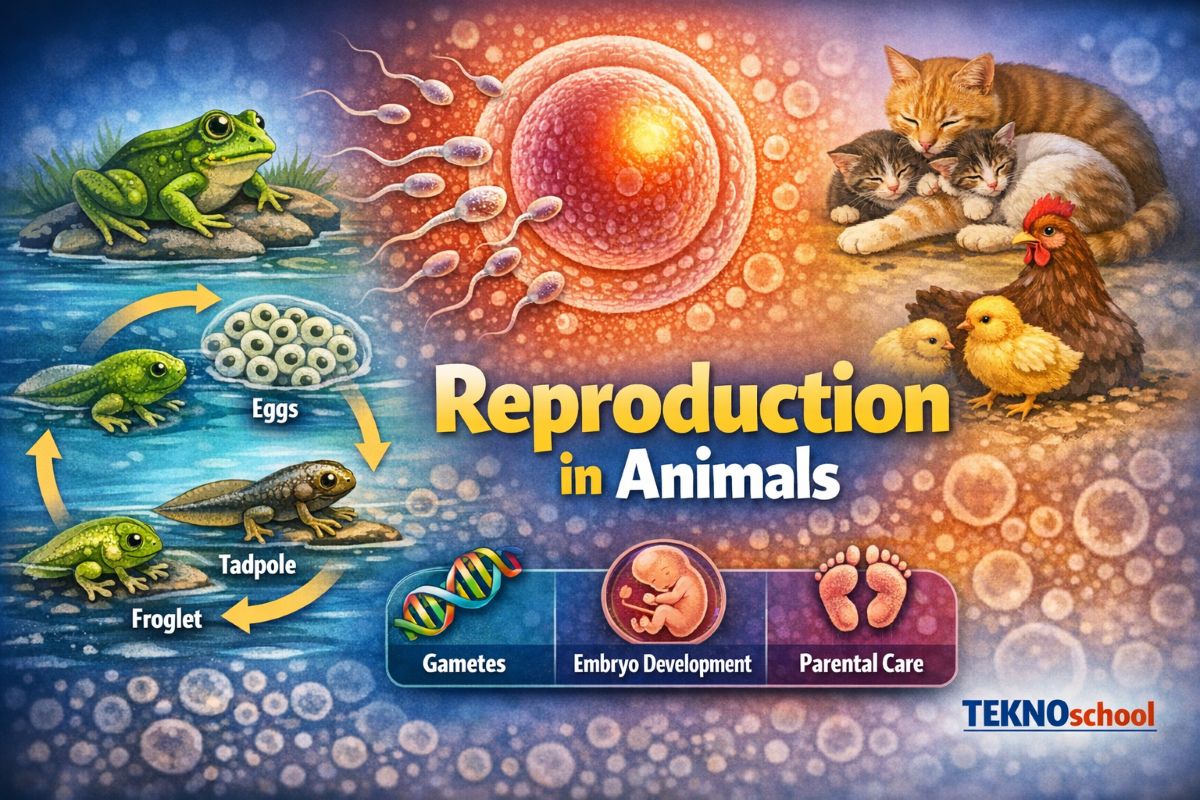
🐸 Life Cycle of a Frog — Metamorphosis
The frog undergoes metamorphosis — a series of dramatic changes in body form during development. This is a classic example of external fertilisation and oviparous reproduction.
Adult Frog
Mates in water; the female lays hundreds of eggs
Eggs (Spawn)
Fertilised eggs surrounded by jelly in water
Tadpole
Hatches from an egg; has gills and a tail; lives in water
Young Frog
Legs develop, tail shrinks, lungs replace gills
Adult Frog
Fully formed, both land and water, the cycle repeats
🦋 Metamorphosis is the process of transformation from larva to adult in two stages: Incomplete metamorphosis (e.g., grasshopper: egg → nymph → adult) and Complete metamorphosis (e.g., butterfly/frog: egg → larva → pupa → adult).
🔬 Asexual Reproduction — Methods
In asexual reproduction, a single parent produces offspring without the involvement of gametes or fertilisation. The offspring are genetically identical clones!
1. Binary Fission
The parent organism splits into two halves, each becoming a new individual. This is the simplest form of asexual reproduction.
2. Budding
A small outgrowth called a bud develops on the parent’s body. The bud grows, matures, and eventually detaches to become a new individual. The parent continues to survive.
3. Regeneration
The ability of an organism to regrow lost body parts. In some animals, each fragment of the body can develop into a complete new organism!
🐑 Cloning — Modern Asexual Reproduction
Cloning is the production of an exact genetic copy of an organism using its DNA. The most famous example is Dolly the Sheep (1996) — the first mammal to be cloned from an adult body cell. Cloning has applications in medicine, agriculture, and conservation.
🐑 Dolly (1996)
🌿 Identical Offspring
📊 Sexual vs. Asexual Reproduction — Full Comparison
📋 Complete Quick Reference — All Organisms
📖 Key Vocabulary — Terms to Remember
Reproduction
Process by which living organisms produce offspring of their own kind
Gamete
Sex cell (sperm or ovum) involved in sexual reproduction
Fertilisation
Fusion of male gamete (sperm) with female gamete (ovum)
Zygote
Cell formed after fertilisation; the very first cell of a new organism
Embryo
Early stage of development from a zygote through cell division
Foetus
Embryo with recognisable body parts (after ~8 weeks in humans)
Metamorphosis
Series of changes in body form during an organism’s development
Oviparous
Animals that lay eggs; young ones hatch from eggs
Viviparous
Animals that give birth to live young; embryo develops in uterus
Placenta
Organ connecting foetus to mother’s uterus for nutrition and oxygen
Binary Fission
Asexual reproduction by splitting into two equal halves
Cloning
Production of genetically identical organisms using DNA technology
📝 Chapter Summary
Everything you need to remember — condensed and colour-coded!
🔴 What is Reproduction?
Reproduction is the process by which living organisms produce new individuals of their own kind. It ensures the continuity of life on Earth and is one of the most fundamental characteristics of living beings.
🔵 Sexual Reproduction
Involves two parents and the fusion of gametes (sperm + ovum). Fertilisation may be external (fish, frog) or internal (birds, reptiles, mammals). Results in a zygote → embryo → new organism. Produces genetic variation.
🟢 Asexual Reproduction
Involves only one parent; no gametes or fertilisation. Methods include Binary Fission (Amoeba), Budding (Hydra), and Regeneration (Planaria). Offspring are genetically identical to the parent.
🟡 Oviparous vs Viviparous
Oviparous animals lay eggs (fish, frog, hen, snake). Viviparous animals give birth to live young (humans, dogs, cows, whales). In viviparous animals, the foetus develops in the uterus and receives nutrition via the placenta.
🟣 Frog Life Cycle & Metamorphosis
Frogs reproduce sexually via external fertilisation. Their life cycle involves complete metamorphosis: Egg → Tadpole → Young Frog → Adult Frog. The tadpole is the larval stage. Metamorphosis is the transformation process.
🟩 Human Reproduction
Humans are viviparous. Internal fertilisation occurs in the fallopian tube. The zygote develops into an embryo, which embeds in the uterus. After 8 weeks, it becomes a foetus. Gestation period is ~9 months. The foetus is nourished by the placenta.
🔴 Cloning
Cloning is a modern artificial method of asexual reproduction, producing genetically identical organisms. The first cloned mammal was Dolly the Sheep in 1996, created using nuclear transfer technology.
🎯 Quiz — Test Your Knowledge!
Q1Which of the following is an example of asexual reproduction?
Q2The fusion of sperm and egg is called:
Q3Animals that lay eggs are called:
Q4In which organism does binary fission occur?
Q5The larval stage of a frog is called:
Q6Which organ connects the foetus to the mother’s uterus?
Q7The first cloned mammal “Dolly” was a:
Q8In frogs, fertilisation is:
Q9Regeneration as a mode of reproduction is seen in:
Q10The correct sequence of human development is:
📄 Worksheet — Reproduction in Animals
✏️ Section A: Fill in the Blanks (1 mark each)
- The process by which living organisms produce new individuals of the same kind is called ______reproduction.____________.
- The fusion of a sperm and an egg cell is called __________________fertilization..
- Animals that give birth to live young ones are called ___________viviparous animals_______ animals.
- The larval stage of a frog is called ____________tadpole.______.
- The first cloned mammal was a sheep named ______Dolly____________, cloned in the year _______1996___________.
✅ Section B: True or False (1 mark each)
- In asexual reproduction, offspring are genetically different from the parent. False
- Frogs undergo external fertilisation in water. True
- The placenta provides nutrition to the foetus inside the mother’s womb. True
- Binary fission is a method of sexual reproduction seen in Amoeba. False
- Hen is an example of a viviparous animal. False
✍️ Section C: Short Answer Questions (2 marks each)
- What is the difference between internal and external fertilisation? Give one example of each.
Internal fertilisation occurs inside the female’s body. Example: Humans, cows, dogs.External fertilisation occurs outside the body, usually in water, where eggs and sperm meet. Example: Frogs, fish. - Define metamorphosis and explain the life cycle of a frog. Metamorphosis is a biological process in which an animal undergoes a major change in body structure during its development from young to adult. These changes are often drastic and involve the transformation of shape, organs, and lifestyle.Life cycle of a frog: A frog’s life cycle includes three main stages:
- Egg: The female frog lays eggs in water.
- Tadpole: The eggs hatch into tadpoles, which have gills, a tail, and live in water like fish.
- Adult Frog: The tadpole gradually develops legs, loses its tail, and lungs replace gills. This transformation is called metamorphosis, resulting in an adult frog that can live on land.
- Explain how budding occurs in Hydra. In Hydra, budding is a type of asexual reproduction. A small outgrowth called a bud develops on the body of the parent Hydra due to repeated cell division at a specific spot. The bud grows gradually, developing tentacles and a mouth. When it becomes fully mature, it detaches from the parent and lives as an independent Hydra.
- What is the role of the placenta in human reproduction? The placenta is a special organ that forms between the mother and the foetus during pregnancy. Its main role is to supply nutrients and oxygen to the developing foetus and to remove waste products from the foetus’s blood. It also helps protect the foetus by allowing the transfer of antibodies from the mother.
- Distinguish between oviparous and viviparous animals with two examples each.
Oviparous Animals Viviparous Animals Animals that lay eggs. Animals that give birth to live young ones. Development of the embryo occurs outside the mother’s body. Development of the embryo occurs inside the mother’s body. Examples: Hen, Frog Examples: Human,
📝 Section D: Long Answer Questions (3 marks each)
- Compare sexual and asexual reproduction with at least four differences. Which method produces more genetic variation and why?
Differences between Sexual and Asexual Reproduction
Sexual Reproduction Asexual Reproduction Involves two parents (male and female). Involves only one parent. Fusion of gametes (sperm and egg) takes place. No fusion of gametes occurs. Offspring show genetic variation because traits come from both parents. Offspring are genetically identical to the parent (clones). Process is slower and requires more energy. Process is faster and requires less energy. Seen in humans, cows, dogs, etc. Seen in Amoeba, Hydra, yeast, etc. Which method produces more genetic variation and why?
Sexual reproduction produces more genetic variation. This is because the offspring receive genes from two different parents, and the mixing of genetic material during fertilisation creates new combinations of traits. As a result, each individual is unique, which increases the chances of survival and adaptation in changing environments.
- Describe the process of human reproduction from fertilisation to birth. Include the terms: zygote, embryo, foetus, placenta, uterus, and gestation.Human reproduction begins when a male sperm cell fuses with a female egg cell. This fusion is called fertilisation, and it usually takes place in the fallopian tube of the female reproductive system.After fertilisation, the following stages occur:
1. Formation of Zygote
The fusion of sperm and egg forms a single cell called the zygote. This zygote contains genetic material from both parents.
2. Development into Embryo
The zygote divides repeatedly as it moves toward the uterus. Once it attaches to the wall of the uterus, it develops into an embryo. During this stage, the basic body structures begin to form.
3. Role of the Placenta
A special organ called the placenta forms between the mother and the developing embryo. The placenta supplies oxygen and nutrients to the embryo and removes waste products from its blood. It also passes antibodies from the mother to protect the developing baby.
4. Formation of the Foetus
After about eight weeks, the embryo becomes a foetus. The foetus has a more recognisable human shape, and its organs continue to grow and mature inside the uterus.
5. Gestation and Birth
The period from fertilisation to birth is called gestation. In humans, the gestation period is about nine months. When the foetus is fully developed, the muscles of the uterus contract, and the baby is delivered through the birth canal.
- What is cloning? Describe the significance of Dolly the sheep. What are the possible uses and concerns of cloning in modern science?
1. What is Cloning?
Cloning is the process of creating a genetically identical copy of an organism. In cloning, the new organism has the same DNA as the original organism from which it was produced. It is a form of asexual reproduction carried out artificially in laboratories.
2. Significance of Dolly the Sheep
Dolly, born in 1996, was the first mammal cloned from an adult body cell. She was created using a technique called somatic cell nuclear transfer (SCNT), where the nucleus of an adult cell was transferred into an egg cell whose nucleus had been removed.
Dolly’s birth was significant because:
- It proved that specialised adult cells can be reprogrammed to create an entire organism.
- It opened new possibilities in genetics, medicine, and biotechnology.
- It showed that cloning complex mammals is scientifically possible.
Dolly lived for six years and gave birth to healthy lambs, showing that cloned animals can reproduce normally.
3. Possible Uses of Cloning in Modern Science
- Medical Research: Cloning can help scientists study genetic diseases and develop new treatments.
- Organ Production: Cloning technology may one day help grow tissues or organs for transplantation.
- Conservation of Endangered Species: Cloning could help revive or protect species that are close to extinction.
- Agriculture: High‑quality animals with desirable traits (like high milk yield) could be cloned to improve livestock.
4. Concerns and Ethical Issues of Cloning
- Low Success Rate: Many cloning attempts fail, and cloned animals often suffer from health problems.
- Ethical Concerns: Cloning raises questions about interfering with nature and the moral status of cloned organisms.
- Reduced Genetic Diversity: If many identical animals are produced, it may weaken the species’ ability to adapt to diseases or environmental changes.
- Human Cloning Risks: Human cloning is widely considered unsafe, unethical, and is banned in most countries.
- Explain three methods of asexual reproduction in animals. Name the organisms and describe how each method works.Asexual reproduction is a mode of reproduction in which only one parent is involved, and the offspring produced are genetically identical to the parent. Three common methods in animals are:
1. Binary Fission – Amoeba
Organism: Amoeba. How it works: In binary fission, the parent Amoeba splits into two equal halves. First, the nucleus divides into two nuclei. Then the cytoplasm divides, forming two identical daughter Amoebae. This is the simplest and most common method of asexual reproduction in unicellular organisms.
2. Budding – Hydra
Organism: Hydra How it works: A small outgrowth called a bud appears on the body of the parent Hydra due to repeated cell division. The bud grows, develops tentacles and a mouth, and eventually detaches to become an independent Hydra. This method allows rapid multiplication.
3. Fragmentation / Regeneration – Planaria
Organism: Planaria (flatworm). How it works: If a Planaria is cut into two or more pieces, each piece can regenerate the missing parts and develop into a complete organism. This ability to regrow entire body parts makes regeneration a powerful method of asexual reproduction in simple animals.
- Why is reproduction considered one of the most important life processes? What would happen if a species stopped reproducing? Explain in detail.
1. Importance of Reproduction
Reproduction is considered one of the most important life processes because it ensures the continuity of a species. All living organisms have a limited lifespan — they grow, mature, age, and eventually die. If new individuals were not produced, the species would gradually disappear.
Reproduction helps in:
- Maintaining population size
- Passing genetic information from one generation to the next
- Ensuring the survival of species in changing environments
- Preserving diversity through genetic variation (especially in sexual reproduction)
Thus, reproduction is essential for the survival of life on Earth.
2. What would happen if a species stopped reproducing?
If a species stopped reproducing:
- No new individuals would be born.
- The existing members would continue to age and die naturally.
- Over time, the population would shrink.
- Eventually, the species would become extinct.
This is why reproduction is crucial — it prevents extinction and keeps life going from one generation to the next.
🔗 Section E: Match the Following (1 mark each)
Column A
- 1Amoeba
- 2Hydra
- 3Frog
- 4Human
- 5Planaria
Column B
- aViviparous, internal fertilisation
- bBinary fission
- cRegeneration
- dBudding
- eExternal fertilisation, metamorphosis
Write your answers here:
1 →
2 →
3 →
4 →
5 →
Answer Key: 1-b, 2-d, 3-e, 4-a, 5-c
Life continues through the incredible process of reproduction — from the simplest single-celled Amoeba to the complex journey of human birth. Every living organism carries the drive to continue its species!
📚 CBSE Class 8 Science | Reproduction in Animals