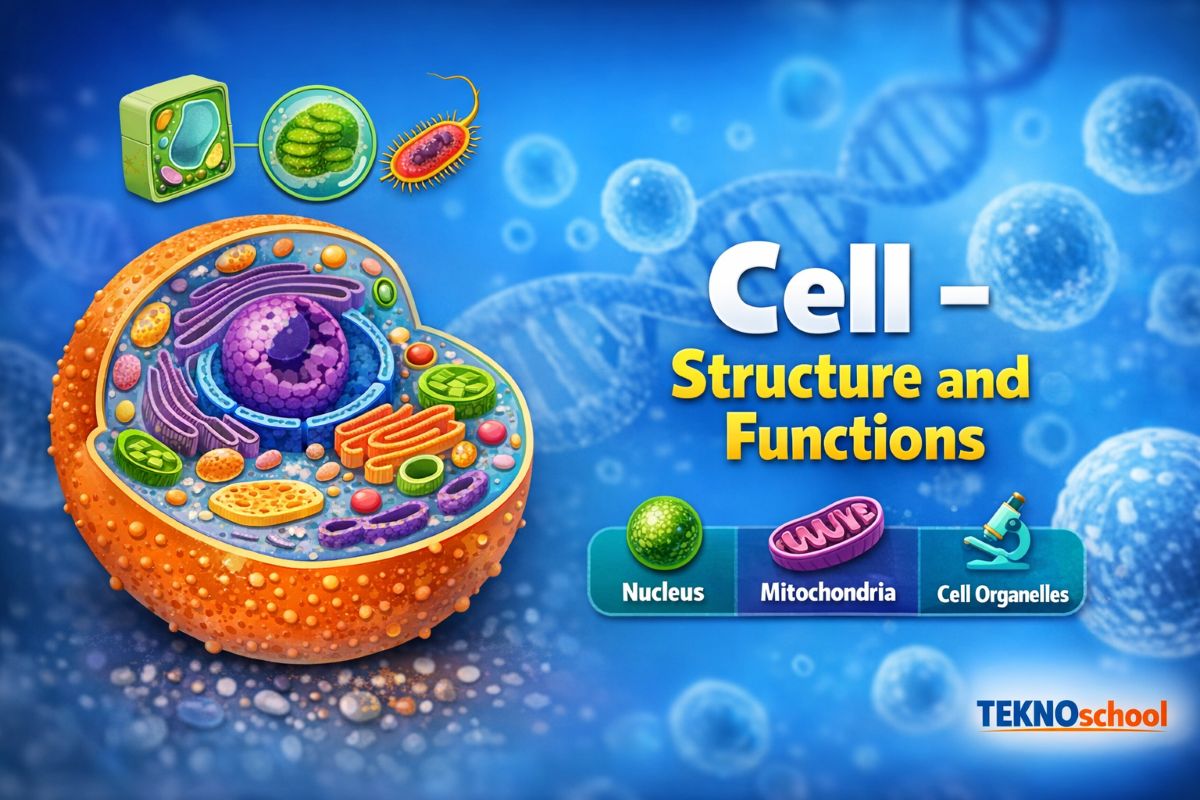
Cell – Structure and Functions
🌱 All living organisms — from the tiniest bacteria to the tallest tree and even you — are made of cells. The cell is the basic structural and functional unit of life. Some organisms, like amoeba, are made of just one cell (unicellular), while humans, animals, and plants are made of billions of cells (multicellular). Let’s dive deep into this microscopic world!
✨ Why Is the Cell So Important?
Structural Unit
Cells form the physical structure of all living things — like bricks in a building.
Functional Unit
All life processes — digestion, respiration, reproduction — happen at the cell level.
Hereditary Unit
Cells carry DNA — the genetic blueprint passed from parent to offspring.
🔭 Discovery of the Cell
Robert Hooke (1665)
First observed cells in a thin slice of cork using a self-designed microscope. He noticed small, box-like compartments and called them “cellulae” (little rooms in Latin). He is credited with naming the cell.
Anton van Leeuwenhoek (1674)
First observed living cells — he saw bacteria and protozoa in pond water. He made powerful microscopes with over 200× magnification and is called the “Father of Microbiology.”
📜 Cell Theory (Schleiden & Schwann, 1839)
All living organisms are composed of one or more cells.
The cell is the basic unit of structure and function in living things.
All cells arise from pre-existing cells. (Added by Virchow)
🔄 Unicellular vs. Multicellular Organisms
📐 Shape and Size of Cells
Cells vary enormously in shape and size depending on their function. There’s no single “typical” cell — each is perfectly designed for its job!
RBC
Biconcave disc shape — no nucleus — maximises oxygen-carrying surface area
Nerve Cell
Very long with branched ends — up to 1 metre! Transmits electrical signals fast
Muscle Cell
Long, cylindrical, and striated — contracts and relaxes for movement
Ostrich Egg
Largest single cell visible to the naked eye — about 15 cm in diameter!
📏
Size fact: Most cells range from 1–100 micrometres (µm). A human hair is about 70 µm thick. Mycoplasma is the smallest cell known (~0.1 µm). The neuron (nerve cell) is the longest cell.
🧫 Parts of a Cell — The Organelles
Every cell is a miniature city, with each organelle playing a specific role. Let’s meet the team!
1. Cell Membrane (Plasma Membrane)
A thin, flexible layer that surrounds every cell. It is selectively permeable — it allows some substances to pass in and out while blocking others. Present in both plant and animal cells. It separates the cell’s internal environment from the outside world.
2. Cell Wall
A thick, rigid outer layer found only in plant cells (and bacteria/fungi). Made of cellulose in plants. It provides shape, structural strength, and protection. It is fully permeable — allows water and dissolved substances to pass freely.
3. Nucleus — The Control Centre
The most important organelle! It controls all cell activities, like a brain. Surrounded by a nuclear membrane (with tiny pores). Contains chromosomes made of DNA — our hereditary material. The nucleus also contains the nucleolus (makes ribosomes). Bacteria do not have a true nucleus — they are prokaryotes.
🔵 Nucleolus makes rRNA
4. Cytoplasm
A jelly-like fluid that fills the cell between the cell membrane and nucleus. All organelles are suspended in the cytoplasm. It is the site of many chemical reactions. Contains water, salts, sugars, proteins, and other molecules needed for cell function.
5. Mitochondria — Powerhouse of the Cell
Rod-shaped or oval organelles that produce ATP (Adenosine Triphosphate) — the energy currency of the cell — through the process of cellular respiration. Found in both plant and animal cells. They have their own DNA and can self-replicate! Cells needing more energy (like muscle cells) have more mitochondria.
6. Plastids — Only in Plant Cells
Large organelles found only in plant cells. Three types:
Chloroplasts
Contains chlorophyll — site of photosynthesis. Gives plants green colour.
Chromoplasts
Contains coloured pigments (red, yellow, orange). Gives colour to flowers and fruits.
Leucoplasts
Colourless; stores starch, oils, and proteins. Found in roots and seeds.
7. Vacuoles — Storage Tanks
Membrane-bound sacs that store water, food, waste products, and other materials. Plant cells have one large central vacuole (up to 90% of cell volume!) that maintains cell turgidity. Animal cells have small, temporary vacuoles. In unicellular organisms (like Amoeba), food vacuoles help in digestion.
🌱 vs 🐾 Plant Cell vs Animal Cell
A detailed side-by-side comparison of the two major cell types
🔬 Prokaryotic vs Eukaryotic Cells
Prokaryotic Cell
- 🔸 No defined nucleus (no nuclear membrane)
- 🔸 DNA floats freely in cytoplasm
- 🔸 No membrane-bound organelles
- 🔸 Generally smaller and simpler
- 🔸 Examples: Bacteria, Blue-green algae
- 🔸 Evolved earlier (ancient life forms)
Eukaryotic Cell
- 🔹 Has a well-defined nucleus (with nuclear membrane)
- 🔹 DNA enclosed within nucleus
- 🔹 Has membrane-bound organelles
- 🔹 Larger and more complex
- 🔹 Examples: Plants, Animals, Fungi
- 🔹 Evolved later (more advanced)
📋 Organelle Quick Reference Table
Everything at a glance — perfect for revision!
📖 Key Terms to Remember
Cell
Basic structural and functional unit of all living organisms
Organelle
Specialised structures within a cell that perform specific functions
Selectively Permeable
Allows only certain substances to pass through (property of cell membrane)
Chromosome
Thread-like structures in nucleus carrying genetic information (DNA)
Chlorophyll
Green pigment in chloroplasts that absorbs sunlight for photosynthesis
Cellulose
Complex carbohydrate that makes up the plant cell wall
ATP
Adenosine Triphosphate — energy molecule produced by mitochondria
Prokaryote
Organism whose cells lack a membrane-bound nucleus (e.g., bacteria)
Eukaryote
Organism whose cells have a well-defined nucleus with nuclear membrane
🤯 Did You Know? Amazing Cell Facts!
🧮
The human body contains approximately 37 trillion cells — that’s 37,000,000,000,000!
⚡
A single cell makes about 10 million ATP molecules per second to power all its activities!
🧬
If you stretched out all the DNA from one human cell, it would be about 2 metres long!
🔄
The human body replaces about 330 billion cells every day — that’s 3.8 million cells per second!
❓ Important Questions for Exam
Q1. Who discovered the cell and when?
✏️ Robert Hooke in 1665, while examining a thin slice of cork under his compound microscope.
Q2. Why is the cell called the basic unit of life?
✏️ Because all living organisms are composed of cells, and all life processes (nutrition, respiration, reproduction, excretion) occur at the cellular level.
Q3. What is the difference between plant and animal cells?
✏️ Plant cells have a cell wall, chloroplasts, plastids, and a large central vacuole — all absent in animal cells. Animal cells have centrioles; plant cells generally do not.
Q4. Why are mitochondria called the powerhouse of the cell?
✏️ Mitochondria produce ATP (energy) through cellular respiration, supplying energy for all cellular activities — just like a powerhouse supplies electricity.
Q5. What is the function of the nucleus?
✏️ The nucleus is the control centre of the cell. It directs all metabolic activities, contains DNA (genetic information), and controls cell reproduction.
Understanding cells is the foundation of understanding all life. Keep exploring, keep questioning, and always look closer!
📚 CBSE Class 8 Science | Chapter: Cell — Structure and Functions