Energy Fundamentals
⚡ Energy Fundamentals
Energy is the hidden force behind almost every process in a plant, building, workshop, and utility system. When we understand how energy moves, changes form, and gets wasted, we can make better decisions that improve performance and reduce cost. The key idea is simple: every unit of energy should do useful work before it disappears into heat, loss, or unnecessary consumption. That is why learning the basics of electricity, thermal energy, power, demand, and heat transfer is so valuable for energy management and practical efficiency improvements.
🌟 Why Energy Understanding Matters
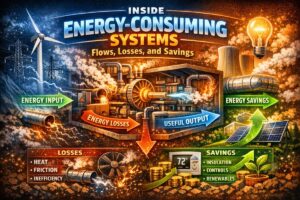
Energy does not vanish; it changes from one form to another. Electrical energy can run a motor, light a lamp, or heat a resistor, and, in the end, most of it becomes heat in the surrounding area. Thermal energy may transfer through steam, hot water, gases, or surfaces, and if it is not properly managed, a large portion can be lost before it reaches the intended process. A smart energy approach begins with awareness of where energy is purchased, where it is converted, and where it finally serves a useful purpose.
- ✅ Useful energy is the energy that actually performs a required task.
- ✅ Lost energy usually appears as unwanted heat, leakage, friction, or inefficiency.
- ✅ Better energy visibility leads to better savings opportunities.
🔌 Electricity and Useful Work
Electricity is one of the most flexible forms of energy because it can be distributed easily and converted into many other forms. A facility receives electricity through the meter and then routes it through cables, panels, drives, motors, heaters, controls, and instruments. Some equipment uses electricity directly, while other equipment first converts it into motion, light, sound, or heat. The important point is that electricity should do the maximum possible useful work before it turns into waste.
- ⚡ Motors convert electrical energy into mechanical output.
- ⚡ Heaters convert electrical energy directly into heat.
- ⚡ Poorly selected or badly maintained loads increase losses.
📏 Power, Demand, and Energy
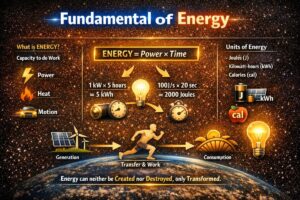
Power tells us how fast energy is being used. Energy tells us how much is used over time. That difference is important because a machine can have high power for a short burst or moderate power for a long operating period, and both situations affect the bill in different ways. Demand usually means average power over a measured period, while energy is the accumulated total used during that time.
- 📘 Power is the rate of energy use.
- 📘 Energy is power multiplied by time.
- 📘 Demand helps describe the load seen by the utility or system.
🔄 Voltage, Current, and Power Factor
Voltage acts like the push, current acts like the flow, and power is the useful action created by both together. In alternating current systems, voltage and current do not always line up perfectly, especially when motors, transformers, and coils are present. That mismatch creates a lower power factor, which means the system draws more apparent power than truly needed for useful output. Improving power factor is one of the simplest ways to reduce electrical stress and improve efficiency.
- 🔋 Resistive loads usually have a better power factor.
- 🔋 Inductive loads tend to reduce power factor.
- 🔋 Capacitors can help correct a poor power factor.
- 🔋 A better power factor can reduce unnecessary kVA burden.
🌡️ Thermal Energy in Real Systems
Thermal energy is everywhere in industrial and commercial systems. Boilers, furnaces, hot water loops, steam headers, dryers, heat exchangers, and HVAC systems all depend on heat being moved effectively from one place to another. The real challenge is not only producing heat, but producing it in the right amount, at the right time, and at the right temperature. If the system is oversized, poorly insulated, or badly controlled, a huge amount of energy can disappear before doing any productive work.
- 🔥 Thermal energy is most useful when it reaches the target process efficiently.
- 🔥 Oversized equipment often creates avoidable losses.
- 🔥 Insulation and control systems strongly influence performance.
💨 Sensible Heat and Latent Heat
Not all heat behaves in the same way. Sensible heat changes temperature, so it is easy to observe with a thermometer. Latent heat is hidden during a phase change, such as melting, boiling, condensation, or freezing. This means a material can absorb or release a large amount of energy without changing temperature at that moment. Steam systems, humid air, refrigeration, and drying processes all depend heavily on this hidden energy behavior.
- ❄️ Ice absorbs heat while melting.
- 💧 Water absorbs more heat while turning into vapour.
- 🌫️ Moist air stores hidden energy that affects cooling and heating.
🔥 How Heat Moves
Heat transfers in three main ways: conduction, convection, and radiation. Conduction happens through direct contact, such as heat passing through a wall, plate, pipe, or metal surface. Convection happens when a fluid, such as air or water, carries heat as it moves. Radiation transfers heat through electromagnetic waves and does not need material contact, which is why a hot surface can warm surrounding objects even across a gap.
- 🧱 Conduction is strongest in solid contact paths.
- 🌬️ Convection depends on fluid movement.
- ☀️ Radiation becomes important at higher temperatures.
🏭 Practical Energy Loss Sources
Energy losses often hide inside familiar equipment. Heat escapes through uninsulated surfaces, air leaks through gaps, motors operate at poor loading, pumps run against unnecessary resistance, and ducts or pipelines transfer heat where they should not. Even small inefficiencies become expensive when repeated continuously across long operating hours. This is why good energy practice focuses on eliminating waste at the source instead of only reducing total consumption.
- 🏗️ Insulation reduces unwanted heat escape.
- 🏢 Tight building envelopes reduce air leakage.
- 🧊 Efficient refrigeration reduces avoidable cooling load.
- ⚙️ Correctly sized equipment performs better over time.
🎯 Final Practical Message
The real value of energy fundamentals is not theory alone. It is the ability to look at any system and ask a few practical questions: where is the energy coming from, how is it being converted, where is it being lost, and how can that loss be reduced? When these questions become part of daily thinking, energy efficiency stops being a one-time project and becomes a normal way of working. That mindset creates better performance, lower cost, and stronger control over every form of energy used in the facility.