Temperature Measurement Sensors: Types and Principles
Temperature Measurement Sensors: Types and Principles
From Fahrenheit’s glass tube to modern infrared cameras — the complete guide to how we measure heat
Temperature is one of the most measured quantities in science, industry, medicine, and everyday life. Every refrigerator, engine, furnace, and human body relies on some form of temperature sensing to function correctly. Yet no single sensor technology works perfectly across all temperature ranges and environments — which is exactly why engineers have developed nearly a dozen distinct types of temperature instruments, each rooted in a different physical principle and often bearing the name of the scientist who first described it.
This guide walks through every major temperature sensor category, explaining the underlying physics, how each device converts temperature into a usable signal, and the pioneer whose work made it possible.
💡 Key Concept: Every temperature sensor converts thermal energy into another measurable quantity — electrical resistance, voltage, pressure, radiation, or mechanical expansion. Understanding that conversion is the key to choosing the right sensor for any application.
1. Thermocouples — The Seebeck Effect
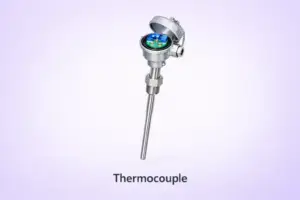
The thermocouple is the workhorse of industrial temperature measurement. When two dissimilar metals are joined at one end, and the junction is heated, a small voltage — typically a few millivolts — is generated at the open ends. This is the Seebeck effect, named after the Estonian-German physicist Thomas Seebeck, who discovered it in 1821 while noticing that a magnetic needle deflected when a temperature gradient was present across a metal circuit.
The voltage is produced because heat causes charge carriers (electrons) to diffuse from the hot end to the cold end at different rates in each metal, creating a net potential difference. The magnitude of this voltage — roughly 40–70 microvolts per degree Celsius, depending on the metal pair — is converted to temperature using standardised calibration tables. Common types include Type K (chromel/alumel, general purpose), Type J (iron/constantan, older industrial use), and Type R/S (platinum-rhodium, for very high temperatures).
2. Resistance Temperature Detectors (RTDs) — Ohm’s Law & Matthiessen’s Rule
RTDs exploit a simple truth: the electrical resistance of a pure metal increases predictably and almost linearly with temperature. As the metal heats up, atoms vibrate more intensely, scattering electron flow and raising resistance. Sir William Siemens proposed using platinum for this purpose in 1871, and the Pt100 sensor — a platinum wire or film element with a nominal resistance of exactly 100 Ω at 0°C — became the global standard. The underlying physics traces back to Georg Ohm’s 1827 law and Matthiessen’s Rule governing the temperature dependence of metal resistivity.
RTDs are the most accurate contact sensors available for the −200°C to +600°C range, with repeatability often better than ±0.1°C. A small, known current is passed through the element, and the resulting voltage drop is measured to calculate resistance, which is then converted to temperature via a standardised polynomial equation (the Callendar-Van Dusen equation).
3. Thermistors — Semiconductor Resistance
The thermistor (thermal resistor) is a ceramic semiconductor, typically made from metal oxides such as manganese, cobalt, or nickel sintered together. Unlike a metal RTD, a Negative Temperature Coefficient (NTC) thermistor dramatically decreases in resistance as temperature rises — sometimes by orders of magnitude over a 100°C span. This behaviour occurs because rising temperature liberates more charge carriers within the semiconductor, drastically reducing resistivity.
Thermistors are extremely sensitive — far more so than RTDs — making them ideal for medical applications like clinical thermometers, incubators, and body temperature patches where resolving 0.01°C matters. Their non-linearity requires careful characterisation using the Steinhart-Hart equation. PTC (Positive Temperature Coefficient) variants, often based on barium titanate, are used mainly as resettable fuses and self-regulating heaters rather than precision sensors.
4. Infrared Sensors & Pyrometers — Planck’s Radiation Law
Every object above absolute zero emits electromagnetic radiation in proportion to the fourth power of its absolute temperature — a relationship described by the Stefan-Boltzmann Law. Max Planck’s quantum theory of blackbody radiation (1900) precisely characterised the spectral distribution of this emission. Infrared sensors and optical pyrometers capitalise on this: they measure the intensity or spectral peak of thermal radiation without ever touching the object.
A non-contact infrared thermometer focuses emitted radiation onto a thermopile (a series of small thermocouples) or a photodetector. The resulting signal is processed against the object’s emissivity — its efficiency as a radiator relative to a perfect blackbody — to yield temperature. Thermal imaging cameras use focal-plane arrays of microbolometers to produce full two-dimensional temperature maps in real time, a technology indispensable for predictive maintenance, building energy audits, and medical fever screening.
5. Bimetallic Strip Thermometers — Thermal Expansion
The bimetallic strip is among the oldest and most mechanically elegant temperature sensors. Two metals with significantly different coefficients of thermal expansion — typically brass and Invar (iron-nickel alloy) — are bonded together along their length. When temperature changes, each metal expands or contracts at its own rate, causing the composite strip to bend. The degree of bending is directly related to the temperature change.
This bending drives mechanical indicating pointers in dial thermometers and oven gauges, or opens and closes electrical contacts in thermostats and circuit breakers. Coiled bimetallic elements are used in HVAC thermostats. While not highly accurate, the bimetallic sensor’s self-powered, purely mechanical operation makes it rugged, reliable, and independent of any electrical supply.
6. Liquid-in-Glass Thermometers — Liquid Thermal Expansion
Galileo Galilei constructed the first thermoscope in 1593, using the expansion of air in a bulb to drive a water column. Daniel Gabriel Fahrenheit perfected the mercury-in-glass thermometer in 1714 and established the first reproducible temperature scale. Anders Celsius proposed his centigrade scale in 1742, anchoring 0° at water’s freezing point and 100° at its boiling point. These three scientists, between them, gave us both the instrument and the language of temperature measurement.
The principle is volumetric thermal expansion: a liquid enclosed in a glass bulb expands into a narrow calibrated capillary as the temperature rises. Mercury was the standard for centuries due to its wide liquid range and linear expansion, but environmental regulations have driven a shift to alcohol (coloured ethanol) and other safer fluids in modern instruments.
7. Thermopiles — Multiple Seebeck Junctions
A thermopile is an array of thermocouples connected in series, built to increase sensitivity. Where a single thermocouple generates tens of microvolts, a thermopile of 100 junctions generates tens of millivolts — a much easier signal to amplify cleanly. Leopoldo Nobili built the first thermopile in 1829; Macedonio Melloni refined it to detect the infrared radiation from warm objects across a room, effectively launching the science of thermal radiometry.
Modern thermopiles are fabricated on silicon wafers using MEMS processes, producing tiny, low-cost sensors used in ear thermometers, touchless forehead thermometers, and gas analysers. Their absorber surfaces are coated black to maximise infrared absorption, and the hot junctions sit on a thermally isolated membrane while the cold junctions rest on the surrounding substrate.
8. Integrated Circuit (Silicon) Temperature Sensors — PTAT Principle
Integrated circuit temperature sensors exploit a fundamental property of silicon p-n junction diodes: the forward voltage across a diode decreases predictably with rising temperature (approximately −2 mV/°C). By running two transistors at different collector current densities, the difference in their base-emitter voltages produces a signal that is Proportional To Absolute Temperature (PTAT). This signal is trimmed, amplified, and digitised entirely on-chip, producing a calibrated digital temperature reading in a package smaller than a pea.
Devices like the LM35, DS18B20, and TMP117 have made precision temperature sensing accessible to hobbyists, embedded systems designers, and medical device engineers alike. They are self-contained, require no external calibration, and communicate directly with microcontrollers — representing the convergence of physics and semiconductor engineering into a single chip.
Quick Comparison: All Sensor Types at a Glance
| Sensor Type | Principle | Scientist / Year | Range | Best For |
|---|---|---|---|---|
| Thermocouple | Seebeck effect (voltage from heat) | Seebeck, 1821 | −200 to +2300°C | Furnaces, jet engines |
| RTD (Pt100) | Metal resistance rises with heat | Siemens, 1871 | −200 to +850°C | Precision industrial process |
| Thermistor (NTC) | Semiconductor resistance drops sharply | Ruben / Wagner, 1930s | −50 to +150°C | Medical, HVAC, food |
| Infrared / Pyrometer | Blackbody radiation (Stefan-Boltzmann) | Planck / Stefan, 1879–1900 | −50 to +3500°C | Non-contact, moving objects |
| Bimetallic Strip | Differential thermal expansion | Harrison / Amontons, 1700s | −30 to +550°C | Thermostats, dial gauges |
| Liquid-in-Glass | Volumetric liquid expansion | Fahrenheit / Celsius, 1714–1742 | −80 to +600°C | Labs, general use |
| Thermopile | Series thermocouples absorb IR | Nobili & Melloni, 1829 | −40 to +500°C | Ear/forehead thermometers |
| IC / Silicon Sensor | PTAT — p-n junction voltage | Widlar / Bakker, 1963+ | −55 to +150°C | Electronics, IoT, wearables |
Key Takeaways
- No single sensor covers all temperatures, environments, and accuracy requirements — sensor selection is always a trade-off among range, accuracy, response time, cost, and contact vs. non-contact measurement.
- Thermocouples win on range and ruggedness; RTDs win on accuracy; thermistors win on sensitivity; infrared sensors win when contact is impossible.
- Every sensor technology rests on a foundational discovery — Seebeck, Planck, Stefan-Boltzmann, Ohm — demonstrating that instrumentation is always applied physics.
- Modern silicon IC sensors have democratised precision temperature measurement, bringing calibrated ±0.1°C accuracy to devices that cost less than a cup of coffee.