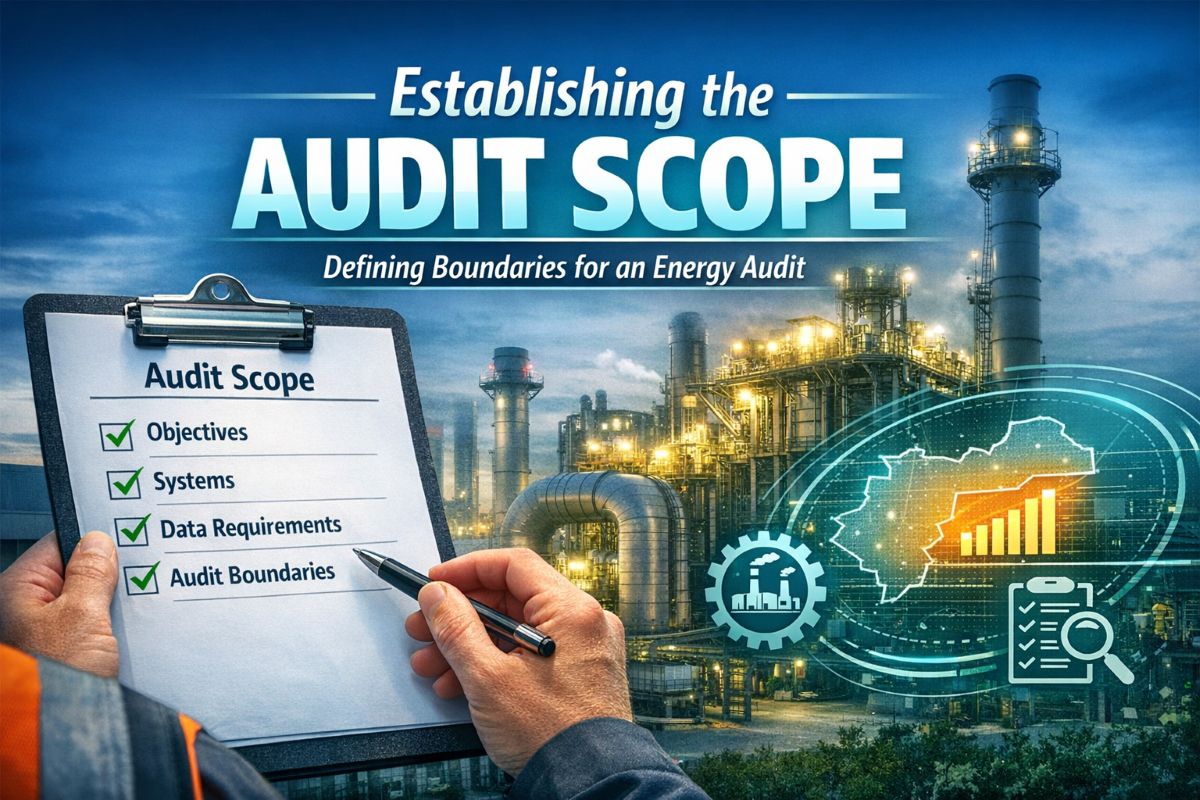
Establishing the Audit Scope
📗 Establishing the Audit Scope
🎯 From Big Intention to Clear Boundaries
Once the energy audit mandate is agreed upon, the very next critical step is to convert that broad intention into a clear, practical audit scope. Without a defined scope, the audit can become too wide, too shallow, or completely misaligned with what management actually needs.
The scope is where you draw the lines of responsibility and coverage: which plants, utilities, processes, systems, and time periods will be studied, and to what depth. It turns a general statement like “we want to save energy” into a specific, manageable assignment that an audit team can truly deliver.
🧭 What Does “Audit Scope” Really Mean?
The audit scope is the formal definition of what is included and excluded from the energy audit. It does not describe how to do the audit (that is methodology), but it explains where and how far the audit will go.
In simple terms, the scope answers questions like:
Which facility, building, or production block is covered?
Are all utilities included (electricity, steam, fuel, compressed air, chilled water, HVAC, etc.)?
Are we covering only major equipment, or also secondary/support systems?
Is the audit limited to operations, or does it also cover design and maintenance practices?
Are we looking only for low-cost measures, or also for capital projects?
Once these boundaries are defined, everyone knows what the audit will look at and what it will not.
🏭 Why Scope Matters So Much in Industry
Industrial plants are complex. Energy flows through boilers, turbines, compressors, pumps, furnaces, motors, chillers, HVAC systems, and long networks of pipes and cables. If you say “audit everything” without a defined scope, you are actually saying “audit nothing properly.”
A good scope ensures that:
The audit stays focused on the most relevant areas.
Data collection and measurements are realistic and manageable.
The team does not spend time on minor systems while major losses stay untouched.
The final report is aligned with the plant’s priorities and constraints.
In other words, the scope protects the audit from becoming a never-ending survey or a superficial overview that nobody can use.
📌 Key Elements of a Strong Audit Scope
A practical and effective audit scope usually covers several important dimensions:
Physical boundary
Which sites, plants, buildings, sections, or production lines are included? For example, “main production plant and utility block” or “boiler house, compressor house, and packaging line.”Energy boundary
Which energy types will be assessed? Electricity, steam, fuel oil, gas, biomass, compressed air, chilled water, hot water, etc.System boundary
Which systems or equipment groups are in focus? For instance, boilers, steam distribution, refrigeration systems, HVAC, compressed air, large motors, pumps, furnaces, and process heaters.Depth of detail
Is this a preliminary walk-through, a detailed energy audit, or an investment-grade study? The scope should clearly state the expected depth.Time horizon
Which period of operation is considered? Typical options are “last 12 months of operation,” “current normal operating condition,” or “specific high-production season.”Output expectations
Does the audit need to provide only a list of opportunities, or also detailed technical designs and financial evaluations?
Together, these points make the scope real and executable, instead of vague and aspirational.
🧠 Linking Scope to the Energy Audit Mandate
The audit mandate describes why the audit is being performed; the scope describes where and how far it will be applied.
For example:
If the mandate says “reduce overall plant energy cost by 10%,” the scope might include all utilities and major process areas.
If the mandate says “improve boiler and steam system performance,” the scope might be limited to boiler house, steam lines, steam traps, condensate recovery, and major steam users.
If the mandate says “prepare for ISO 50001 certification,” the scope might include all significant energy uses and the management practices associated with them.
When the scope is properly derived from the mandate, the entire audit becomes coherent, rather than a collection of random observations.
🛠️ How to Define the Scope Step by Step
A practical way to build the audit scope is:
Review the mandate and condition survey notes
Understand management objectives and the early site observations.Identify major energy users and utilities
List the main energy-intensive systems and their approximate consumption.Prioritize systems based on impact and feasibility
Focus on areas where realistic savings and improvements are likely.Discuss boundaries with key stakeholders
Confirm with production, utilities, maintenance, and finance teams which areas must be included.Decide on audit depth
Clarify whether each system will be covered in detail, sampled, or reviewed at a high level.Document inclusions and exclusions clearly
Write down what is in scope and what is not, in simple, unambiguous language.Get management confirmation
Ensure that top management agrees with the defined scope before detailed work begins.
This process avoids scope disputes later and ensures the team understands exactly what they are accountable for.
🔍 Typical Scope Choices in Real Plants
In real industrial practice, you often see scopes such as:
“Plant-wide electrical energy audit with focus on large motors, drives, compressors, and HVAC.”
“Steam system audit from boiler outlet to end users, including traps and condensate recovery.”
“Compressed air system audit covering compressors, dryers, receivers, distribution lines, and major users.”
“Energy audit of the administration building and utilities feeding it (lighting, HVAC, office equipment).”
“Detailed energy audit of the main manufacturing building, including process equipment, utilities, and building envelope.”
Each of these examples has clear boundaries. The audit team can plan measurements, manpower, and time accordingly.
⚠️ What Happens When the Scope Is Not Clear
If the scope is not clearly defined, several problems tend to appear:
The audit grows uncontrollably and overshoots the schedule.
Critical systems receive too little attention while minor issues consume time.
Data becomes inconsistent because there was no shared understanding of which lines or areas to track.
Departments argue later about whether some system “was part of the audit” or not.
The final report becomes scattered and difficult to use as a structured improvement plan.
Many energy audits fail not because of poor engineering skills, but because scope discipline was missing at the start.
💬 Communicating the Scope Across the Plant
Even a well-written scope document is useless if nobody reads or understands it. That is why the scope must be clearly communicated to all relevant stakeholders before detailed audit activities begin.
Good communication may include:
A short kickoff meeting with all involved departments.
A one-page scope summary shared via email or notice.
Clear mention of which areas and systems the team will visit.
Clear indication of the type of support needed (data, escorts, access to panels, etc.).
When people know what is coming, they are more cooperative. When they are surprised, they may resist or delay.
📊 Matching Scope with Data and Instruments
The scope also has a technical side: it determines what data and instruments will be required.
For example:
If the scope includes detailed motor efficiency checks, you may need portable power analyzers and logging tools.
If the scope includes boiler efficiency, you may need flue gas analyzers and accurate fuel/steam measurement.
If the scope includes compressed air systems, you may need leak detection tools and pressure/flow measurement points.
Defining the scope early lets you prepare the right measurement plan, so the audit team does not arrive on site and discover they are not equipped to fulfill expectations.
🏁 Scope and Level of Audit (Walk-through vs Detailed)
In many organizations, audits are categorized by level (for example, preliminary walk-through, detailed audit, or investment-grade audit). The scope must match the level:
A walk-through audit usually has a broader scope but lower depth, focusing on obvious savings and quick wins.
A detailed audit often has a narrower scope but deeper analysis, including measurements, calculations, and project-level recommendations.
An investment-grade audit may focus on specific projects and will require rigorous data and financial modeling.
If you promise an investment-grade output but set a walk-through scope, expectations will not be met. Aligning level and scope is therefore essential for credibility.
🧩 Integrating Scope with Future Energy Management
Finally, the audit scope should not be designed in isolation from the plant’s long-term energy management strategy.
If the organization is moving toward:
ISO 50001 implementation,
integrated management systems,
decarbonization targets, or
digital energy monitoring,
Then the audit scope should be aligned with those directions. For example, you might prioritize significant energy uses, high-emission equipment, or systems that will later be included in continuous monitoring.
This way, the audit becomes more than a one-time project; it becomes a strong foundation for ongoing energy performance improvement.
✨ Closing: Scope Is the Practical Shape of the Audit
When the mandate defines why, the scope defines where, what, and how far. Together, they transform a broad desire to “save energy” into a disciplined, focused, and achievable energy audit.
So before diving into detailed measurements, spreadsheets, and payback calculations, take the time to design and agree the audit scope. 📗 It will guide your fieldwork, protect your schedule, and ensure that your final report speaks directly to the plant’s real priorities.